

title: [Book Sharing] Coach - The Trillion-Dollar Management Lesson
published: false
date: 2025-07-27 00:00:00 UTC
tags:
canonical_url: https://www.evanlin.com/reading-trillion-dollar-coach/
---
[](https://moo.im/a/zAKMPR "Coach")
Coach - The Trillion-Dollar Management Lesson, Steve Jobs, Page, and Pichai's Unpublicized Coach's High-Performance Team Mindset
Trillion Dollar Coach : The Leadership Playbook of Silicon Valley’s Bill Campbell
Author: Eric Schmidt Jonathan Rosenberg Alan Eagle Original Author: Eric Schmidt Jonathan Rosenberg Alan Eagle
Translator: Xu Tianning Publisher: Global Views Monthly
#### Book Purchase Recommendation Website:

- Readmoo: [Buy it here](https://moo.im/a/zAKMPR).

# Preface:

This is the 4th book I've finished reading in 2025. I've read really few books this year. However, this book is quite interesting. Although it's not the team mindset written by Bill Campbell himself, it's a collection of insights from several authors who interviewed many Silicon Valley leaders after his death, which makes it even more precious. It allows readers to relate to many relevant figures and backgrounds, making it easier to immerse themselves in the relevant context.

## Outline
From the sports field to the business world, behind every extraordinary high-performance individual, there is a coach.
Even seasoned veterans have potential they don't even know they have;
Faced with options without standard answers, they also need guidance to refocus on the most important things!
From Apple's Cook, Alphabet's Hannes and Pichai, to Facebook's Zuckerberg and Sandberg, when many top entrepreneurs, CEOs, and senior executives today have doubts, they all ask Bill Campbell.
Google CEO Pichai said: "He always helps me see what's most important at the right time."
YouTube CEO Wojcicki said: "He can help people unleash their potential and promote teamwork."
Silicon Valley venture capital father Doerr said: "Bill Campbell is the wisest person I've ever met."
Apple CEO Cook said: "His contribution to Apple is incalculable and irreplaceable. Everyone can learn from the greatest coach in our industry."
An excellent manager must first be an excellent coach;
The higher a person's position, the more their success depends on whether they can help others succeed!
Bill started as a college football coach and entered Silicon Valley at the age of forty-three. From coaching teams to coaching corporate teams, Bill was well-loved because he understood the human nature that everyone wants to be respected and valued. His coaching methods never appeared in any official documents, and he rarely appeared in mainstream media. Close apprentices Schmidt and others spent more than two years interviewing nearly a hundred top industry figures, summarizing the management wisdom and leadership philosophy of this legendary business godfather, explaining 32 golden management rules for building trust, building teams, and promoting growth.
.Whether personal development or the fate of the company, it depends on the quality of interpersonal relationships
.Seek the best ideas. If the goal is to reach a consensus, it will only lead to groupthink and poorer decisions
.Everyone wants to be liked and doesn't want to be betrayed. Stimulating positive human values will bring positive business results
.The authority of a manager comes from the trust of subordinates, peers, and superiors, not authoritarian management
.Only guide those who are willing to be taught, no need to teach everyone, otherwise you will be very tired
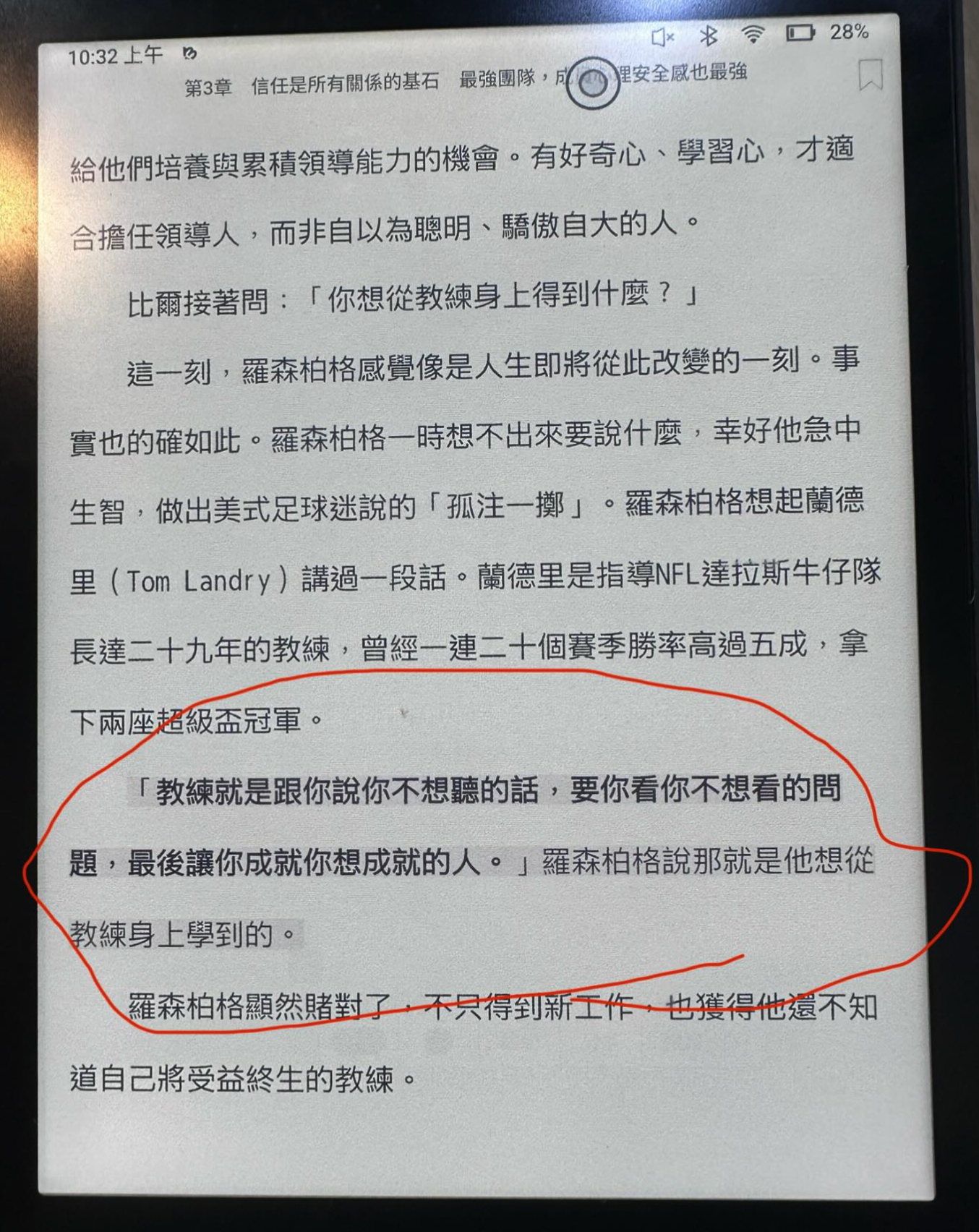
"A coach is someone who tells you what you don't want to hear, makes you look at what you don't want to see, and finally makes you achieve the key person you want to achieve." Everyone can learn from this book how to coach themselves and the people around them to become better.
The world faces many challenges, and only teams can solve them, and teams all need coaches. In an era that urgently needs leadership, the common coach of today's most powerful CEOs, venture capitalists, entrepreneurs, and senior executives provides you with the secrets to break through and succeed.
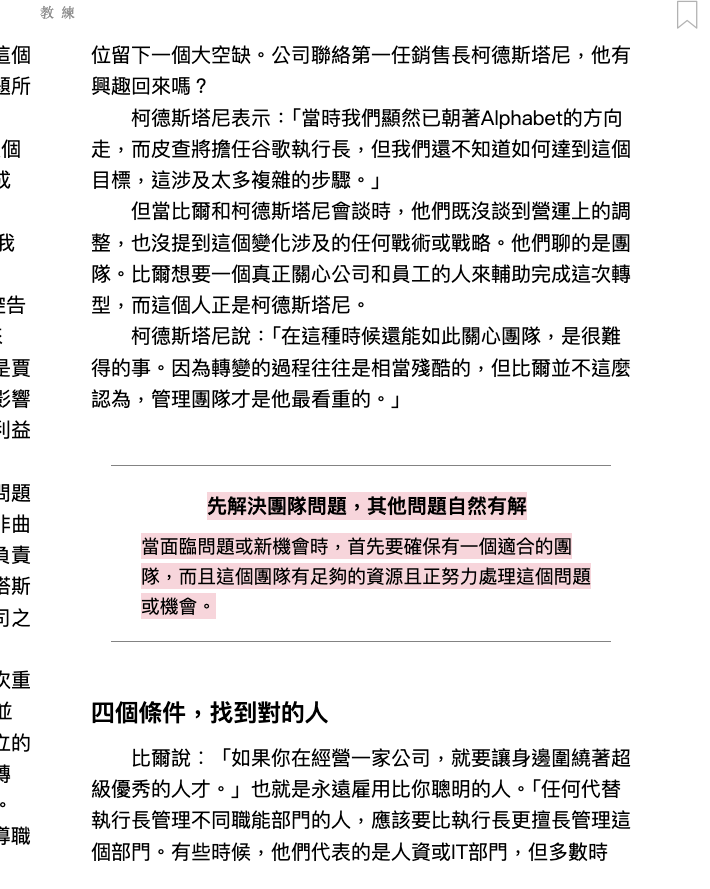
The summary focuses on Bill Campbell's coaching methods, covering his core concepts of leadership philosophy, social skills, empathy, team management, and board operations, emphasizing the importance of trust, psychological safety, and effective communication.
#### 1. Social Skills and Interpersonal Connections
Bill emphasizes that **building relationships is the foundation of leadership**, encouraging managers to take the initiative to interact with colleagues, care about their lives, and build connections with sincere greetings.
- Important sentences
- "It wasn't easy for me to cultivate this kind of interpersonal relationship, but I worked hard to do it. Fortunately, the more I do it, the easier it becomes."
- "I used to try to remember everyone's names, and when I met people in the elevator, I would try to talk to the colleagues next to me, greet them, and ask them how they were doing recently? What are they busy with?"
- "Treating the people around you well is the most valuable investment in life."
- Bill uses simple greetings (such as "Is everyone at home doing well?") to get closer, building relationships before dealing with work, demonstrating a humanistic leadership style.
#### 2. Empathy and Psychological Safety
Bill's leadership style emphasizes **empathy**. He bases it on listening and observation, providing appropriate advice, and creating a psychological safety net that allows team members to dare to express themselves.
- Important sentences
- "Bill will listen and observe. This is the ability of a coach, he can provide different perspectives and take you to a high point to look at the problem."
- "Cultivating psychological safety in a team and building trust are key. Cornell University first defined psychological safety in a 1999 study: 'Team members unanimously agree that they can speak their minds in the team without fear of offending anyone, it's a team atmosphere that allows people to be themselves.'"
- "Trust is the foundation of a company's success, but many business books today no longer talk about it... What everyone feels most deeply from Bill is trust."
- He encourages managers to provide sincere feedback, acknowledge problems, and motivate the team to move forward, ensuring that members feel respected and trusted.
#### 3. Problem Solving and Facing Challenges Directly
Bill is good at **finding and solving the "elephant in the room"**, that is, those thorny problems that are ignored, emphasizing that leaders should face challenges directly and give them priority.
- Important sentences
- "Find the thorny problems that everyone avoids talking about, put them in front of everyone, and then solve them first, so that these problems don't continue to simmer in the company due to office politics, causing greater harm."
- "Bill will clearly raise the problem, forcing everyone to pay attention to it, 'leaving no room for office politics.'"
- "As long as Bill is there, there will never be an elephant in the room."
- He emphasizes that leaders should make decisive commitments, focus on the best choices for the team, and avoid personal interests overriding the team.
#### 4. Effective Communication and Active Listening
Bill advocates **active listening**, emphasizing focused listening, asking questions to clarify problems, and stimulating the other party's sense of effectiveness and belonging.
- Important sentences
- "When communicating with people, first focus, put all your attention on listening to the other person speak; don't listen while thinking about what you're going to say next."
- "The most important thing he learned from Bill is 'focus on the person in front of you, listen carefully, and then start discussing. To achieve truly effective communication, focus, listen, and dialogue have a sequence.'"
- He guides others to make the best decisions on their own by telling stories, rather than forcing orders.
#### 5. Team Management and Talent Development
Bill believes that a **high-quality team is the key to success**. Managers should provide resources, respect, and trust to help talent grow and unleash their potential.
- Important sentences
- "Talent is the foundation of any company's success. The main job of a manager is to help subordinates complete their work in a more effective way and grow from the process."
- "Bill is a team coach, and his job is to build a team, shape a team, put the right people in the right positions (and remove the wrong people from the positions that don't suit them)."
- "Teamwork is needed to do anything."
- He emphasizes that managers should treat subordinates like children, guide them on the right path, and handle resignations with generosity and respect.
#### 6. Board of Directors and High-Performance Talent Management
Bill suggests that the board of directors should be composed of people with practical operational experience, and emphasizes that managing high-performance but difficult-to-get-along-with talent requires balancing their contributions and team harmony.
- Important sentences
- "Bill told Kostolo, you need to have other operators to rely on. Bill also clearly pointed out what kind of people are not good directors: 'Those people swagger in, want to be the smartest person in the room, and talk a lot.'"
- "How to manage those high-performance but difficult-to-get-along-with team members in the company is one of the most headache-inducing problems for managers."
- "If these arrogant people constantly put their own interests above the team, even if they are talented, they are not tolerable."
#### 7. Demonstrate Sincerity and Integrity
Bill is known for his sincerity and humanistic leadership, emphasizing that managers should show their complete selves and inspire the potential of others with trust and encouragement.
- Important sentences
- "Bill never deliberately removed his human touch from his work. He also treats everyone as a complete person, with a professional side, a private side, a family side, an emotional side, and a complete person made up of all aspects."
- "A coach is someone who tells you what you don't want to hear, makes you look at the problems you don't want to see, and finally makes you achieve the person you want to achieve."
- "Bill can always pass on courage to me, and I am always encouraged by it. I learned one thing from Bill: to be a person who gives energy to others, rather than constantly consuming the energy of others."
#### 8. The Role and Responsibility of Leaders
Bill believes that the core of a leader lies in **doing things and bringing influence**, rather than relying solely on titles or personal achievements. He emphasizes that managers should put the company's interests first and lead by example.
- Important sentences
- "What you did before doesn't matter, what you're thinking now doesn't matter, the point is what you do every day."
- "A title makes you a manager, and subordinates make you a leader."
- "The manager's first priority is to ensure that the people they lead are both happy and successful."
## Thoughts
I came across this book because I didn't expect that Bill, who came from a football coaching background, could become a team mentor for the top 100 CEOs.
This book has given me a lot of inspiration, mainly in terms of leading a team. There are many parts in it that give me a lot of new ideas:
- Leading a team, starting from "people":
- Many times, I feel that the system is right. The team should move in the right direction, but it seems that the people in the team are still the biggest factor.
- Find the "elephant in the room" in the team's problems:
- The "elephant in the room" is a very obvious problem in the team, but often everyone will ignore it. Or think that there is no need to deal with it,
These cases, and the text of my related bookmarks above, actually give me a lot of ideas. It also lets me know that important problems in the team may need to be solved before many meetings. I also highly recommend that many people who want to lead a team read this book together.


Top comments (0)