

title: [Book Sharing] Just Keep Buying - The Ultimate Answer for Data Scientists' Investment, Proven Methods for Saving and Getting Rich
published: false
date: 2023-10-06 00:00:00 UTC
tags:
canonical_url: http://www.evanlin.com/reading-just-keep-buying/
---
[](https://moo.im/a/EFIQTW "Just Keep Buying")
Just Keep Buying: Proven Ways to Save Money And Build Your Wealth
Author: Nick Maggiulli
Original Author: Nick Maggiulli
Publisher: Business Weekly
#### Book Recommendation Website:

- Readmoo: [Purchase Link](https://moo.im/a/EFIQTW)

# Preface:

This is the 13th book I finished reading in 2023. This is a book that friends are recommending, all recommending the importance of this book for investment. There are also friends who focus on "voo and chill" which makes me, who often wavers, quite envious. This book also constantly awakens my purpose and thoughts on investment. So I started to understand how this book makes people willing to "just keep buying".

# Content Summary:
★Is "buy low" a guaranteed investment strategy?
Wrong! The strongest data scientist tells you:
Don't waste time watching the market outside in order to catch the bottom,
"Just keep buying" is the undefeated rule for getting rich!
★Authors of "Atomic Habits" and "The Psychology of Money" strongly recommend it,
Published and became the Amazon investment category bestseller,
BookAuthority selected as the best financial book of 2022
●When a data scientist studies the stock market...
"Wait for the right time to buy low," "Don't put all your eggs in one basket," "Buy low, sell high"... The investment world is full of rich vocabulary and wise experts, proposing various guaranteed profit strategies. Do you agree and accept them all?
However, Nick Maggiulli, a data scientist and wealth management expert, says that at this time, you need to rely on data and evidence, rather than blind faith and speculation. Because various long-standing views are not always right and do not apply to everyone or every situation.
Maggiulli comes from an ordinary family and didn't even know what stocks were before going to college. He worried about not having enough money every day, which caused him serious anxiety about money. He read many investment books and articles and faithfully followed the practices, but his fear of the future did not disappear. In order to unravel the mystery of money, he used his expertise as a data scientist to analyze the stock market and founded the "OfDollarsAndData.com" blog, continuously publishing investment and financial management articles based on data analysis, turning seemingly boring data into vivid and understandable stories, becoming the most distinctive blog in the financial world.
## Saving Money? Borrowing Money? Retirement Section:
### How much money should you save?
- Save all the money you can save.
### The 2x Rule
- When making a large expenditure, you should put the corresponding amount into investment (savings) items.
- For example, when buying a million-dollar car, you should first have a million dollars invested.
### When should you borrow money?
- Reduce risk
- To obtain returns higher than the loan
- Student loans are worthwhile and cheap loans, you must borrow.
### Timing of buying a house
- You plan to stay in this location for ten years
- You have a stable personal and professional life
- You can afford it
### When can you retire?
- Save a sum of money and spend 4% each year and not spend it all for thirty years.
- Alternative statement:
- If the total amount is placed in the stock market, with a 4% annual return, you can rely on the annualized return to support your daily expenses for thirty years.
## About Investment
### The main reasons for investing:
- For future savings
- To fight inflation (2~5%)
- To replace your human capital with financial capital (that is, passive income exceeds your active income) 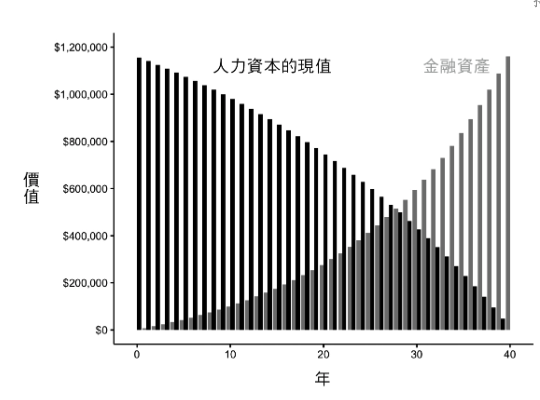
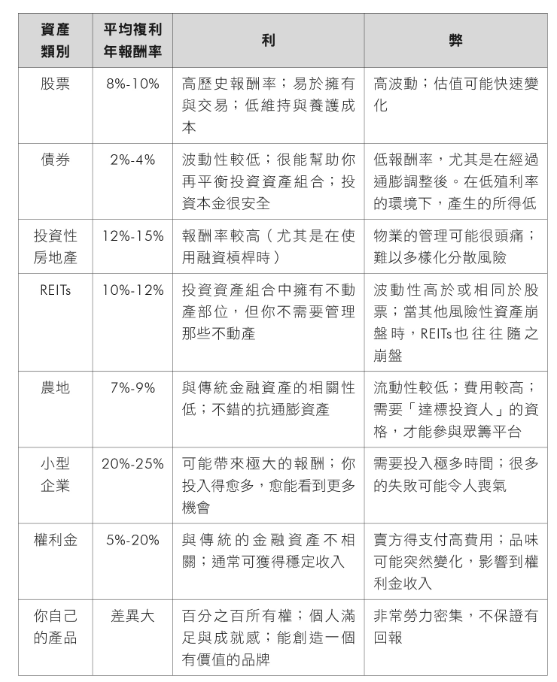
- Advantages and disadvantages of various wealth-generating tools
- Invest in the overall market, don't invest in individual stocks.
- According to statistics: From 1926 to 2016, only 4% of stocks had returns higher than the overall market.
- However, of the 28,853 companies listed after 1950, 22,469 (78%) of the companies are no longer around.
- How early should you buy?
- The earlier, the better!
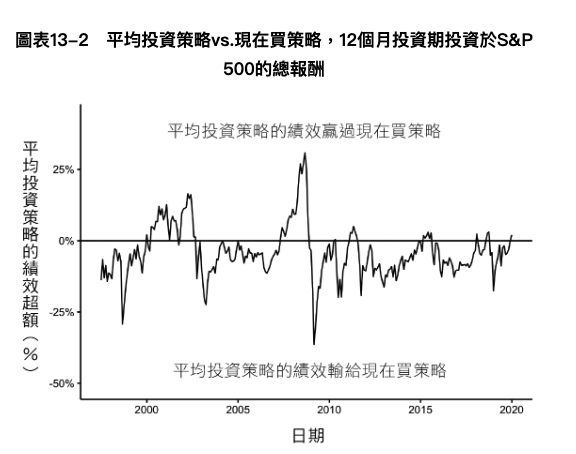
- Difference in returns between average investment and buying now
- On average, for every 12-month investment period, the average investment strategy performs 4% lower than "buying now". In all 12-month investment periods from 1997 to 2020, 76% of the performance was worse than "buying now". **(Usually you need to hold for more than 10 years)**
- Usually, during a "market crash", the returns of "average investment" will be higher than "buying now". But when the market crashes, investors are the least enthusiastic about investing.
### Why you shouldn't wait to buy low?
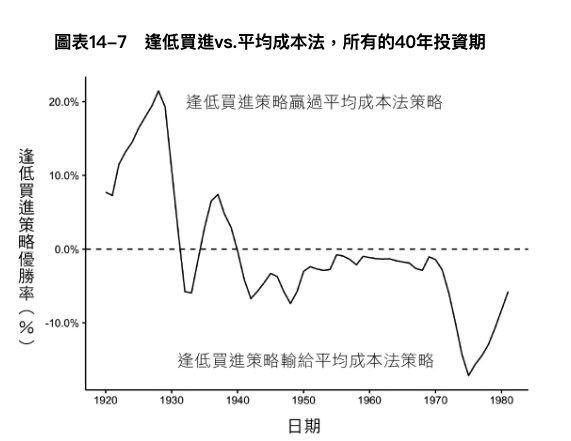
- Buying low (if you can catch it correctly) is far higher than the average cost in the short term.
- But in the long run, are more than 70% of the times buying low worse? Why? Because the so-called low points don't appear often, and the average cost allows funds to be continuously invested.
- Continuously saving money to expect to buy low will eventually be in vain. As long as the investment time is long enough, continuous buying will have higher returns than buying low. (More importantly, no one knows the so-called "real low point", and no one wants to buy when the stock market crashes.)
### Why you shouldn't be afraid of market fluctuations?
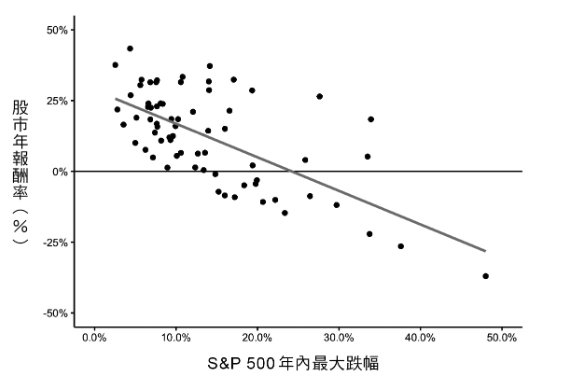
- To maximize returns, try to avoid market declines exceeding 15%, but you don't have an investment fairy, and you can't correctly catch the time to re-enter the market.
- It will also be mentioned later that the taxes generated by repeatedly entering the market will actually make you spend more profits.
- After 1950, the declines in that year exceeded 10% (or more), and in the end, there were actually positive returns in that year.
### How to enter the market during a crisis?
- A 33% drop requires a 50% increase to break even.
- But bring it into the annualized return:
- As long as it's five years, with an 8% annualized return, you have a chance to break even.
- But you have to see the market correctly. In the case of Japan, it is very likely that you won't break even for 20 years. But even in the Japanese stock market, if the time is extended from 1980 to 2020, there will still be positive returns.
- If the market is not good, it doesn't mean you won't break even, it just takes longer. (That is, opportunity cost)
### When to sell?
- Balance the investment portfolio
- It is recommended to balance individual stocks into the overall market.
- Get rid of a concentrated (or loss-making) position
- If there is no better target, you should not rashly sell a loss-making position.
- You also need to think about taking profits, after all, you don't know how high it will fly.
- Meet your financial needs
- This is the most anticipated way, the only reason to sell is because you want to pay for actual financial needs.
## The most important asset
- Time is your most important asset, and it's getting more and more expensive.
- Investing early and continuously investing can allow profits to continue to grow.
- You can always earn more money, but more money can't help you buy time.
# Thoughts:
This is a book whose title is the main purpose, "just keep buying" sounds simple, but a lot of people will have different ideas. Why not sell when the market is falling, and then buy in at the end? Why not be empty-handed during a big crash? If you want to buy, what should you buy? Should you invest everything at once? Or buy in batches?
This book will explain to you in a very easy-to-understand way, step by step, about these principles, and in the end, you will truly understand and accept why "just keep buying" will be the way to handle your assets with the highest returns?
Through many historical data, it tells you how much profit you can make if you avoid the decline? It also tells you through data how much profit can come if you keep holding?
Of course, the principle of "just keep buying" is also for the overall market to explain this principle, precisely because it is optimistic that the economy will cycle and the positions in your hands will always slowly come back.
What you should do during a crash is to keep buying, and consider adding more positions in the section close to the annual limit (-30%). Because no matter what, the rebound after a big crash is often the most amazing data. For you, as long as there is no excessive leverage in it, it is the most normal option to keep buying through the handling of funds.
Are you really investing in the overall market? Or are you also chasing highs and cutting lows? I suggest you also buy this book to take a look.


Top comments (0)