

title: [Book Sharing] Ecosystem Competition Strategy - Redefining Value Structure, Identifying the Right Game in Transformation, Mastering Strategic Tools, and Winning the Initiative (Book Excerpt)
published: false
date: 2022-12-30 00:00:00 UTC
tags:
canonical_url: http://www.evanlin.com/reading-Winning-the-Right-Game/
---
[](https://moo.im/a/exCKOZ "Ecosystem Competition Strategy")
Ecosystem Competition Strategy - Redefining Value Structure, Identifying the Right Game in Transformation, Mastering Strategic Tools, and Winning the Initiative
Winning the Right Game: How to Disrupt, Defend, and Deliver in a Changing World
Author: Ron Adner
Original Author: Ron Adner
Translator: Huang Tingmin
Publisher: Global Views Monthly
#### Book Purchase Recommendation Website:

- [Readmoo Online Book Purchase](https://moo.im/a/exCKOZ)

# Preface:

This is the twenty-fourth book I've read this year. I originally received a physical copy of this book. However, because I was traveling abroad, I couldn't get the physical book to read. I'm also someone who likes to read e-books, so I bought the e-book version. And most of the chapters were read through the e-book's narration, which was really an interesting book.

I would also like to explain in advance that this book has a very large vision. It clearly explains the process of ecosystem transformation, the establishment of ecosystems, and even how to defend and win. However, readers who are practitioners may not completely agree with some of the methodologies inside. But the examples given inside really supplemented me with a lot of things I didn't understand.

# Thoughts

This book breaks down the entire ecosystem competition strategy as if it were a textbook, clearly explaining the composition of the ecosystem, the elements that make up the ecosystem, and the ways in which the ecosystem grows, as well as how to win in the ecosystem. There are many examples given inside, which have given me a new understanding of many things:

- [Kodak](https://zh.wikipedia.org/zh-tw/%E4%BC%8A%E5%A3%AB%E6%9B%BC%E6%9F%AF%E8%BE%BE%E5%85%AC%E5%8F%B8)'s wrong market strategy.
- [Lexmark](https://en.wikipedia.org/wiki/Lexmark)'s proactive transformation strategy.
- Spotify, TomTom, and Wayfair related strategies.

The above two are related to changes in the ecosystem, but what should you do when a strong competitor comes along? The author also provides relevant cases to share. In the second half, the author promotes Microsoft's Nadella as an example and a case of transformation. Because Nadella organized an external ecosystem and integrated resources internally. (This is also the most difficult.)

Many times, many organizations advocate "passion," but passion is not a guiding principle. Trust and understanding the company's strategy is a sentence that everyone follows, and it is also a way to combine changes and transformations within the internal ecosystem.

(Thoughts to be continued)

# Introduction:
In the process of industry transformation, losing the wrong game is eliminated faster than failing in competition!
Collins, the management guru of "Built to Last," praised: One of the most important strategic thinkers of the 21st century
A new heavyweight from "MIT Sloan Management Review"
In 2012, Kodak announced bankruptcy, transforming from a highly respected global imaging leader to a classic failure case that missed the digital transformation.
Is this really the case? In fact, what truly destroyed Kodak was not missing the opportunity for digital transformation, but rather its complete disregard for the radical disruption brought about by changes in the ecosystem!
Industry collapse and ecosystem restructuring are the challenges facing all companies today!
When opportunities and threats no longer follow traditional industry boundaries,
Who are the partners? Who will become potential rivals? How should we compete?
Adner, a strategy professor at Dartmouth's Tuck School of Business, a prestigious Ivy League school, has long studied corporate innovation and other fields, and has received numerous awards and accolades. He is also a world-renowned corporate ecosystem strategy master. In this new work, he clearly explains the concepts and value creation methods of ecosystems that differ from traditional industries, breaks down past analyses of value chains, supply chains, resources, and capabilities, and proposes new strategic thinking that is essential for success in ecosystem competition.
## Chapter 1: Losing the Wrong Game is Equivalent to Failure

Companies are constantly driving new industry transformations due to the invention of new products. But Kodak, which invented the digital camera patent in 1975, later went bankrupt. In the news, we often assume that they were eliminated by digital cameras because the company was old and didn't follow the transformation. But the real story is often not like that. Kodak's failure was not in missing the opportunity, but because they lost the wrong game.

Kodak started building the digital imaging field in 1980, and by acquiring ofoto.com (an online photo album website), they made their "digital printing" field even bigger. In 2005, Kodak still had the first-place sales of digital cameras in the United States. They also knew that film was already a sunset market, and they also started to see printing consumables, and built their own ecosystem through the printing of digital photos.
BBC "The ten most expensive liquids in the world in 2018, ranked eighth, losing to scorpion venom, insulin, and Chanel No. 5 is black printer ink"
Through the expansion of the photo printing market, in 2007, Kodak even had 90,000 digital photo printing machines across the United States. Then, through changes in value propositions, value structures, and related markets, the main reason for Kodak's failure is explained.
### Value Proposition, Value Structure, and Activities
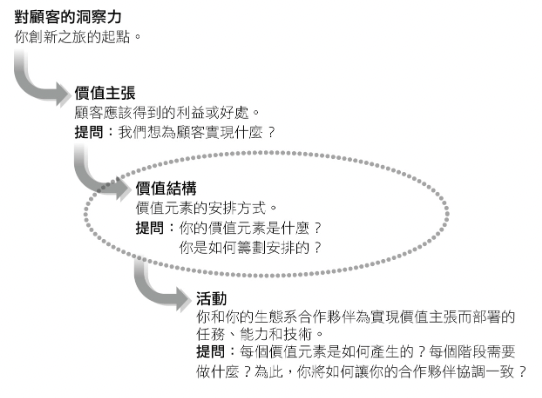
- **Business Model**: How your customers pay you.
- **Value Structure**: How you create value, why your customers are willing to pay you.
### Changes in Value Structure Driven by Technological Transformation
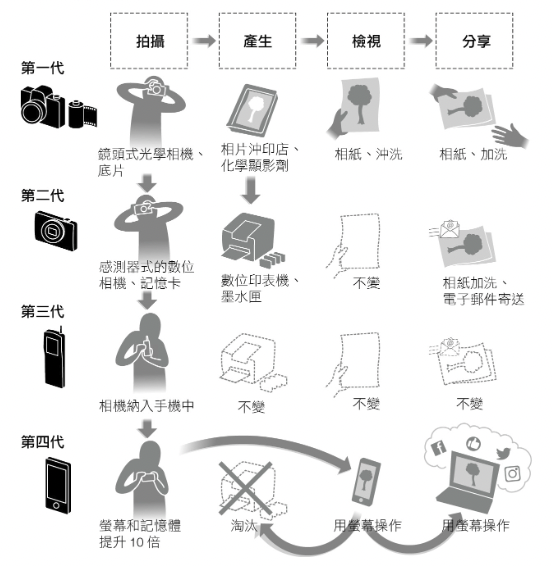
So Kodak didn't "lose" in digital transformation, but rather won big. So why did they fail? It was because they lost the wrong game. After the first-generation iPhone was released in 2007, most people took photos with their phones and shared them "directly online." From then on, the demand for digital photo printing was once again eliminated.
### Contrasting Case: Lexmark's Proactive Transformation
Lexmark may not be known to people now, but before, they competed with EPSON in the printer market. But as the printer market also shifted to mobile phones, the entire industry began to shrink. Lexmark actively transformed into a company specializing in digital documents and digital document processes. And by acquiring Perceptive Software and 14 other companies related to document processing, they consolidated their position in the digital document processing market.
## Chapter 2: Ecosystem Defense: Collaboration
This chapter discusses ecosystem defense, which does not refer to the world that changes due to the emergence of the environment (or new products). Instead, it discusses how you should defend yourself when a powerful enemy is coming to your ecosystem:
### Competition between Wayfair and Amazon in the Furniture Market
Wayfair was originally a middleman (i.e., an online store) that displayed and sold furniture and related products. After 2014, through the increase of furniture warehouses, many merchants could put their furniture in the warehouses to save expenses and ship faster. At this time, Wayfair was like the largest online store among furniture companies, until 2017, Amazon also decided to join the e-commerce service in the furniture market.
Knowing that Amazon's entry would challenge them, Wayfair did not choose to expand its battlefield, but instead focused more on its related market - the furniture sales industry. It used the uniqueness of the furniture market: most customers don't know what they want to buy? Or, customers don't know what they can buy for their space? And Wayfair is building a related technology field - as long as you take a 2D photo, it can help you turn the photo into a 3D model and put it into the scene for customers to understand. Through these methods, customers can discover the products they need themselves.
This is definitely not competing with Amazon, but defending its own field and consolidating its best ecosystem.
### TomTom's Adaptation to Google Map in Map Data
TomTom and Germin were originally leading companies in map data, but after the iPhone 3G was launched (again, the iPhone). Google also released Google Map services on mobile OS when the Android 2.0 system was announced. Google originally used TomTom's subsidiary Tele Atlas's map data, but later started to build its own map data. And Google Map has an open API, which allows the entire map service to become a case that every software manufacturer can join.
What should TomTom do at this time? For TomTom, their niche is to become a loyal provider of customer information. It will not be used for advertising, so the safe map data has become the focus of customer trust. Conversely, perhaps it is also the main factor of being second?
### Spotify vs. Apple Music
Spotify was originally a streaming music company, but after Apple Music was launched in iOS 8.4 in 2015. Apple Music took six months to have six million paying users worldwide, which is what Spotify took four years to achieve.
They are somewhat similar to TomTom and Google Map, facing a huge competitor. Their competitive point is "We are not giants, we are everyone's friends." Although they once did a "performer experiment" plan (allowing individual creators to bypass record companies and directly upload music), this was immediately canceled.
## Chapter 3: Ecosystem Offensive: From Increasing Competition to Changing Competition
This mentions the way to build an ecosystem:
- Establish a "Minimum Viable Ecosystem" **MVE** (Minimum Viable ecosystem)
- Follow a phased expansion path
- Deploy ecosystem delivery
Perhaps this is a bit difficult to understand, and the author also used some examples to illustrate his ecosystem building system.
### Taking the Amazon Alexa case as an example of the ecosystem:
- **Alexa Phase 1: Establish an ecosystem**: By using cheap and intelligent Bluetooth speakers, many people can buy them together.
- **Alexa Phase 2: Phased expansion**: Open to every manufacturer to join the application of Alexa's artificial intelligence communication capabilities – Alexa Skill.
- **Alexa Phase 3: Ecosystem delivery**: Artificial intelligence is more advanced, and every smart home appliance can directly use Alexa. No need to buy Amazon Echo, you just need to cooperate with them, even if you are an air conditioner manufacturer, you can also use the relevant functions.
### Taking the ASSA Abloy case as an example of the ecosystem:
[ASSA Abloy](https://www.assaabloy.com/au/en) is a traditional door lock manufacturer, and their ecosystem expansion method is as follows:
- **[ASSA Abloy](https://www.assaabloy.com/au/en) Phase 1: Establish an ecosystem**: Has a large number of door lock systems, and with the evolution of products, there are also a large number of digital door lock systems. Through the CLIQ cloud door loss system.
- **[ASSA Abloy](https://www.assaabloy.com/au/en) Phase 2: Phased expansion**: Connect every door through digital door locks, so that the door lock itself is connected to the cloud.
- **[ASSA Abloy](https://www.assaabloy.com/au/en) Phase 3: Ecosystem delivery**: The key is no longer a piece of iron, it can be your mobile phone, or even any item that can represent you. Also, let this "identity authentication" become their next ecosystem. (Identity recognition)
The ecosystem proposed here is not so smooth. Here's an explanation:
- **[2004 Hi-O](https://dach.assaabloy.com/de/en/produktkatalog/effeff-t395536-hi-o-connectors)**: Unified specifications, so that everyone can follow the specifications of door lock manufacturing. However, it limits the autonomy and customization space of door lock manufacturers, making other manufacturers unwilling to join.

- **[Aperio](https://www.assaabloy.com/pl/en/solutions/topics/access-control/aperio)**: And Aperio does not have unified door lock specifications (number of holes, size, etc.), only providing the basic framework for the entire door lock communication.
<iframe width="560" height="315" src="https://www.youtube.com/embed/lCcHf7ZJnKo" title="YouTube video player" frameborder="0" allow="accelerometer; autoplay; clipboard-write; encrypted-media; gyroscope; picture-in-picture" allowfullscreen=""></iframe>
Later, the mechanism of **[Aperio](https://www.assaabloy.com/pl/en/solutions/topics/access-control/aperio)** allowed other manufacturers to join, and the door lock ecosystem of [ASSA Abloy](https://www.assaabloy.com/au/en) expanded in this way.
## Chapter 4: The Timing of Disrupting the Ecosystem: Too Early May Be Worse Than Too Late
Here is another interesting case. After Philips formulated the HDTV specifications in 1986, it was 20 years earlier than the integration of other systems. Furthermore, the video equipment at that time had not yet reached high-definition equipment. So this plan also led the company to a loss of 2.5 billion US dollars.
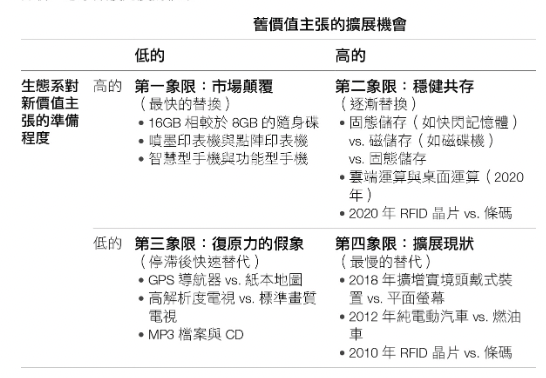
Here, the degree of preparation of the ecosystem for the new value proposition is divided into four quadrants, which are:
- **Market Disruption**: Inkjet printers and dot matrix printers
- **Stable Coexistence**: Cloud Computing and Desktop Computing
- **Resilience Illusion**: MP3 and CD
- **Expanding the Status Quo**: Belonging to future alternatives.
## Chapter 5: The Trap of the Native System
The ecosystem is a different game, and the leaders and followers of the ecosystem complete different parts of the value creation puzzle. In a successful ecosystem, there are no winners and losers, only partners who benefit in different ways.
In the case of electronic medical records, this is a case that is very suitable for explaining the trap of the native system. Medical technology giants Cerner ([later acquired by Oracle in 2022/06](https://www.ithome.com.tw/news/151399)) and Epic were originally promoting a shared medical record system, but with the US spending $27 billion (2009 Health Information Technology for Economic and Clinical Health Act) , hospitals were motivated to participate in related collaborations.
## Chapter 6: The Thinking of Leading the Ecosystem: Coordination and Execution
Establishing a leading position in an emerging ecosystem requires prioritizing the protection of others' value creation. Some leaders' capabilities and identities are connected to maximizing the value of their own organizations. For them, the emerging ecosystem is a challenging environment, and this uncoordinated background relies on carefully building and consolidating alliances.
### Related Strategy Changes of Microsoft:
- **Ballmer:**
- Through Windows -> Cloud -> Set Top Box -> Entertainment Center
- **Nadella:**
- Developing Office for other platforms –> iOS office on Salesforce. (Originally MSFT and Salesforce were competitors in CRM software).
- Of course, there is Ballmer's MVE preparation platform (Azure and Office 365), but Nadella deployed the ecosystem environment, allowing him to exert the true Office ecosystem.
### Changes and Transformations within the Internal Ecosystem
Whenever a new plan requires cross-departmental interaction, it is necessary to manage the transformation of the internal ecosystem. In Microsoft's case, Azure and Office are the responsibility of two departmental systems, but because of the appointment of a new executive, people from both organizations are willing to cooperate to transform the relevant ecosystem.
## Chapter 7: Making Everyone Clear About Company Strategy
In a stable environment, companies can use the budget as a crutch for strategy, tracking the development of current business on the current route. But in a rapidly changing environment, talking about the budget is a poor and strategy-degrading communication language, and its level is far below the level of the problem you want to address.
Passion may be a way, but passion is not a guiding principle. Trust and understanding the company's strategy is a sentence that everyone follows, and it is also a way to combine changes and transformations within the internal ecosystem.


Top comments (0)