
title: [DevOps] Netflix Game Platform Director Sees Tech Debt as Innovation - Tech debt as innovation by Bruce Wang
published: false
date: 2025-06-09 00:00:00 UTC
tags:
canonical_url: https://www.evanlin.com/til-tech-debt-as-innovation/
---
<iframe width="560" height="315" src="https://www.youtube.com/embed/0NnAtoZoqPY?si=NYP5b-LQOn8XFhKQ" title="YouTube video player" frameborder="0" allow="accelerometer; autoplay; clipboard-write; encrypted-media; gyroscope; picture-in-picture; web-share" referrerpolicy="strict-origin-when-cross-origin" allowfullscreen=""></iframe>
# Preface
It seems I saw a post on Threads, which is a 25-minute short speech. But I spent two or three hours carefully watching it, and it constantly brought back my memories. This is a speech from the LeadDev conference, mainly discussing "Technology Debt," which is what software developers fear the most.
Netflix's Bruce Wang shares his experience in managing technical debt: technical debt is a natural product of innovation, requiring the establishment of a common language and clear definitions, open discussion, and proactive handling. Proper management of technical debt can promote business innovation and drive company growth.
## Content Sharing
Most of the following content is based on some slides, with some annotations and my own thoughts.
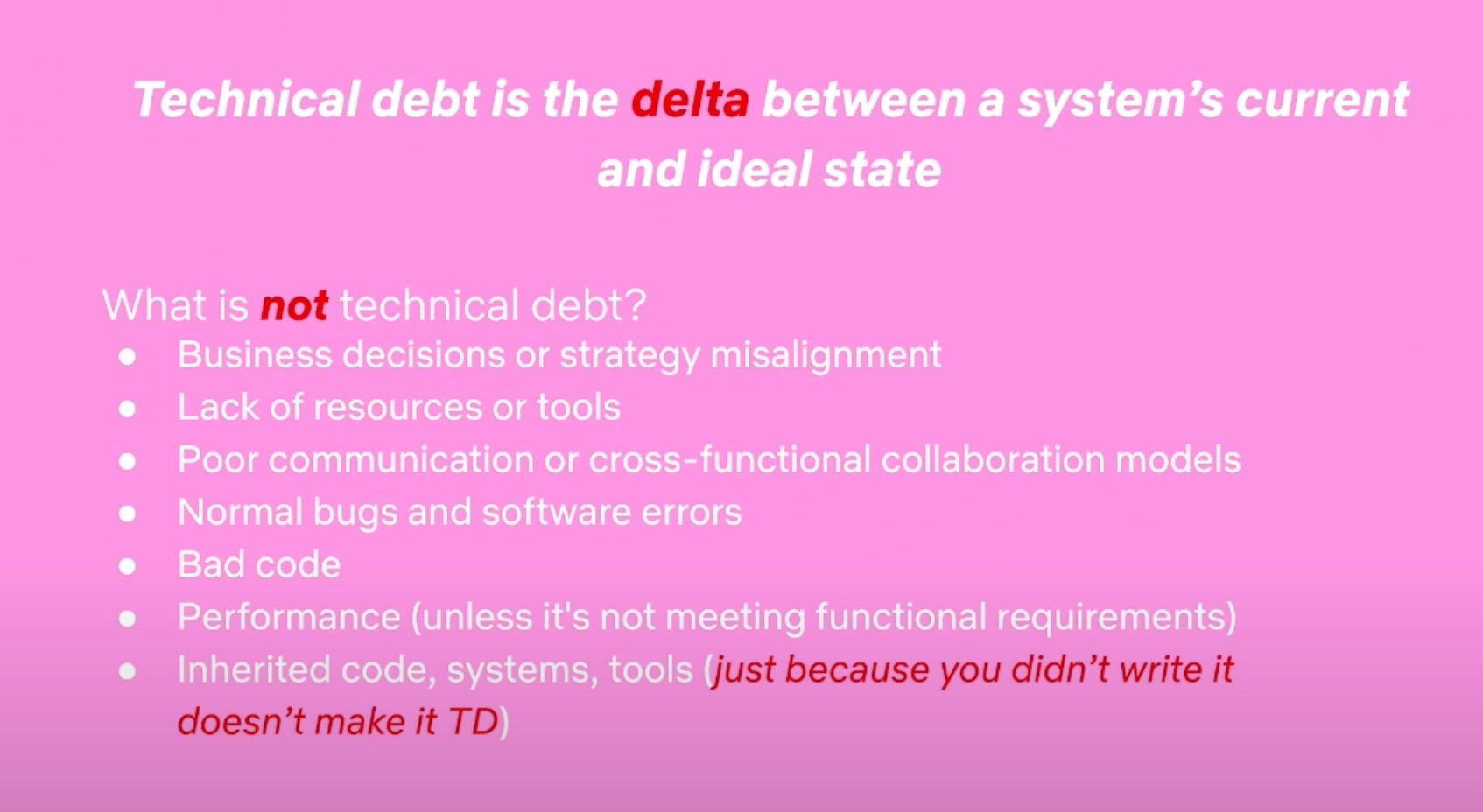
#### What are not Tech Debts?
- Business decisions (what the boss doesn't do) - lack of resources
- Lack of communication between different models
- Bug. (Very often~~ too lazy to solve it, so it's called tech debt)
- Bad Code (written poorly~~ it won't be tech debt either) - Performance issues (performance issues are definitely not tech debt)
- You are not familiar with these codes…. (It seems that a lot of people say this, as if rewriting it would eliminate tech debt XD)
#### Guidelines for defining and describing "Technical Debt":
In terms of definition:
- The most important thing is to research what your "technical debt" is? You can't just say, this is an old framework, so it's a technical debt.
- Be "clear", "visualize" and "proactively" identify and clearly define all technical debts.

#### How to deal with "Technical Debt":
Find it accurately and give it a name.
- Limitations on the flow of information in a certain Tunnel -> Tunnel X Project Don't say "technical debt" when something happens.
- You need to clearly state which technical debt it is, don't treat technical debt as a vague (suitcase) term for not wanting to fix and not wanting to deal with it.

#### "Maintain/Improve or Migrate?"
In the software development process, many software development engineers often take over old systems. When it comes to maintenance (or optimization), people with less experience often choose to migrate directly to a new system. This is often the riskiest thing, and there are too many dangers that may occur:
- Changes in supervisors (suddenly don't want to change)
- Personnel changes (another group of people)
- Changes in the external environment (business suddenly disappears? Covid causes business to boom?)
- Technological changes (AI suddenly appears)
- The biggest risk is: you don't even know how to Migrate.
The so-called technical debt will disappear. Maybe it won't…. You will only have a bunch of business logic that you forgot to move over.

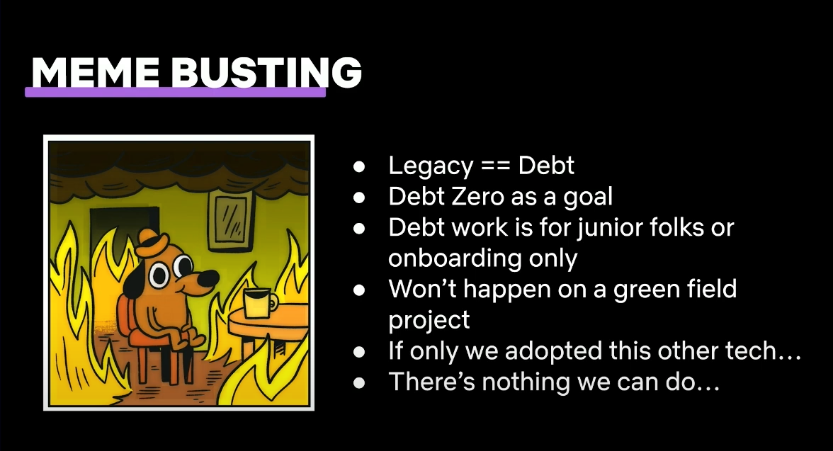
#### Debunking the Myths of Technical Debt
- Legacy is not technical debt, it's just that you haven't spent time understanding it.
- Technical debt does not need to be completely cleared, but the most important ones should be cleared when necessary.
- Technical debt involves important business logic and more underlying technologies, let the professionals (seniors) handle it.
- Technical debt occurs in any product, and there is actually more in new products.
- Introducing new programming languages and new frameworks will only bring more technical debt.
- Every company has a way to deal with technical debt.
#### Handling technical debt well, facing more business challenges
If we can be more intelligent and proactively face these technical debts, instead of using technical debt as an excuse for not wanting to maintain it every day. This way, we are seriously facing this business service and can confidently say "YES" to the upcoming business needs.

## Afterword
Although it's a 25-minute speech, I spent two or three hours slowly appreciating and savoring every word. Many of the content also echoes the journey of a software developer and the blood and tears of the past (?). I highly recommend everyone to think carefully about these related contents.

Evan Lin
Posted on Originally published at evanlin.com on
DevOps: Netflix Gaming Platform Director Views Tech Debt as Innovation
For further actions, you may consider blocking this person and/or reporting abuse


Top comments (0)