

title: [Book Sharing] Nexus - From the Stone Age to the AI Era
published: false
date: 2025-04-26 00:00:00 UTC
tags:
canonical_url: https://www.evanlin.com/reading-nexus/
---
[](https://moo.im/a/jlpqwG "連結")
連結: 從石器時代到AI紀元
Nexus : A Brief History of Information Networks from the Stone Age to AI
作者: 哈拉瑞
原文作者: Yuval Noah Harari
譯者: 林俊宏 出版社:天下文化
出版日期: 2024/09/10
#### Purchase Recommendation Website:

- Readmoo: [Buy it here](https://moo.im/a/jlpqwG).

# Preface:

This is the second book I finished reading in 2025. I initially read this book simply because it was one of the best-selling books recently, but I didn't expect that there would be many parts inside that are really worth pondering.

I highly recommend that those who are interested can take a look. It shares a lot of historical stories and related explanations, allowing you to better understand human history and the connection of information flow.

<iframe width="560" height="315" src="https://www.youtube.com/embed/YsLWeGDgO-8?si=ficY-BaCN75UI6_o" title="YouTube video player" frameborder="0" allow="accelerometer; autoplay; clipboard-write; encrypted-media; gyroscope; picture-in-picture; web-share" referrerpolicy="strict-origin-when-cross-origin" allowfullscreen=""></iframe>
# Content Summary:
What will AI do now and in the future?
Harari's new masterpiece, "Nexus," tells us in an inspiring way,
how we got to this moment,
and the urgent choices we must make for survival and development.
"Nexus" examines information networks and information flow through the long lens of human grand history,
how we are brought to the AI era.
Harari guides us through the Stone Age, through the canonization of the Bible,
the invention of the printing press, the rise of mass media, and the resurgence of populism...
Examples of how systems like the Roman Empire, the Qin Empire, the Catholic Church, and the Soviet Union
use information technology to achieve their goals, whether good or bad.
Information is neither the raw material of truth nor just power and weapons;
"Nexus" explores many hopeful middle grounds between extremes,
rediscovering our shared humanity as the iron curtain falls and the silicon curtain rises.
Cover
【Opening】The road ahead is full of thorns
Part 1 The Network Formed by Humanity
Chapter 1 What is Information?
Chapter 2 Stories - Infinite Connections
Chapter 3 Documents - Paper Tigers Can Bite
Chapter 4 Errors - Absolute Correctness is an Illusion
Chapter 5 Choices - A Brief History of Democracy and Totalitarianism
Part 2 Non-Biological Networks
Chapter 6 New Members - The Difference Between Computers and Printing Presses
Chapter 7 Non-Stop - Network Monitoring is Everywhere
Chapter 8 Error-Prone - The Reality Between Computers
Part 3 Computer Politics
Chapter 9 Democracy - Can We Still Talk?
Chapter 10 Totalitarianism - Power to the Algorithm?
Chapter 11 The Silicon Curtain - Global Empire, or Global Division?
【Epilogue】Building a Self-Correcting Mechanism
# Thoughts:
This book explains the stories related to information and knowledge itself, causing human connection and opposition. The author has a very clear explanation in the following interview:
<iframe width="560" height="315" src="https://www.youtube.com/embed/WxpI0w0PkBM?si=W5Pg5PrKZZVFZ4mN" title="YouTube video player" frameborder="0" allow="accelerometer; autoplay; clipboard-write; encrypted-media; gyroscope; picture-in-picture; web-share" referrerpolicy="strict-origin-when-cross-origin" allowfullscreen=""></iframe>
In many promotional materials, it might make people think that he is exploring the relationship between AI and humans, but in fact, the author is exploring a deeper question — the "connection" problem between people.
This book starts with information exchange, and then conveys information through stories. At the beginning, it mentions that everyone has heard that "history is written by the victors," which is a way of transmitting information connections. All the political stories you think are actually written by the winning side, and the story will have a more powerful transmission effect. It also mentions that many stories in the Bible are also worth pondering, mainly because of the different times and political backgrounds at the time.
Stories can create a "third-level reality": the reality between subjects, subjective reality, and inter-subjective reality.
#### Stories Create Current Events
So Hitler was able to win the 1933 election because, under the German economic crisis, many people believed the stories he proposed.
Looking back at the way people "connect," it talks about "books." Books are the most original medium for connecting and transmitting people, from the "Bible" to various important books. But with the changes in human history and the politics of various regions, the content of the Bible also has different doctrines and interpretations of schools. There are even differences in the transmission versions.
#### Changes in Books and Religion
But does religion have a self-correcting mechanism? The body of religion is human, and humans will have many prejudices and errors, and naturally there will be related correction mechanisms. This also represents the mutual connection between humans, and there are also many ways to repair it.
#### Repair Mechanisms for Connections
Science also has a self-correcting mechanism. The book mentions Shechtman's "quasicrystal" theory, which shocked the entire scientific community and was also resisted by many scholars and public opinion. But with the progress of science and technology, the entire theory was slowly clarified. The connection of the theory itself was also repaired.
#### Political - Connections Generated by Democracy and Totalitarianism
Returning to politics, democracy is naturally a kind of connection between people. The people elect government units through the democratic system. If problems occur, it also means that the people have the opportunity to withdraw their own decisions. Does this make people feel that "democracy" is a fragile and compromised product? The author also mentioned that the essence of democracy lies in the changes under many choices, discussions, and compromises. Compared to the "easy dichotomy" brought by "totalitarianism," democracy is actually quite fragile. The so-called democracy is that the people have the right to vote and oppose. And totalitarianism does not:

#### In contrast, complex democracy is actually simple totalitarianism
Stalin is considered by everyone to be the totalitarian ruler of the Soviet Union. He established an extreme totalitarian organization and ruling system. Many countries still follow the relevant methods:
- **Secret Police**: Unified management of information and encouragement of reporting. Cutting off the connection between people, not believing each other. (Stalin's Great Purge)
- **Depriving the people of the right to elect and vote**: Consolidating their own political rights.
But because of his own excessive totalitarian rule, no one dared to approach him and give him enough medical treatment on the day he fell ill.
#### Information Asymmetry and Disconnection Created by Social Media
Here, it is proposed that in this era of the rise of social media, people are increasingly fond of "getting the same circle" encouragement on social media. But they prefer to argue and oppose each other in the "different circle." This is actually because AI calculates that this is a problem with the recommendation system.
#### Can decentralized information achieve democracy?
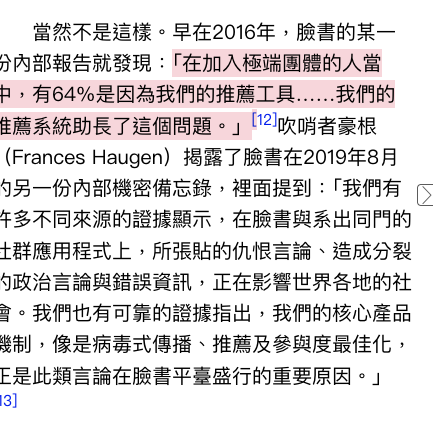
Here, it also explores the interaction between the latest technology and democracy, whether decentralized information can be used to preserve information and achieve true social democracy? But the author also raises the question, if a totalitarian ruler like Stalin rules 51% of the people, can he eliminate other voices?
## How We Should Be Careful
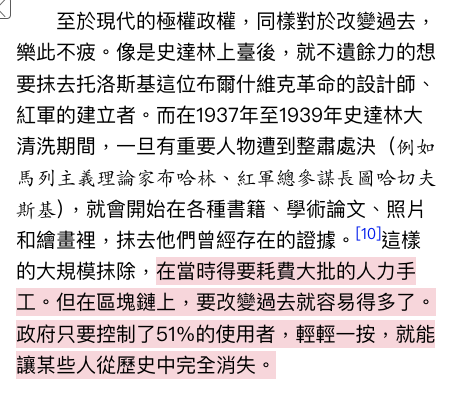
As mentioned earlier: **"Democracy is quite complex and fragile"**, in contrast, **populism** and **totalitarianism** are relatively simple and easy to understand. This is also a problem that democracy itself needs to solve, but on SNS, we will see many "simple violent" ways of speaking to encourage many opposing emotions. The reason you see it is not necessarily that it represents the emotions of most people, but rather the result of the recommendation system.
The recommendation system will recommend "what you like" to make you feel the same, but it is more inclined to recommend "what you hate" to make you reply to the article. The same is true for politics. If you see simple approval and opposition, you should spend some time reading more books and information. To fully understand the arguments of each side, rather than being limited to various arguments that oppose and destroy "connections."
Regardless of the information you like or the information you don't like. We hope that everyone has the ability to actively research information. Just like reading, you need to be able to obtain information and think about the real problems. Compare the previous and current statements of these politicians, whether it is just the operation of certain political orientations.
Finally, I would like to echo everyone again, "Democracy is a relative concept," and there is no such thing as a black-and-white idea. "Democracy is complex and fragile," but maintaining the people's right to elect and decide their own votes is true democracy.


Top comments (0)