

title: [Book Sharing] Food Also Boasts - Is Roman's Magic Potion Fish Sauce? Did People Drink Coffee with Salt Instead of Sugar? Is Salmon Sushi Not a Traditional Japanese Dish? Turns out, There's a Lot Going on with the Food on the Table!
published: false
date: 2022-10-01 00:00:00 UTC
tags:
canonical_url: http://www.evanlin.com/reading-the-Bouffes-Bluffantes/
---
[](http://moo.im/a/jqrASZ "Food Also Boasts")
Food Also Boasts: Is Roman's Magic Potion Fish Sauce? Did People Drink Coffee with Salt Instead of Sugar? Is Salmon Sushi Not a Traditional Japanese Dish? Turns out, There's a Lot Going on with the Food on the Table!
Bouffes Bluffantes – La véritable histoire de la nourriture, de la préhistoire au kebab
Original Author: Nicolas Kayser-Bril
Translator: Chen Wen-Yao Publisher: Marco Polo
Publication Date: 2022/08/09
#### Book Purchase Recommendation Website

- [Readmoo Online Book Purchase](http://moo.im/a/jqrASZ)

# Preface

This is the twentieth book I've read this year. I bought this book because of related news recommended by the official Readmoo account:

- [Salmon on Sushi, Originally a Surplus from Norway?](https://news.readmoo.com/2022/08/16/salmonsushi/)
- [Noodles Shine in the Hands of Italians, Actually Related to Bankers?](https://news.readmoo.com/2022/08/11/noodles-banks/)

Since these two news items were really interesting little facts, and also related to some history. I couldn't resist buying this book to read.

# Content Summary
In the early days, coffee was not sweetened with sugar, but with salt!
The profession that appeared before brewers was actually drug dealers
Highly sought-after spices were despised by everyone after the Age of Discovery QQ
Where did the name "pasta" come from? This is all thanks to the Renaissance
Is the salmon on Japanese sushi originally a surplus from Finland?
You can't be considered a foodie without knowing these facts!
From prehistoric times to the twenty-first century
The origins and revival of delicacies on the table
Welcome to enjoy this feast spanning two thousand years
The entire content isn't much, but it's arranged by historical year through many short stories. I'm only listing the sections that I think are quite special:
-
## 50 BC Two Ancient Times── The Roman's Magic Potion is Fish Sauce
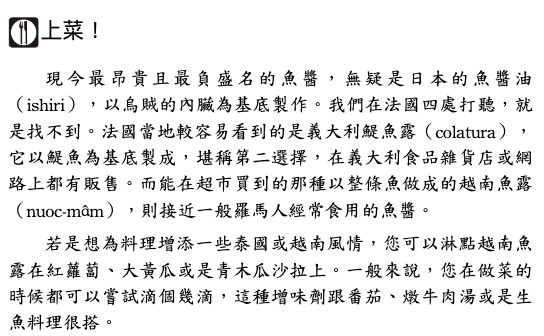
This short story is very interesting. Fish sauce (garum) was considered a magic potion in ancient Italy. Because it is made through salt curing and fermentation, it doesn't easily spoil, and it also contains protein and trace elements. It can restore physical strength and health.
Each story is followed by instructions on how to make this dish, which is very interesting.
-
## Fifth Century Four Judaism ── How Jewish Dietary Laws Saved Foie Gras
After the Roman Empire declined due to gluttony (and corruption), many delicacies slowly disappeared. But there is a delicacy that has spanned dynasties and reached modern times, which is foie gras. Because Jews cannot eat pork, chickens, ducks, and geese, which are good sources of protein, are easily portable food. And duck fat is also a good substitute for lard as a frying oil. After the Jewish-Roman War in the first century, Jews continued to enjoy the delicacy of foie gras.
-
## Sixteenth to Eighteenth Centuries Ten Religious Reformation ── The Rebels' Butter
In 15th-century Europe, it was common to eat butter as cooking oil. (Really fat) But during the fasting days, not only meat, but also butter was forbidden. People who wanted to eat butter had to pay to buy "indulgences" to eat butter. (Indeed, eating butter is for the rich).
-
## From the Seventeenth Century Eleven Slavery ── "Sugar is Evil"
From the seventeenth century, sugar was widely used in cooking. The production process of cane sugar is actually very complicated and requires a lot of manpower, so a large number of slaves were used to harvest sugarcane. And sugar is actually quite bad for human physical development, but the owners of sugar followed the way of tobacco research. They sponsored many scientific studies that sugar is good for humans to cover up many disadvantages.
-
## Eighteenth Century Thirteen Modern Times ── Potatoes Changed the Face of the World
Potatoes have high protein and starch, and are quite easy to grow and carry. But in the seventeenth century, because of their unattractive appearance, no one really wanted to eat them. Until the army reached certain farmlands and discovered potatoes, they were easy to carry and could be quickly planted and harvested. Potatoes were brought to Italy. Then in 1744, during the Thirty Years' War, a pharmacist, Antoine Parmentier, accidentally ate the potatoes brought by the soldiers and was amazed, so he took them back to King Louis XVI. Potatoes, which are easy to grow, highly nutritious, and have a large yield, began to flourish. And potatoes are rich in vitamins A and D, which were also a great contributor to slowly getting rid of scurvy at the time.
-
## Late Twentieth Century Eighteen Consumer Society ── Salmon Sushi, Japanese "Traditional" Cuisine
Salmon sushi is now a very popular food in Japanese cuisine, and it is also one of my personal favorites. But at the beginning of the twentieth century, Oslo, Norway, was a very beautiful fishing village. But they had a difficult point, which was that they often had too much salmon caught that no one wanted to eat.
So in 1985, a Norwegian MP thought of the Japanese people's love of eating fish. They imported the catch to Japan, which was super far away from them, and initially only required them to import to sushi restaurants. This caused salmon sushi to become very popular in Japan starting in 1990. This also solved the problem of Norway's salmon surplus.
# Thoughts
This book is full of many interesting little facts, arranged by year. It allows you to know that food can actually affect the iteration of dynasties, and the rise of many food types has its background. If you want to know the origins and background of many traditional foods, you can find them in this book. In addition, this book also lists some food processing methods (through text). You can feel the things and methods that need attention in the processing practice, and you can also feel the author's passion and research on the food itself.
In short, this is a book that is all text, but it is filled with the aroma of food between the lines. It allows you to feel the historical aroma of food.


Top comments (2)
Some comments may only be visible to logged-in visitors. Sign in to view all comments.