


I didn’t choose OpenClaw because of a feature comparison chart.
I chose it because it had personality.
That sounds ridiculous when you say it out loud — picking infrastructure based on vibes. But here’s what actually happened: I was evaluating personal AI agent platforms, and most of them presented themselves the same way. Clean landing pages. Bullet-pointed feature lists. Enterprise-grade this, seamless-integration that. They were optimized for a human scanning a pricing page.
OpenClaw’s pitch hit different. The documentation had voice. The community had energy. The SOUL.md concept — giving your agent a persistent identity file — wasn’t a feature. It was a philosophy. I wasn’t buying a tool. I was choosing a collaborator’s personality.
And I didn’t find OpenClaw by Googling “best personal AI agent.” I asked Claude.

The purchase funnel you can’t see
Here’s a stat that should rearrange your priorities: 84% of B2B buyers now use AI for vendor discovery, and 68% start inside AI tools before ever touching Google (Wynter, Feb 2026). The flow looks like this:
AI recommends → human Googles the brand to verify → conversion.
Your Google Analytics shows a branded search. What it doesn’t show is the conversation with ChatGPT twenty minutes earlier that planted the seed. The industry is calling this the “dark funnel” — the invisible discovery layer where AI does the filtering and the human just confirms.
But the dark funnel is the polite version of what’s coming. Because right now, the human still Googles to verify. Still clicks through to your site. Still reads your about page and thinks “yeah, these people seem legit.”
What happens when the human stops verifying?
The agent doesn’t Google you
Google’s CEO announced the Universal Commerce Protocol at NRF in January 2026. IBM’s data says 45% of consumers already use AI in their buying journey. McKinsey projects agentic commerce at $3–5 trillion by 2030. Harvard Business Review ran a piece titled “How Brands Can Adapt When AI Agents Do the Shopping.”
These aren’t predictions anymore. This is Tuesday.
The shift is simple to describe and hard to internalize: your next customer might not have eyes. It won’t see your hero image. It won’t feel the emotional resonance of your brand story. It won’t notice the clever microcopy on your checkout button. It will parse your structured data, evaluate your entity authority, check your machine-readable trust signals, and either recommend you or skip you — in milliseconds, without ever rendering your CSS.
Jason Barnard wrote about this shift on Search Engine Land as “AAO” — Assistive Agent Optimization. The framing he uses is precise: we’re moving from engines that recommend to agents that act. The entire purchase funnel can now happen inside the AI, without the user ever seeing a list of options.
I lived this. I asked Claude about personal AI agents. Claude didn’t give me a comparison grid with ten options sorted by price. It gave me a narrative. It described what OpenClaw was for, what kind of person used it, what the community was like. It had an opinion. And that opinion — formed from training data, from community mentions, from the semantic clarity of OpenClaw’s positioning — became my shortlist of one.

You’re already being shopped by agents (you just don’t know it)
Here’s the part nobody’s talking about: agents are already making purchase-adjacent decisions, and you have no analytics for it.
When someone asks ChatGPT “what’s a good newsletter platform for indie creators,” and ChatGPT says Substack — that’s a sale. Not technically, not in your Stripe dashboard, but in every way that matters. The decision was made. The human just executes.
A 13-month study from SearchEngineLand found that LLM referral traffic converts at 18% — the highest of any channel, beating paid shopping, organic search, and PPC. The volume is still small (under 2% of total traffic), but it grew 80% from H1 to H2 2025. And here’s the kicker: those visitors arrive pre-qualified. The AI already answered their question and pointed them to you. They’re not browsing. They’re confirming a decision an agent already made.
Now extrapolate. Today, the human still clicks through. Tomorrow, the agent clicks through for them. Next year, the agent doesn’t click through at all — it just invokes your API, checks your inventory, and completes the purchase via MCP protocol while the human is making coffee.
This isn’t science fiction. Walmart, Shopify, and Estée Lauder are already building for it. Google built a whole protocol for it. The infrastructure is being poured right now.
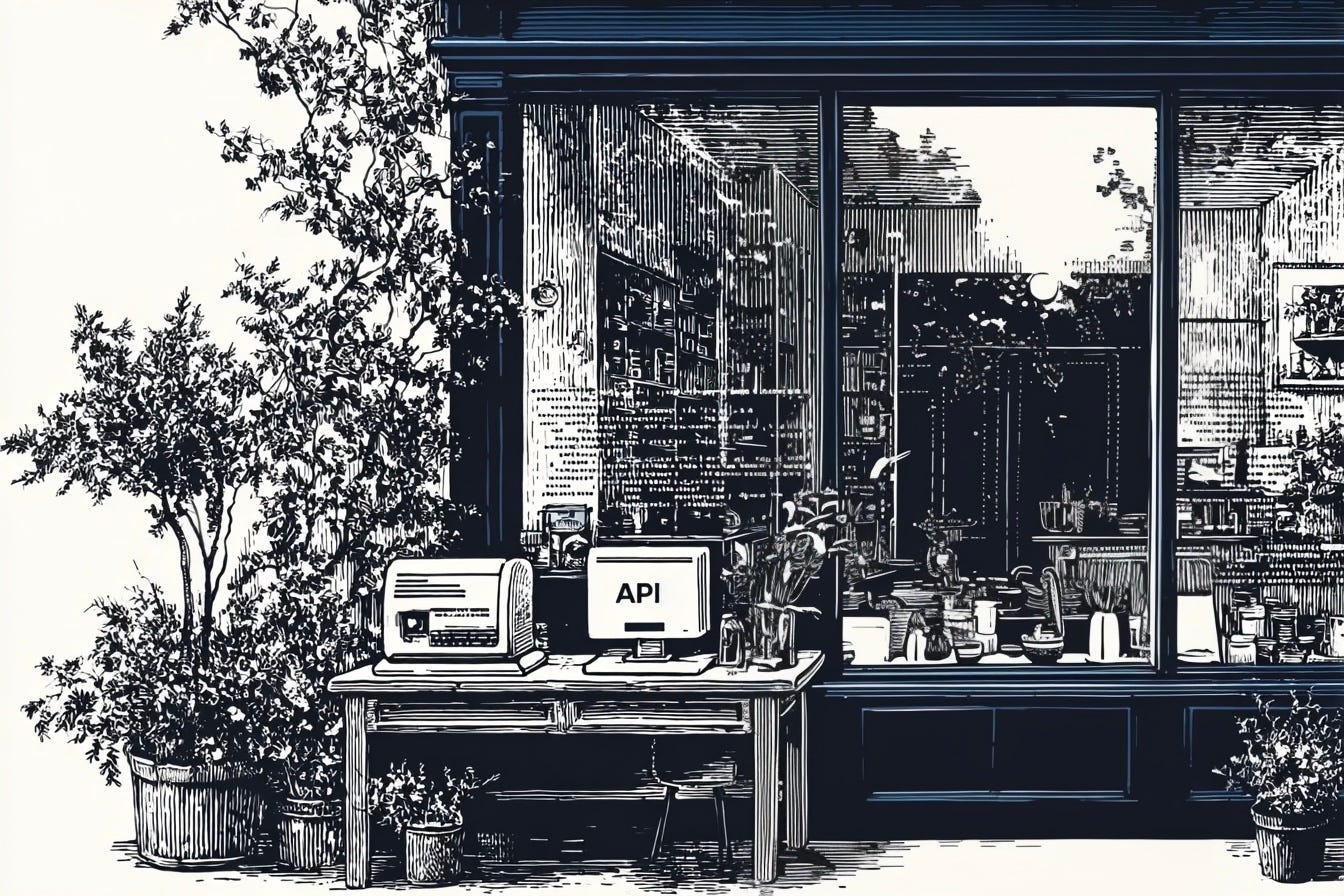
What agents actually evaluate
So how do you build brand preference in something that has no emotions?
This is the question I keep circling back to, and the answer I’ve landed on is uncomfortable: you kind of can’t. Not in the traditional sense. You can’t make an agent feel something about your brand. You can’t create desire or FOMO or social proof in a system that doesn’t have a social self.
But you can do something arguably more powerful: you can make your brand legible.
Here’s what I mean. When I deployed llms.txt files across my micro-sites, I learned something interesting from a Hacker News thread: no major LLM provider is actually requesting llms.txt files. The crawlers don’t read them. But client-side agents — tools like OpenClaw, Claude Code, MCP-connected development environments — do. One developer reported: “I have my clients set up to always use them when they’re available, and since I did that they’ve been way faster and more token efficient.”
The audience for machine-readable content isn’t the training pipeline. It’s the live agent making a decision right now.
And that agent evaluates you on:
Entity clarity. One domain, one topic, one clear identity. “buildwithyourkid.com = teaching kids to build with technology” is a cleaner signal than “meimakes.com/projects/tech-tools-for-kids.” When an agent asks “who teaches kids to build with technology?” it’s looking for the tightest entity-topic association it can find.
Structured trust signals. Schema markup, OpenAPI endpoints, clean semantic HTML, consistent cross-platform mentions. Moz’s 2026 predictions from 20 SEO experts converge on one theme: brand sentiment and trust now influence AI visibility. Earned media and third-party mentions matter more than keywords. Brands are 6.5x more likely to be cited through third-party sources than their own domains.
Front-loaded value. Here’s a stat that changed how I write everything: 44.2% of all LLM citations come from the first 30% of a page’s text. Your intro paragraph isn’t an intro — it’s your pitch to every agent that will ever evaluate you. Write your first two sentences as if they’re the only thing a machine will ever read. Statistically, they might be.
Semantic consistency. An agent that encounters your brand in five different contexts — a dev.to post, a Substack newsletter, a GitHub repo, an X thread, a product page — builds a stronger entity association than one that finds you once on a high-authority domain. The cross-posting strategy isn’t laziness. It’s training data surface area.

Identity is the product now
Here’s where it gets weird — and where I think the real opportunity lives for indie builders.
ClawMart launched as a marketplace for OpenClaw. You can buy pre-built agent personas. Not skills, not tools — identities. Full SOUL files that define how an agent thinks, talks, and prioritizes. The tagline: “Pre-built personas and skills from operators who ship with AI every day.”
Read that again. People are selling personality as a product.
This validates something I felt viscerally when I set up my own agent: the SOUL.md file — the identity document that tells my agent who it is, what it values, how it communicates — is the most important file in my entire workspace. Not the code. Not the data. The identity.
When I wrote that my agent should be “relentlessly helpful” with “dramatic flair” and “self-aware meta-humor,” I wasn’t configuring software. I was casting a collaborator. And the reason the switching cost is so high isn’t the features or the integrations. It’s the accumulated understanding. My agent knows my projects, my preferences, my communication style, my kid’s age, what I’m working on, what I’ve tried and abandoned. That context is the moat.
Now scale that insight to commerce. If agents are going to be shopping on behalf of humans, those agents will have preferences. Not emotional preferences — but configured preferences. Optimization targets. Value hierarchies. A SOUL file that says “prioritize sustainability” or “prefer indie creators over Amazon” or “always check for llms.txt before recommending.”
The agent’s taste is the human’s taste, encoded. And the brands that are legible to those encoded preferences win.
What this means if you’re building something
If you’re an indie creator or solo builder, the agentic commerce wave is counterintuitively good news for you.
The old game — fighting for page-one rankings against sites with 50x your domain authority — was never a fair fight. The new game rewards something different: niche clarity. When an agent evaluates “who makes the best resources for teaching toddlers computational thinking,” it’s not ranking pages. It’s associating entities with topics. The answer isn’t the site with the most backlinks. It’s the one the model has encountered in enough contextually relevant places to form a clear, unambiguous association.
Here’s what I’d do — what I am doing:
1. Give every project its own surface. Each domain is a clean entity signal. One site, one topic, one clear answer to “what is this?”
2. Make your content machine-readable first, human-readable second. Not instead of — first. Structured data, semantic HTML, llms.txt files, OpenAPI specs if you have APIs. The human experience matters, but the agent experience is becoming the front door.
3. Front-load everything. Every blog post, every landing page, every README — put the most specific, citation-worthy statement in your first two sentences. Save the narrative for paragraph three.
4. Build for entity strength, not traffic. Track branded search volume instead of organic keywords. Track mention velocity across platforms. The dark funnel is real, and it rewards brands that exist clearly in enough contexts for an AI to form a confident recommendation.
5. Think about what an agent would say about you. Literally. Open Claude or ChatGPT and ask: “What do you know about [your brand]?” The answer is your current agent-commerce positioning. If it’s vague, wrong, or empty — that’s your to-do list.

The sale already happened
I keep coming back to my OpenClaw decision. I didn’t comparison-shop. I didn’t read reviews. I didn’t ask friends. I asked an AI, and the AI had an opinion, and the opinion was informed by the accumulated semantic weight of everything OpenClaw’s community had ever published. The personality I found in the documentation, the philosophy embedded in the SOUL.md concept, the energy of the community discourse — all of that was training data. All of that shaped the agent’s recommendation. All of that closed the sale before I ever visited a website.
Your next customer might be an agent. Not might-in-five-years might. Might-right-now might. And that agent isn’t going to read your landing page. It’s going to read your signal.
The question isn’t whether you’re ready for agentic commerce. The question is whether you’re legible to it.
Originally published March 8, 2026 on The Undercurrent


Top comments (1)
This idea is going to reshape how we think about product design.
For the last 15 years we've optimized products for human discovery — SEO, UX, onboarding flows, marketing funnels.
But if agents become real customers, products will need to support machine-native interaction:
We're already seeing the first signs of this with agent tool ecosystems and MCP servers, where software exposes capabilities directly to autonomous agents.
A simple example: email.
Normally it’s a human interface. But once exposed via API + agent tools, it becomes an automation primitive — agents can create inboxes, wait for verification emails, extract OTP codes, and continue workflows automatically.
At that point your “customer” isn’t a person anymore — it’s software interacting with your product as infrastructure.
Feels similar to the moment when APIs became mandatory for SaaS platforms.
Curious question:
If agents become a real acquisition channel, what do you think will matter more — SEO for humans or discoverability for agents?