


Stop optimizing for nominal wages. Start optimizing for cognitive surplus and time sovereignty.
In the modern startup ecosystem, there is a piece of conventional wisdom that acts as a silent killer: “Get a high-paying, stable corporate job to fund your dream.”
On paper, it sounds responsible. In reality, it is a trap. For a founder—especially a technical one—a high-status full-time role is often a "gold-plated cage" that drains your energy, steals your intellectual property, and ensures you never have the "escape velocity" needed to launch.
I have abandoned that path. Instead, I have adopted a radical decoupling of Survival from Self-Actualization. I call it the Low-Entropy Employment Model.
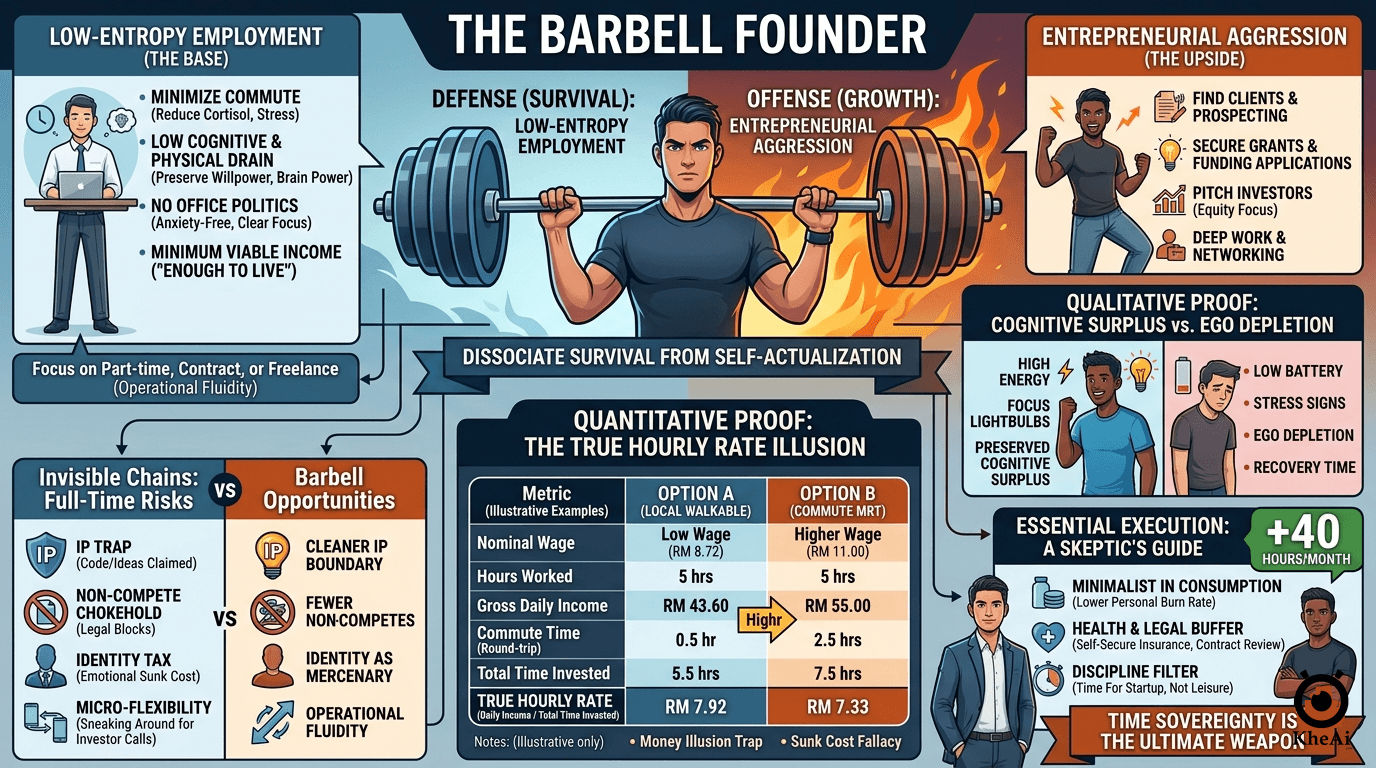
1. The Strategy: Nassim Taleb’s Barbell
In finance, the Barbell Strategy involves avoiding the "middle ground." You place 90% of your resources in hyper-safe, boring assets to guarantee survival, and 10% in highly aggressive, speculative bets for massive upside.
I have applied this to my life:
- The Safety (90%): A "mindless," part-time, or contract job that is walkable and stress-free. It provides the Minimum Viable Income.
- The Aggression (10%): My startup. This is where 100% of my ambition, creativity, and aggression are focused.
Most people get stuck in the middle—a moderately stressful, moderately paying job that pays just enough to stay comfortable, but drains just enough energy to stay stagnant.
2. The Biology: Cognitive Surplus vs. Ego Depletion
Why do I prioritize "mindless" work? Because of a psychological reality called Ego Depletion.
The human brain has a finite daily reservoir of willpower and decision-making capacity. If your day job requires you to solve complex algorithmic problems, navigate toxic office politics, or manage high-stakes client crises, your prefrontal cortex is chemically exhausted by 5:00 PM.
The Founder’s Axiom: Free time is useless if you have no cognitive energy left to spend.
By choosing a low-entropy job, I arrive at my "startup hours" with my nervous system intact. I am not "recovering" from my day job; I am starting my real day with a full battery.
3. The Math: The "True Hourly Rate" Illusion
Let’s use a skeptical, research-based simulation to debunk the "higher pay" myth. Consider two options for a 5-hour part-time shift (20 days/month):
- Option A: A local job within walking distance. Pay: RM 8.72/hr.
- Option B: A "better" job requiring a commute (MRT/LRT). Pay: RM 11.00/hr.
Society says take Option B. The math says otherwise when we calculate the Total Cost of Employment (TCE).
$$True\ Hourly\ Rate = \frac{Total\ Daily\ Income}{Hours\ Worked + Commute\ Time}$$
| Metric | Option A (Local) | Option B (Commute) |
|---|---|---|
| Gross Daily Income | RM 43.60 | RM 55.00 |
| Time Invested | 5.5 Hours (0.5h walk) | 7.5 Hours (2.5h transit) |
| True Hourly Rate | RM 7.92 / hr | RM 7.33 / hr |
The Verdict: Option B is a net loss. Not only is the true rate lower, but the Opportunity Cost is 40 hours of lost time per month. Those 40 hours could be used to write 3 government grants, pitch 50 investors, or build a core product feature.
4. The Invisible Chains: The Risk of Full-Time
For a programmer or technical founder, a salaried full-time role is strategically dangerous.
The Intellectual Property (IP) Trap
Standard full-time contracts often include "Assignment of Inventions" clauses. Legally, any code you write—even on your own laptop at 2:00 AM—can be claimed by your employer if it’s even tangentially related to their field.
The Solution: Freelance or part-time contracts are "cleaner." They define a narrow scope of work, leaving your "after-hours" IP safely in your hands.
The "Identity Tax"
Corporate culture demands emotional "alignment." They want you to care about their vision. This creates an Emotional Sunk Cost. You start optimizing for a promotion you don't actually want, which tethers your self-worth to a hierarchy you don't own.
The Non-Compete Chokehold
Full-time roles often come with non-compete clauses that can legally block you from launching a startup in a similar industry for years. mercenary, part-time roles rarely carry this legal weight.
5. The Execution
This strategy is not a "slack-off" plan. It is an optimization plan. To make it work, you must adhere to three strict rules:
I. Minimalist Consumption
You cannot live a high-status lifestyle on a low-entropy income. You must be a Minimalist in Consumption to remain a Maximalist in Production. Every RM saved is a second of freedom bought.
II. The Health & Legal Buffer
Since you are forgoing corporate benefits, you must be disciplined:
- Insurance: Use a portion of your income to secure your own medical and life insurance.
- Contract Review: Never sign a part-time contract without checking for IP-grabbing clauses.
III. The Discipline Filter
If you take an "easy" job but spend your reclaimed 40 hours on Netflix or gaming, you aren't a Barbell Founder—you are just underemployed. This strategy only works if you go to "war" for your startup the moment you clock out of your survival job.
Conclusion: Time Sovereignty is the Ultimate Weapon
In the startup game, the person who can stay in the arena the longest wins. By lowering your burn rate and protecting your cognitive energy, you become incredibly difficult to kill.
Stop optimizing for a job title. Start optimizing for Time Sovereignty. Your startup deserves your best brain—don't sell it to the highest bidder for a few extra Ringgit and a long commute.
What is your "True Hourly Rate" today? Is it time to quit the "good" job for the right one?


Top comments (1)
i really resonate with your point about the "gold-plated cage" of high-status jobs. it’s so crucial to prioritize cognitive surplus and time sovereignty. at moonshift, we help founders build apps quickly-get a next.js + postgres + auth setup deployed in about 7 minutes, and you own the code on your github. if you're interested, i can offer you a free run to see how it fits your needs.
Some comments may only be visible to logged-in visitors. Sign in to view all comments.