


New World Order
With the COVID-19 crisis, one trend has gained a lot of momentum: remote working. A lot of workers were asking for it for quite some time, pressing their companies to allow them to work from anywhere and trust them that they could be more productive on their own terms.
The coronavirus forced their hands obviously and now some companies decided that remote working was worth it. Twitter announced their teams can keep working from home "forever". Facebook also started the transition towards allowing more of their employees to work remotely.
These two are just some examples of how the crisis help the work from home movement gain traction. Of course, how we do remote work in this crisis is another subject entirely. For hundred of thousands of people, the change was not prepared, or even not wanted. In this configuration, we are trying to make remote work function, during a crisis. But that's another debate.
What about the salary?
According to this tweet:
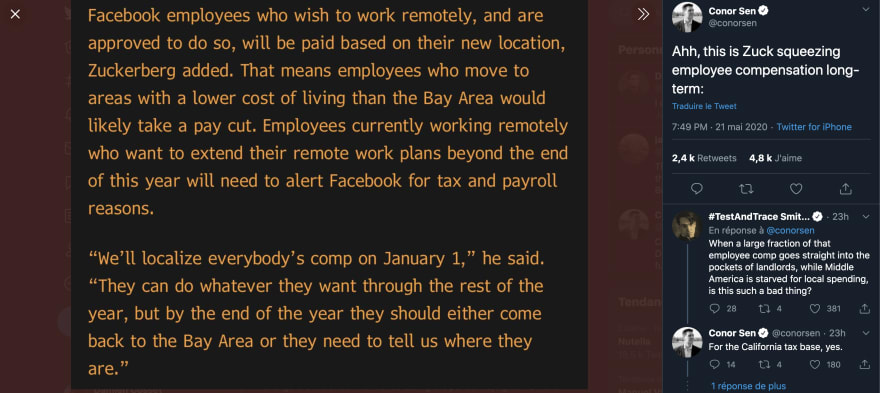
Our good friend Zucky is basically saying Facebook will not pay employees the same based on their location. There are no details yet of what will be done, and how. But it begs the question:
Should remote workers salaries differ based on their location?
Assuming two developers with the same skills, experience and productivity. One lives in New York, the other lives in Marrakech. As a CEO, should you adapt the salary of the developer living in New York, because the cost of living will be much higher than in Morocco?
Basecamp, a company with most of their employees working from home, pays their employees based on same base, which I believe is the New York market. Doesn't matter where they work from. Same experience? Same job? Same pay, period.
If you are a Facebook worker in California, you will be payed higher than a Facebook worker in London. And that disparity will continue after the coronavirus crisis ends and Facebook moves to a remote friendly environment.
What do you think? On one end, if two developers have the same position, they should be able to claim the same compensation for the same work. Should we include the environment they live in in that compensation? A worker in San Francisco is most likely to spend a good amount of his salary to pay a rent. While the developer in Morocco will most likely spend a smaller percentage of his salary towards her housing.
But then, if you start with housing, where do you stop? Should you consider the size of the employee's family? If they still want to work at the office from time to time or full time, should you compensate the salary for the commute costs?
This is a difficult issue, with quite a lot of nuances. Personally, I quite like the "Basecamp" way: pick a fair location and adapt your salaries based on that location.
I'd love to know where you stand on this issue 😄
Love ❤️
Sources:


Oldest comments (46)
With that move I foresee a mass exit of Facebook employees due to this. Which can be a huge boon for other big tech companies or startups to snap them
up as they don't implement something as outrageous as this.
You have a great point
I mean, collectively in IT, we pay developers from India, Bangladesh and al. a much more lower salary than ours and it seems like everyone is fine with it unless it impacts us. We should address this first before complaining about that "injustice".
Couldn't agree more with that observation. I think there is a larger problem of racism when it comes to that sort of problem.
I think people will talk about the cost of living or what not, when the real issue comes from the internalized racism creeping in our society.
Are Indian developers living in the US paid lower wages? If not, racism is not the issue here.
We actually have protections to prevent this in the US. This could absolutely still be rooted in racism.
Not only on the US, there are similar laws all over the world. This doesn't prevent a certain amount of disparity anyway, but I have no specific data to support this claim (as much as there's a disparity between men and women, for example).
But still, an Indian developer in San Francisco is paid orders of magnitude more than one in Delhi. I don't think this could be remotely disputed.
What actually abysmal in the US is what's considered "minimum wage" by law, which is way below the poverty limit 😟
I feel there is something to that ... paying Indian devs way less than US devs just because they're living in India somehow doesn't feel right, especially so when both are working remotely i.e. not in an office.
When people are getting into an office to get work done I feel it's somehow different and more justified to "discriminate" on salary/wages because they're really physically tied to that location.
But if companies decide to go full-remote and have their employees working remotely, then location should not be a factor at all - ZERO - that's the whole point of "remote". So in that case differentiating salaries based on location is an absolute no-no in my opinion.
I am from Sri Lanka and here we are annually getting paid 10k to 20K. When comparing with the US they are getting paid, 100k-120k at least. But for us, this is not a bad amount when compared to other industries. but here it is much harder to buy required hardware etc with that cost. Let's say most of US developers are using apple products while here we have to stick with cheaper products. That is where the issue comes in!
If every person is delivering something valuable, they must have treated the same way!
I don't want to offend anyone but this logic is a bit odd to me. If the company pays less for developers from India, Bangladesh and etc why don't they just get everybody from there and fire you guys? They will make more money that way and if they are as good as you guys no one will see a difference.
The problem is that it is not even close to the case. I had the pleasure to work with more than 20-30 team members from the countries you are "marking" and there is a big difference in knowledge and etc.(They were all in teams of 4-5 and I was like a manager to all of them.) Not everybody is the same and I'm sure there are differences everywhere but in most cases, companies get people from those countries for cheap labor, not for the good code/tests or etc.
Yes companies invest these asian countries because they need to reduce the cost. But if you compare the knowledge, as a sri lankan and as a person who have worked with developers who were getting paid well, there is no such a big different. Sometimes our people are better than them. Then i have that issue why they are getting paid more than us without even having more knowledge than us?
I think it's justified to some extent. Cost of living in different countries varies greatly, and for the most part companies aren't thrilled to pay significantly more than the market.
Living in India is far cheaper compared to San Francisco, so one could argue that by paying employees the same amount, your Indian employee will be significantly richer compared to his American coworker. Is it fair? I don't think so. There's no silver bullet obviously.
Also, don't forget that in different countries average compensations can be quite different regarding what they contain (pension, study funds, 401k...), where these things might not be applicable in other places - how would you compare them?
With all that, if an employee in SF chooses to move to a suburb to enjoy a more relaxed environment he/she should not be "taxed" for it in any way.
But by your logic I should move to SF first, get hired, then immediately move back to the suburbs. To take advantage of the higher pay that won’t get normalised. Having to renegotiate every time I move leads to all kinds of weird situations, when nothing about my relationship with the employer has changed.
Instead if the solution is to pay people what they’re worth to the company it’s kept simple: It doesn’t matter where you live, go to countryside to be rich if you’d like it’s your choice.
Well I get why you may think so, but that was not my intention, so I'll try to make myself clearer - there should be no salary gap between a metropolitan area and the surrounding suburbs. Heck - there should be no salary gap if you move from SF to NY (I am not from the US so I can't compare cost of living, but I assume it's similar).
However, when we're talking about different countries or even continents I think my original point still stands - cost of living plays a big role in overall compensations.
The problem it's that if I live in a poor country and can't afford to go into a rich country. I'll be tied to my salary forever, the quality of life also changes, for example: In Brazil, earning $5k it's really rich, whatever, I don't have the freedom to do this because of the problem that the country has with security, I don't have the same buying power that I could have in a rich country.
Workers should always be paid for their work. I believe it to be as simple as that. When you are paid a salary, you are paid for the skills, knowledge, and time you invest in the work. Someone working from New York would have the same working experience as someone living in any other part of the world.
Agreed! I hope there's no bias and racism in any tech companies. We must value camaraderie for every nationalities.
How do you see it considering taxes and cost of living?
It's really weird discussion, salary is a product of market, market is different from country to country...
It is an odd discussion. I was being overly simple with my general statement before. A business has workers to maintain the market presence which they inhabit. By saying that a business can make compromises for workers that operate in a lower rate market they are merely maximizing profit potentials within the business' own market. This portrays a profit-first business mentality.
In short, regardless of the market that the employee occupies the business must have the staff they are employing to be successful within their own market, meaning they should be able to facilitate the expenditure of that market.
We pay developers in different countries different rates but we pay them well enough for their cost of living. Everyone needs to advocate for themselves at some point and ask for they pay they believe they deserve based on skill and cost of living. When I don’t like about what facebook is doing (if they are going to do this) is reduce pay based on where someone lives.
Also what about the perks they offer for working from the office? Meals or other services. Do they give employees a stipend for this? What benefits will there be to working from home? If you will be paid less and lose these perks then it would be better to just go into the office.
Its not an easy subject.
On one side, I think you should be paid according to your experience and what the company will benefit from your work.
In the other hand you work to make a living, and it kind of is not fair that if you live in a cheaper country, you'll get a better quality of life (based on what you earn) than a person earning the same in an expensive country.
Also, there's this difficulty of leveraging companies in different countries. A company in, say, Romania, can't compete in terms of salary with a company in Canada, even thought they can hire the same exact people.
So we'll all want to work for Canada, leaving Romania with less options for workers.
But I feel that the way Facebook so doing it is petty. They have all the money in the world and it seems they'll lower their workers salary if they wish to work from home? I'm not sure if this is the case. If it is, it's crappy, if they're talking about future decisions of new employees than I don't think it's that bad.
Execution will be everything. I hope that companies don't do it just for the sake of paying less. But, yeah, I feel that will happen, as always
What do gou mean "its not fair"? Why?
This is just an idea, I haven't fully thought about it :)
If you live in Poland and earn 3000USD month and your colleague earns the same but lives in San Francisco, you'll have a better living standard than your SF colleague, because it's cheaper to live in Poland. It wouldn't be fair for the guy living in SF.
That was my reasoning. It has some validity but probably has counterpoints :)
What do you think?
I think that as long as we're not talking about the kind of wages where you can't afford to live, it's not an issue.
So what if the person in SF doesn't have the same perks? They don't magically "deserve" more because of where they live.
I probably didn't explain myself correctly. I don't think some people should get more, I think they should get the same according to the living-cost of the places they live. But that is next to impossible to measure, of course.
But yes, I wholly agree with
I think this should be pretty simple: the salary should be based on the position, and established up front in the usual fashion. If it's a remote position, you the worker should take into account the cost of living in either the area you are IN or the area you WANT to be in when negotiating the salary, or even considering the job offer.
If you're already being paid a certain salary, and you decide to move while keeping the job, I don't think it's fair to force the company to pay you more than they were before just because you moved to a higher cost-of-living area. A Duluth-based tech company should not have to pay considerably more to Employee X than anyone else just because he decides to go remote and move to NYC.
At the same time, the company should pay the same (in general) for remote or in-office, not more or less for either. I say "in general" because salary negotiation is a thing, but there shouldn't really be significant differences based solely on remote status or where you live.
The cost savings to a company for remote workers (if any, depending on their infrastructure) are a reasonable incentive for the employer to support remote work, so it also isn't fair to expect them to roll up those savings into some sort of bonus for the worker.
Long story short: in-office, or remote from anywhere, should be the effective same salary. The only time geography should affect salary is if the employee is being required to move to or stay in an area by the company.
If a company has multiple offices, each with a different average salary — let's say London and Seattle — then the salary for the remote worker should depend on which office he or she works out of. There are other factors that determine the base office, including time zone factors, where the team needing the worker is based, et cetera. This doesn't have to be complicated, because honestly, it has nothing to do with it in the end. If Employee X is hired to be part of the team based out of Seattle, he should be compensated based on the average for the Seattle team, and London doesn't even factor into it.
Anything more or less is unfair to the worker, or the employer, or both. Individual differences in salary needs and expectations is why we have salary negotiation.
Bear in mind other things apart from "cost of living" come into effect here.
In the USA people tend to have less vacation and almost no "notice period" should they be fired or the company go under. Sick pay is another one, in France or the Netherlands being sick would require significant support from your employer for a very extended period - in an "at will" state in the USA you are probably just facing massive medical bills with no support.
Let's take an example from the UK. You can become a contract developer - earn £400 a day. No sick pay, no holiday (that you aren't paying yourself for) and until recently you could game the tax so that £400 was more like £500. But you have to keep changing jobs and there is risk if you are older and more likely to fall ill. So lots of people take permanent jobs - lower basic pay but holiday, sickness cover, redundancy cover etc.
My point is, not sure you can just pick a market and go "that's the reference" because that is probably massively unfair to people who have high costs of living and can't change that because of their families etc. Why should an American suffer with massive health insurance costs meaning that their effective standard of living is lower than someone in the UK with no medical bills at all? Does not seem equitable to me.
Paying at a level that for a local area means you can have a reasonable home, reasonable car, be protected for your health and then equalising disposable income per job would seem fair - but there is a massive cost in itself just maintaining that.
I imagine many businesses will try to use this line to guilt their employees into accepting less pay based on their circumstances, which is far from fair.
I hope Facebook changes their stance on it because it will set a standard for thousands of other workers.
Some comments may only be visible to logged-in visitors. Sign in to view all comments.