


This is a submission for the Hacktoberfest Open-Source AI Challenge Week 3: Slow and Steady.
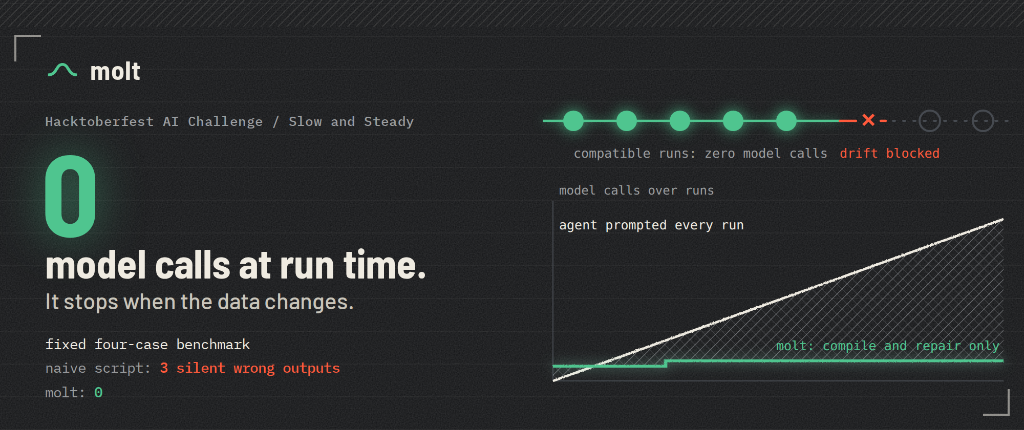
Here is the number that matters. I ran a four-case drift benchmark against a naive positional cleanup script—the kind everybody writes at 11pm and then forgets about. The script produced three silently wrong outputs. Molt produced zero: it processed the clean files and refused the drifted ones before a single bad row reached disk.
Steady-state execution takes about 16 milliseconds and makes zero model calls.
The model ran once, at the beginning, and hasn't been needed since. That is the entire point.
// From evidence/benchmark.json:
{
  "naive_positional_script_baseline": {
    "case_count": 4,
    "silent_wrong_outputs": 3,
    "drift_cases_accepted_without_validation": 2
  },
  "molt_drift_measurement": {
    "case_count": 4,
    "silent_wrong_outputs": 0,
    "blocked_drift_cases": 2,
    "runtime_model_calls": 0,
    "mean_latency_ms": 3.968
  }
}
What I Built: The Chore
Every month the same expense export lands in the same folder with the same four problems: whitespace on merchant names, three different date formats, amounts formatted as "$1,240.00" strings, and a category column that uses Food, food, and F&B interchangeably.
Twenty minutes of repetitive manual drudgery.
The obvious 2026 fix is to pipe the file through an LLM. I didn't want to, for three reasons:
- Per-file cost: It costs money on every run, forever.
- Non-deterministic: The same file can produce different outputs twice.
- Quiet failure: A model that mis-parses one date out of four hundred hands you a clean-looking CSV with a wrong number in it, and you only find out at quarter close.
So I inverted it: use the model as a compiler, not a runtime.
Video
Compile Once, Run Forever
Molt splits the job into two phases that never touch each other:
-
Phase one (once): A local Gemma model (
gemma3:4bvia Ollama) looks at a masked schema profile—column names and inferred types, never a single raw row—and emits a JSON recipe constrained to a closed operation allowlist:trim,parse_date,parse_decimal,map_values,split_column,select_columns,dedupe. It cannot emit Python. It cannot emit shell. If it proposes an op that isn't on the list, the recipe is rejected before anything runs. -
The Verifier Gate: That recipe then has to survive an independent verifier—golden fixtures written by hand, row-count invariants, null-injection checks, and an idempotence test (
apply(apply(x)) == apply(x))—and then it has to survive an explicit human approval click. - Phase two (forever): Approved recipes execute in pure Python. No model, no network, no tokens, no variance. Same input, same output, every time.
MOLT: COMPILE ONCE, RUN FOREVER
 [ PHASE 1: COMPILE ONCE ]                                      [ VERIFICATION & APPROVAL GATE ]
 -------------------------                                      --------------------------------
  Raw CSV Export (in/)                                            Candidate Recipe v1 (JSON)
           │                                                                 │
           ▼                                                                 ▼
 ┌──────────────────────┐   Masked Profile (Headers/Dtypes)    ┌────────────────────────────────────┐
 │  CSV Profiler        │ ───────────────────────────────────▶ │  Independent Verifier Gate         │
 │  (molt/application)  │  *ZERO raw cell rows or PII*         │  • Closed 9-Op Allowlist Check     │
 └──────────────────────┘                                      │  • Golden Input/Output Fixtures    │
                                                               │  • Row-Count & Null Invariants     │
 ┌──────────────────────┐                                      │  • Idempotence: f(f(x)) == f(x)    │
 │  Local Gemma 3:4b    │ ───────────────────────────────────▶ └─────────────────┬──────────────────┘
 │  (Ollama via HTTP)   │  Constrained JSON Recipe DSL                           │
 └──────────────────────┘  *Cannot emit Python or shell*                         ▼ (Pass: 6/6)
                                                               ┌────────────────────────────────────┐
                                                               │  Explicit Human Approval           │
                                                               │  [Accept & Activate Recipe v1]     │
                                                               └─────────────────┬──────────────────┘
                                                                                 │
 ════════════════════════════════════════════════════════════════════════════════╪════════════════════
                                                                                 │
 [ PHASE 2: RUN FOREVER (DETERMINISTIC STEADY STATE) ]                           ▼
 -----------------------------------------------------                 Active Recipe v1 Store
  New Incoming File (in/)                                                        │
           │                                                                     │
           ▼                                                                     │
 ┌──────────────────────────────────────────┐                                    │
 │  Contract Drift Check (16ms)             │ ◀──────────────────────────────────┘
 │  • Required columns match?               │
 └─────────────────────┬────────────────────┘
                       │
         ┌─────────────┴─────────────┐
         │                           │
  [ Compatible: PASS ]        [ Drift Detected: FAIL ]
         │                           │
         ▼                           ▼
 ┌───────────────────────────┐ ┌───────────────────────────┐
 │ Pure Python Engine        │ │ Quarantine & Block (16ms) │
 │ (molt/core.py)            │ │ • Moved to quarantine/    │
 │ • Reuses approved recipe  │ │ • SHA-256 Fingerprinted   │
 │ • ~16ms execution latency │ │ • Audit bead turns RED    │
 │ • 0 RUNTIME MODEL CALLS   │ └─────────────┬─────────────┘
 └─────────────┬─────────────┘               │
               │                             │
 ┌─────────────▼─────────────┐               │ [ OUT-OF-BAND REPAIR FLOW ]
 │ Temporal Worker Checkpoint│               ▼
 │ • Durable state barrier   │ ┌────────────────────────────────────────────────────────┐
 │ • Crash replay resilience │ │ Mastra Repair Sidecar (:4112 / Groq openai/gpt-oss)    │
 └─────────────┬─────────────┘ │ • Out-of-band TypeScript agent receives masked diff    │
               │               │ • Proposes candidate Recipe v2 (stored as INACTIVE)   │
 ┌─────────────▼─────────────┐ └────────────────────────────┬───────────────────────────┘
 │ Atomic Write to done/     │                              │
 │ • Zero duplicate rows     │                              ▼
 │ • Graph: +1 Call Avoided  │ ┌────────────────────────────────────────────────────────┐
 └───────────────────────────┘ │ Verifier Regression (6/6) ──▶ Human Accepts Recipe v2 │
                               └────────────────────────────────────────────────────────┘

 ═════════════════════════════════════════════════════════════════════════════════════════════════════
 [ CROSS-CUTTING PRIVACY & OBSERVABILITY BOUNDARY ]
 ──────────────────────────────────────────────────
  ┌──────────────────────────────────────────────┐  ┌───────────────────────────────────────────────┐
  │ Sentry 9-Stage Agent Tracing                 │  │ TabPFN Local CPU Anomaly Scorer               │
  │ • 9 Spans: profile ──▶ verify ──▶ execute    │  │ • 1,500 Synthetic Expense Holdout Rows        │
  │ • Strict Allowlist: _SAFE_ATTRIBUTE_KEYS     │  │ • 94.55% Precision / 72.22% Recall            │
  │ • Scrub Hook: send_default_pii=False         │  │ • Strictly Advisory: Never Alters Source Bytes│
  │ • Zero raw rows or secrets sent to APM       │  │ • Local CPU only (telemetry_enabled: false)   │
  └──────────────────────────────────────────────┘  └───────────────────────────────────────────────┘
*Figure 1: Raw data stays inside the local deterministic runtime. Only masked metadata ever reaches a model.*

---
The Lazy Payoff
Drop a file in in/. Molt fingerprints its schema, matches the approved recipe, runs it, writes the result atomically to done/, and logs the run.
You weren't there. You don't need to have been there.
That's the sloth version of automation: expend energy once, deliberately, on the part that actually needs thinking, and then coast on near-zero energy indefinitely. The counter on the dashboard that reads model calls avoided is really a counter of mornings I didn't spend babysitting a data script.

Figure 2: Run beads, the calls-avoided ledger, the seven-stage lifecycle stepper, and the active recipe under review.
When the Data Changes: The Complete Drift & Repair Flow
Deterministic automation has one classic failure mode: the vendor changes the export, your script keeps running, and it silently produces garbage. This is the exact problem Molt was built to solve.
Here is the exact step-by-step visual lifecycle of what happens when data drifts:
1. Drift Detected, Run Blocked in 16ms
A file arrived missing the notes column. Molt did not guess. It did not impute. It did not ask a model to invent a value. A pure-Python contract check caught it in 16ms, moved the file to quarantine/ with a SHA-256 fingerprint, and turned the run bead permanently red.

Figure 3: Run 2 tripped REQUIRED_COLUMN_MISSING. The timeline highlights the red audit bead, the status panel details the error, and the out-of-band "Suggest Mastra repair" button is revealed.
The evidence diff page shows what was expected, what arrived, and the exact contract rule that fired—structural metadata only, zero raw financial values rendered:

Figure 4: The Safe Evidence Diff report for the blocked run. Displays observed headers vs. required contract, audit decision trace, and approved recipe limits.
2. Mastra Agent Proposes, Regression Tests Verify
Repair happens out of band, which is the most critical design decision in the project:
- The operator clicks
[Suggest Mastra repair]. - A Mastra agent runs as an isolated TypeScript service on its own port (
mastra-repair/on port 4112). - It receives the active recipe, the masked profile, and the structural error—zero customer PII or raw CSV rows.
- Powered by Groq (
openai/gpt-oss-120b), Mastra proposes a candidate recipe removing the obsoletenotesrequirement while preserving every formatting rule. - The candidate is stored as an inactive draft, advancing the lifecycle stepper:
1. Drift blocked->2. Ask Mastra->3. Candidate stored.

Figure 5: Mastra proposed a repair. The candidate is stored separately and remains completely inactive until independent regression tests pass and a human explicitly approves.
- The operator clicks
[Run repair tests]. Molt ignores the agent's opinion of its own work and executes the full regression suite: 6/6 checks passed.
3. Human Operator Reviews & Accepts the Repair
Molt never auto-promotes an unreviewed candidate. The operator reviews the four-line JSON diff in the dashboard:
[Candidate Recipe v2 Review]
- Required columns: ["date", "merchant", "amount", "category", "notes"]
+ Required columns: ["date", "merchant", "amount", "category"]
Status: VERIFIED (6/6 checks passed). Waiting for human acceptance.
The operator clicks [Accept repair]. The candidate is promoted to Recipe v2 (Active).

Figure 6: The repair is activated. The banner confirms: "APPROVED: Repair was activated. New runs now process with the repaired recipe."
4. Quarantined File Re-executes Green (Zero Model Calls)
With Recipe v2 active, the quarantined file re-runs deterministically:

Figure 7: Run 5 succeeds under Recipe v2. Six rows written atomically, latency ~16ms, and exactly 0 runtime model calls.
-
Timeline Update: Run 5 turns green (
PASS: SUCCEEDED). - Execution Metrics: 6 rows processed, latency 16ms, 0 runtime LLM calls.
- Calls Avoided Chart: The graph updates in real time, recording that steady-state production remains completely free of repeated model inference.
An LLM participated in fixing the pipeline. An LLM never touched the data.
How I Built It: Where the Local Model Actually Failed
I tested gemma3:4b on a difficulty ladder, five trials per rung, because "it worked on my demo" is not engineering evidence.
| Task Difficulty | First Request Pass Rate | With Configured Retries | Verification Result |
|---|---|---|---|
| Trim merchant text | 5/5 | 5/5 | Verified & Passed |
| Trim + parse dates | 4/5 | 5/5 | Verified & Passed |
| Trim + dates + decimals | 3/5 | 4/5 | Verified & Passed |
| Full 6-operation task | 0/5 | 0/5 | Blocked by Verifier |
Zero out of five. On the full task—renames, regex split, date normalisation, currency parsing, category mapping, dedupe—a 4B model running on a laptop simply could not hold all six rules in context at once.
The failure mode is the one that should frighten you: in one run, Gemma's natural-language summary confidently stated that it had parsed the amount column. Its actual executable JSON omitted the decimal transform entirely. The model told me it did something it had not done.
In an ungated agent pipeline, that recipe ships and your amounts remain text strings. In Molt, the verifier rejected it, and not one invalid recipe ever reached production across the whole ladder. The architecture absorbed the model's weakness instead of inheriting it.
// From evidence/gemma-rung3-rejected-candidate.json:
{
  "recipe": {
    "name": "Trim, Normalize Date, Parse Decimal",
    "description": "Trims whitespace from merchant, normalizes date to YYYY-MM-DD, and parses amount to two decimal places.",
    "operations": [
      {
        "type": "trim",
        "columns": [
          "merchant"
        ]
      }
    ]
  },
  "rung": 3,
  "verification": {
    "status": "FAIL",
    "failed_checks": 1,
    "failed_check_codes": [
      "golden_output"
    ]
  }
}
Look at the operations array: it contains ONLY trim. The model claimed it parsed date and amount in its natural-language description, but completely omitted those operations from the executable JSON. Molt's verifier caught the discrepancy immediately and failed the golden check before anything could execute.
That's the result I'm proudest of, and it only exists because I assumed from line one that the model would lie to me.
Evidence: Full evaluation evidence · Rejected candidate
But Is the Verifier Any Good? Mutation Testing
A verifier that never catches anything is just ceremony. So I mutated 20 known-good recipes on purpose—inverted dedupe keys, dropped transforms, unmapped categories—and measured what survived.
The initial suite caught 18 of 20.
The two survivors were real gaps: an unmapped category policy and a dedupe key edge case. I wrote two targeted fixtures, re-ran the identical 20 mutations, and got 20/20 (100% catch rate), with the valid recipe still passing 11/11 checks cleanly.
// From evidence/verifier-catch-rate-after.json:
{
  "before_summary": {
    "total": 20,
    "caught": 18,
    "missed": 2,
    "misses": [
      "dedupe_wrong_column",
      "preserve_unknown_policy"
    ],
    "catch_rate": 0.90
  },
  "after_summary": {
    "total": 20,
    "caught": 20,
    "missed": 0,
    "catch_rate": 1.00
  },
  "correct_recipe": {
    "verification_status": "PASS",
    "checks_passed": "11/11",
    "checks_failed": 0
  }
}
Evidence: Mutation test evidence
Why Open Innovation Mattered Here
This project is only possible with open weights and open frameworks, and not for ideological reasons:
- The data can't leave: Expense lines, payroll, invoice detail—these don't get posted to a third-party cloud API because a blog post said agents are cool. Gemma runs locally with zero network egress. The privacy boundary isn't a policy promise in a Terms of Service; it's the physical fact that the process makes no network calls.
- I could measure the model's limits: Running locally and unmetered, I ran the ladder 20+ times, watched it fail, and designed the verifier around the observed failures. With a metered closed API I'd have run it three times, seen it mostly work, and shipped the silent-corruption bug.
- The artifact is readable: An open model compiling to declarative JSON gives me something I can diff, review, commit to Git, and regression-test. A closed agent gives me a vibe and an invoice.
- It's swappable: Gemma is a dependency, not a foundation. The allowlist and the verifier are mine. A better 4B model next month is a single config change, and the fact that it's a config change is itself the argument.
- Marginal cost is genuinely zero: The recurring chore has no recurring bill.
What Molt Can't Do (Explicit Limitations)
Being straight about this, because the post would be dishonest otherwise:
- Verification is evidence, not mathematical proof: My fixtures cover the input classes I imagined; a sufficiently novel or malicious file can still slip through a passing suite.
- The op allowlist is deliberately narrow: Anything outside those nine operations needs new code, not a new prompt.
- A 4B local model cannot compile a six-rule recipe in one shot: Complex chores need either a larger local model (e.g. 14B/32B) or decomposition into staged sub-recipes.
- TabPFN is strictly advisory: Evaluated on synthetic data, it flags statistical outliers but has no authority to alter records or block execution.
- Molt is not autonomous by design: A human promotes every recipe version. That is a deliberate ceiling on how lazy it will ever let you be.
Demo: Try It in 30 Seconds
No API key, no Ollama install, and no network connection required.
1. Instant Offline Demo
python -m molt demo --offline --approve
Four benchmark cases: two clean batches processed, two drifted batches halted, zero execution model calls.
2. Live Local Dashboard
python -m molt --state-dir workspace serve --host 127.0.0.1 --port 8765
Open http://127.0.0.1:8765/ in your browser.
Figure 8: Responsive bento layout check at 390px width with 0px horizontal overflow.
Code: Under the Hood
Code:



Compile once. Verify against truth. Reuse forever without repeated inference
🎬 Watch Digital Video (MP4) • ⚡ View Animated Explainer (GIF)
What is Molt?
Every month the same expense export lands with the same problems: whitespace on merchant names, three different date formats, amounts formatted as "$1,240.00" strings, and inconsistent categories.
Piping recurring CSV files through an LLM is expensive, non-deterministic, and prone to silent data corruption. Molt inverts the pattern: use the model as an offline compiler, never a production runtime.
-
Phase 1 (Compile Once): A local Gemma model (
gemma3:4bvia Ollama) inspects a masked schema profile (column names and types only, zero raw cell rows) and emits a recipe constrained to a closed 9-operation allowlist. -
The Verifier Gate: Independent golden fixtures, null-injection checks, row-count invariants, and idempotence tests (
apply(apply(x)) == apply(x)) validate the candidate before human approval. - Phase 2 (Run Forever): Approved recipes execute in…
The contract gate is the heart of the safety model, and it is forty lines of boring Python rather than anything clever:
def check_contract(recipe: dict[str, Any], headers: list[str]) -> None:
    required = recipe["input_contract"]["required_columns"]
    missing = [c for c in required if c not in headers]
    if missing:
        raise MoltError(
            "REQUIRED_COLUMN_MISSING",
            f"Missing required column(s): {', '.join(missing)}.",
            details={"missing": missing, "expected": required, "observed": headers},
        )
    if recipe["input_contract"].get("allow_extra_columns") is False:
        extras = [c for c in headers if c not in required]
        if extras:
            raise MoltError(
                "INPUT_TYPE_MISMATCH",
                f"Unexpected column(s): {', '.join(extras)}.",
            )
Around it:
-
molt/core.py: The deterministic execution engine, checkpoint ledger, and atomic writes. -
molt/application.py: Lifecycle state machine, verification gates, and human approval boundaries. -
molt/ollama.py: Constrained local Gemma/Ollama recipe compilation client. -
molt/temporal.py: Durable Temporal workflow definitions and activity worker. -
mastra-repair/: Isolated TypeScript microservice for out-of-band repair proposals. -
molt/web/: Obsidian graphite bento dashboard with zero external CDN dependencies. -
tests/: 79 Python unit/integration tests and 9 Node.js dashboard/diff tests.
Three Integrations With Full In-Post JSON Evidence
Rather than asking you to blindly trust marketing claims, here is the exact machine-verified evidence for our partner integrations:
1. Temporal: Crash Recovery & Durable Checkpointing
Steady-state execution runs inside a durable Temporal workflow. We injected process kills mid-flight (MOLT_CRASH_AT=1 killing both worker and server). Upon restart, Temporal picked up from step 1's saved checkpoint without duplicate writes and without making any model calls:
// From evidence/temporal-crash-recovery.json:
{
  "status": "COMPLETE",
  "workflow": {
    "result_status": "SUCCEEDED",
    "temporal_outcome": "completed",
    "llm_calls": 0,
    "rows_read": 4,
    "rows_written": 3
  },
  "failure_injection": {
    "mode": "MOLT_CRASH_AT",
    "after_step": 1,
    "activity_attempts": 2,
    "checkpoint_created": true,
    "checkpoint_resumed": true
  },
  "claim_boundary": "Real local Temporal server and worker workflow; one injected activity failure and idempotent retry."
}
2. TabPFN: Local Advisory Anomaly Detection
Evaluated locally on CPU across 1,500 synthetic expense rows (1,200 training rows, 300 held-out test rows). It flags statistical schema spikes without modifying a single byte of source data:
// From evidence/tabpfn-accuracy.json:
{
  "task": "supervised_binary_classification",
  "dataset": { "rows": 1500, "train_rows": 1200, "held_out_rows": 300 },
  "holdout_metrics": {
    "confusion_matrix": {
      "true_positives": 52,
      "false_positives": 3,
      "true_negatives": 225,
      "false_negatives": 20
    },
    "precision": 0.9455,
    "recall": 0.7222,
    "accuracy": 0.9233
  },
  "source_rows_changed": 0,
  "advisory_only": true
}
Why is 72% recall acceptable? Because TabPFN is strictly advisory and non-blocking—it is an extra signal for operator triage, while the deterministic Python contract gate is what actually guarantees zero corrupt rows reach disk.
3. Sentry: 9-Stage Distributed Tracing & Strict Redaction Allowlist
Molt instruments all nine workflow lifecycle stages in molt/application.py using an allowlist-based scrub boundary in molt/telemetry.py:
The 9 Lifecycle Tracing Spans:
1. automation.profile_csv        (profiles header names and inferred dtypes)
2. tabpfn.score_rows             (computes advisory outlier probabilities)
3. recipe.validate_operations    (enforces closed 9-op allowlist)
4. recipe.compile_gemma          (local Ollama compiler envelope check)
5. recipe.verify_examples        (runs golden fixture regression tests)
6. recipe.approve_version        (records explicit operator promotion)
7. repair.propose                (dispatches masked schema to Mastra sidecar)
8. automation.check_drift        (pure Python contract check in 16ms)
9. automation.execute_approved_recipe (deterministic Python transform)
The Redaction Proof (Why It Is Safe to Upload): To guarantee that confidential payroll data, invoices, customer PII, or internal file paths never leave your infrastructure, molt/telemetry.py enforces a strict two-tier scrub boundary:
- Strict Key Allowlist: Attributes are dropped by default unless explicitly included in the safe set:
# From molt/telemetry.py:
_SAFE_ATTRIBUTE_KEYS = {
    "attempt", "checks_passed", "checks_total", "column_count",
    "input_bytes", "input_rows", "model_calls", "output_rows", "status"
}
_SENSITIVE_KEY_PARTS = (
    "content", "csv", "file", "path", "prompt", "response", "row", "secret", "token", "value"
)
-
Payload Scrub Hook: The Sentry SDK initializes with
send_default_pii=Falseand hooksbefore_sendandbefore_send_transactionto sanitize payloads before transmission:
# Verified in tests/test_telemetry.py:
scrubbed = before_send({
    "message": "raw",
    "request": {"url": "https://private/path"},
    "status": "ok",
    "count": 3,
    "data": {
        "prompt": "raw prompt",
        "input_rows": 4,
        "free_text": "raw csv cell value: $1,240.00"
    }
})
# Result verified by unit test:
assert scrubbed == {"status": "ok", "count": 3, "data": {"input_rows": 4}}


Verification Snapshot
Recorded October 25, 2026:
| Check | Result | Details |
|---|---|---|
| Python test suite | 79 PASSED, 20 subtests | Full core, app, and verifier suite |
| Dashboard & diff (Node) | 9 PASSED | Web UI lifecycle & diff integrity |
| Mastra TypeScript build | PASSED | Clean tsc --noEmit
|
| Gemma local smoke compile | PASSED | Passed all envelope, schema & profile gates |
| Mastra live repair | PASSED | 6/6 verifier checks passed |
| Temporal chaos recovery | PASSED | Checkpoint resume, no duplicate writes |
| TabPFN evaluation | PASSED | 94.55% precision, full matrix disclosed |
| Sentry redaction | PASSED | Strict allowlist verified |
| Offline submission check | PASSED | 0 model calls, clean execution + quarantine |
| Drift benchmark | PASSED | 0 silent errors vs. 3 naive script errors |
Machine-Readable Verification Evidence
Here is the exact verification check recorded from evidence/live-integration-check-2026-10-25.json:
{
  "checked_at": "2026-10-25",
  "privacy": "Aggregate-only evidence. Zero raw row payloads recorded.",
  "repository_checks": {
    "python_pytest": "79 passed, 20 subtests passed",
    "node_dashboard_and_diff": "9 passed",
    "typescript_build": "PASS",
    "offline_submission_check": "PASS",
    "benchmark": "PASS"
  },
  "gemma_ollama": {
    "status": "PASS",
    "model": "gemma3:4b",
    "live_model_calls": 1,
    "validation_gate": {
      "response_envelope": "PASS",
      "recipe_schema": "PASS",
      "profile_contract": "PASS"
    }
  },
  "mastra_groq": {
    "sidecar_health": "PASS",
    "provider_model": "groq/openai/gpt-oss-120b",
    "model_calls": 1,
    "molt_verification": "PASS",
    "verification_checks": "6/6",
    "human_approval": "gated"
  },
  "tabpfn": { "precision": 0.9455, "recall": 0.7222, "source_bytes_altered": 0 },
  "temporal": { "status": "PASS", "checkpoint_recovery": "idempotent", "model_calls": 0 }
}
Prize Categories
-
Best Use of Gemma: Local
gemma3:4bcompilation, constrained JSON schema output, a published failure ladder including an honest 0/5 result, and zero-call reuse thereafter. - Mastra Agent Sidecar: Out-of-band TypeScript repair agent with typed read-only tools and masked schema profiles, gated behind Molt’s own verifier and human approval.
-
Best Use of Temporal: Durable steady-state execution with injected crash recovery (
MOLT_CRASH_AT=1), checkpoint barriers, and idempotent replay. - Best Use of TabPFN: Local CPU anomaly advisory with a fully disclosed confusion matrix, non-commercial licensing boundaries, and zero data modification.
- Sentry: Nine-phase tracing with strict allowlist redaction stripping all row values and PII.
The point of Molt isn’t that the AI is right. On the hardest task I gave it, it was wrong five times out of five and told me it had succeeded.
The point is that it never gets the last word.


Top comments (0)