

{"id":378,"date":"2026-10-05T01:02:16","date_gmt":"2026-10-05T01:02:16","guid":{"rendered":"https://aiflowpm.com/wp-content/uploads/2026/10/what-is-scope-creep-in-agile-diagram.jpg","raw":"https://aiflowpm.com/wp-content/uploads/2026/10/what-is-scope-creep-in-agile-diagram.jpg"},"modified":"2026-10-05T01:02:16","modified_gmt":"2026-10-05T01:02:16","slug":"what-is-scope-creep-in-agile-workflow-diagram","status":"inherit","type":"attachment","link":"https://aiflowpm.com/what-is-scope-creep-in-agile-workflow-diagram/","title":{"raw":"What is Scope Creep in Agile? - Workflow Diagram","rendered":"What is Scope Creep in Agile? – Workflow Diagram"},"author":1,"featured_media":0,"comment_status":"","ping_status":"closed","template":"","meta":[],"permalink_template":"https://aiflowpm.com/?attachment_id=378","generated_slug":"what-is-scope-creep-in-agile-workflow-diagram","class_list":["post-378","attachment","type-attachment","status-inherit","hentry"],"description":{"raw":"","rendered":"
"},"caption":{"raw":"","rendered":""},"alt_text":"What is Scope Creep in Agile? - Architecture & Framework","media_type":"image","mime_type":"image/jpeg","media_details":{"width":1152,"height":928,"file":"2026/10/what-is-scope-creep-in-agile-diagram.jpg","filesize":771121,"sizes":{"medium":{"file":"what-is-scope-creep-in-agile-diagram-300x242.jpg","width":300,"height":242,"filesize":20659,"mime_type":"image/jpeg","source_url":"https://aiflowpm.com/wp-content/uploads/2026/10/what-is-scope-creep-in-agile-diagram-300x242.jpg"},"large":{"file":"what-is-scope-creep-in-agile-diagram-1024x825.jpg","width":1024,"height":825,"filesize":152253,"mime_type":"image/jpeg","source_url":"https://aiflowpm.com/wp-content/uploads/2026/10/what-is-scope-creep-in-agile-diagram-1024x825.jpg"},"thumbnail":{"file":"what-is-scope-creep-in-agile-diagram-150x150.jpg","width":150,"height":150,"filesize":8156,"mime_type":"image/jpeg","source_url":"https://aiflowpm.com/wp-content/uploads/2026/10/what-is-scope-creep-in-agile-diagram-150x150.jpg"},"medium_large":{"file":"what-is-scope-creep-in-agile-diagram-768x619.jpg","width":768,"height":619,"filesize":101428,"mime_type":"image/jpeg","source_url":"https://aiflowpm.com/wp-content/uploads/2026/10/what-is-scope-creep-in-agile-diagram-768x619.jpg"},"full":{"file":"what-is-scope-creep-in-agile-diagram.jpg","width":1152,"height":928,"mime_type":"image/jpeg","source_url":"https://aiflowpm.com/wp-content/uploads/2026/10/what-is-scope-creep-in-agile-diagram.jpg"}},"image_meta":{"aperture":"0","credit":"","camera":"","caption":"","created_timestamp":"0","copyright":"","focal_length":"0","iso":"0","shutter_speed":"0","title":"","orientation":"0","keywords":[],"alt":""}},"post":null,"source_url":"https://aiflowpm.com/wp-content/uploads/2026/10/what-is-scope-creep-in-agile-diagram.jpg","missing_image_sizes":[],"filename":"what-is-scope-creep-in-agile-diagram.jpg","filesize":771121,"exif_orientation":1,"image_output_format":null,"image_save_progressive":false,"image_quality":{"default":82,"sizes":[]},"_links":{"self":[{"href":"https://aiflowpm.com/wp-json/wp/v2/media/378","targetHints":{"allow":["GET","POST","PUT","PATCH","DELETE"]}}],"collection":[{"href":"https://aiflowpm.com/wp-json/wp/v2/media"}],"about":[{"href":"https://aiflowpm.com/wp-json/wp/v2/types/attachment"}],"author":[{"embeddable":true,"href":"https://aiflowpm.com/wp-json/wp/v2/users/1"}],"replies":[{"embeddable":true,"href":"https://aiflowpm.com/wp-json/wp/v2/comments?post=378"}],"wp:action-unfiltered-html":[{"href":"https://aiflowpm.com/wp-json/wp/v2/media/378"}],"wp:action-assign-author":[{"href":"https://aiflowpm.com/wp-json/wp/v2/media/378"}],"curies":[{"name":"wp","href":"https://api.w.org/{rel}","templated":true}]},"post_title":"How to Stop Agile Scope Creep Without Killing Innovation","post_content":"
Scope creep does not kill projects overnight. It starves them one "quick favor" at a time.
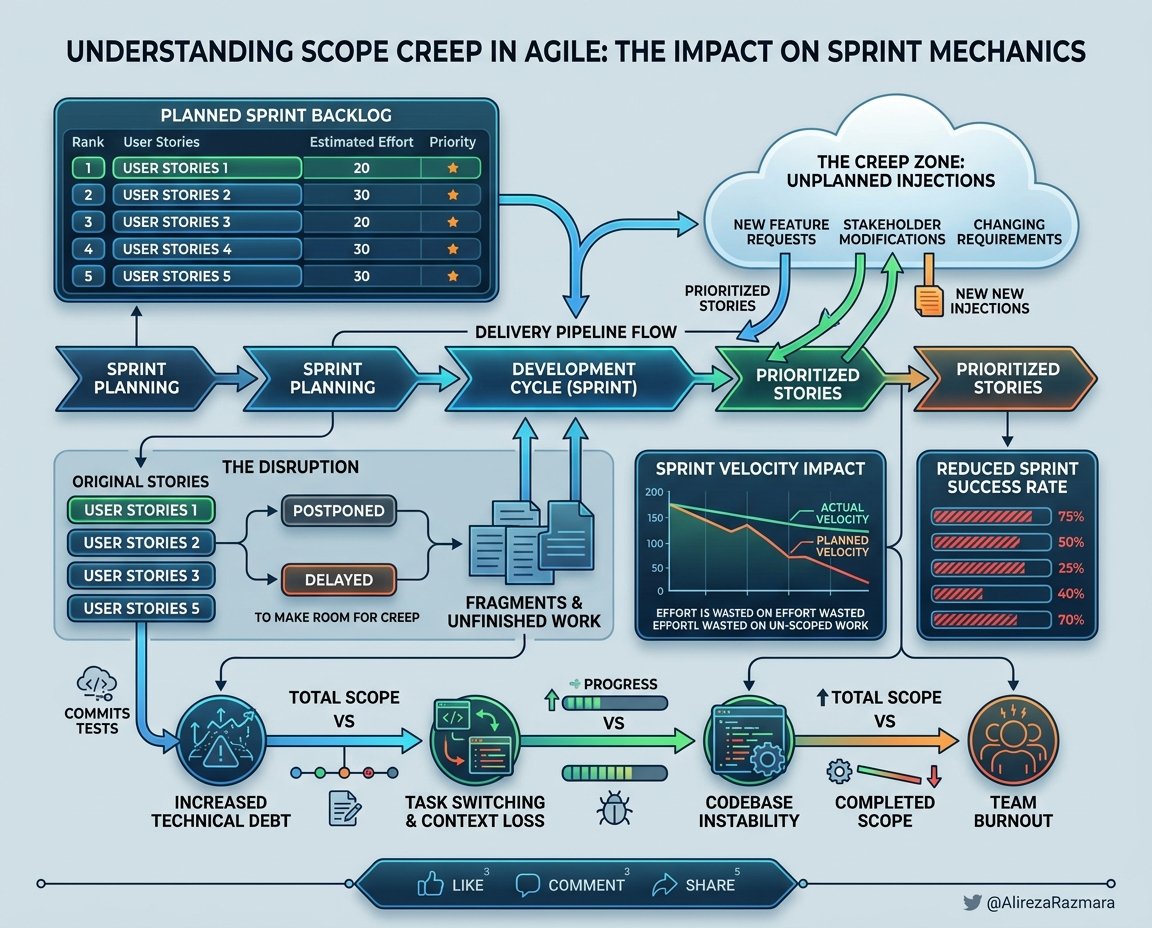
We have all been there. You are three days into a two-week sprint. A stakeholder messages a developer directly asking for a minor tweak. An unrefined edge case quietly slips into the active iteration. Suddenly, your team is drowning in unexpected complexity, the burndown chart flatlines, and a predictable delivery cycle feels like a pipe dream.
In Agile, we welcome changing requirements, even late in development. It is a core principle. But there is a massive difference between Agile adaptability and uncontrolled scope creep.
Adaptability is intentional, transparent, and value-driven. Scope creep is chaotic, hidden, and value-diluting.
Here is how elite Scrum Masters and Technical Leaders keep scope creep under control without closing the door on innovation or alienating their stakeholders.
What is Scope Creep in Agile?
Scope creep is the uncontrolled, undocumented expansion of project requirements without corresponding adjustments to time, budget, or resources. It happens when new features or tasks bypass the formal prioritization process and get squeezed into active development cycles.
Stakeholders rarely introduce scope creep out of malice. Usually, it stems from a genuine desire to improve the product, combined with a lack of understanding regarding how disruptive context switching is to an engineering team. A request that takes thirty seconds to type out in Slack might take three days of development, testing, and deployment to actually build.
To fix this, we have to stop treating scope management as building a wall around the development team. Instead, it is about creating radical transparency around the true cost of change.
Anchor to the Sprint Goal
How do you stop scope creep using the Sprint Goal? You use the Sprint Goal as an absolute filter for all incoming requests during an active iteration. If a new request does not directly support the current goal, it does not enter the active sprint.
Many teams treat the Sprint Goal as an administrative afterthought. They write a vague sentence that effectively translates to "finish the tickets in Jira." That is a massive missed opportunity.
A strong Sprint Goal is a specific, cohesive business objective. For example: "Enable users to securely reset their passwords via email."
When a stakeholder inevitably drops by mid-sprint and asks, "Can we also add a profile picture upload feature right now?" the Scrum Master or Product Owner has a clear, objective shield.
The response becomes: "That does not align with our current Sprint Goal of securing the password reset flow. We will put it in the backlog for the next iteration." This shifts the conversation from a subjective "no" to an objective alignment with agreed-upon business priorities.
Enforce the "Trade-Off" Rule (One In, One Out)
How do you handle emergency feature requests mid-sprint? You enforce the trade-off rule by requiring stakeholders to remove equivalent work to accommodate the new request.
Capacity is not elastic. You cannot pour ten gallons of water into a five-gallon bucket. Yet, this is exactly what happens when managers force new requirements into an already fully-loaded sprint.
If an executive introduces a genuinely critical "Must-Have" request on day four, the immediate response should not be panic, nor should it be immediate compliance. It should be a simple math equation.
Ask the stakeholder: "What are we taking out of the current sprint to make room for this?"

This tactic works wonders because it makes the cost of change hyper-transparent. It forces the requester to evaluate their "emergency" against the value of the work already in progress. If the new request is truly a high priority, they will gladly swap something else out. If it is just a passing whim, they will usually ask you to defer it to a later date.
Empower the Product Owner to Say "Not Now"
How should a Product Owner decline scope creep? A strong Product Owner defers scope creep by acknowledging the value of the idea and routing it to the Product Backlog for future refinement and prioritization.
An inexperienced Product Owner thinks their job is to please everyone. A veteran Product Owner knows their job is to maximize the value of the product, which often means protecting the team's focus.
You rarely need to give stakeholders an outright "No." A hard rejection often breeds resentment and political friction. Instead, master the art of the "Not Now."
When a new feature request comes in, try this script: "That is a really interesting idea and I see how it adds value. Let's get it added to the Product Backlog. We can refine the details together next week and prioritize it against the upcoming roadmap."
This response validates the stakeholder's contribution without derailing the current development cycle. It ensures that every new idea must compete for its place on the roadmap based on actual ROI, rather than who asked for it the loudest.
Sharpen Acceptance Criteria and Definition of Done (DoD)
How do Acceptance Criteria prevent scope creep? Clear Acceptance Criteria establish exact boundaries for a user story, preventing developers and stakeholders from accidentally expanding the work during execution.
Ambiguity is the breeding ground for scope creep. If a ticket is written loosely—for example, "Update the dashboard UI to look better"—you are practically begging for endless revisions.
The developer builds what they think looks good. The stakeholder reviews it and says, "Actually, can we add a filtering sidebar? And maybe a data export button?" Because the boundaries of the ticket were never defined, the work expands indefinitely.
To combat this, teams must rigorously enforce Acceptance Criteria before a ticket ever enters a sprint. Good criteria are boolean: they are either demonstrably true, or they are false.
- Poor Criteria: Make the export process faster.
- Strong Criteria: The user can click 'Export' and download a CSV of their transaction history within 3 seconds, capped at 10,000 rows.
Coupled with a robust Definition of Done (DoD) that clearly outlines testing, security, and deployment standards, sharp Acceptance Criteria ensure that a feature is declared finished when the original requirements are met. Any "nice-to-have" additions discovered during review become brand-new tickets.
The Hidden Cost of Context Switching
Why is scope creep so damaging to software engineering teams? It forces context switching, which destroys deep focus, introduces technical debt, and mathematically slows down total output.
When developers are pulled away from their planned work to handle a "quick favor," they do not just lose the thirty minutes it takes to write the code. They lose the time it takes to mentally offload their current complex task, orient themselves to the new problem, and eventually regain their focus on the original task.
Studies consistently show that shifting between complex cognitive tasks can eat up to 20% of a developer's productive capacity per shift. When scope creeps unchecked, you aren't just adding more work; you are actively degrading the team's ability to execute the work they already had.
By strictly managing scope, you are protecting the psychological safety and cognitive flow of your engineers. A team that operates with intense, unbroken focus will always out-deliver a team that is constantly reacting to the loudest voice in the room.
Open the Floor
Managing scope is not about being rigid. It is about demanding intentionality. Agile requires us to pivot when the market demands it, but we must pivot with our eyes wide open to the trade-offs involved.
How does your team handle high-priority surprise requests mid-sprint? Do you strictly enforce the swap rule, defer everything to the backlog, or absorb the pain? Drop your tactics below.
","post_slug":"stop-agile-scope-creep-tactics","category_id":9}Originally published at https://aiflowpm.com/stop-agile-scope-creep-tactics/


Top comments (0)