

I Built StudyBuddy AI for a Friend Who Was Tired of Turning Notes Into Study Material 📚🤖
This is my submission for the Hacktoberfest 2026 Weekend Challenge: Build for a Friend.
Build something with open-source AI at its core.
Instead of building another generic AI chatbot, I wanted to build something practical for a student.
So I built StudyBuddy AI — an AI-powered study assistant that turns raw study notes into a structured study pack with summaries, key takeaways, practice questions, answers, and explanations.
👋 The Problem
A friend of mine often has the same problem before exams:
They already have the notes.
But then comes the difficult part:
- What should I actually remember?
- What are the important points?
- What questions could be asked?
- Can I test myself?
- Do I really understand the topic?
Turning a large set of notes into useful revision material can take a lot of time.
I wanted to build something that could take those notes and immediately turn them into something that is actually useful for studying.
That's how StudyBuddy AI started.
🎓 What Is StudyBuddy AI?
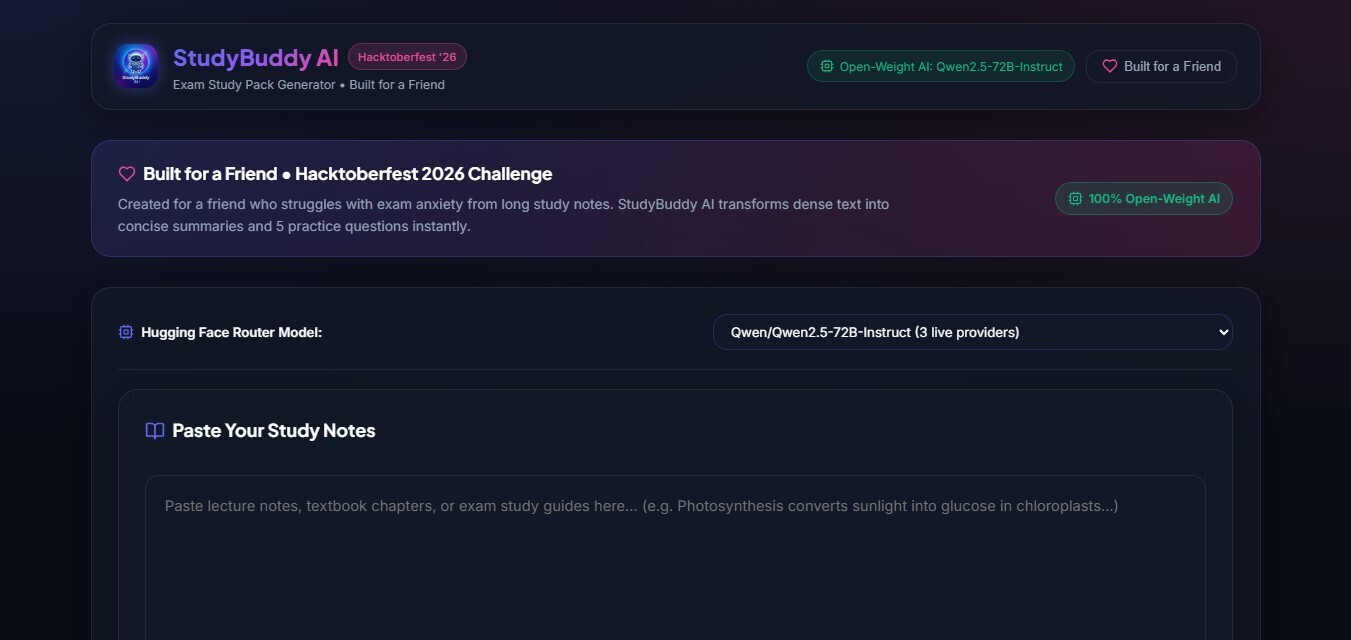
StudyBuddy AI takes a student's study notes and transforms them into a structured Study Pack.
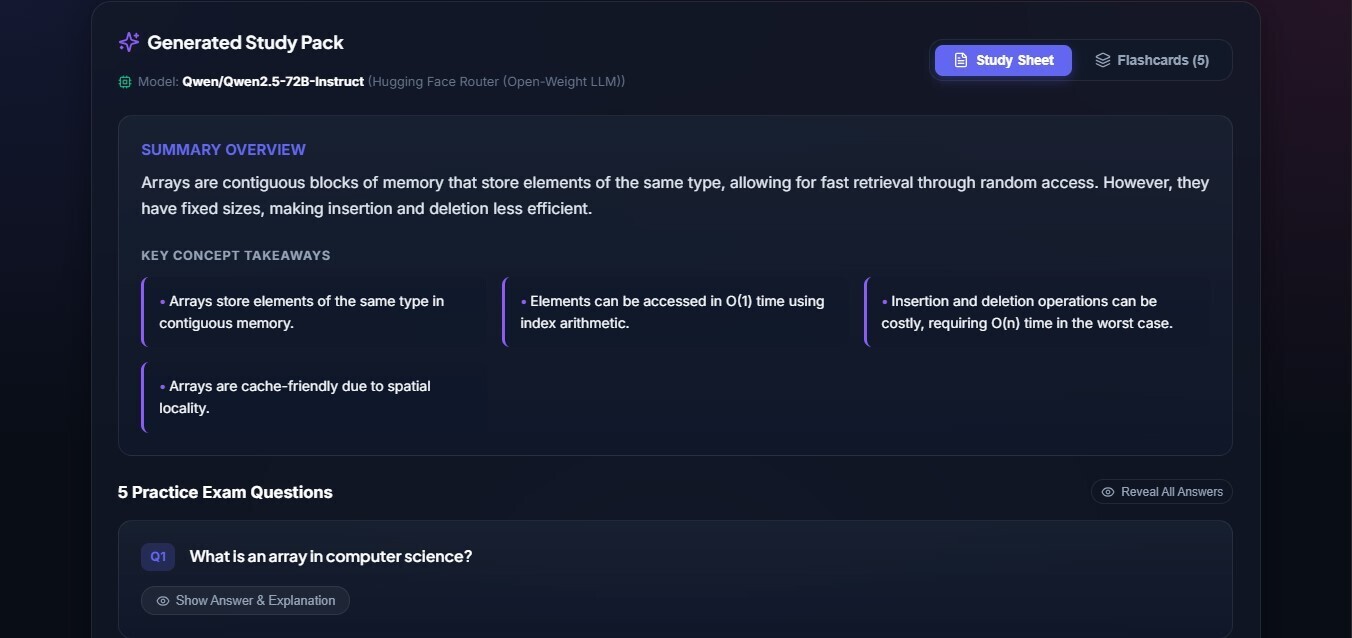
The student provides their notes, and the application generates:
- 📝 Summary
- 🔑 Key Takeaways
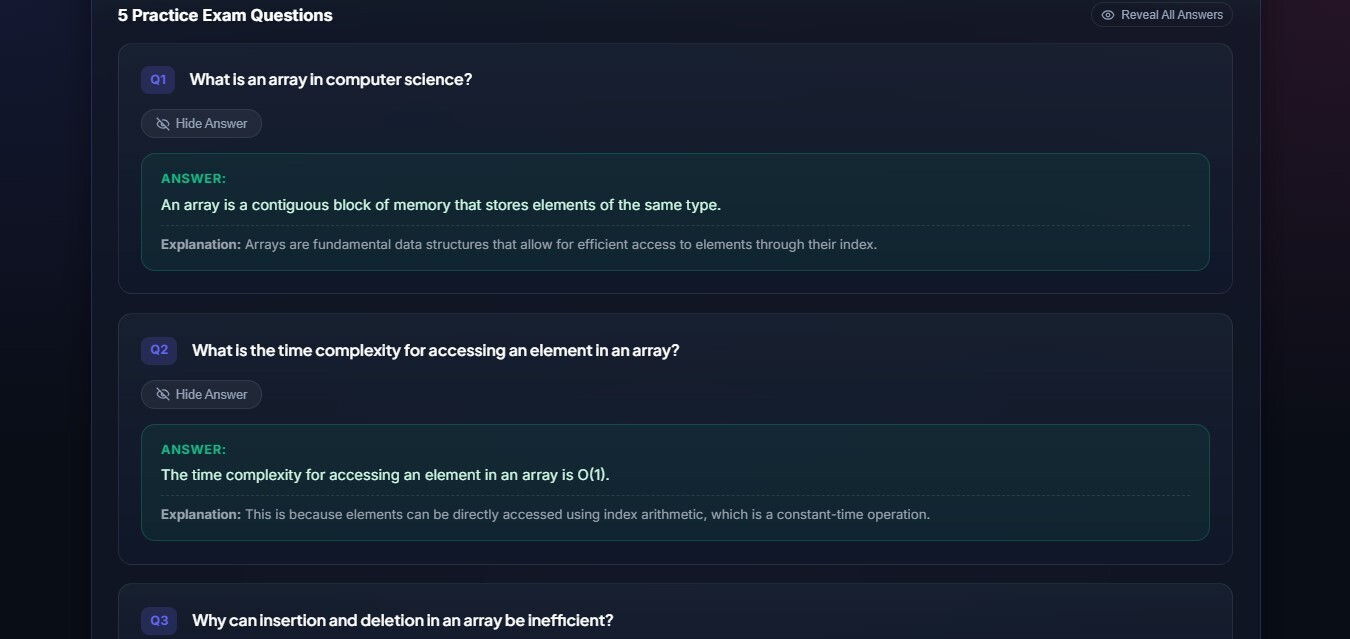
- ❓ Practice Questions
- ✅ Answers
- 💡 Explanations
The goal is simple:
Paste your notes → Generate a study pack → Revise → Test yourself
The demo shows the complete flow:
- Enter study notes
- Select an available AI model
- Generate the study pack
- Read the summary and key takeaways
- Practice with generated questions
- Reveal answers and explanations
🚀 Try the Project
GitHub Repository:
https://github.com/Jainil26/hacktoberfest-weekend-2026
🧠 How It Works
The architecture is intentionally simple.
text
Student
↓
React Frontend
↓
Express.js Backend
↓
Hugging Face Router
↓
Open-Weight AI Model
↓
Structured Study Pack
↓
React Interface
1. Student Input
The student pastes their study notes into the application.
2. Backend Processing
The React frontend sends the notes to the Express.js backend.
3. AI Processing
The backend creates a structured prompt based on the student's notes.
The prompt is then sent to the Hugging Face Router.
4. Model Generation
An available open-weight AI model processes the notes and generates:
Summary
Key takeaways
Practice questions
Answers
Explanations
5. Study Pack
The generated content is returned to the React application and displayed in an organized interface.
🤖 Model Selection
The default model used by StudyBuddy AI is:
Qwen/Qwen2.5-72B-Instruct
But I didn't want to hard-code the application around a single model.
StudyBuddy AI also includes a dynamic model selector.
It discovers compatible models currently available through Hugging Face's inference providers and allows the application to work with available models.
This is useful because model availability through hosted inference can change.
Instead of presenting users with models that may not currently work with the configured inference service, the application can discover compatible options dynamically.
💡 Why Open-Weight AI?
Open-weight AI was an important part of this project.
StudyBuddy AI uses open-weight models through Hugging Face inference providers.
This approach provides several interesting possibilities:
🔄 Flexibility
The application isn't conceptually locked to one model.
Compatible models can be swapped depending on availability and requirements.
💻 Deployment Options
When hardware allows, compatible open-weight models can potentially be deployed locally instead of relying entirely on hosted inference.
🛠️ Developer Control
Developers have more control over the model and deployment environment.
🧪 Experimentation
Open-weight models make it easier to experiment with different models and AI application architectures.
💰 Cost Flexibility
Developers can choose between hosted inference and self-hosted deployment depending on their requirements.
For StudyBuddy AI, this means the AI layer can evolve independently from the rest of the application.
🛠️ Tech Stack
Frontend
React 18
Vite
Vanilla CSS3
Lucide Icons
Canvas Confetti
Backend
Node.js
Express.js
CORS
Dotenv
AI
Hugging Face Router
Hugging Face Inference Providers
Qwen/Qwen2.5-72B-Instruct
📂 Project Structure
hacktoberfest-weekend-2026/
│
├── client/
│ ├── public/
│ │ └── logo.jpg
│ │
│ └── src/
│ ├── components/
│ │ ├── AboutModal.jsx
│ │ ├── FlashcardQuiz.jsx
│ │ ├── ModelSelector.jsx
│ │ ├── NoteInput.jsx
│ │ └── StudyPackView.jsx
│ │
│ ├── App.jsx
│ ├── App.css
│ └── main.jsx
│
├── server/
│ ├── aiService.js
│ ├── index.js
│ └── sampleNotes.js
│
├── .env.example
├── .gitignore
├── package.json
├── package-lock.json
├── README.md
└── ...
🧪 Example
Imagine a student has these notes:
TCP is a connection-oriented transport layer protocol.
It provides reliable and ordered delivery of data.
TCP uses acknowledgements, sequence numbers and retransmission
to ensure reliable communication between devices.
Instead of manually converting those notes into revision material, StudyBuddy AI can generate a structured study pack.
📌 Summary
A concise explanation of TCP and its purpose.
🔑 Key Takeaways
TCP operates at the transport layer.
TCP provides reliable data delivery.
TCP maintains ordered communication.
TCP uses acknowledgements and sequence numbers.
Lost data can be retransmitted.
❓ Practice Questions
The application generates questions based on the submitted study material.
✅ Answers & Explanations
Students can reveal the answers and explanations to check their understanding.
The idea is not simply to give the student an AI-generated summary.
It is to create a small revision + self-testing workflow from the material they already have.
🔐 Security
The Hugging Face API token is stored using environment variables.
Sensitive information should never be committed to the repository.
.env
API keys
Access tokens
Passwords
Private credentials
The .gitignore file is configured to exclude environment files and dependency directories.
🔮 What's Next?
There are several features I would like to add in future versions:
📄 PDF and document upload
🧠 Multiple study modes
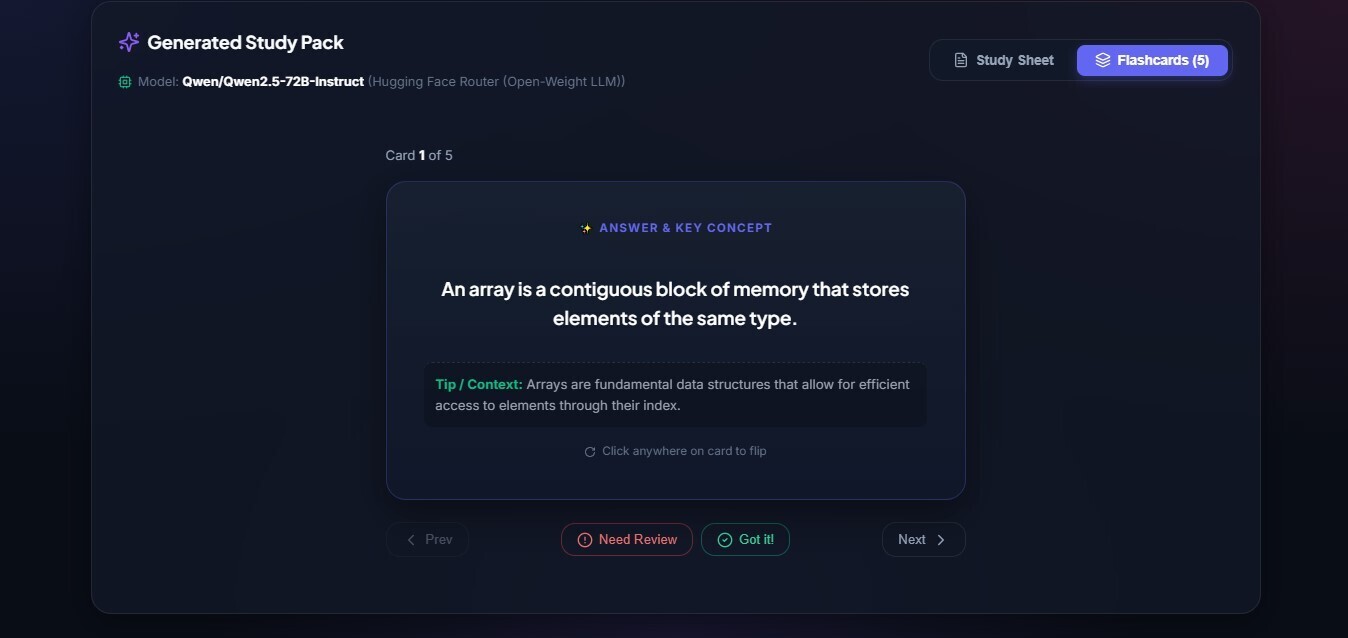
🗂️ Dedicated flashcard generation
🎚️ Difficulty selection
📖 Detailed topic explanations
💻 Local model support
🤖 More Hugging Face models
📊 Study history
📈 Progress tracking
🔁 Spaced-repetition support
The current version intentionally keeps the core workflow simple.
❤️ Why I Built It
One thing I like about building AI applications is that the best ideas don't always need to be huge.
Sometimes the problem is simple:
"I have my notes. I just need a better way to study them."
StudyBuddy AI is my attempt to solve exactly that.
It combines a normal full-stack web application with open-weight AI to create something that can actually be used during everyday studying.
🧑💻 What I Learned
Building StudyBuddy AI gave me hands-on experience with:
Integrating AI models into a full-stack application
Working with Hugging Face inference
Building structured prompts
Dynamically discovering available AI models
Connecting React with an Express backend
Handling environment variables securely
Designing an AI-powered user workflow
Thinking about model flexibility instead of hard-coding a single model
🎯 Hacktoberfest 2026
This project was built for the Hacktoberfest 2026 Weekend Challenge: Build for a Friend.
The challenge focuses on building something with open-source AI at its core that solves a real problem for a friend or someone you care about.
For me, that problem was studying.
Instead of building a complicated AI system just for the sake of using AI, I wanted to build a small application where the AI component directly contributes to solving the problem.
🙌 Feedback Welcome
I'd love to hear what you think about StudyBuddy AI.
If you are a student, what feature would make a tool like this more useful for your study workflow?
And if you're a developer, I'd especially love feedback on the architecture, AI integration, and model-selection approach.
Built with ❤️ and open-weight AI for Hacktoberfest 2026.


Top comments (0)