

The Distinction That Defines Scale
Every product organization, once it grows beyond a certain number of people, hits a critical scaling wall. This wall is the confusion between Value Streams and Product Domains. If you treat them as the same, your organizational structure is built on a fundamental illusion that limits your growth potential.
This isn’t an academic discussion; it’s an organizational architecture decision that determines whether a company scales to a billion-dollar valuation or collapses under its own technical debt.
As scale becomes inevitable, it comes with a cost. In the early stages, your product is simple. Your Value Stream (the customer outcome path) and your Product Domains (the reusable capabilities that enable it, could be as simple as “notifications”) are managed by the same team. By design, velocity is high.
The moment you introduce a new Value Stream which could be anything from a new product line, a new user type, to a new geographical market, the model instinctively breaks. The core capabilities (Domains) become shared resources.
If the team that owns the Notification Domain is incentivized by the first Value Stream’s KPI (e.g., App Open Rate), they will optimize notifications for that goal alone. When the second Value Stream needs a compliant, auditable notification log, they are blocked. They either wait forever or build their own version.
This organizational gridlock leads to:
- Duplicated Effort: Teams repeatedly building the same core capabilities.
- Conflicting KPIs: Optimization for one team’s goal sabotages another.
- Exponential Debt: The company accrues debt not just in code, but in organizational structure and lack of reuse.
When this happens, a compelling approach is to decouple and empower. The best product organizations design their teams to reflect this architectural duality explicitly. You need clear, sometimes opposing incentives to force the right strategic tradeoffs.
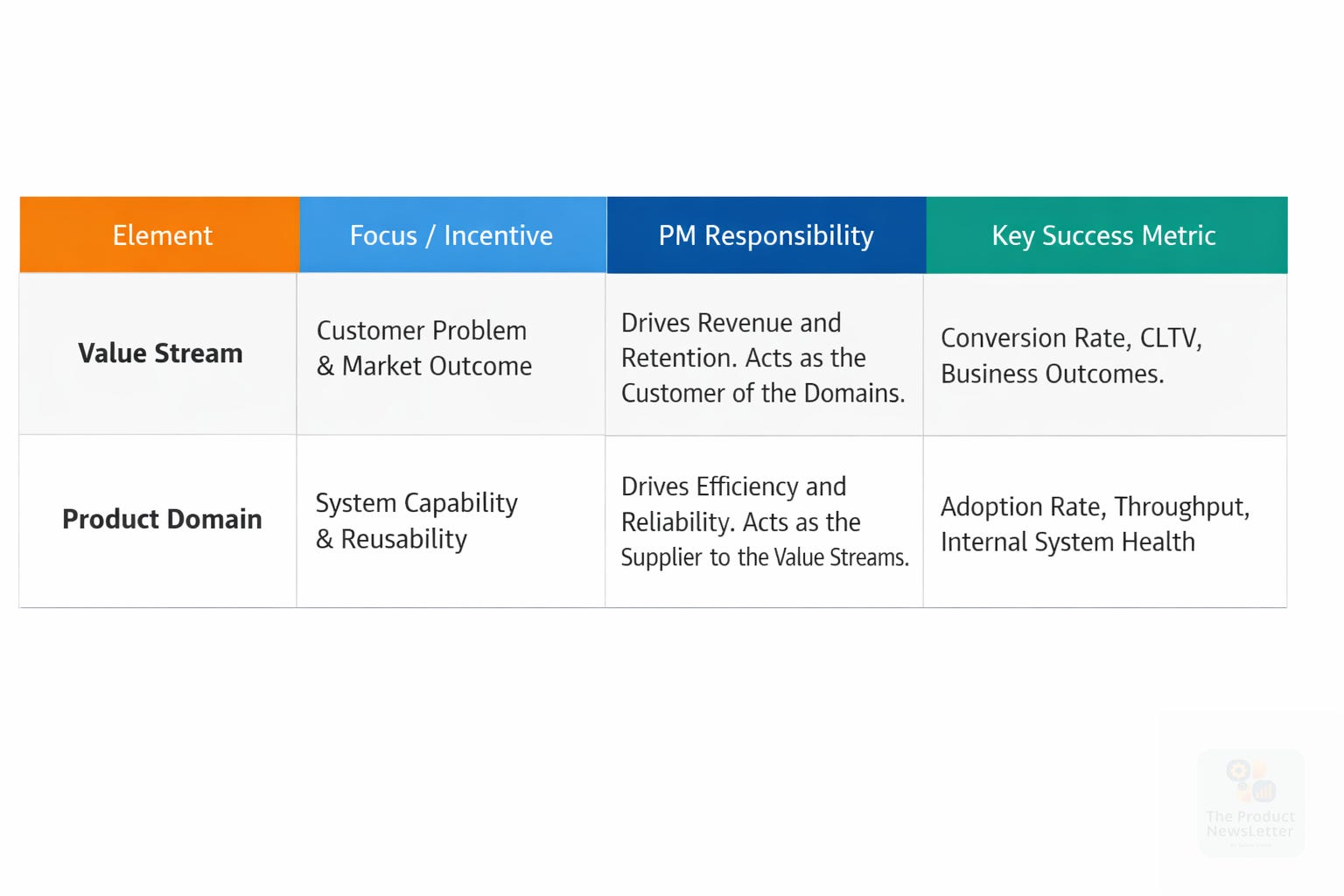
Important Strategic tradeoffs
The Mandate is that you must give explicit, separate ownership to both sides.
- Value Stream Leaders: Own the $R$ and $R$ (Revenue and Retention). They own the customer experience end-to-end and prioritize features that move the market.
- Product Domain Leaders (Platform PMs): Own the $R$ and $R$ (Reuse and Reliability). They own the architecture and ensure that capabilities like Payments or Identity are scalable and adopted across the entire product ecosystem.
In Summary
What I have been trying to say is orgs must demonstrate intentionality and prioritize that over inertia. Product Leadership is the intersection of Strategy, Org Design, and Systems Architecture.
This distinction between Domains vs. Value Streams is an irreversible, one-way door decision on how your company will scale. You can move fast on reversible features, but you must slow down and be deliberate on organizational design. Getting this structure wrong is organizational self-sabotage.
The best product leaders do not just manage a product; they craftily manage the system that builds the product.
Aligning your org chart to this Domains vs. Value Streams duality is the most crucial architectural choice you will ever make.


Top comments (0)