


What happened when millions of people suddenly couldn't access their emails, meetings and AI tools?
Imagine opening your laptop in the morning, trying to check your emails, but Outlook refuses to load.
You open Microsoft Teams to join a meeting. It doesn't work either. You try Copilot, but that's unavailable too.
For millions of people, this became reality during Microsoft's global outage in November 2026.
Some of Microsoft's most popular services, including Outlook, Teams, Microsoft 365 and Copilot, experienced major disruptions.
The outage affected users and businesses across different countries and lasted for more than 24 hours.
But what actually happened? Why did it take so long to fix? And how could one company's technical problem affect so many people?
Let's break it down.
1. What Happened?
On November 12, 2026, users started reporting problems with Microsoft's services.
People couldn't access their emails, join meetings or use some of their regular Microsoft applications.
The disruption affected services including:
- Outlook: Users faced problems accessing and sending emails.
- Microsoft Teams: Meetings and workplace communication were disrupted.
- Microsoft 365: Some productivity services became unavailable.
- Copilot: Users experienced problems accessing Microsoft's AI assistant.
This wasn't just a problem affecting one office or one country. Reports came from users across the world.
For businesses that depend on Microsoft every day, even a few hours without these services can create serious problems.

2. Why Did Microsoft's Services Stop Working?
This is probably the biggest question.
According to Microsoft's explanation, the incident was connected to an earlier network-capacity upgrade and a subsequent network change.
In simple words, Microsoft experienced a problem with the infrastructure responsible for keeping its services connected and running.
Think of Microsoft's cloud infrastructure like a huge highway.
Thousands of cars travel through it every second. Normally, traffic is distributed across multiple roads.
But imagine several major roads suddenly becoming unavailable.
The remaining roads would become overcrowded, causing traffic jams.
Something similar can happen in cloud infrastructure.
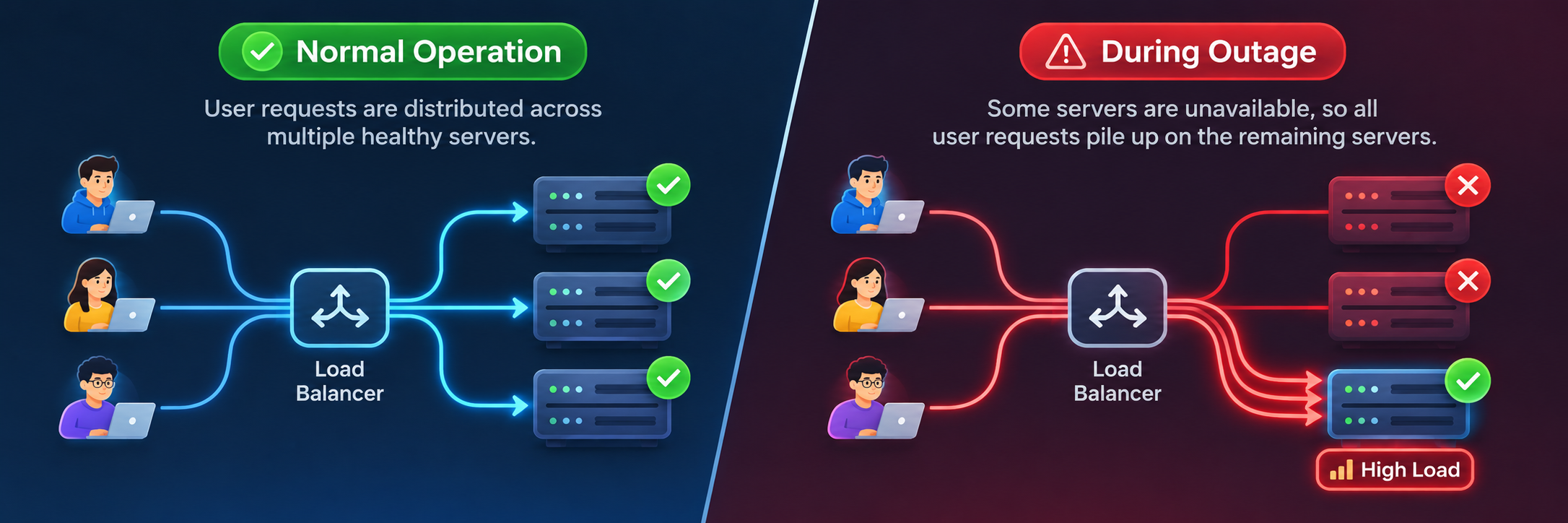
When servers become unavailable, the remaining servers may have to handle more requests than usual.
This can create additional problems and make the entire system harder to recover.
3. Why Did It Take More Than 24 Hours to Fix?
You might wonder: Microsoft has thousands of engineers and some of the world's largest data centres. Why couldn't they fix the problem immediately?
Because restoring a large cloud service isn't as simple as restarting your computer.
Engineers first need to identify the problem, understand which systems are affected and restore them without creating additional failures.
Even after servers start working again, millions of users may try to reconnect at the same time.
This puts additional pressure on the recovering infrastructure.
Microsoft's engineers worked on restoring services and stabilising the affected systems before confirming that services had been restored on November 14.

4. Was Microsoft Hacked?
Whenever a major technology company experiences an outage, people naturally wonder whether it was a cyberattack.
Was someone attacking Microsoft's servers?
Was it a DDoS attack?
Was there a security vulnerability?
Microsoft stated that there was no indication that the outage was caused by a cyberattack. It also ruled out AI agents as the cause.
Instead, the company pointed to a technical problem involving its network infrastructure.
This is an important distinction.
A service can go offline without anyone hacking it.
Sometimes, a software bug, configuration change or infrastructure failure is enough to disrupt an entire service.

5. Who Was Affected?
The impact went far beyond people unable to check their emails.
Businesses, government organisations and other institutions reported problems.
Some examples included:
- Airlines: Indian airlines, including IndiGo, Akasa Air and Air India, reported disruptions to email support services.
- Financial organisations: Some businesses had to use alternative communication methods to continue their work.
- Government services: Organisations in countries including Japan, Singapore and Australia reported operational disruptions.
- Healthcare: Some healthcare organisations experienced communication-related difficulties.
The incident showed how much modern organisations depend on cloud-based services.

6. What Can We Learn From This Outage?
There is one major lesson from this incident.
Never depend entirely on one service for everything.
Imagine your entire organisation uses Outlook for emails and Teams for communication. If both become unavailable, how will employees communicate?
Businesses should always have backup plans.
Some important steps include:
- Keep alternative communication methods available.
- Maintain independent backups of important data.
- Prepare an emergency response plan.
- Understand which third-party services your organisation depends on.
- Test recovery plans before an actual outage happens.
These practices aren't just for large companies. Even small businesses should think about them.

The Microsoft outage reminds us of something important: even the biggest technology companies aren't immune to failures.
We often assume that cloud services will always be available. We use them for our emails, meetings, documents and even everyday business operations.
But sometimes, one infrastructure problem can affect millions of people.
For cybersecurity professionals and IT teams, this incident is a reminder that security isn't only about preventing hackers.
It's also about keeping systems available, preparing for failures and making sure businesses can continue operating when something goes wrong.
Because a system isn't truly reliable just because it works every day. It's reliable when it can recover when things go wrong.
Sources and Further Reading:
- Microsoft official service incident updates.
- Reuters coverage of the global outage.
- Associated Press coverage of service restoration.
- WIRED analysis of cloud infrastructure dependency.


Top comments (0)