


In the fast-moving, high-stakes world of digital marketing, one truth remains absolute: your campaigns are only as strong as the data that fuels them.
Picture this: You have spent weeks crafting the perfect email campaign. The copy is persuasive, the design is sleek, the subject line is catchy, and the offer is irresistible. You hit "Send", expecting a flood of traffic and sales. Instead, you hear crickets. Worse, you check your analytics and see that a significant portion of your emails never even made it to the inbox.
What went wrong? The culprit usually isn’t your content or your product—it’s your data.
The number one reason emails fail to generate ROI is simple: dirty, outdated, or unverified email lists.
Email databases naturally decay by approximately 22% every year due to job changes, abandoned accounts, and human error. If you aren't proactively managing this decay, you are sabotaging your own success. This is where understanding how to verify & clean email lists becomes the ultimate superpower for any business that prioritises deliverability, sender reputation, and revenue.
In this guide, we will dive deep into why hygiene matters, the mechanics of verification, and how to achieve significant bounce rate reduction to keep your marketing machine running smoothly.
The Hidden Dangers of a "Dirty" Email List
Many marketers view list size as a vanity metric—the bigger, the better. However, sending emails to invalid or inactive addresses is a silent killer for your marketing efforts. When you skip email list cleaning, you aren't just wasting money on sent messages; you are actively damaging your reputation with Internet Service Providers (ISPs) like Gmail, Outlook, and Yahoo.
Here is the domino effect of a neglected list:
The Deliverability Death Spiral: ISPs assign every sender a "reputation score". If you consistently hit invalid emails, ISPs assume you are a spammer. This lowers your score, causing your legitimate emails to active subscribers to land in the Spam folder.
Wasted Marketing Budget: Most Email Service Providers (ESPs) charge based on subscriber count. Keeping 5,000 invalid emails on your list means you are literally paying to send messages into a black hole.
Skewed Analytics: You cannot accurately measure success if 20% of your audience never received the email. Cleaning your list gives you a true picture of your open and click-through rates (CTR).
To stop this, you must prioritise list hygiene. It is not optional; it is the foundation of modern email strategy.
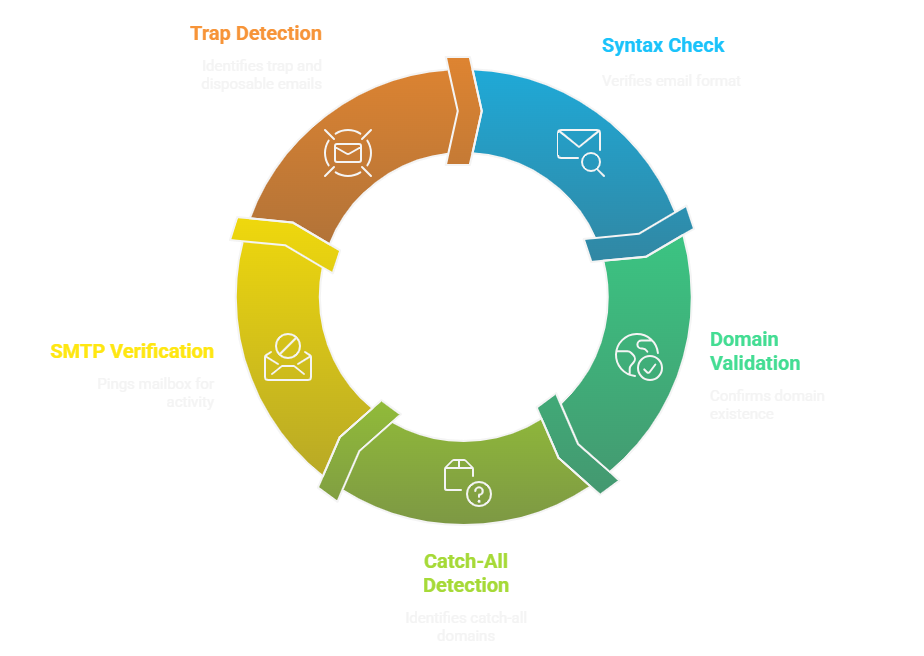
How Email Verification Works: A Look Under the Hood
You might be thinking, "Can't I just manually delete the bad emails?"
Unfortunately, no. Manual cleaning is impossible at scale and ineffective against hidden technical threats. This is where a professional email verification tool becomes essential. These automated solutions go far beyond checking for typos. They perform complex validation steps to ensure only safe, active emails remain on your list.
Here is a breakdown of what happens during the verification process:
1. Syntax and Formatting Checks
The first layer of defence is identifying human error. If a user types john.doe@gmal.com instead of john.doe@gmail.com or forgets the @ symbol entirely, the tool flags it immediately.
2. Domain and DNS Validation
Just because an email looks right doesn't mean it works. The tool checks the Domain Name System (DNS) records to ensure the domain is live and has a valid Mail Exchange (MX) record, which is required to receive messages.
3. Identifying "Catch-All" Domains
Some servers are configured to accept all emails sent to a domain, regardless of whether the specific username exists. These are risky because they can skew your metrics or eventually bounce. Verification tools categorise these so you can decide whether to quarantine or test them.
4. SMTP Verification (Mailbox Pinging)
This is the gold standard of email list cleaning. The tool initiates a handshake with the recipient's mail server, asking, "Does this specific user exist here?" The server responds with a "Yes" or "No", and the connection is closed before an actual email is sent. This confirms validity without disturbing the user.
5. Trap and Disposable Detection
Disposable Emails: Temporary addresses used by people who want your free ebook but not your newsletter. These hurt engagement and are removed instantly.
Spam Traps: These are decoy addresses set up by ISPs specifically to catch spammers. Hitting just one can get your domain blacklisted. Verification tools cross-reference known spam trap databases to protect you.
The Direct Link Between Cleaning and Bounce Rate Reduction
Your bounce rate—the percentage of emails that are rejected by mail servers—is the heartbeat of your deliverability health.
In the eyes of ISPs, a bounce rate above 2% is a red flag. If you consistently hover above this threshold, you are in the danger zone for blocking.
When you take the time to verify & clean email lists, the impact on bounce rate reduction is immediate and drastic. You can often lower your bounce rate by over 90% in a single scrub.
The "Positive Deliverability Loop":
You clean your list, removing hard bounces.
Your next campaign has a near-zero bounce rate.
ISPs see this and trust your domain more.
Your emails are prioritised for the Primary Inbox rather than the Promotions tab.
More subscribers see, open, and click your emails.
Your engagement metrics soar, further boosting your reputation.
The Unexpected SEO Benefits of Clean Lists
Most marketers treat email and SEO as separate silos, but they are deeply interconnected. While email list cleaning doesn't directly change your Google ranking, it supports the user signals that Google loves.
Increased Website Traffic: When your emails actually land in the inbox, more people click through to your content.
Better On-Page Metrics: Email subscribers are usually your most loyal audience. When they visit your site, they tend to stay longer, read more pages, and bounce less. These "user signals" tell search engines that your content is valuable.
Brand Authority: Consistent communication builds trust. When people trust your brand, they are more likely to search for your company name on Google ("Branded Search"), which is a massive ranking factor.
Best Practices: When and How to Clean
Hygiene isn't a "one-and-done" task; it is a lifestyle for your data. To maintain high deliverability, follow these frequency guidelines:
Active Senders (Weekly/Bi-weekly emails): Verify your list every 30–45 days.
Moderate Senders (monthly emails): Verify every 60–90 days.
Re-engagement Campaigns: If you are emailing a segment that hasn't heard from you in 6 months, you must clean that list before hitting send.
New Imports: Always verify a new list before merging it with your main database.
Pro Tips for Maintenance:
Implement Double Opt-In: Send a confirmation email to new subscribers. This ensures the email is valid and the user genuinely wants to be there.
The Sunset Policy: If a subscriber hasn't opened an email in 6–12 months, let them go. It is better to have a smaller, engaged list than a massive list of ghosts.
Real-Time Verification: Connect an API to your signup forms to block typos and fake emails the moment they are entered.
Conclusion
In 2025, you cannot afford to guess with your data. The difference between a successful campaign and a wasted budget often comes down to the quality of your contact list.
By making the effort to verify & clean email lists consistently, you are doing more than just deleting bad data. You are protecting your brand's reputation, maximising your marketing ROI, and ensuring that your message reaches the people who actually want to hear from you. Don't let invalid emails sabotage your hard work. Leverage a trusted solution like Bouncify to make list hygiene a priority, and watch your deliverability soar.


Top comments (0)