... And it's articles like this that make me think we were better off before anyone could publish anything on the internet.
The main problem I have is your piece is actually well written, thus it is probably going to be taken as gospel by newbie devs.
I enjoy the ease of writing callback functions instead of for loops as much as anyone, but it is such a biased outlook to claim that this is always the right solution.
Why don't you mention the areas where imperative loops outshine higher order functions? E.g. the fact that a for loop is ~10x faster than a forEach callback
It's widely known that loops based on callback functions generally perform much worse than imperative loops. Here's an example, where forEach is 96% slower than a vanilla for loop: stackoverflow.com/questions/438217...
C'mon man, I appreciate that you want to share your knowledge, but if you are going to write posts with such provocative titles then you need to know this stuff. I am a big fan of functional programming and much prefer it over OOP, but the aspect I dislike most about FP is the performance hit from making everything immutable


... And it's articles like this that make me think we were better off before anyone could publish anything on the internet.
The main problem I have is your piece is actually well written, thus it is probably going to be taken as gospel by newbie devs.
I enjoy the ease of writing callback functions instead of for loops as much as anyone, but it is such a biased outlook to claim that this is always the right solution.
Why don't you mention the areas where imperative loops outshine higher order functions? E.g. the fact that a for loop is ~10x faster than a
forEachcallbackI believe this is untrue. Can you substantiate this claim?
It's widely known that loops based on callback functions generally perform much worse than imperative loops. Here's an example, where
forEachis 96% slower than a vanillaforloop: stackoverflow.com/questions/438217...C'mon man, I appreciate that you want to share your knowledge, but if you are going to write posts with such provocative titles then you need to know this stuff. I am a big fan of functional programming and much prefer it over OOP, but the aspect I dislike most about FP is the performance hit from making everything immutable
Try yourself.
let arr = [];
for(x = 0; x < 100000; x++) {arr.push(Math.random());}
function oldFor(d) {
aux = [];
const t0 = performance.now();
for(x=0; x < d.length; x++) {
aux.push(d);
}
return (performance.now() - t0);
}
function eachFor(d) {
let aux = [];
const t0 = performance.now();
d.forEach(v => {
aux.push(v);
});
return (performance.now() - t0);
}
oldFor(arr);
eachFor(arr);
Okay. This is your code in typescript with a 10M length array. The forEach time is double.
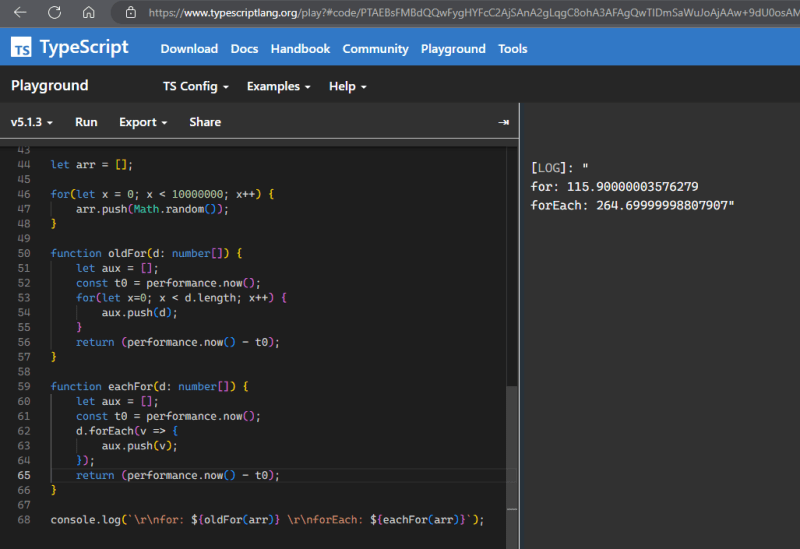
I made another for just testing the other loops with a 10M length array.
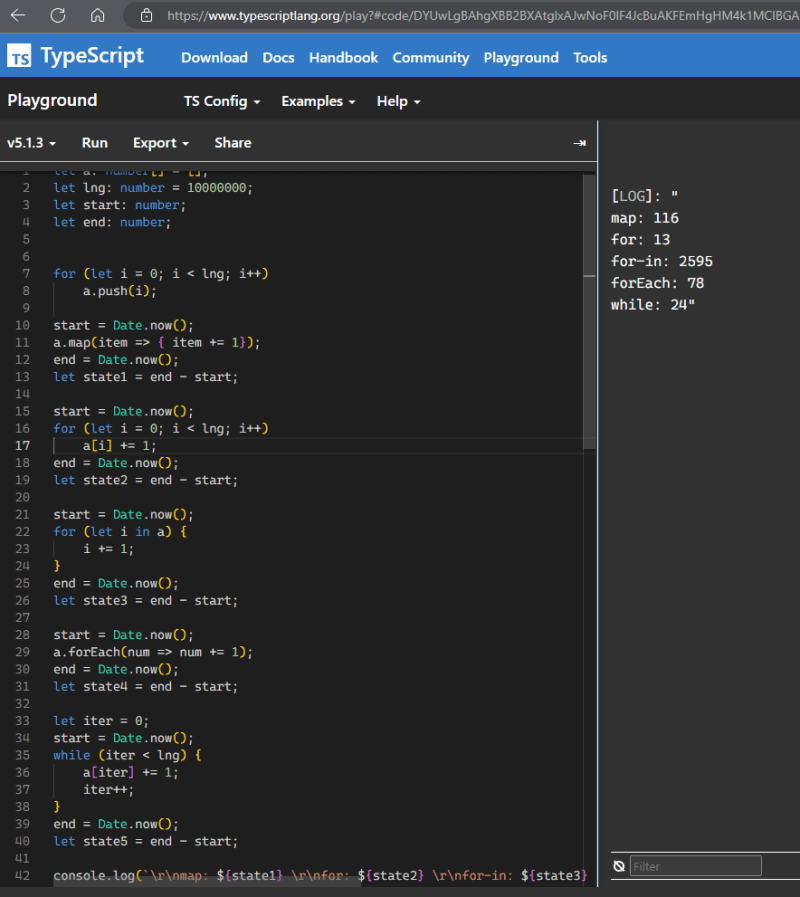
So... the conclusion is... If you want to loop through big arrays just use the old for loop. And I made an account just for to send this comment.