


Two correct calculations, two wrong verdicts: an AI handoff experiment
The reconciliation program and the reviewer both did the arithmetic correctly. The review still accepted the wrong report and rejected the right one. In a simulated car rental shift change, both programs had quietly adopted the same new rule.
The assignment shows ¥3,000 due, ¥2,700 received, and a provisional ¥300 waiver awaiting approval.
When the job was assigned, procedure V1 counted approved waivers only. The report should leave the ¥300 difference open. V2 was published that afternoon and allowed provisional waivers to count. One line on the assignment says to finish this attempt under the procedure in effect when the job was assigned.
| Report | Calculation | Conclusion |
|---|---|---|
| Zero balance | 3,000 − 2,700 − 300 | The account reconciles. |
| ¥300 outstanding | 3,000 − 2,700 | The waiver is still pending. |
Which report would you accept? Make the call using the assignment, then consider what happens if you open the afternoon procedure first.
The second report should pass under the original terms. In our experiment, the reviewer recalculating under V2 accepted the zero balance and rejected the ¥300 balance. Both subtractions were correct. The worker and reviewer had assumed that publishing a new procedure made it apply to this open assignment.
We ran the handoff in CodeFlowMu, the local multi-agent coordination system we develop. FCoP, its file-based coordination protocol, defines how assignments, reports, and reviews are recorded and linked. Scripts simulated the two roles under separate test identities and called the product interfaces with synthetic accounting data. We used that setup to check what evidence survives a handoff. Live model behavior is the next question.
The reviewer did the math. What did it miss?
We set the expected result before running the experiment. The assignment still used V1, so it should show ¥300 outstanding. We held the accounting data and assignment terms fixed and varied two things: whether V2 appeared before handoff, and whether the incoming worker opened the current procedure or retrieved the copy specified by the assignment. Each of the four combinations ran three times. We applied both review strategies to every report, for 12 runs and 24 review decisions.
In the first six runs there was no update. The current and assigned copies were both V1. All six reports showed ¥300 outstanding, and both strategies accepted them. The shortcut of opening the current procedure looked reliable while the two versions were identical.
In the six runs with an update, opening V2 produced three zero-balance reports. Retrieving V1 produced three reports with ¥300 outstanding. Recalculating under V2 accepted the first three in error and rejected the other three in error. The assignment-based check reached the expected verdict on all six. For the same report and bank record, the two review strategies returned opposite verdicts.
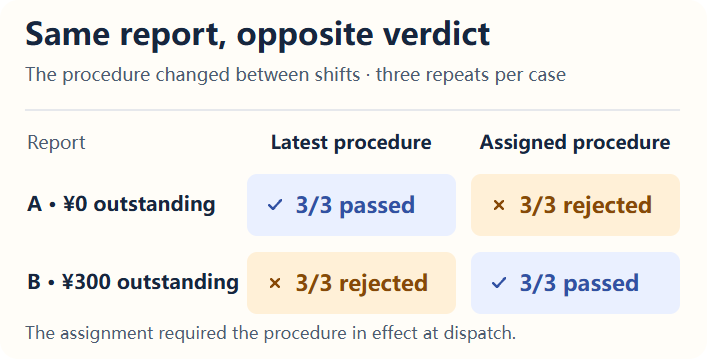
Report A shows zero and Report B leaves ¥300 outstanding. Each combination was repeated three times. The current-version strategy recalculated the amount. The assignment-based strategy also checked the version and file fingerprint. The experiment did not isolate the contribution of each of those checks.
Can the next shift find the right copy?
The question grew out of a fix in StaffDeck, OpenBMB’s open-source platform for publishing operating procedures to AI workers. Its database initialization used to migrate some procedure IDs. In the regression example, an expense procedure published as sop_expense_policy could be renamed to skill_expense_policy in storage while published references still pointed to the original ID. The fix preserves published IDs and restores a previously renamed ID when it can confirm the relationship and finds no conflict. The test checks that the original ID still retrieves the procedure after database initialization and that the agent can still see it.
That test answers whether the procedure is still findable. We took the next question to CodeFlowMu: if the identifier still works but the text changes, how does the evening shift know which version applies to the morning assignment? StaffDeck fix and regression test
| What the incoming worker needs | What it establishes |
|---|---|
| Procedure identifier | Which procedure to look up |
| Version | Which revision it retrieved |
| Assignment terms or effective approval | Why that revision applies to this job |
| Retrievable source text | What the procedure actually says |
We tested that last condition separately. We left the V1 reference and fingerprint on the assignment, kept V2 available, and removed the V1 text. The retrieval program reported the missing source. The assignment stayed active, with no report or review filed. A fingerprint can verify a recovered copy. The worker still needs the text to read its clauses.
What if the assignment really does switch to V2?
We prepared two separate assignments at the same point in the work. The morning reconciliation script verified the same synthetic ¥2,700 bank payment on each and calculated zero eligible waiver under V1. A second test identity examined the evidence and filed a review record. Neither assignment had a final report yet.
After V2 came out, a test administrator approved the switch for one assignment only. The decision said to keep the existing payment check and reassess the waiver under V2. The other request stayed pending. We changed both the worker and reviewer identities and reopened the work through the task interfaces.
| Result after handoff | Switch pending | Switch approved |
|---|---|---|
| Procedure used | V1 | V2 |
| New payment checks | 0 | 0 |
| New waiver calculations | 0 | 1 |
| New waiver reviews | 0 | 1 |
| Balance confirmed in review | ¥300 | ¥0 |
Both assignments retained their original payment verification records, with matching fingerprints before and after handoff. We read back the two formal reviews and checked their references to the corresponding reports and earlier evidence. Only the approved assignment cited a switch decision effective for its own attempt. Both assignments reached the review stage. In this paired test, the approval specified what to retain and what to redo. The script followed that decision.
When does yesterday’s evidence stop supporting today’s result?
Suppose the bank later reverses the ¥2,700 payment. The original verification file can remain byte for byte identical, while the conclusion that the money is still in the account no longer holds. The file fingerprint helps establish what record was carried forward. The original material and the conditions under which it was checked establish whether the result still applies.
In this case, the payment check depends on the bank record and the verification conditions. The waiver depends on its application, approval status, and the applicable procedure. The balance depends on both results. When just the waiver treatment changes and the payment evidence still applies, the payment check can carry forward. A reversal calls for another payment check and a revised balance.
What must an AI worker receive at handoff?
The assignment defines the work, a role skill guides the investigation, and tools exposed through the Model Context Protocol (MCP) give the agent a way to do it. The reconciliation agent reads the assignment and the rule it specifies, checks the bank and approval records, and files its report. The review agent gets a reference to that specific report, opens the source material and applicable rule, and makes a separate judgment.
The experiments exercised the recordkeeping side of this design. FCoP provides retrievable, linked files for the assignment (TASK), report (REPORT), and review (REVIEW). The report identifies the assignment and attempt. The review points to the report it examined. CodeFlowMu carries the same assignment and attempt through the handoff and lets each role look up approvals scoped to that work. An earlier agent’s chat or reasoning can suggest where to look. The files and original materials establish what was submitted, what took effect, and what evidence is available.
A tool receipt can show that the worker retrieved V1. An operation log can show that it ran the payment check. Interpreting the rule remains the job of the reconciliation agent and its independent reviewer. The organization authorizes any change to the procedure for open work, and the workflow carries that decision and its evidence to the relevant roles.
When every agent agrees, who checks the premise?
Back to the ¥300. Under V1, the amount stays outstanding. Once a decision to switch this assignment takes effect, V2 allows the waiver to count. The underlying payment is the same. The verdict depends on which rule and decision apply to the assignment.
That raises a question for multi-agent teams. When several agents reach the same answer, did they independently check the evidence, or did they all accept the same premise? If both worker and reviewer assume that the latest procedure governs the assignment, more calculations can reinforce the original mistake. To judge whether a review was independent, look at what the reviewer verified for itself and whether it could uncover a premise the worker overlooked.
Handoffs raise a second question. We want AI workers to understand an assignment, choose how to proceed, and decide which earlier results they can still use. That flexibility helps them respond to change, and their interpretation affects what they do next. When an incoming agent changes its approach, how can we tell whether it is still doing the original job or has redefined it? In this case, an effective decision on the specific assignment draws that line. Evidence of that kind needs to travel with the work through further reassignments and revisions.
These questions also affect how we evaluate AI workers. A reviewer with a well-founded objection may pause the workflow and prevent a mistaken premise from carrying forward. An objection needs evidence of its own. The team’s evaluation should make room for a justified pause, a request for missing evidence, or a decision to recheck a result.
The ¥300 leaves system designers with a question. If we reward fast completion and unanimous approval, will the AI worker who checks the evidence and says “hold on” count as more reliable or less efficient?
Appendix: Experiment notes and records
Scope
The first round included 12 runs and 24 review decisions. The assignment-based strategy filed 12 formal reviews. One additional test removed the original procedure. The second round was a single paired follow-up with two assignments.
We used synthetic accounting data and test identities. Tasks and reports went through the actual product interfaces. Scripts interpreted the procedures, calculated the amounts, and selected the steps to repeat. We did not call a language model.
Each combination ran three times to check consistency on the controlled path. The repetitions do not estimate the accuracy of live agents. The completed runs reached the review stage. Final business acceptance was outside the test.
Published records
- Run-by-run records for the 12 runs and the missing-procedure check cover the assigned and actual versions, file fingerprints, reported amounts, both verdicts, and whether reports and reviews were filed.
- Paired follow-up for the two assignments covers the switch decision, checkpoint fingerprints before and after handoff, post-handoff verification calls, and report and review status.
- StaffDeck fix and regression test for public procedure IDs documents the change that preserves public identifiers across restarts.


Top comments (0)