


Most Codex conversations start the same way. Someone has seen a demo, a few developers are already trying it, and a leader asks: "Can we roll this out to the team?"
It's a fair question. Before answering it, the team needs to agree which problem Codex should help solve and how it will judge the result.
I recently worked through the Codex Deployment Practitioner course. My main takeaway was to treat a Codex rollout as a decision about how the team works. Your workflow should tell you where to start, what to measure and when to stop.
This post develops that takeaway using the course's running example. Aldford AI, a fictional consultancy, is helping Chester Circuits, a fictional engineering organisation, decide how to introduce Codex. Neither company is real. The problems probably are.
The pilot loop
The team scopes the task, Codex prepares the work within an agreed boundary, and a human reviews the output. The evidence determines whether to expand, adjust or stop.

```plain text
Scope the task -> Codex prepares evidence -> Human reviews -> Expand, adjust or stop
|
Adjust the boundary and repeat
## 1. Translate interest into decisions
Interest gives you a reason to investigate. A pilot needs answers you can test.
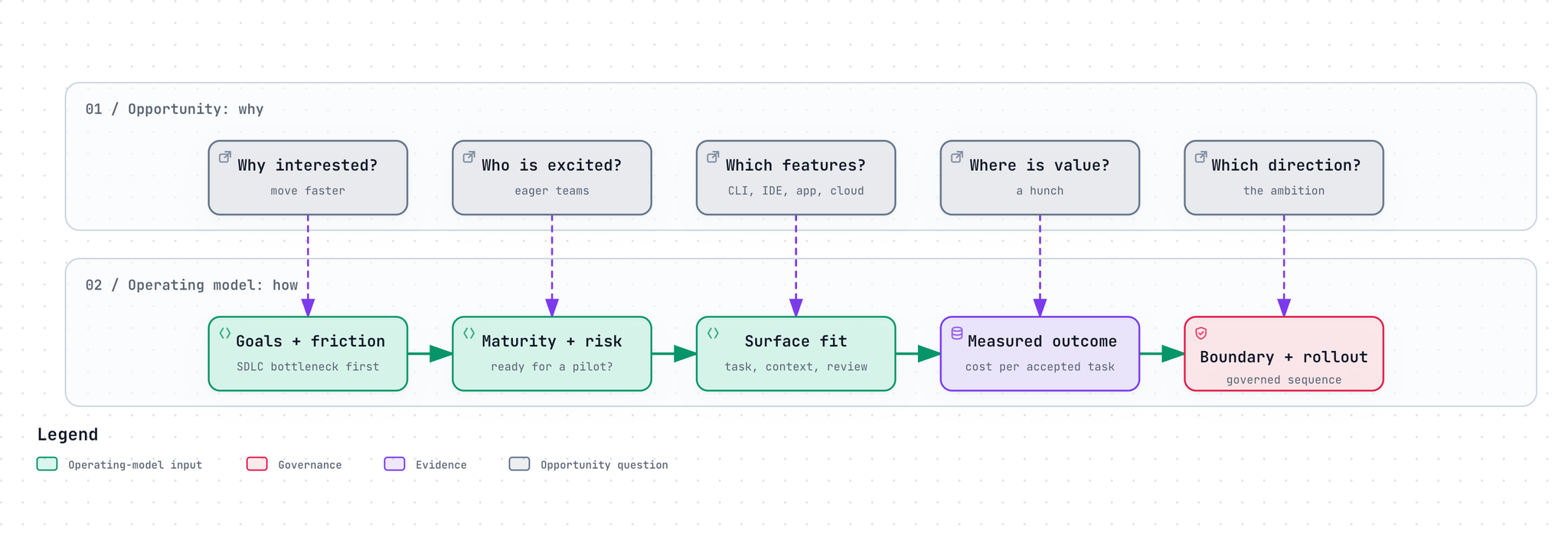
| Starting question | Decision needed |
| ------------------------------- | --------------------------------------------------------------------------------- |
| Why are we interested in Codex? | Which engineering goal and repeated delivery bottleneck should the pilot address? |
| Which teams are excited? | Which teams have clear ownership, reliable tests and reviewers available? |
| Which features look useful? | Which task, client and execution environment fit the workflow and its risks? |
| Where might value appear? | What measurable improvement would justify the usage and review effort? |
| What happens next? | What are the pilot boundary, success criteria, stop conditions and decision date? |
## 2. Find repeated delivery friction
Software delivery includes planning, design, testing, review, documentation, deployment and maintenance. Look for repeated work that produces an output someone can inspect. Missing test evidence, documentation gaps and review preparation are more useful starting points than a general wish to code faster.
A developer saying "I want to try Codex" is an adoption signal. Chester Circuits needs a more specific problem:
> Reviewers repeatedly spend time reconstructing change intent, locating test evidence and asking authors for missing context.
That gives the pilot a bounded task: prepare the information a reviewer needs. It does not establish that Codex will reduce the time a pull request waits for an available reviewer. Measure preparation time and queue time separately.
## 3. Bound one pilot
| Element | Proposed review-preparation pilot |
| -------------------- | ------------------------------------------------------------------------------------------------------------------------------------------------------------------------------------ |
| Task | Summarise the change and its intent, cite relevant files and test output, flag missing evidence, and return questions for the reviewer. Separate observed evidence from assumptions. |
| Approved context | Changed files, pull-request description, ticket summary, relevant business logic, review checklist, supplied test output and definition of done. |
| Human responsibility | Inspect the summary and its references. The human reviewer remains accountable for review and approval. |
| Restricted actions | No approval, merge, deployment, unrelated repository access, unapproved commands or broad refactoring. |
| Decision | Expand only when the agreed quality and reviewer-time targets are met and no boundary violation remains unresolved. Otherwise adjust and repeat, or stop. |
For this fictional example, a proposed starting point is two weeks or 20 eligible pull requests, whichever comes first. A small sample is an initial signal; if it is too thin to support a decision, extend the evaluation without widening the task.
Compare similarly sized changes with a recent baseline. Before starting, record a target reduction in reviewer preparation time and a maximum acceptable summary-correction rate. Accept a summary only when its claims are traceable to the supplied context, missing evidence is explicit, and the reviewer can use it without substantive correction. Record rejected summaries and the time spent checking or repairing them.
Enforce the boundary with repository permissions, filesystem and network restrictions, and command approval controls. A prompt alone is insufficient. Test that an allowed task succeeds and that attempts to access another repository, run an unapproved command or merge a pull request are blocked. Review any available connector permissions too.
Pause on a boundary violation or fabricated validation evidence. Investigate and verify the repair before resuming. A pilot that can only ever expand isn't a pilot. It's a rollout with extra steps.
## 4. Choose where the task runs
Codex is available through the CLI, IDE extension, desktop app and cloud workflows. Distinguish the client someone uses from where the task executes. Local runtime policy, cloud access and connected-system permissions need separate checks. Local tool execution also does not establish where model inference or data processing takes place.
For Chester Circuits, suppose reviewers already prepare reviews in their IDE. The IDE extension would be a reasonable starting point. If preparation already happens in a hosted workflow, evaluate that option instead. Approve repository access, execution controls, data handling, validation expectations and review ownership before either route.
OpenAI's [admin rollout guide](https://learn.chatgpt.com/docs/enterprise/admin-setup) explains the separate access boundaries and how to verify them. Check the controls available in the actual workspace and configuration.
## 5. Collect evidence of value and control
| Evidence | What to record for this pilot |
| ----------------- | --------------------------------------------------------------------------------------------------------------------------------------------------------------------------------------- |
| Workflow outcomes | Reviewer preparation time, clarification requests, summary corrections, accepted outputs and rework. Compare the results with the baseline. |
| Safeguards | Whether tasks used approved context, respected action restrictions, returned traceable evidence and received human review. Record blocked attempts, violations and escalation outcomes. |
You need both. A pilot can feel useful and still be unsafe to expand if nobody checked the outputs. It can also be beautifully controlled and simply not worth expanding. Keep the task scope and acceptance rules consistent so that the comparison means something.
## 6. Put cost beside the results
Where billing data is available, use the total measured usage cost across every pilot attempt, including failures and retries:
```plain text
cost per accepted task = total measured usage cost across all attempts / accepted tasks
Count each task once when its output meets the agreed quality threshold. If no tasks are accepted, report total cost and zero accepted tasks; the ratio is undefined. Track reviewer time and rework alongside usage cost. A cheap summary that takes longer to check may still be poor value.
If only credits or an allowance are visible, report those units without inventing a currency conversion. Before starting, name the usage owner, the threshold that prompts a review and the person who can change or stop the pilot.
A usage dashboard is not itself a spending cap. Verify the limits and controls that apply to the plan and configuration, using the current OpenAI usage and pricing guidance.
Rolling out your own
- Choose one repeated delivery problem and a task a person can review.
- Agree the baseline, pilot duration, quality threshold and stop conditions.
- Restrict context and actions, then test that the controls enforce the boundary.
- Choose a client and execution environment that fit the workflow.
- Name the reviewer, usage owner and person who can stop the pilot.
- Compare workflow outcomes, safeguard evidence, review effort and usage cost.
- Expand, adjust or stop when the agreed pilot period ends.
The same questions apply to other coding agents, including Claude Code and Devin. Verify each tool's execution model, permissions, data handling and billing controls before applying the pilot.
How is your team introducing coding agents, and what evidence would make you stop the pilot?


Top comments (0)