

Hi 👋! You are reading one of my free articles - I hope it helps you level up your PM skills. Want to go deeper? My premium subscribers get exclusive frameworks and strategies I don’t share anywhere else - content that has helped hundreds of product managers land better roles and make bigger impact.
Ready to accelerate your product career? *Subscribe now** for premium access and join a community of exceptional PMs gaining an edge every week.*
Now, let’s dive into today’s insights…
Stop what you’re doing and read this.
There is a hidden truth in product management that almost no one talks about and its that:
Most PMs spend 80% of their time on operational busywork and only 20% on the strategic thinking that builds great products.
User interview analysis, stakeholder updates, meeting summaries, competitive research, PRD writing; These are some of the endless cycle of “important” tasks that slowly kill your ability to think strategically about what really matters.
Many Product Managers I know spend 40+ hours a week on this operational quicksand. They were good at it, efficient even. However, they were dying inside because they had become human document processors rather than product operators.
But then something clicked (like it’s about to for you too).
What if the goal isn’t to get better at operational work?
What if the goal is to eliminate it entirely?
Today,
- Intelligent systems handle 60% of my operational tasks.
- I spend 70% of my time on strategy, user discovery, and product decisions.
By offloading 60% of my operational work to intelligent systems, I was able to reclaim my time. Now, 70% of my time is spent on strategy, discovery, and decisions, up from just 20% before. This is the stuff that moves the business forward.
Now, to the exact system I built to escape the operational trap.
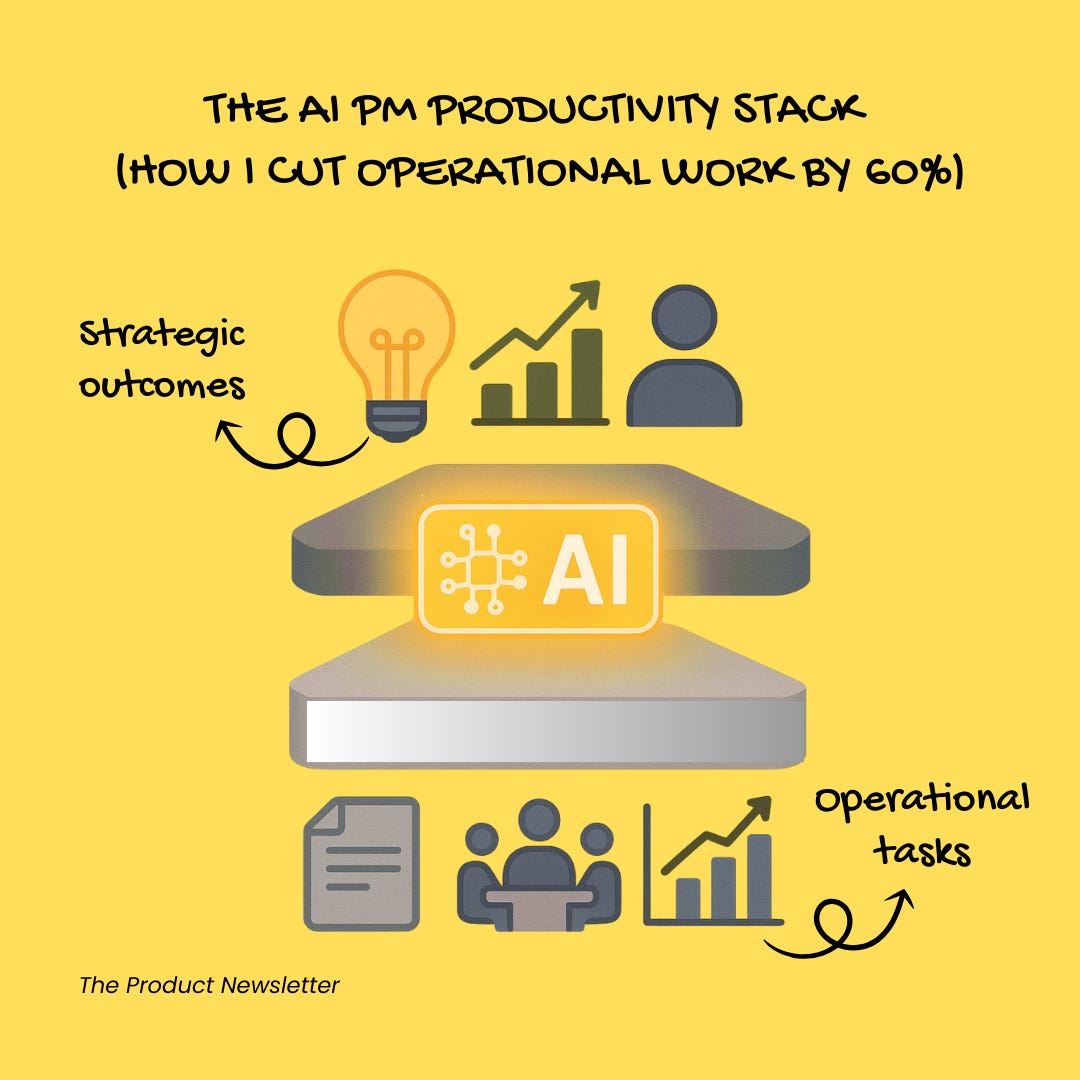
Why Most PMs Fail with AI (And How to Avoid It)
I've talked to hundreds of PMs about AI. They crash in two predictable ways:
- The Overwhelmed:
There are too many tools.
I don't know where to start.
I'm terrified of making a mistake with customer data.
- The Burned:
I tried the AI hype.
Got generic garbage that made me look stupid to my team. Never again.
Both categories miss the fundamental insight: AI doesn’t replace your strategic thinking. It eliminates the grunt work that buries your strategic thinking.
💡 The breakthrough occurs when you stop asking AI to be smart for you and start using it to handle the repetitive tasks that prevent you from being smart.
My Four Systems That Changed Everything
After testing 50+ approaches, I finally landed on what works:
1. Information Processing (Reclaimed 20+ hours per month)
❌ The Old Way: You are manually reading through user interviews, trying to spot patterns, coding themes by hand.
✅ The New Way: AI finds patterns in minutes that take me hours to catch.
🎯 The Process: When I have user interviews to analyze, I upload transcripts to Claude with this prompt:
Analyze these user interview transcripts. Identify:
- Top 3 pain points mentioned by 50%+ users.
- Feature requests grouped by frequency.
- Unexpected insights that contradict our assumptions.
Present as bullets with direct quotes.
What used to take me an entire weekend now takes 45 minutes. More importantly, AI catches patterns across interviews that I miss when reading manually.
2. Documentation & Communication (Reclaimed 15+ hours per month)
❌ The Old Way: You are staring at blank pages, writing PRDs from scratch, formatting for hours.
✅ The New Way: AI creates structured first drafts, I focus on strategy and refinement.
🎯 The Process: For any product document, I start with this prompt:
Create a PRD outline for [feature]. Include:
- User problem statement.
- Success metrics.
- User stories.
- Technical considerations.
- Rollout plan.
Use this context: [paste research summary]. Make it specific to B2B SaaS workflows.
First draft got completed in 20 minutes rather than 3-5 hours. I spend saved time on strategy and user validation instead of formatting and structure.
3. Analysis & Decision Support (Reclaimed 10+ hours per month)
❌ The Problem: You are experiencing spreadsheet hell, trying to find patterns in user data.
✅ The Solution: AI spots correlations and generates testable hypotheses instantly.
🎯 The Key Insight: AI excels at pattern recognition but fails at understanding what patterns mean for your specific business. Use it for analysis, not decisions.
4. Research & Synthesis (Reclaimed 8+ hours per month)
❌ The Problem: Staying current with market trends and competitive moves is a hassle.
✅ The Solution: AI synthesizes information from multiple sources faster than any manual process.
🎯 What Works: Perplexity for market research (better than Google for connecting multiple sources), Claude for translating complex concepts into practical PM insights.
Now, to the execution strategy that works
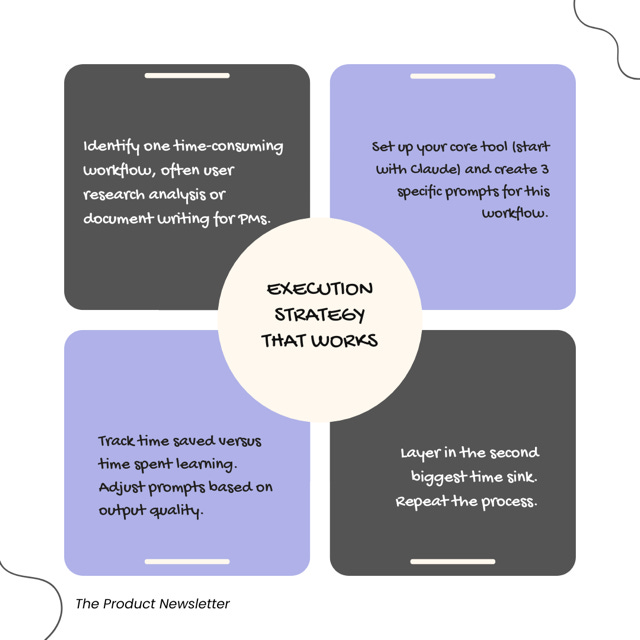
Week 1: Pick ONE workflow that devours most of your time. For most PMs, this is user research analysis or document writing.
Week 2: Set up your core tool (start with Claude) and create 3 specific prompts for this workflow.
Week 3: Track time saved versus time spent learning. Adjust prompts based on output quality.
Week 4: Layer in the second biggest time sink. Repeat the process.
💡 One critical rule to guide you is to: Master one workflow completely before adding complexity. Most PMs fail because they try to transform everything at once.
Where AI Fails
As good as the learning experience was, I’ve also experienced a painful learning curve. Let me save you weeks of frustration that I went through. Here’s what AI cannot yet do:
- Strategic thinking: AI suggests frameworks but cannot make trade-offs specific to your business context, competitive position, or user needs.
- Stakeholder management: It can write the perfect email, but cannot read the political undercurrents in your organization.
- Creative problem-solving: Generates obvious solutions but misses the breakthrough ideas that fit your unique constraints.
- Customer empathy: AI categorizes feedback but cannot understand the emotional nuance that drives user behavior.
💡 The Fundamental Rule: Use AI to process information faster. Use your human judgment to make better decisions.
The 80/20 That Changes Everything
I believe if you apply AI 20%, you will observe 80% productivity gains in the following areas:
- Use it for content summarization (user research, competitive analysis, market trends).
- Use AI for first-draft creation (PRDs, updates, technical documentation).
- Use for pattern recognition (usage data analysis, feedback themes, user behavior).
- Use to synthesis information (turning scattered research into structured insights).
Focus obsessively on these four. Everything else is noise.
Here’s what this actually means for your career:
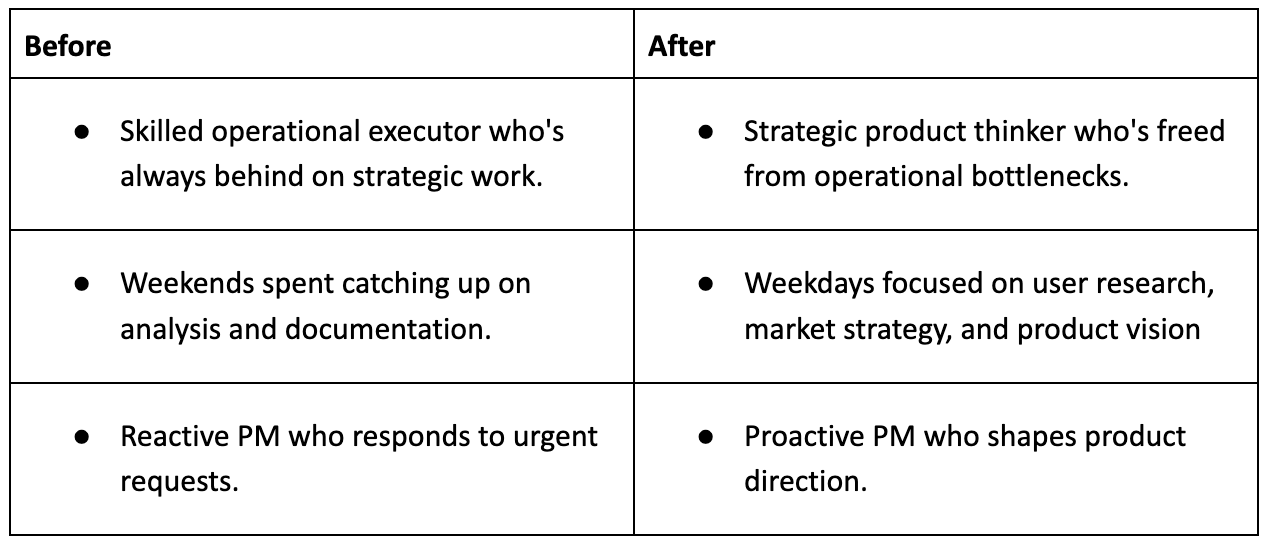
This isn’t about working less. It’s about working on what matters.
Here are my next step recommendations for you to get started:
Starting point: Pick the operational task that ate most of your time last week.
Action: Set up Claude Pro ($20/month). Test one workflow and measure the time difference.
Feedback loop: Then come back and tell me what happened.
Quick Updates
Next Week I’ll be sharing the exact prompts I use to analyze hundreds of user interviews and turn messy feedback into clear product decisions.
Feel free to respond to the poll below. I’d like to learn about those PM tasks that eat most of your time. I’ll also be addressing the top responses in next week’s deep dive.
Loading...
Also, if this piece resonated with you, share it with another PM who’s drowning in operational work. Let’s help more product people get back to building great products instead of just documenting them.
To help you hit the ground running, here’s my AI PM Productivity Stack with tested prompts, team templates, and implementation guide. Do let me know in the comment section what outputs you derive from it when you use it.
See you next week for the deep dive into Customer Research at Scale!
ICYMI: Last week, I ended the month long product eval series dissecting the most culturally relevant app of your time. Read it here 👇🏾
[
Eval Drop #006: Instagram- The App That Survived Reinvention
·
August 29, 2025
Read full story](https://salemsmith.substack.com/p/eval-drop-006-instagram-the-app-that)


Top comments (0)