I think I'm missing the benefit in taking on the complexity of partial hydration when you still have dynamic parts that will need to access data from the server regardless of when they are hydrated. Fewer round-trips to the server is better, right? Is this complexity just to reduce the initial JavaScript size delivered to the client?
Are there examples in the wild of partial hydration in a complex app that can be used to compare against SSR + hydration, like we saw from remix with the ecommerce demos?
While all great ideas on paper, I think this is missing some substance to back up the claims against the tried and true champion: SSR.
I do think you are missing something. The article might be worth a re-read. This is all SSR and doesn't introduce more round trips. If you mean that MPAs do a full page reload sure but keep in mind you are hitting the server already in these scenarios. But you are correct initial page load is a big part of it.
Unfortunately where you see this employed the most is huge eCommerce. Those sites are also plagued by 3rd party scripts and ads. We develop independent of them and since introducing Marko at ebay.com in 2013 we haven't been allowed to let any degradation in performance come from the numbers we doing in Java + jQuery before then.
amazon.com is server side rendered and has no client side rendering framework. The potential latency hit didn't justify it.
We were stuck with jQuery 1.6.4 😬
SSR React wasn't fast enough for us. This blew my mind.
19:26 PM - 22 Jan 2022
In fact most large companies have a version of this when you consider internal framework Wiz from google and the investment React has been making into server components.
I can show some size comparisons from ebay.com between sizes of partial (component) and full hydration. It doesn't take much to do a little math to see the impact.
I know the hackernews demos are pretty poor in that they are mostly uninteractive so removing the script tags almost does the same thing. But even then you can already see the benefit. In fact in the original version of the Remix vs Next article Remix did exactly that so it isn't unlike the creators are naive to the benefits here.
But it goes beyond just code size but serialization savings. I just went on hackernews and found a story with an absurd amount of comments. Look at the difference between Marko and Remix anyway way you choose. I made essentially identical versions of this demo:
This is much more clear to me now, thank you. The issue isn't SSR itself, the issue is the hydration strategy after server rendering. The first few paragraphs seem almost like an attack on SSR, so I was confused why you'd be discussing concepts that build on top of SSR.
Yeah I felt it necessary to knock the "l'm doing SSR in my SPA so I'm good" mentality down a couple pegs in order to help reset expectations for broader look at the topic. To me this is hardly a done topic. There are so many ways to make it better.
So I'm really excited about all the technology in this area. Remix and Sveltekit improves on Next. We're all moving forward. I think its important to view our efforts at like a 2-3/10 right now instead of the 9/10 people are sort of picturing. I think this area is pushing our mental model of what the best architectures are and how they apply to different use cases. Honestly I'm not sure there is a clear direction with both things like React Server Components and Qwik showing us what is possible with really different models. Or how Marko continues to show that these techniques can be done automatically and more optimal than a human would practically write the code.
For further actions, you may consider blocking this person and/or reporting abuse
We're a place where coders share, stay up-to-date and grow their careers.


I think I'm missing the benefit in taking on the complexity of partial hydration when you still have dynamic parts that will need to access data from the server regardless of when they are hydrated. Fewer round-trips to the server is better, right? Is this complexity just to reduce the initial JavaScript size delivered to the client?
Are there examples in the wild of partial hydration in a complex app that can be used to compare against SSR + hydration, like we saw from remix with the ecommerce demos?
While all great ideas on paper, I think this is missing some substance to back up the claims against the tried and true champion: SSR.
I do think you are missing something. The article might be worth a re-read. This is all SSR and doesn't introduce more round trips. If you mean that MPAs do a full page reload sure but keep in mind you are hitting the server already in these scenarios. But you are correct initial page load is a big part of it.
Unfortunately where you see this employed the most is huge eCommerce. Those sites are also plagued by 3rd party scripts and ads. We develop independent of them and since introducing Marko at ebay.com in 2013 we haven't been allowed to let any degradation in performance come from the numbers we doing in Java + jQuery before then.
It's not just ebay. Amazon has similar concerns:
In fact most large companies have a version of this when you consider internal framework Wiz from google and the investment React has been making into server components.
I can show some size comparisons from ebay.com between sizes of partial (component) and full hydration. It doesn't take much to do a little math to see the impact.
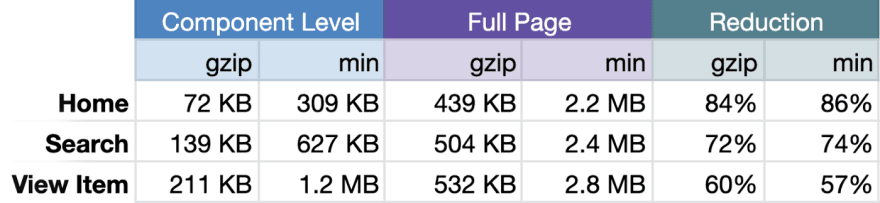
I know the hackernews demos are pretty poor in that they are mostly uninteractive so removing the script tags almost does the same thing. But even then you can already see the benefit. In fact in the original version of the Remix vs Next article Remix did exactly that so it isn't unlike the creators are naive to the benefits here.
But it goes beyond just code size but serialization savings. I just went on hackernews and found a story with an absurd amount of comments. Look at the difference between Marko and Remix anyway way you choose. I made essentially identical versions of this demo:
Remix: remix-hackernews.ryansolid.workers...
Marko: hn.markojs.workers.dev/story/30186326
Notice the difference streaming and partial hydration make here. I can keep churning out examples but it takes time.
This is much more clear to me now, thank you. The issue isn't SSR itself, the issue is the hydration strategy after server rendering. The first few paragraphs seem almost like an attack on SSR, so I was confused why you'd be discussing concepts that build on top of SSR.
You've got a 👍 from me.
Yeah I felt it necessary to knock the "l'm doing SSR in my SPA so I'm good" mentality down a couple pegs in order to help reset expectations for broader look at the topic. To me this is hardly a done topic. There are so many ways to make it better.
So I'm really excited about all the technology in this area. Remix and Sveltekit improves on Next. We're all moving forward. I think its important to view our efforts at like a 2-3/10 right now instead of the 9/10 people are sort of picturing. I think this area is pushing our mental model of what the best architectures are and how they apply to different use cases. Honestly I'm not sure there is a clear direction with both things like React Server Components and Qwik showing us what is possible with really different models. Or how Marko continues to show that these techniques can be done automatically and more optimal than a human would practically write the code.