

Most hiring teams do not realize this, but the biggest hiring mistake rarely happens in interviews or final decisions. It happens much earlier, during resume screening.
A role goes live, applications start coming in, and within a day you are already overwhelmed. Not because you are inefficient, but because the volume makes it impossible to give every candidate the attention they deserve. You skim faster, rely on quick judgment, and unknowingly miss candidates who could have been a strong fit.
This is exactly where AI changes the process.
Instead of reviewing resumes one by one, teams are now using systems like AI screening to evaluate and prioritize candidates in seconds based on real relevance. It is not about replacing recruiters. It is about making the first step of hiring more structured and reliable.
In this guide, we will walk through how to screen resumes with AI in a practical, real-world way that actually improves hiring outcomes.

Why Resume Screening Needs a Rethink
Most hiring processes still treat resume screening as a simple filtering step.
In reality, it is one of the most important decision points. The candidates you shortlist determine the quality of your entire pipeline. If this step is flawed, everything that follows is affected.
Manual screening struggles for three key reasons.
First, it does not scale. Reviewing hundreds of resumes with the same level of attention is not realistic. Second, it creates inconsistency. Your evaluation changes depending on workload, time, and even energy levels. Third, it introduces bias. Small signals like formatting or familiar company names start influencing decisions.
This is not about effort. It is about limitations of the process itself.
What AI Resume Screening Does Differently
It Focuses on Relevance, Not Appearance
Traditional screening often prioritizes what is easy to notice.
AI shifts the focus to what actually matters. It evaluates how closely a candidate’s experience aligns with the role. It recognizes patterns, connects different types of experience, and surfaces candidates based on capability rather than presentation.
It Gives You a Strong Starting Point
Instead of beginning with a long list of resumes, you start with a shortlist that is already ranked.
This changes your role from filtering applications to evaluating top candidates.
A Practical System to Screen Resumes With AI
Step 1: Define Outcomes, Not Just Skills
Before using any tool, step back and think about the role differently.
Do not just list skills. Define what success looks like. What should this person accomplish in the first few months? What kind of impact should they create?
Clear outcomes lead to better screening decisions.
Step 2: Choose the Right Screening Approach
Not all tools provide meaningful insights.
Some still rely on keyword matching, which limits their effectiveness. What you need is a system that evaluates real experience and context.
You can explore AI tools that are designed to help recruiters move beyond basic filtering and actually understand candidate quality.
Step 3: Upload Resumes and Let AI Structure the Data
Once your system is set up, upload candidate resumes in bulk.
AI automatically extracts key information such as skills, work history, and achievements. It then standardizes this data so every candidate is evaluated fairly.
This removes the need for manual sorting and preparation.
Step 4: Analyze Candidates Through Ranking
This is where AI creates the biggest shift.
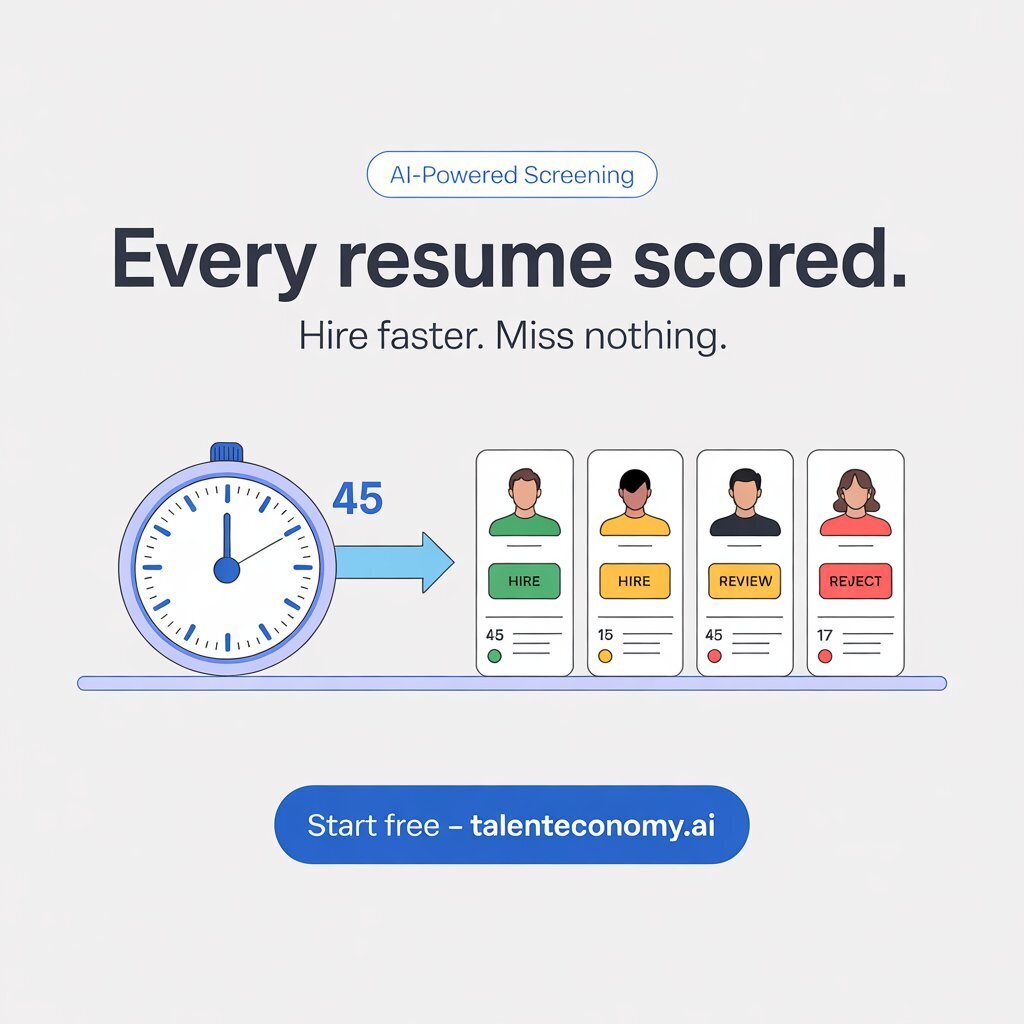
Instead of going resume by resume, the system evaluates all candidates together and ranks them based on fit.
Using something like candidate ranking allows you to immediately identify the most relevant profiles without guesswork.
Step 5: Focus on Insights, Not Just Resumes
One of the biggest advantages of AI is the structured insights it provides.
You can see:
- Why a candidate is ranked higher
- Which skills align with the role
- Where there are gaps
This helps you make faster and more confident decisions.
Step 6: Act Quickly on Top Candidates
Speed plays a critical role in hiring.
Once you have your shortlist, move forward without delay. Engage candidates early and maintain momentum throughout the process.
The faster you act, the better your chances of securing top talent.
Step 7: Continuously Improve Your Process
AI screening is not static. It improves with use.
After each hiring cycle, review your outcomes. Identify what worked and what did not. Adjust your criteria accordingly.
Over time, this creates a stronger and more effective hiring system.
Best Practices for AI Resume Screening
Prioritize Real Experience
Focus on what candidates have actually done, not just how their resumes are written.
Keep Human Judgment Involved
AI supports decision making, but final evaluation should always include human input.
Maintain Consistency
Use the same criteria across all candidates to ensure fairness and accuracy.
Balance Speed With Thoughtful Evaluation
Move quickly, but do not skip important steps in the process.
Common Mistakes to Avoid
Even with AI, hiring can go wrong if the process is not used properly.
Some common mistakes include:
- Starting without clear role definition
- Using tools that rely only on keywords
- Ignoring AI-generated insights
- Delaying decisions after shortlisting
Avoiding these can significantly improve your hiring outcomes.
Conclusion
Learning how to screen resumes with AI is not about adopting a new tool. It is about improving how hiring decisions are made from the very beginning.
When used correctly, AI transforms resume screening from a time-consuming task into a structured process that delivers better results. It helps teams handle volume, reduce inconsistency, and focus on the candidates who actually matter.
Platforms like TalentEconomy.ai are built to support this shift, helping recruiters and founders move from manual screening to evidence-based hiring in minutes.
If you want to experience this in action, you can try AI screening or explore recruiting tools designed to simplify resume evaluation.
Visit https://talenteconomy.ai/ to get started with free credits, screen candidates faster, and hire the top 1 percent with confidence.
FAQ
Is AI resume screening better than manual screening?
Yes, because it improves consistency, speeds up the process, and focuses on relevant candidate signals.
Can founders use AI screening without a recruiter?
Absolutely. AI tools are especially useful for founders who need to hire efficiently without a large team.
Does AI remove bias completely?
It reduces many forms of bias by focusing on structured evaluation, but it should always be monitored.
How fast can AI screen resumes?
Most modern systems can analyze and rank candidates within seconds.
Is it difficult to get started?
No. Most tools are user-friendly and can be implemented quickly.


Top comments (0)