


High-density government summits, ministerial exhibitions, and corporate conferences across Riyadh, Jeddah, and the broader GCC are expanding rapidly under Saudi Vision 2030. With tens of thousands of registered VIPs and delegates arriving simultaneously, the physical and digital infrastructure at the gate dictates the entire operational outcome of the event.
When you rely on standard cloud-only ticketing apps, intermittent venue Wi-Fi and API latency can bring check-in counters to a complete halt. Engineering true enterprise accreditation requires a localized, hardware-integrated stack: offline-resilient edge caching, cryptographic thermal encoding, and continuous passive telemetry.
Here is how StampIQ architects infrastructure to guarantee zero-downtime registration and real-time delegate tracking at Saudi mega-events.
The Architecture of Queue Disruption
Standard event tech stacks fail in enterprise environments for three main reasons:
- Cloud Latency: Relying on a round-trip HTTP request to a central database for every attendee scan causes severe gate congestion when 5,000 visitors arrive at once.
- Optical Scan Bottlenecks: Manual QR code scanners are slow, require deliberate positioning, and suffer in varying ambient lighting.
- Network Drops: If the venue's ISP connection goes down, standard web-based portals crash entirely.
To solve this, we decoupled the physical gate operations from external internet connectivity.
1. Offline-First Edge Resilience with SQLite & WAL
To prevent network interruptions from freezing our registration portals, every local check-in node runs an embedded SQLite database. Instead of polling an external server for every scan, client stations write locally, configured with Write-Ahead Logging (WAL).
WAL ensures that readers and writers do not block each other, allowing our nodes to process continuous high-throughput scans asynchronously.
javascript
// Example SQLite Edge Node Configuration
const sqlite3 = require('sqlite3').verbose();
const db = new sqlite3.Database('./edge_cache.db');
// Enable Write-Ahead Logging for non-blocking concurrent reads/writes
db.serialize(() => {
db.run("PRAGMA journal_mode=WAL;");
db.run("PRAGMA synchronous=NORMAL;");
// Create offline sync table
db.run(`CREATE TABLE IF NOT EXISTS local_scans (
id TEXT PRIMARY KEY,
uhf_tag_id TEXT,
timestamp DATETIME DEFAULT CURRENT_TIMESTAMP,
sync_status INTEGER DEFAULT 0
)`);
});
Zero-Latency Processing: Check-ins are appended locally in under 5 milliseconds.
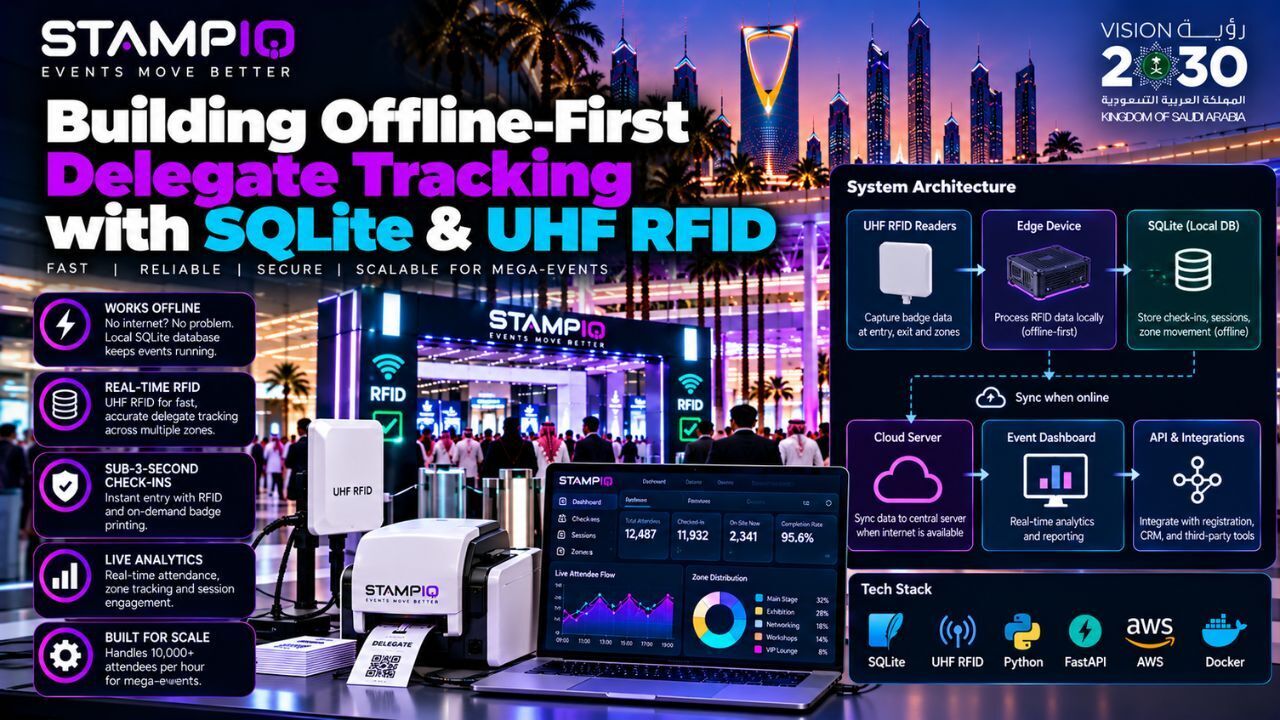Deterministic Synchronization: Background workers stream differential updates to the central cloud cluster whenever network connectivity is active. If Wi-Fi drops, scanning continues unabated, syncing perfectly once the connection restores.
2. Sub-3-Second Thermal Badge EncodingPre-printing badges causes administrative chaos. Our deployment standard relies on rapid on-demand thermal issuance directly integrated with automated badge sorting.
As the digital pass is scanned, a direct thermal print engine processes the personalized badge in under 3 seconds. Simultaneously, an integrated encoder writes an encrypted payload (UHF EPC Gen 2 standard) to the badge's embedded microchip, guaranteeing that credentials cannot be cloned.
3. Passive UHF RFID Portals for Zero-Contact TelemetryTo measure live hall capacities and sponsor booth exposure, we utilize passive UHF RFID overhead portals instead of tap-based NFC cards or manual barcode scanners. Plaintext [ Overhead UHF RFID Portal Array ]
│
┌───────────────┴───────────────┐
▼ ▼
[ Antenna Beam: Lane A ] [ Antenna Beam: Lane B ]
As delegates walk naturally through entry arches wearing their durable, waterproof UHF event wristbands, the portals harvest RF energy and read the cryptographic IDs at distances up to 8 meters. Utilizing advanced anti-collision framing, the edge readers filter up to 400 tag transmissions per second without signal corruption.
4. Real-Time Analytics & Capacity ManagementWe stream this passive spatial telemetry back to a centralized event analytics platform, providing organizers with a custom KSA reporting dashboard.
Security teams can monitor live gate influx and hall capacities dynamically, receiving automated alerts before venues exceed civil defense safety thresholds[cite: 12]. Floor managers can reallocate catering and staff instantly based on real-time crowd heatmap.
Engineering for Vision 2030The scale of modern Saudi business sectors demands highly resilient infrastructure. By bridging physical hardware integration with edge-caching software, event leaders can guarantee a flawless operational flow from the first scan to the final keynote.
If you are building or scaling localized enterprise infrastructure, explore how our secure event registration platform handles high-density workloads across the GCC


Top comments (0)