


Despite the wealth of data available, distilling a coherent narrative from a Kubernetes cluster remains a challenge for modern infrastructure teams. Even with powerful visualization tools like the Policy Board, Service Graph, and specialized dashboards, users often find themselves spending significant time piecing together context across different screens. Making good use of this data to secure a cluster or troubleshoot an issue becomes nearly impossible when it requires manually searching across multiple sources to find a single “connecting thread.”
Inevitably, security holes happen, configurations conflict causing outages, and teams scramble to find that needle-in-the-haystack cause of cluster instability. A new approach is needed to understand the complex layers of security and the interconnected relationships among numerous microservices. Observability tools need to not only organize and present data in a coherent manner but proactively help to filter and interpret it, cutting through the noise to get to the heart of an issue. As we discussed in our 2026 outlook on the rise of AI agents, this represents a fundamental shift in Kubernetes management.
Key Insight: With AI Assistant for Calico, observability takes a leap forward, providing a proactive, conversational, and context-aware intelligence layer to extract actionable insights from a sea of raw telemetry. SREs can interrogate their data through a natural language interface instead of having to painstakingly construct complex queries, removing knowledge barriers and reducing MTTR (Mean Time to Repair).
Beyond Manual Log Analysis
To understand the impact of the AI Assistant for Calico, it is helpful to look at the traditional workflow through the lens of the challenges platform teams face daily. Troubleshooting connectivity issues, for example, typically starts with a look at traffic flows, identifying ones that may be problematic, then drilling down into the details while looking up possibly relevant policies, network configuration, ingress rules, and hostname resolution in different dashboards and sets of logs. Often one or more multi-step queries have to be run and then the results have to be filtered to start getting an idea of what may be going wrong. This is particularly difficult when Kubernetes flat networks fail at scale, increasing the complexity of every query.
This sort of manual navigation slows down problem resolution and imposes a high cognitive cost on SREs. Even for seasoned engineers, debugging can take hours or even days when the answer must be excavated from multiple sources of information.
Natural Language Insights
The AI Assistant for Calico resolves these bottlenecks by replacing cumbersome queries with a seamless, natural-language interface that interprets telemetry instead of just displaying it and synthesizes data from multiple sources so you don’t have to. By moving away from rigid query languages, the assistant changes how engineers interact with their cluster data in three primary ways:
- Ask, Don’t Query: Troubleshooting now starts with an articulation of intent instead of a lengthy session wrestling with search fields and operators. Being able to simply ask “What are the unrestricted egress destinations currently receiving traffic from my pods?” without painstakingly cobbling together and testing a multi-layered query is a paradigm shift. It moves the engineer’s focus from the mechanics of the search to the logic of the solution.
- Context-Aware Explanations: The assistant doesn’t just return raw data; it provides summaries and recommendations generated from real telemetry and policy context. It can explain, for instance, that “Traffic is denied because policy X in namespace Y blocks TCP 443.” It also suggests further troubleshooting steps and offers remediation advice.
- Unified Visibility Across the Cluster: The assistant provides insights across clusters, namespaces, and workloads, extracting details that would previously require drilling down into, for example, a specific flow or policy configuration. All of a sudden, that “connecting thread” between seemingly isolated events becomes a lot clearer.
AI Assistant for Calico allows engineers to quickly zero in on relevant information using a conversational form of root-cause analysis that even junior members of the team can have success with.
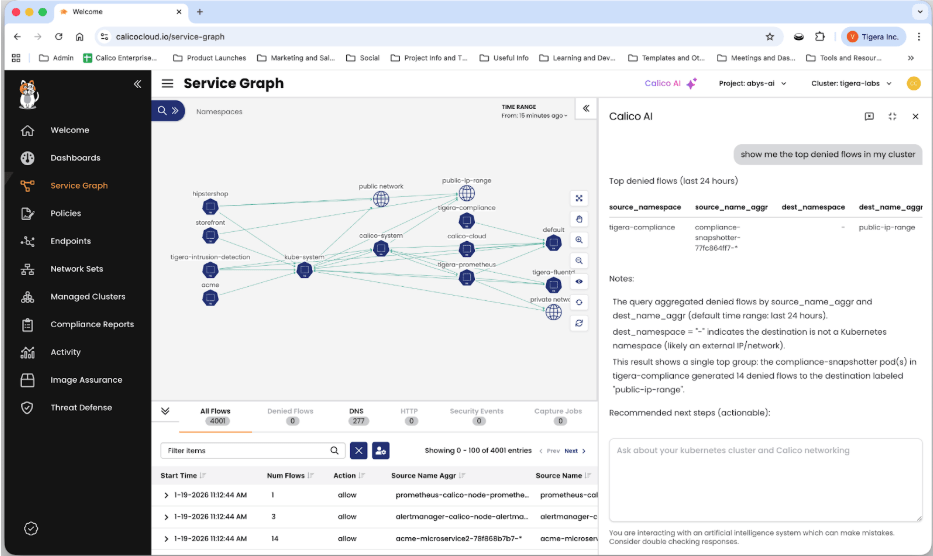
AI Assistant for Calico can quickly get you the information you need
Proactive Security and Policy Optimization
While reactive troubleshooting is critical, the AI Assistant for Calico also enables a proactive security posture by identifying misconfigurations and security gaps that might otherwise go unnoticed:
-
- Surfacing Exposure Risks: The AI Assistant can identify workloads exposed to the internet or detect egress exposure risks, such as pods communicating with unrestricted external destinations.
- Policy Recommendations and Generation: Instead of starting from scratch, users can ask the AI to recommend a base policy or generate a specific snippet, such as a policy to block all egress traffic from a specific training pod.
- Cleaning up the Mesh: The assistant helps maintain cluster stability and security hygiene by detecting unused or missing network policies.
- Identifying Gaps: It proactively surfaces network flows that have no policies applied to them, ensuring that the principle of least privilege is maintained across the cluster—a key requirement highlighted in the 2025 GigaOm Radar for Container Networking.
These capabilities streamline the time-consuming and error-prone process of manually managing intricate policy syntax, making for more stable, performant, and secure clusters.
Real-World Scenario: Rapidly Resolving a Blocked Service Connection
To see the impact of these capabilities, consider a common high-pressure situation for a platform engineer. An engineer receives an urgent alert that a critical production service is unable to communicate with its database.
In a traditional environment, the engineer would spend 30 to 60 minutes manually checking network policies, inspecting flow logs, and verifying namespace labels across multiple clusters to find the culprit. Every minute of manual investigation increases the risk of service downtime and customer frustration.
The AI Solution: Instead of manual log diving, the engineer asks the AI Assistant for Calico a direct question: “Why is the frontend-service in the production namespace unable to reach the db-service?”. The AI instantly analyzes the environment and identifies that a recent policy update is missing a necessary egress rule for the specific database port. Total resolution time is reduced from over an hour to just a few minutes.
Thinking ahead, the engineer asks for an audit of all staged policies. AI Assistant for Calico finds another incorrect policy—this one with a misspelled label selector—averting a future outage.
View Interactive Demo: Exploring Assistant for Calico →
A New Standard for Platform Operations
The introduction of the AI Assistant for Calico in the Winter 2026 release is the next step in observability and Kubernetes management. By adding the ability to interrogate a cluster in plain English, Calico’s unified platform bridges the gap between high-fidelity telemetry data and practical solutions
Beyond the immediate operational gains, this AI-powered approach fits into a broader strategy of defense in depth and operational simplicity, specifically regarding ingress security for AI workloads. It removes the friction of complex debugging, accelerates onboarding for new team members, and ensures that your security posture remains consistent even as your architecture scales.
Experience the Power of AI Assistant for Calico
Ready to see how AI can accelerate your Kubernetes troubleshooting and network policy management?
Watch the On-Demand Demo
Sign Up for Calico Cloud (Free Trial)
The post AI Assistant for Calico: Troubleshooting at the Speed of Thought appeared first on Tigera - Creator of Calico.


Top comments (0)