


llm_providers:
- name: "openai_primary" type: "openai" api_key_env: "OPENAI_API_KEY_PRIMARY" models: ["gpt-4o"]
- name: "anthropic_fallback" type: "anthropic" api_key_env: "ANTHROPIC_API_KEY_FALLBACK" models: ["claude-3-5-sonnet"]
- name: "google_gemini_fallback" type: "google-gemini" api_key_env: "GOOGLE_GEMINI_API_KEY_FALLBACK" models: ["gemini-1.5-pro"]
routing_rules:
- path: "/v1/chat/completions"
fallbacks:
- provider: "openai_primary"
- provider: "anthropic_fallback"
- provider: "google_gemini_fallback"
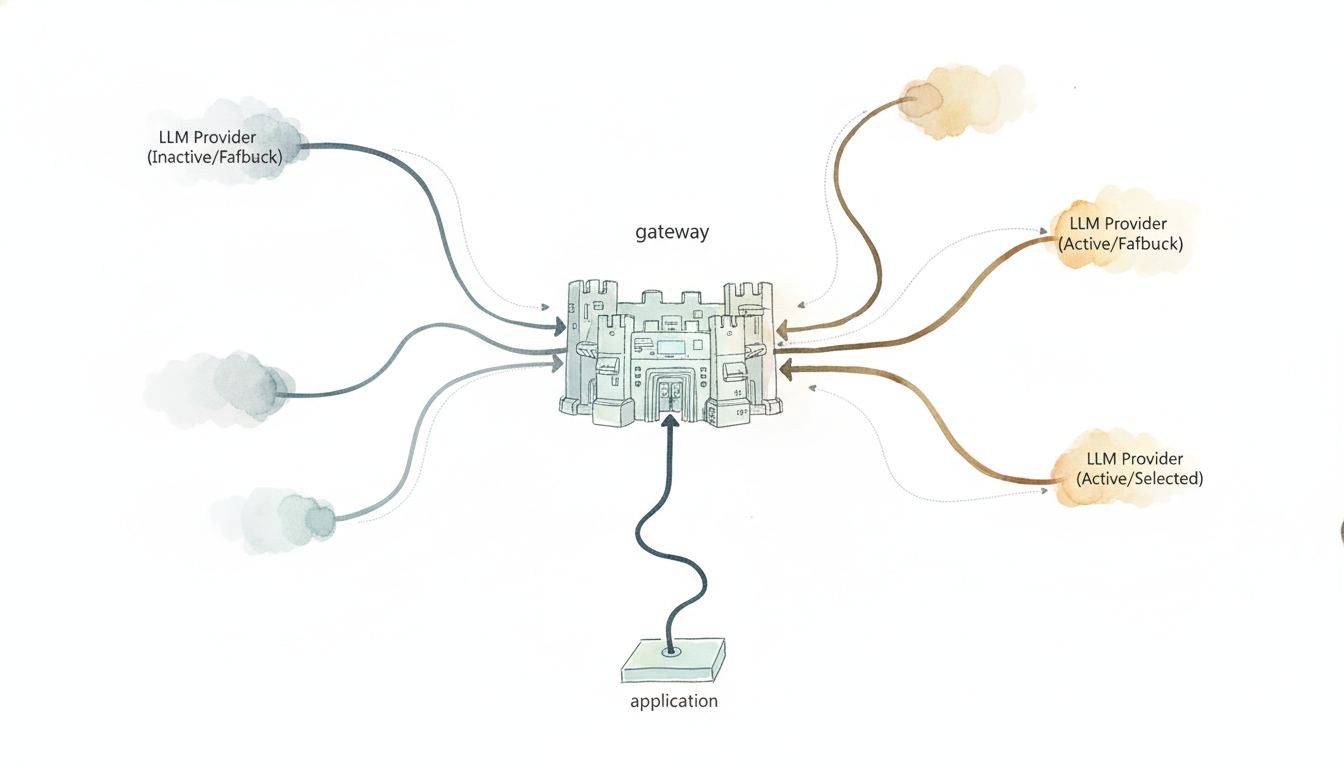
## Key Considerations for Implementing LLM Fallbacks
When designing an LLM fallback strategy, several factors contribute to its effectiveness:
* **Failure Detection:** Beyond simple HTTP error codes, robust systems should detect issues like unusually high latency, malformed responses, or model degradation [17]. Health checks and circuit breaker patterns are essential [17].
* **Fallback Model Selection:** Not all fallbacks need to match the primary model's quality. A tiered quality fallback strategy can gracefully degrade performance rather than failing outright, potentially routing to a cheaper or less capable model as a last resort [4, 17, 31]. This requires careful evaluation to ensure fallback models provide acceptable output quality [31].
* **Cost Management:** Fallback mechanisms can optimize costs by prioritizing cheaper models or by hedging requests only for latency-sensitive paths [4, 17]. However, parallel hedged requests can double costs during the hedging window, making them suitable for specific, high-priority workloads [4].
* **Observability:** Robust monitoring of fallback trigger rates, success rates at different positions in the fallback chain, and latency per provider is crucial [4, 16]. This helps identify consistent issues with primary providers or suboptimal fallback configurations.
* **Prompt Compatibility:** Different LLMs may require slightly different prompting strategies to achieve comparable results. Normalizing system prompts and validating responses across fallback models is vital to prevent "silent degradation" where the response is technically successful but functionally incorrect [22, 31].
## Future-Proofing LLM Infrastructure
The LLM ecosystem continues to evolve rapidly, with new models and providers emerging frequently. A flexible fallback strategy prepares an application for this dynamic environment. By abstracting the LLM provider layer behind a dedicated gateway, teams can change, add, or remove providers without altering application code [31]. This agility allows applications to quickly adapt to new offerings, optimize for cost and performance, and maintain resilience against an unpredictable external landscape.
Teams evaluating AI gateways can [request a Bifrost demo](https://getmaxim.ai/bifrost/book-a-demo) or review the [open-source repository](https://github.com/maximhq/bifrost) to explore how robust fallback mechanisms can harden their AI applications against the inevitable challenges of production environments.
## Sources
* [1] [LiteLLM Proxy: The Open-Source Alternative for Multi-Provider LLM Failover and Load Balancing - DEV Community](https://dev.to/berriai/litellm-proxy-the-open-source-alternative-for-multi-provider-llm-failover-and-load-balancing-4f51)
* [4] [Failover Routing Strategies for LLMs in Enterprise AI Applications - Maxim AI](https://www.getmaxim.ai/bifrost/blog/failover-routing-strategies-for-llms-in-enterprise-ai-applications)
* [6] [Why you should not build your application on top of OpenAI's APIs - Miyagami Amsterdam](https://miyagami.com/blog/building-on-openai-risks)
* [13] [Your Primary LLM Provider Failed? Enable Automatic Fallback with Bifrost - Maxim AI](https://www.getmaxim.ai/bifrost/blog/llm-provider-fallback-bifrost)
* [16] [Multi-Provider LLM Resilience: Failover, Quotas, and Drift](https://www.assemblyai.com/blog/multi-provider-llm-resilience-failover-quotas-and-drift)


Top comments (0)