

{"id":447,"date":"2026-10-11T00:29:31","date_gmt":"2026-10-11T00:29:31","guid":{"rendered":"https://aiflowpm.com/wp-content/uploads/2026/10/what-exactly-is-a-release-candidate-in-agile-delivery-diagram.jpg","raw":"https://aiflowpm.com/wp-content/uploads/2026/10/what-exactly-is-a-release-candidate-in-agile-delivery-diagram.jpg"},"modified":"2026-10-11T00:29:31","modified_gmt":"2026-10-11T00:29:31","slug":"what-exactly-is-a-release-candidate-in-agile-delivery-workflow-diagram","status":"inherit","type":"attachment","link":"https://aiflowpm.com/what-exactly-is-a-release-candidate-in-agile-delivery-workflow-diagram/","title":{"raw":"What Exactly is a Release Candidate in Agile Delivery? - Workflow Diagram","rendered":"What Exactly is a Release Candidate in Agile Delivery? – Workflow Diagram"},"author":1,"featured_media":0,"comment_status":"","ping_status":"closed","template":"","meta":[],"permalink_template":"https://aiflowpm.com/?attachment_id=447","generated_slug":"what-exactly-is-a-release-candidate-in-agile-delivery-workflow-diagram","class_list":["post-447","attachment","type-attachment","status-inherit","hentry"],"description":{"raw":"","rendered":"
"},"caption":{"raw":"","rendered":""},"alt_text":"What Exactly is a Release Candidate in Agile Delivery? - Architecture & Framework","media_type":"image","mime_type":"image/jpeg","media_details":{"width":900,"height":725,"file":"2026/10/what-exactly-is-a-release-candidate-in-agile-delivery-diagram.jpg","filesize":145458,"sizes":{"medium":{"file":"what-exactly-is-a-release-candidate-in-agile-delivery-diagram-300x242.jpg","width":300,"height":242,"filesize":21628,"mime_type":"image/jpeg","source_url":"https://aiflowpm.com/wp-content/uploads/2026/10/what-exactly-is-a-release-candidate-in-agile-delivery-diagram-300x242.jpg"},"thumbnail":{"file":"what-exactly-is-a-release-candidate-in-agile-delivery-diagram-150x150.jpg","width":150,"height":150,"filesize":7910,"mime_type":"image/jpeg","source_url":"https://aiflowpm.com/wp-content/uploads/2026/10/what-exactly-is-a-release-candidate-in-agile-delivery-diagram-150x150.jpg"},"medium_large":{"file":"what-exactly-is-a-release-candidate-in-agile-delivery-diagram-768x619.jpg","width":768,"height":619,"filesize":102613,"mime_type":"image/jpeg","source_url":"https://aiflowpm.com/wp-content/uploads/2026/10/what-exactly-is-a-release-candidate-in-agile-delivery-diagram-768x619.jpg"},"full":{"file":"what-exactly-is-a-release-candidate-in-agile-delivery-diagram.jpg","width":900,"height":725,"mime_type":"image/jpeg","source_url":"https://aiflowpm.com/wp-content/uploads/2026/10/what-exactly-is-a-release-candidate-in-agile-delivery-diagram.jpg"}},"image_meta":{"aperture":"0","credit":"","camera":"","caption":"","created_timestamp":"0","copyright":"","focal_length":"0","iso":"0","shutter_speed":"0","title":"","orientation":"0","keywords":[],"alt":""}},"post":null,"source_url":"https://aiflowpm.com/wp-content/uploads/2026/10/what-exactly-is-a-release-candidate-in-agile-delivery-diagram.jpg","missing_image_sizes":[],"filename":"what-exactly-is-a-release-candidate-in-agile-delivery-diagram.jpg","filesize":145458,"exif_orientation":1,"image_output_format":null,"image_save_progressive":false,"image_quality":{"default":82,"sizes":[]},"_links":{"self":[{"href":"https://aiflowpm.com/wp-json/wp/v2/media/447","targetHints":{"allow":["GET","POST","PUT","PATCH","DELETE"]}}],"collection":[{"href":"https://aiflowpm.com/wp-json/wp/v2/media"}],"about":[{"href":"https://aiflowpm.com/wp-json/wp/v2/types/attachment"}],"author":[{"embeddable":true,"href":"https://aiflowpm.com/wp-json/wp/v2/users/1"}],"replies":[{"embeddable":true,"href":"https://aiflowpm.com/wp-json/wp/v2/comments?post=447"}],"wp:action-unfiltered-html":[{"href":"https://aiflowpm.com/wp-json/wp/v2/media/447"}],"wp:action-assign-author":[{"href":"https://aiflowpm.com/wp-json/wp/v2/media/447"}],"curies":[{"name":"wp","href":"https://api.w.org/{rel}","templated":true}]},"post_title":"Is Your Release Candidate Actually Ready, Or Is It Sprint Spillover?","post_content":"
What Exactly is a Release Candidate in Agile Delivery?
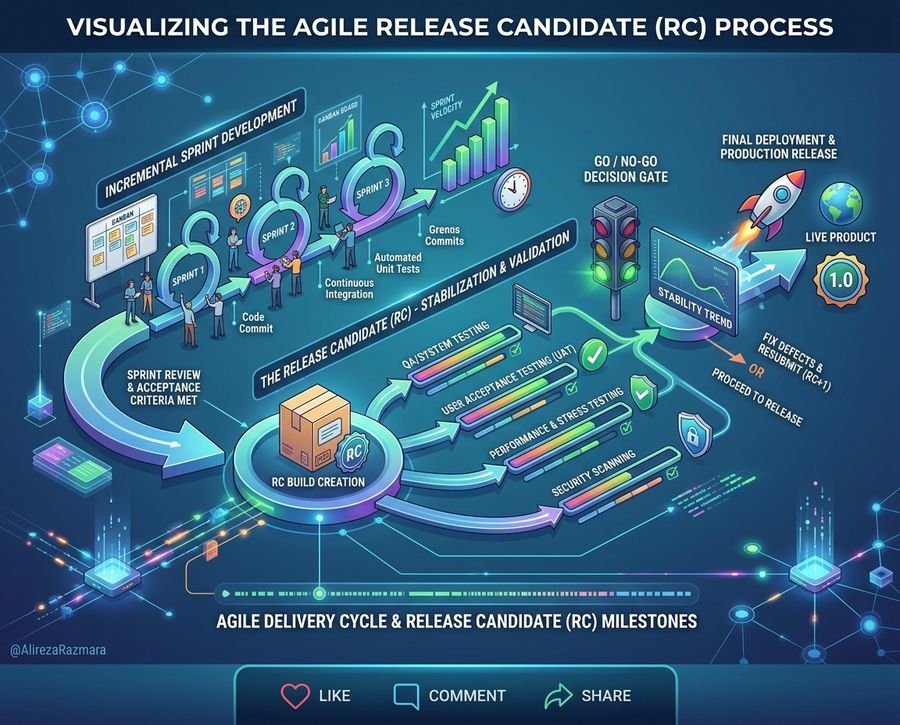
A Release Candidate (RC) is the final, immutable software build intended for production deployment, serving as a definitive verification gate rather than a phase for ongoing development. It represents a completed, sealed increment of work where no new code is introduced unless it addresses a critical deployment blocker.
Too often, engineering teams treat a Release Candidate as a chaotic playground for last-minute fixes and prolonged manual testing. I see this anti-pattern constantly when auditing delivery pipelines. You look at the sprint board, and the RC phase is just a disguise for work that spilled over from the last sprint.
In high-performing Agile and DevOps cultures, an RC isn't a rough draft. It is a promise. A true Release Candidate is the exact build you bet on shipping to production—unless a critical, show-stopping issue proves otherwise. If your RC phase involves developers actively writing new features or tweaking UI elements, it is not an RC. It is just another development build. The core purpose of the Release Candidate is risk mitigation. You are transitioning entirely from value creation to validation. When teams fail to understand this boundary, they slip into bad habits that ultimately sabotage their delivery speed.
Spotting the "Sprint Spillover" Disguise
Sprint spillover masquerading as a Release Candidate happens when incomplete sprint work is pushed into a stabilization phase instead of being moved back to the product backlog. You can spot this dysfunction when an RC cycle drags on for weeks while developers actively fix minor bugs that should have been caught during standard sprint testing.
If your team spends two to three weeks "stabilizing" an RC, you do not have an agile pipeline. You have a mini-Waterfall cycle dressed up in Scrum terminology. This extended phase usually reveals deep flaws in how the team manages its Definition of Done (DoD). Look for these glaring symptoms in your workflow:
- The Infinite RC Loop: RC1 turns into RC2, which turns into RC15. You are compiling constantly because the build was never genuinely stable to begin with.
- In-Flight Patching: Instead of killing a bad RC and building a new one from the main branch, engineers hotfix the RC branch directly. This creates version control chaos and environment divergence.
- Scope Creep: "Since we are testing this anyway, can we just slip in this one tiny change?" This mentality destroys the predictability of the release.
Accepting these symptoms as "normal" creates a culture where developers throw code over the wall, assuming QA will catch the resulting mess during the stabilization phase. It completely undermines developer accountability and shifts the burden of quality to the very end of the cycle.
Four Pillars of a Mature Release Candidate Workflow
A mature release candidate workflow relies on artifact immutability, strict blocker criteria, absolute feature freezes, and clear business alignment. These four elements ensure that releasing software becomes a predictable, low-risk event rather than a stressful, highly manual marathon.
1. Absolute Code and Feature Freeze
The scope must be definitively sealed. Zero new features. Zero "small tweaks." When a build is tagged as an RC, the engineering focus shifts entirely toward validation and risk mitigation. If a product owner, stakeholder, or even a lead developer wants a new change, it goes into the next sprint and the next release cycle. Boundaries matter. Enforcing this freeze forces teams to prioritize correctly during active development, rather than relying on the RC as a safety net for forgotten requirements.
2. Strict Artifact Immutability
What you test in your staging environment must be the identical binary artifact that goes live in production. You do not rebuild the code for production. This principle is non-negotiable. If you find a blocker, you don't patch the RC in-flight. You scrap it. You fix the issue in your main development branch, run your full suite of automated tests, and then generate RC2. This "build once, deploy anywhere" mentality prevents environment-specific anomalies and ensures your staging test results actually guarantee production stability.
3. Ruthless P0/Blocker Criteria
An RC is not the place to fix cosmetic edge cases. The only issues that justify stopping a release are severe bugs that risk data integrity, create security vulnerabilities, or break core business workflows. If a button is misaligned by three pixels, or a secondary tooltip has a typo, that is technical debt for the backlog. It is not a release blocker. Teams must agree on a strict severity matrix before the RC is cut, removing subjective emotional decisions from the deployment pipeline.
4. Business Alignment and Go-To-Market Confidence
A stable RC gives Product Managers, Customer Success, and Operations teams the runway to prepare. They can finalize release notes, train customer support staff, and execute go-to-market strategies with absolute confidence. When an RC is constantly shifting, breaking, or delayed, the business teams are left guessing. This unpredictability erodes trust in the engineering department and impacts the bottom line.
  <figure class="wp-block-image aligncenter size-large" style="margin: 35px auto; text-align: center;">
    <img src="https://aiflowpm.com/wp-content/uploads/2026/10/what-exactly-is-a-release-candidate-in-agile-delivery-diagram.jpg" alt="Spotting the "Sprint Spillover" Disguise - Step-by-Step Architecture" title="Spotting the "Sprint Spillover" Disguise" loading="lazy" style="border-radius: 8px; max-width: 100%; height: auto; box-shadow: 0 4px 12px rgba(0,0,0,0.08);" />
    <figcaption style="font-size: 13px; color: #64748b; margin-top: 8px;">Figure: Spotting the "Sprint Spillover" Disguise</figcaption>
  </figure>
</p>
Metrics That Reveal Your Release Candidate Health
To accurately measure the health of your Release Candidate process, track your Lead Time for Changes, Change Failure Rate, and RC Rejection Rate. These DevOps metrics expose whether your RC is a true verification gate or just a disguised stabilization phase.
RC Rejection Rate: How often is an RC rejected and sent back for a rebuild? If you are frequently abandoning RC1 to build RC5, your upstream quality checks are failing. A high rejection rate means code is being merged before it is genuinely ready.
Lead Time for Changes: Measure the time from a commit being merged to that commit running in production. If your RC phase takes three weeks, your Lead Time will be abysmal, severely limiting your ability to respond to market changes or customer feedback.
Change Failure Rate: If you are spending weeks testing an RC manually and still pushing bugs into production, your manual stabilization phase is not just slow—it is actively ineffective. High change failure rates despite long RC phases indicate a desperate need for automated regression testing.
How to Stop the Stabilization Marathon
To stop prolonged release candidate stabilization, teams must invest heavily in automated regression testing, shift-left quality practices, and feature flag architectures. The goal is to move the heavy lifting of Quality Assurance into the active sprint, long before a build is tagged for release.
Manual testing at the RC stage should be highly targeted and minimal. Think exploratory testing, usability verification, or complex end-to-end integration checks that automation cannot easily handle. The moment a developer submits a pull request, your CI/CD pipeline should be running unit tests, integration tests, static code analysis, and security scans.
Feature flags are the ultimate tactical advantage here. If a non-critical feature is causing friction during the RC phase, you do not need to hold up the entire release. You simply toggle the feature off, deploy the RC on schedule, and fix the isolated issue in a subsequent sprint. Decoupling deployment from feature release is a massive step forward in agile maturity. It allows the pipeline to keep moving even when individual features stumble.
The Agile Coach's Reality Check: Making Deployments Boring
A successful release candidate process is intentionally boring. Deployments should be non-events backed by robust automated testing, seamless CI/CD pipelines, and high engineering confidence. They should not require late nights, weekend war rooms, or panicked executive sign-offs.
If your current process feels like a heavy manual sign-off marathon fueled by organizational anxiety, you need to step back. Look closely at your Definition of Done. Are developers throwing code over the wall to QA on the last day of the sprint? Are you trying to inspect quality into the product at the last minute instead of building it in from the start?
Real agility means confronting these workflow bottlenecks directly. Stop treating the Release Candidate as a safety net for sloppy sprint execution. Treat your next RC as the promise it was always meant to be. Commit to the immutable artifact. Enforce the feature freeze ruthlessly. Watch how quickly the anxiety fades, replaced by the quiet, undeniable confidence of a team that knows exactly what they are shipping.
","post_slug":"release-candidate-vs-sprint-spillover","category_id":9}Originally published at https://aiflowpm.com/release-candidate-vs-sprint-spillover/


Top comments (0)