


Introduction
I tried MiniStack, a free local AWS emulator, and StackPort, a browser-based viewer for its resources.
 ministackorg
/
ministack
ministackorg
/
ministack
Ministack: Free, open-source local AWS emulator - 60+ services, Terraform compatible, real databases. Free forever. MIT licensed.

MiniStack
Free, open-source local AWS emulator. Free forever.
60+ AWS services on a single port · Multi-account & multi-region · Terraform compatible · Real databases · MIT licensed






Ministack.org · Docker Hub · LinkedIn
Why MiniStack?
LocalStack recently moved its core services behind a paid plan. If you relied on LocalStack Community for local development and CI/CD pipelines, MiniStack is your free alternative.
- 60+ AWS services emulated on a single port (4566)
-
Drop-in compatible — works with
boto3, AWS CLI, Terraform, CDK, Pulumi, any SDK - Multi-account & multi-region — a 12-digit access key becomes the account, the SigV4 region scopes the state; isolated tenants and regions on one endpoint, like real AWS
-
Amazon Bedrock locally — Converse / InvokeModel with AWS-exact wire shapes; point
MINISTACK_BEDROCK_PROXY_URLat Ollama, llama.cpp, or vLLM and get real completions through the Bedrock API - Real infrastructure — RDS spins up actual Postgres/MySQL containers, ElastiCache spins…
DaviReisVieira
/
stackport
Open-source universal AWS resource browser for MiniStack, Floci, LocalStack, Moto, and real AWS
StackPort
Universal AWS resource browser for local emulators and real AWS accounts.
Browse, inspect, and manage resources across 35 AWS services with dedicated UIs for S3, DynamoDB, Lambda, SQS, IAM, EC2, CloudWatch Logs, and Secrets Manager.






Screenshots
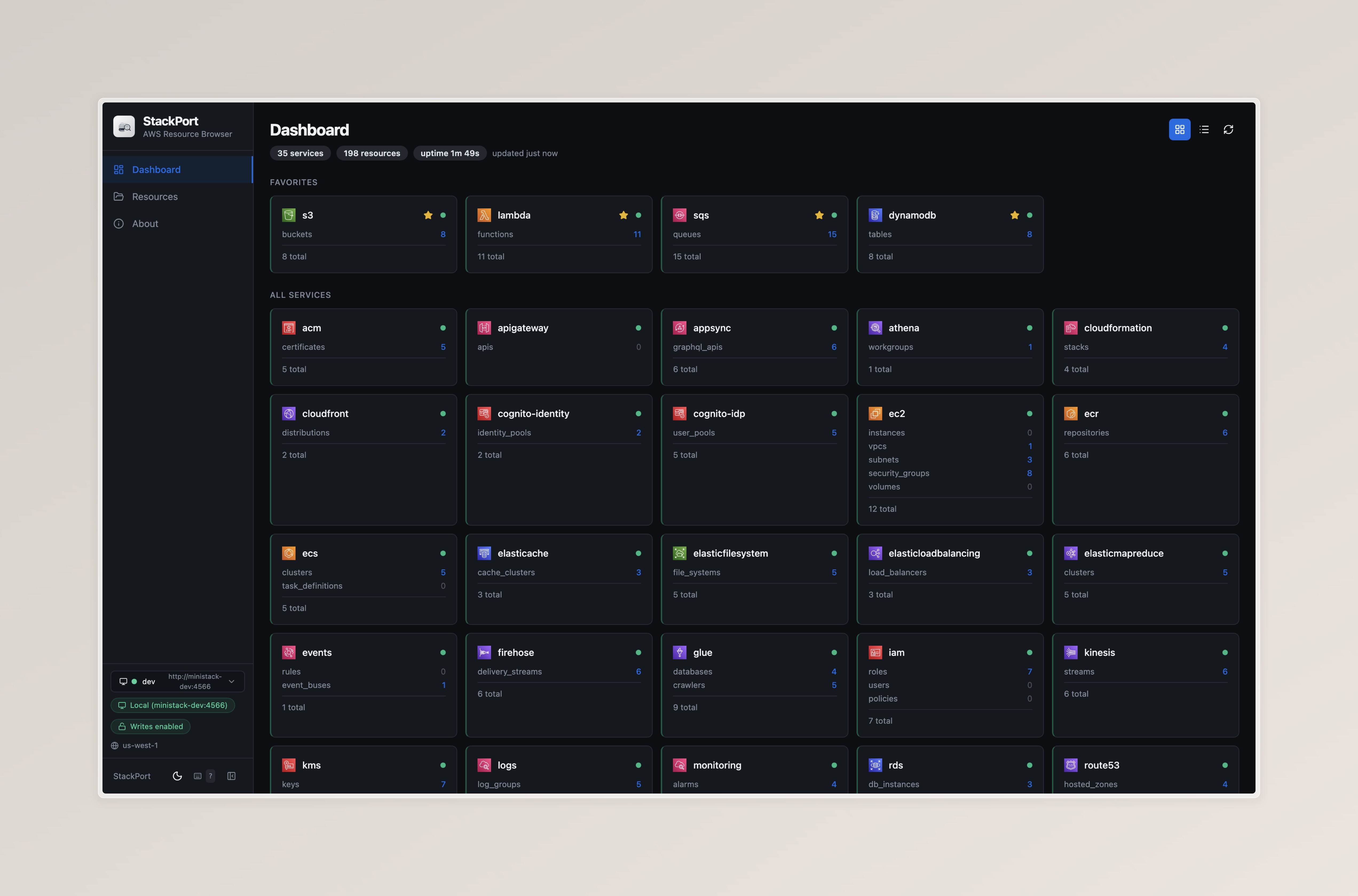
Dashboard — Service overview with resource counts and health status
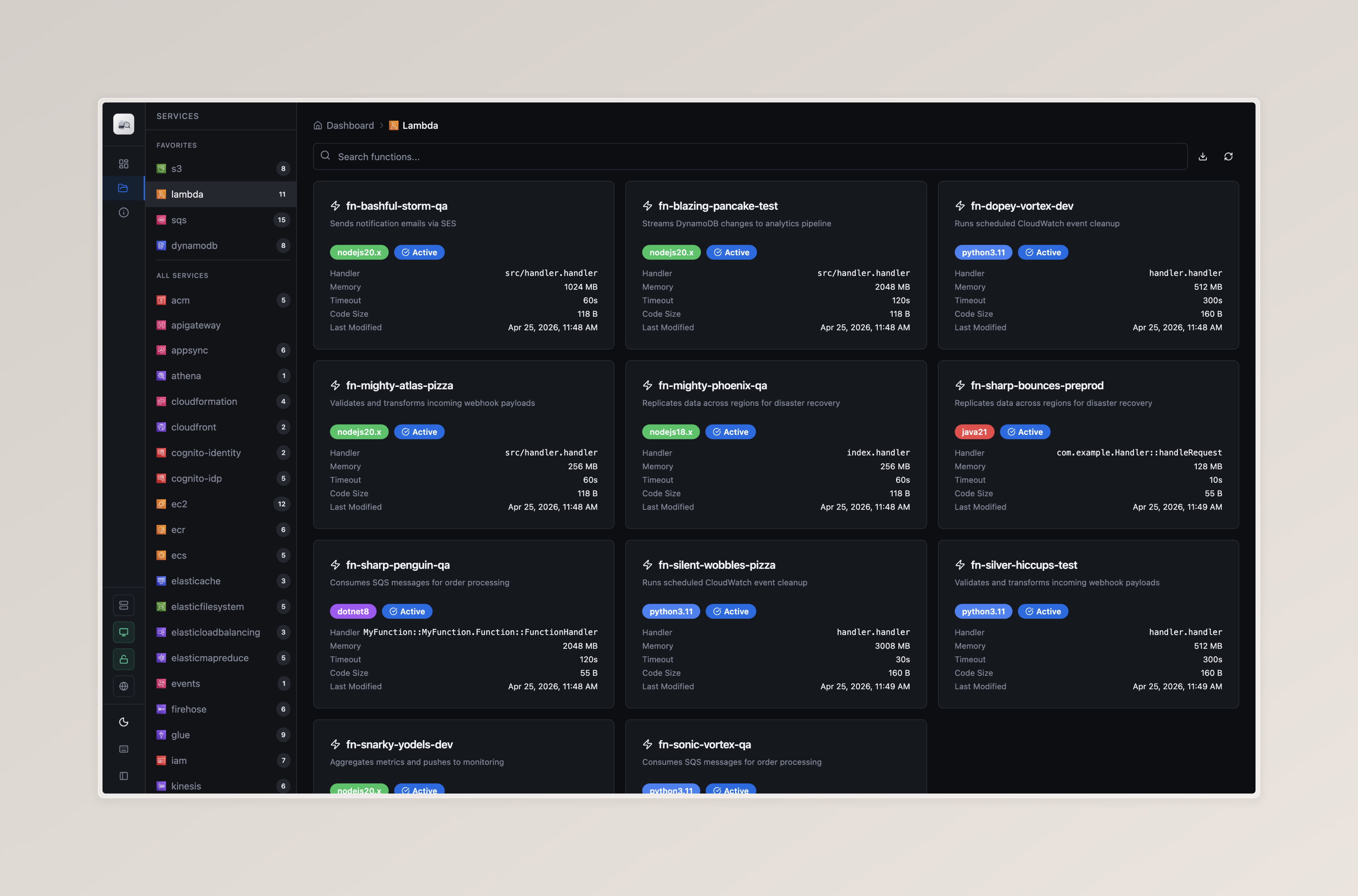
Lambda Browser — Function list with config, aliases, versions, event sources, and invocation panel
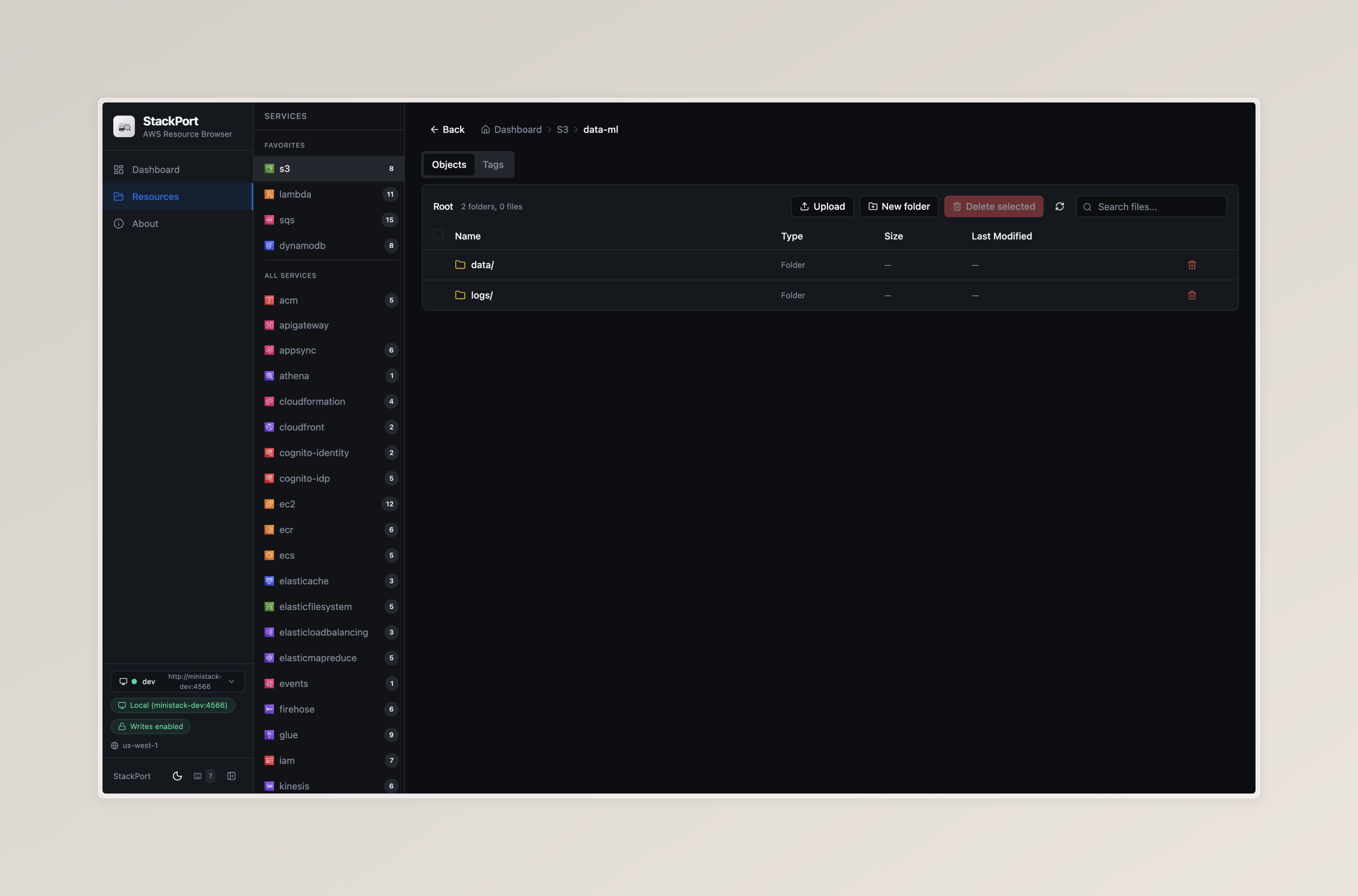
S3 Browser — File browser with upload, download, folder navigation, and tagging
Features
- Browse and inspect resources across 35 AWS services
- 8 dedicated service UIs for S3, DynamoDB, Lambda, SQS, IAM, EC2, CloudWatch Logs, and Secrets Manager
- Write operations — upload/delete S3 objects, query DynamoDB, invoke Lambda, send/receive SQS messages
- Real AWS support — connect to real AWS accounts with read-only mode by default
- Per-endpoint authentication — default credentials, AWS profiles (SSO/AssumeRole), or static keys per endpoint
- Guided lessons — hands-on AWS tutorials that run inside the console and…
This article builds the following pipeline:
EventBridge Scheduler invokes a Lambda function on a schedule
The Lambda function calls an API and publishes the result to SNS
SNS triggers a second Lambda function, which posts to a Slack Incoming Webhook
The API key and the Webhook URL are stored as SecureString parameters in SSM Parameter Store
What Are MiniStack and StackPort?
MiniStack
MiniStack is a local AWS emulator under the MIT license. You can use more than 60 AWS services directly from the AWS CLI, boto3, Terraform, and CDK.

MiniStack — The Best AWS Emulator | Free Open-Source LocalStack Alternative
The best AWS emulator and the best alternative to LocalStack. 60+ AWS services free forever — real Postgres, Redis, Docker containers, full Terraform / CDK / Pulumi support. MIT licensed.
 ministack.org
StackPort
StackPort is a tool for browsing the resources of local emulators and real AWS accounts in a browser. It connects to emulators other than MiniStack (such as LocalStack) and to real AWS accounts.

StackPort: open-source web console for AWS emulators
StackPort is a free, open-source web console for MiniStack, Floci, LocalStack, Moto and real AWS. Browse 35 services, use 13 dedicated views, and learn AWS with guided lessons. One Docker image.
 stackport.cloud
StackPort lets you browse the resources of 35 services.
Eight of them have dedicated screens: S3, DynamoDB, Lambda, SQS, IAM, EC2, CloudWatch Logs, and Secrets Manager. For example, CloudWatch Logs lets you drill down from log groups to log streams to log events.
The other services (such as SSM in this article) are shown as a searchable resource table with a JSON detail view.
Note that StackPort does not support EventBridge Scheduler. The events service only shows EventBridge rules and event buses, so I check the schedule with the CLI.
Architecture
Locally, I run a mock server (mock-api) in place of the external API. For Slack, I use a real Incoming Webhook, with separate channels for the local and AWS environments.

Two things differ between the local environment and real AWS:
External API:
mock-apilocally, API Gateway (MOCK integration) on real AWS. Both returnGET /v1/statusSlack destination:
#notify-demo-locallocally,#notify-demo-awson real AWS
The directory structure is as follows. Terraform is split into a shared module (modules/notify) and one directory per environment (environments/local and environments/aws). Each environment has its own state.
code/
├── lambda/                          # Shared: the same code runs locally and on real AWS
│   ├── fetch_status/
│   │   └── app.py
│   └── notify_slack/
│       └── app.py
├── mock-api/                        # Local only: mock server standing in for the external API
│   ├── Dockerfile
│   └── server.py
├── scripts/
│   ├── put-parameters-aws.sh        # AWS only: registers parameters in the real SSM
│   └── put-parameters.sh            # Local only: registers parameters in MiniStack's SSM
├── terraform/
│   ├── environments/
│   │   ├── aws/                     # For real AWS: points at real AWS
│   │   │   ├── main.tf
│   │   │   ├── outputs.tf
│   │   │   ├── providers.tf
│   │   │   ├── terraform.tfvars
│   │   │   ├── terraform.tfvars.example
│   │   │   └── variables.tf
│   │   └── local/                   # For local: points at MiniStack
│   │       ├── main.tf
│   │       ├── outputs.tf
│   │       ├── providers.tf
│   │       ├── terraform.tfvars
│   │       ├── terraform.tfvars.example
│   │       └── variables.tf
│   └── modules/
│       └── notify/                  # Shared: Lambda, SNS, Scheduler, IAM, and more
│           ├── main.tf
│           ├── outputs.tf
│           ├── variables.tf
│           └── versions.tf
└── docker-compose.yml               # Local only: starts MiniStack, StackPort, and mock-api
Building the Local Environment
You need Docker (Docker Desktop, OrbStack, and so on), Terraform, and the AWS CLI.
Step 1: Start MiniStack, StackPort, and the Mock Server
Start three containers with docker-compose.yml.
services:
  ministack:
    image: ministackorg/ministack:latest
    ports:
      - "4566:4566"
    environment:
      - MINISTACK_REGION=ap-northeast-1
    healthcheck:
      test:
        [
          "CMD",
          "python",
          "-c",
          "import urllib.request; urllib.request.urlopen('http://localhost:4566/_ministack/health')",
        ]
      interval: 5s
      timeout: 3s
      retries: 5

  stackport:
    image: davireis/stackport:latest
    ports:
      - "8080:8080"
    environment:
      - AWS_ENDPOINT_URL=http://ministack:4566
      - AWS_REGION=ap-northeast-1
      - AWS_ACCESS_KEY_ID=test
      - AWS_SECRET_ACCESS_KEY=test
    healthcheck:
      test:
        [
          "CMD",
          "python",
          "-c",
          "import urllib.request; urllib.request.urlopen('http://localhost:8080/api/health')",
        ]
      interval: 10s
      timeout: 3s
      retries: 3
    restart: unless-stopped
    depends_on:
      ministack:
        condition: service_healthy

  # Mock server standing in for the external API
  mock-api:
    build: ./mock-api
    ports:
      - "8000:8000"
    environment:
      - EXPECTED_API_KEY=local-dummy-api-key
The three containers are:
-
ministack: the local AWS emulator. It accepts AWS API calls on port4566 -
stackport: a web UI for browsing MiniStack's resources. It opens on port8080 -
mock-api: a mock server standing in for the external API. It runs on port8000
mock-api is written with only the Python standard library. It has one endpoint that validates the x-api-key header and returns a status.
    def do_GET(self):
        if self.path == "/v1/status":
            if self.headers.get("x-api-key") != EXPECTED_API_KEY:
                return self._send(403, {"message": "Forbidden"})
            return self._send(200, {"status": "ok"})
        return self._send(404, {"message": "not found"})
Start the containers.
cd code
docker compose up -d --build
Open http://localhost:8080 in a browser to see the StackPort dashboard.

Step 2: Register SecureString Parameters in SSM Parameter Store
I register the API key and the Webhook URL outside Terraform.
If you create them as aws_ssm_parameter resources in Terraform, the values remain in the state file in plain text. Write-only arguments (value_wo) in Terraform 1.11 and later keep them out of the state, but I don't use them here.
I prepared a script (scripts/put-parameters.sh) to register them.
#!/usr/bin/env bash
set -euo pipefail

: "${SLACK_WEBHOOK_URL:?Set SLACK_WEBHOOK_URL}"

export AWS_ACCESS_KEY_ID=test
export AWS_SECRET_ACCESS_KEY=test
export AWS_DEFAULT_REGION=ap-northeast-1
ENDPOINT=http://localhost:4566

aws --endpoint-url="$ENDPOINT" ssm put-parameter \
  --name /notify-demo/api-key \
  --type SecureString \
  --value local-dummy-api-key \
  --overwrite

aws --endpoint-url="$ENDPOINT" ssm put-parameter \
  --name /notify-demo/slack-webhook-url \
  --type SecureString \
  --value "$SLACK_WEBHOOK_URL" \
  --overwrite
For the Webhook URL, I use an Incoming Webhook issued for a Slack channel dedicated to local testing (#notify-demo-local).
SLACK_WEBHOOK_URL=<Webhook URL of the local channel> ./scripts/put-parameters.sh
Running the script adds the parameters.

The displayed value is ENCRYPTED: followed by a base64 string. It is not encrypted with KMS, and anyone can decode it back to the original value, so be careful when sharing screenshots.

Step 3: Write the Lambda Code
This is the Lambda function that calls the API (fetch_status). It gets the API key from SSM and publishes the API response to SNS.
import json
import os
import urllib.request

import boto3

ssm = boto3.client("ssm")
sns = boto3.client("sns")

API_BASE_URL = os.environ["API_BASE_URL"]
API_KEY_PARAM = os.environ["API_KEY_PARAM"]
RESULT_TOPIC_ARN = os.environ["RESULT_TOPIC_ARN"]

_api_key = None


def get_api_key():
    # Fetch from SSM only on a cold start; use the cache afterwards
    global _api_key
    if _api_key is None:
        res = ssm.get_parameter(Name=API_KEY_PARAM, WithDecryption=True)
        _api_key = res["Parameter"]["Value"]
    return _api_key


def handler(event, context):
    req = urllib.request.Request(
        f"{API_BASE_URL}/v1/status",
        headers={"x-api-key": get_api_key()},
    )
    # 4xx/5xx raise HTTPError, which makes the Lambda invocation fail
    with urllib.request.urlopen(req, timeout=10) as res:
        result = json.loads(res.read())
    print(f"API status: {result['status']}")

    sns.publish(
        TopicArn=RESULT_TOPIC_ARN,
        Subject="API status check",
        Message=json.dumps(result, ensure_ascii=False),
    )
    return result
This is the Lambda function for Slack notifications (notify_slack). It extracts the SNS message and posts it to the Webhook.
def handler(event, context):
    for record in event["Records"]:
        result = json.loads(record["Sns"]["Message"])
        now = datetime.now().astimezone().strftime("%Y-%m-%d %H:%M:%S %Z")
        text = f":white_check_mark: API status: {result['status']} ({now})"

        req = urllib.request.Request(
            get_webhook_url(),
            data=json.dumps({"text": text}).encode(),
            headers={"Content-Type": "application/json"},
            method="POST",
        )
        with urllib.request.urlopen(req, timeout=10):
            pass
        print(text)
Neither piece of code contains any MiniStack-specific endpoint configuration. MiniStack injects AWS_ENDPOINT_URL into the Lambda execution environment, so boto3 automatically points at MiniStack. The same code can be deployed to real AWS as is.
Step 4: Create the Resources with Terraform
The resources live in the shared module (terraform/modules/notify/main.tf). I don't show every resource. Instead, I excerpt the points I designed to work on both MiniStack and real AWS.
The external API URL is passed through the module variable api_base_url.
resource "aws_lambda_function" "fetch_status" {
  function_name    = local.fetch_name
  role             = aws_iam_role.fetch_status.arn
  runtime          = "python3.14"
  handler          = "app.handler"
  filename         = data.archive_file.fetch_status.output_path
  source_code_hash = data.archive_file.fetch_status.output_base64sha256
  timeout          = 30

  environment {
    variables = {
      API_BASE_URL     = var.api_base_url
      API_KEY_PARAM    = local.api_key_param
      RESULT_TOPIC_ARN = aws_sns_topic.result.arn
    }
  }

  depends_on = [aws_cloudwatch_log_group.fetch_status]
}
terraform/environments/ contains one directory per environment (local and aws). Each has a main.tf that calls the shared module and its own environment-specific settings.
The only differences are providers.tf, which decides the connection target, and terraform.tfvars, which decides the external API URL.
Because the directories are separate, the state is also separate for each environment.
In terraform/environments/local/providers.tf, the provider points only the services I use at MiniStack.
provider "aws" {
  access_key                  = "test"
  secret_key                  = "test"
  region                      = "ap-northeast-1"
  skip_credentials_validation = true
  skip_metadata_api_check     = true
  skip_requesting_account_id  = true

  endpoints {
    iam       = "http://localhost:4566"
    lambda    = "http://localhost:4566"
    logs      = "http://localhost:4566"
    scheduler = "http://localhost:4566"
    sns       = "http://localhost:4566"
    ssm       = "http://localhost:4566"
    sts       = "http://localhost:4566"
  }
}
These are the settings that make it work with MiniStack:
access_key,secret_key: dummy values (test)region: the region to deploy toskip_credentials_validation: skips validating credentials through the STS APIskip_metadata_api_check: skips the check against the AWS metadata APIskip_requesting_account_id: skips retrieving the account IDendpoints: points each service at MiniStack. Specify only the services you use
The local directory (terraform/environments/local/main.tf) calls the module. The external API URL is passed through the variable api_base_url.
module "notify" {
  source = "../../modules/notify"

  region       = "ap-northeast-1"
  api_base_url = var.api_base_url
}
The variable's value goes in terraform/environments/local/terraform.tfvars. Because this file is not managed in Git, create it by copying the template (terraform.tfvars.example). The Lambda function runs inside the MiniStack container, so it reaches mock-api by its Compose service name.
api_base_url = "http://mock-api:8000"
Apply it.
cd terraform/environments/local
cp terraform.tfvars.example terraform.tfvars
# Edit terraform.tfvars if needed
terraform init
terraform apply
Here is the result. The resources are created in MiniStack's default account ID (000000000000).
$ terraform apply
module.notify.data.archive_file.notify_slack: Reading...
module.notify.data.archive_file.fetch_status: Reading...
module.notify.data.archive_file.notify_slack: Read complete after 0s [id=68fb7c506afbeeab169fb65494efc63dd8acba90]
module.notify.data.archive_file.fetch_status: Read complete after 0s [id=013b111cb8285884b651e501fd6f84ad373f787a]
module.notify.data.aws_iam_policy_document.lambda_assume: Reading...
module.notify.data.aws_caller_identity.current: Reading...
module.notify.data.aws_iam_policy_document.lambda_assume: Read complete after 0s [id=2690255455]
module.notify.data.aws_caller_identity.current: Read complete after 0s [id=000000000000]
module.notify.data.aws_iam_policy_document.scheduler_assume: Reading...
module.notify.data.aws_iam_policy_document.notify_slack: Reading...
module.notify.data.aws_iam_policy_document.scheduler_assume: Read complete after 0s [id=644537899]
module.notify.data.aws_iam_policy_document.notify_slack: Read complete after 0s [id=2364181876]
Terraform used the selected providers to generate the following execution plan. Resource actions are indicated with the following symbols:
+ create
<= read (data resources)
Terraform will perform the following actions:
# module.notify.data.aws_iam_policy_document.fetch_status will be read during apply
# (config refers to values not yet known)
<= data "aws_iam_policy_document" "fetch_status" {
+ id = (known after apply)
+ json = (known after apply)
+ minified_json = (known after apply)
+ statement {
+ actions = [
+ "ssm:GetParameter",
]
+ resources = [
+ "arn:aws:ssm:ap-northeast-1:000000000000:parameter/notify-demo/api-key",
]
}
+ statement {
+ actions = [
+ "sns:Publish",
]
+ resources = [
+ (known after apply),
]
}
}
# module.notify.data.aws_iam_policy_document.scheduler will be read during apply
# (config refers to values not yet known)
<= data "aws_iam_policy_document" "scheduler" {
+ id = (known after apply)
+ json = (known after apply)
+ minified_json = (known after apply)
+ statement {
+ actions = [
+ "lambda:InvokeFunction",
]
+ resources = [
+ (known after apply),
]
}
}
# module.notify.aws_cloudwatch_log_group.fetch_status will be created
+ resource "aws_cloudwatch_log_group" "fetch_status" {
+ arn = (known after apply)
+ deletion_protection_enabled = (known after apply)
+ id = (known after apply)
+ log_group_class = (known after apply)
+ name = "/aws/lambda/notify-demo-fetch-status"
+ name_prefix = (known after apply)
+ region = "ap-northeast-1"
+ retention_in_days = 7
+ skip_destroy = false
+ tags_all = (known after apply)
}
# module.notify.aws_cloudwatch_log_group.notify_slack will be created
+ resource "aws_cloudwatch_log_group" "notify_slack" {
+ arn = (known after apply)
+ deletion_protection_enabled = (known after apply)
+ id = (known after apply)
+ log_group_class = (known after apply)
+ name = "/aws/lambda/notify-demo-notify-slack"
+ name_prefix = (known after apply)
+ region = "ap-northeast-1"
+ retention_in_days = 7
+ skip_destroy = false
+ tags_all = (known after apply)
}
# module.notify.aws_iam_role.fetch_status will be created
+ resource "aws_iam_role" "fetch_status" {
+ arn = (known after apply)
+ assume_role_policy = jsonencode(
{
+ Statement = [
+ {
+ Action = "sts:AssumeRole"
+ Effect = "Allow"
+ Principal = {
+ Service = "lambda.amazonaws.com"
}
},
]
+ Version = "2012-10-17"
}
)
+ create_date = (known after apply)
+ force_detach_policies = false
+ id = (known after apply)
+ managed_policy_arns = (known after apply)
+ max_session_duration = 3600
+ name = "notify-demo-fetch-status-role"
+ name_prefix = (known after apply)
+ path = "/"
+ tags_all = (known after apply)
+ unique_id = (known after apply)
+ inline_policy (known after apply)
}
# module.notify.aws_iam_role.notify_slack will be created
+ resource "aws_iam_role" "notify_slack" {
+ arn = (known after apply)
+ assume_role_policy = jsonencode(
{
+ Statement = [
+ {
+ Action = "sts:AssumeRole"
+ Effect = "Allow"
+ Principal = {
+ Service = "lambda.amazonaws.com"
}
},
]
+ Version = "2012-10-17"
}
)
+ create_date = (known after apply)
+ force_detach_policies = false
+ id = (known after apply)
+ managed_policy_arns = (known after apply)
+ max_session_duration = 3600
+ name = "notify-demo-notify-slack-role"
+ name_prefix = (known after apply)
+ path = "/"
+ tags_all = (known after apply)
+ unique_id = (known after apply)
+ inline_policy (known after apply)
}
# module.notify.aws_iam_role.scheduler will be created
+ resource "aws_iam_role" "scheduler" {
+ arn = (known after apply)
+ assume_role_policy = jsonencode(
{
+ Statement = [
+ {
+ Action = "sts:AssumeRole"
+ Condition = {
+ StringEquals = {
+ "aws:SourceAccount" = "000000000000"
}
}
+ Effect = "Allow"
+ Principal = {
+ Service = "scheduler.amazonaws.com"
}
},
]
+ Version = "2012-10-17"
}
)
+ create_date = (known after apply)
+ force_detach_policies = false
+ id = (known after apply)
+ managed_policy_arns = (known after apply)
+ max_session_duration = 3600
+ name = "notify-demo-scheduler-role"
+ name_prefix = (known after apply)
+ path = "/"
+ tags_all = (known after apply)
+ unique_id = (known after apply)
+ inline_policy (known after apply)
}
# module.notify.aws_iam_role_policy.fetch_status will be created
+ resource "aws_iam_role_policy" "fetch_status" {
+ id = (known after apply)
+ name = (known after apply)
+ name_prefix = (known after apply)
+ policy = (known after apply)
+ role = (known after apply)
}
# module.notify.aws_iam_role_policy.notify_slack will be created
+ resource "aws_iam_role_policy" "notify_slack" {
+ id = (known after apply)
+ name = (known after apply)
+ name_prefix = (known after apply)
+ policy = jsonencode(
{
+ Statement = [
+ {
+ Action = "ssm:GetParameter"
+ Effect = "Allow"
+ Resource = "arn:aws:ssm:ap-northeast-1:000000000000:parameter/notify-demo/slack-webhook-url"
},
]
+ Version = "2012-10-17"
}
)
+ role = (known after apply)
}
# module.notify.aws_iam_role_policy.scheduler will be created
+ resource "aws_iam_role_policy" "scheduler" {
+ id = (known after apply)
+ name = (known after apply)
+ name_prefix = (known after apply)
+ policy = (known after apply)
+ role = (known after apply)
}
# module.notify.aws_iam_role_policy_attachment.fetch_status_logs will be created
+ resource "aws_iam_role_policy_attachment" "fetch_status_logs" {
+ id = (known after apply)
+ policy_arn = "arn:aws:iam::aws:policy/service-role/AWSLambdaBasicExecutionRole"
+ role = "notify-demo-fetch-status-role"
}
# module.notify.aws_iam_role_policy_attachment.notify_slack_logs will be created
+ resource "aws_iam_role_policy_attachment" "notify_slack_logs" {
+ id = (known after apply)
+ policy_arn = "arn:aws:iam::aws:policy/service-role/AWSLambdaBasicExecutionRole"
+ role = "notify-demo-notify-slack-role"
}
# module.notify.aws_lambda_function.fetch_status will be created
+ resource "aws_lambda_function" "fetch_status" {
+ architectures = (known after apply)
+ arn = (known after apply)
+ code_sha256 = (known after apply)
+ filename = "./build/fetch_status.zip"
+ function_name = "notify-demo-fetch-status"
+ handler = "app.handler"
+ id = (known after apply)
+ invoke_arn = (known after apply)
+ last_modified = (known after apply)
+ memory_size = 128
+ package_type = "Zip"
+ publish = false
+ qualified_arn = (known after apply)
+ qualified_invoke_arn = (known after apply)
+ region = "ap-northeast-1"
+ reserved_concurrent_executions = -1
+ response_streaming_invoke_arn = (known after apply)
+ role = (known after apply)
+ runtime = "python3.14"
+ signing_job_arn = (known after apply)
+ signing_profile_version_arn = (known after apply)
+ skip_destroy = false
+ source_code_hash = "So5oKi3b/bEDekVIzzKxoKwo1aO2n/JdG+Ioj2nhtVw="
+ source_code_size = (known after apply)
+ tags_all = (known after apply)
+ timeout = 30
+ version = (known after apply)
+ environment {
+ variables = (known after apply)
}
+ ephemeral_storage (known after apply)
+ logging_config (known after apply)
+ tracing_config (known after apply)
}
# module.notify.aws_lambda_function.notify_slack will be created
+ resource "aws_lambda_function" "notify_slack" {
+ architectures = (known after apply)
+ arn = (known after apply)
+ code_sha256 = (known after apply)
+ filename = "./build/notify_slack.zip"
+ function_name = "notify-demo-notify-slack"
+ handler = "app.handler"
+ id = (known after apply)
+ invoke_arn = (known after apply)
+ last_modified = (known after apply)
+ memory_size = 128
+ package_type = "Zip"
+ publish = false
+ qualified_arn = (known after apply)
+ qualified_invoke_arn = (known after apply)
+ region = "ap-northeast-1"
+ reserved_concurrent_executions = -1
+ response_streaming_invoke_arn = (known after apply)
+ role = (known after apply)
+ runtime = "python3.14"
+ signing_job_arn = (known after apply)
+ signing_profile_version_arn = (known after apply)
+ skip_destroy = false
+ source_code_hash = "M+ENHhkFRJqThFhPFiREbrEpiqqEf0cJLzdvTNzrMUY="
+ source_code_size = (known after apply)
+ tags_all = (known after apply)
+ timeout = 30
+ version = (known after apply)
+ environment {
+ variables = {
+ "TZ" = "Asia/Tokyo"
+ "WEBHOOK_URL_PARAM" = "/notify-demo/slack-webhook-url"
}
}
+ ephemeral_storage (known after apply)
+ logging_config (known after apply)
+ tracing_config (known after apply)
}
# module.notify.aws_lambda_permission.notify_slack_from_sns will be created
+ resource "aws_lambda_permission" "notify_slack_from_sns" {
+ action = "lambda:InvokeFunction"
+ function_name = "notify-demo-notify-slack"
+ id = (known after apply)
+ principal = "sns.amazonaws.com"
+ region = "ap-northeast-1"
+ source_arn = (known after apply)
+ statement_id = "AllowExecutionFromSNS"
+ statement_id_prefix = (known after apply)
}
# module.notify.aws_scheduler_schedule.fetch_status will be created
+ resource "aws_scheduler_schedule" "fetch_status" {
+ action_after_completion = (known after apply)
+ arn = (known after apply)
+ group_name = (known after apply)
+ id = (known after apply)
+ name = "notify-demo-fetch-status"
+ name_prefix = (known after apply)
+ region = "ap-northeast-1"
+ schedule_expression = "rate(1 minute)"
+ schedule_expression_timezone = "UTC"
+ state = "ENABLED"
+ flexible_time_window {
+ mode = "OFF"
}
+ target {
+ arn = (known after apply)
+ input = jsonencode(
{
+ source = "scheduler"
}
)
+ role_arn = (known after apply)
}
}
# module.notify.aws_sns_topic.result will be created
+ resource "aws_sns_topic" "result" {
+ arn = (known after apply)
+ beginning_archive_time = (known after apply)
+ content_based_deduplication = false
+ fifo_throughput_scope = (known after apply)
+ fifo_topic = false
+ id = (known after apply)
+ maximum_message_size = (known after apply)
+ name = "notify-demo-result"
+ name_prefix = (known after apply)
+ owner = (known after apply)
+ policy = (known after apply)
+ region = "ap-northeast-1"
+ signature_version = (known after apply)
+ tags_all = (known after apply)
+ tracing_config = (known after apply)
}
# module.notify.aws_sns_topic_subscription.result_to_notify_slack will be created
+ resource "aws_sns_topic_subscription" "result_to_notify_slack" {
+ arn = (known after apply)
+ confirmation_timeout_in_minutes = 1
+ confirmation_was_authenticated = (known after apply)
+ endpoint = (known after apply)
+ endpoint_auto_confirms = false
+ filter_policy_scope = (known after apply)
+ id = (known after apply)
+ owner_id = (known after apply)
+ pending_confirmation = (known after apply)
+ protocol = "lambda"
+ raw_message_delivery = false
+ region = "ap-northeast-1"
+ topic_arn = (known after apply)
}
Plan: 16 to add, 0 to change, 0 to destroy.
Changes to Outputs:
+ fetch_status_function_name = "notify-demo-fetch-status"
Do you want to perform these actions?
Terraform will perform the actions described above.
Only 'yes' will be accepted to approve.
Enter a value: yes
module.notify.aws_cloudwatch_log_group.notify_slack: Creating...
module.notify.aws_cloudwatch_log_group.fetch_status: Creating...
module.notify.aws_iam_role.fetch_status: Creating...
module.notify.aws_iam_role.scheduler: Creating...
module.notify.aws_sns_topic.result: Creating...
module.notify.aws_iam_role.notify_slack: Creating...
module.notify.aws_iam_role.fetch_status: Creation complete after 0s [id=notify-demo-fetch-status-role]
module.notify.aws_iam_role.scheduler: Creation complete after 0s [id=notify-demo-scheduler-role]
module.notify.aws_iam_role.notify_slack: Creation complete after 0s [id=notify-demo-notify-slack-role]
module.notify.aws_cloudwatch_log_group.fetch_status: Creation complete after 0s [id=/aws/lambda/notify-demo-fetch-status]
module.notify.aws_cloudwatch_log_group.notify_slack: Creation complete after 0s [id=/aws/lambda/notify-demo-notify-slack]
module.notify.aws_sns_topic.result: Creation complete after 0s [id=arn:aws:sns:ap-northeast-1:000000000000:notify-demo-result]
module.notify.aws_iam_role_policy_attachment.fetch_status_logs: Creating...
module.notify.data.aws_iam_policy_document.fetch_status: Reading...
module.notify.aws_iam_role_policy_attachment.notify_slack_logs: Creating...
module.notify.aws_iam_role_policy.notify_slack: Creating...
module.notify.data.aws_iam_policy_document.fetch_status: Read complete after 0s [id=193309822]
module.notify.aws_lambda_function.notify_slack: Creating...
module.notify.aws_lambda_function.fetch_status: Creating...
module.notify.aws_iam_role_policy_attachment.fetch_status_logs: Creation complete after 0s [id=notify-demo-fetch-status-role/arn:aws:iam::aws:policy/service-role/AWSLambdaBasicExecutionRole]
module.notify.aws_iam_role_policy.notify_slack: Creation complete after 0s [id=notify-demo-notify-slack-role:terraform-0c334b43e9f77ddf68c66755f5]
module.notify.aws_iam_role_policy_attachment.notify_slack_logs: Creation complete after 0s [id=notify-demo-notify-slack-role/arn:aws:iam::aws:policy/service-role/AWSLambdaBasicExecutionRole]
module.notify.aws_iam_role_policy.fetch_status: Creating...
module.notify.aws_iam_role_policy.fetch_status: Creation complete after 0s [id=notify-demo-fetch-status-role:terraform-5e557969d0acd65274a217f306]
module.notify.aws_lambda_function.notify_slack: Creation complete after 5s [id=notify-demo-notify-slack]
module.notify.aws_lambda_permission.notify_slack_from_sns: Creating...
module.notify.aws_lambda_permission.notify_slack_from_sns: Creation complete after 0s [id=AllowExecutionFromSNS]
module.notify.aws_sns_topic_subscription.result_to_notify_slack: Creating...
module.notify.aws_sns_topic_subscription.result_to_notify_slack: Creation complete after 0s [id=arn:aws:sns:ap-northeast-1:000000000000:notify-demo-result:8876cdbc-24f6-49f7-b09e-14fb507ff76e]
module.notify.aws_lambda_function.fetch_status: Still creating... [00m10s elapsed]
module.notify.aws_lambda_function.fetch_status: Creation complete after 10s [id=notify-demo-fetch-status]
module.notify.data.aws_iam_policy_document.scheduler: Reading...
module.notify.data.aws_iam_policy_document.scheduler: Read complete after 0s [id=1455079044]
module.notify.aws_scheduler_schedule.fetch_status: Creating...
module.notify.aws_iam_role_policy.scheduler: Creating...
module.notify.aws_scheduler_schedule.fetch_status: Creation complete after 0s [id=default/notify-demo-fetch-status]
module.notify.aws_iam_role_policy.scheduler: Creation complete after 0s [id=notify-demo-scheduler-role:terraform-db943e5a1f8c21b3a1a29f7c69]
Apply complete! Resources: 16 added, 0 changed, 0 destroyed.
Outputs:
fetch_status_function_name = "notify-demo-fetch-status"
Two functions appear on the StackPort Lambda screen.

StackPort does not show schedules, so I check them with the CLI.
$ aws --endpoint-url=http://localhost:4566 --region ap-northeast-1 \
>   scheduler list-schedules
{
    "Schedules": [
        {
            "Arn": "arn:aws:scheduler:ap-northeast-1:000000000000:schedule/default/notify-demo-fetch-status",
            "CreationDate": "2026-10-12T09:56:36.343454+09:00",
            "GroupName": "default",
            "LastModificationDate": "2026-10-12T09:56:36.343454+09:00",
            "Name": "notify-demo-fetch-status",
            "State": "ENABLED",
            "Target": {
                "Arn": "arn:aws:lambda:ap-northeast-1:000000000000:function:notify-demo-fetch-status"
            }
        }
    ]
}
Step 5: Verify the Behavior
After a short wait, API status: ok is posted to #notify-demo-local.

You can check the Lambda execution logs on the StackPort CloudWatch Logs screen. First, the log group list shows /aws/lambda/notify-demo-notify-slack and /aws/lambda/notify-demo-fetch-status.

Opening /aws/lambda/notify-demo-notify-slack shows a list of log streams, one per execution.

Opening a log stream shows START, END, and REPORT, plus what the Lambda function printed: the same API status: ok (…) that went to Slack.

Deploying to Real AWS and Verifying the Same Behavior
I deploy the pipeline I verified locally to a real AWS account and check that it behaves the same way.
The Lambda code and the Terraform module are shared with the local environment. Only the environment directory (environments/aws) and the values registered in SSM change.

The thick red borders show what differs from the local environment. An API Gateway created in advance stands in for the external API, and Slack notifications go to the AWS channel (#notify-demo-aws).
Step 1: Register the SSM Parameters
The API key was generated by the API Gateway. I retrieve its value and register it in SSM as a SecureString, together with the Incoming Webhook URL of the AWS channel.
Apart from retrieving the API key, the script is the same as the local one, so I omit its contents.
API_KEY_ID=<API key ID> SLACK_WEBHOOK_URL=<Webhook URL of the AWS channel> ./scripts/put-parameters-aws.sh
This is the Parameter Store in the AWS console after registration.

Opening a parameter shows its SecureString value as ********. Turn on "Show decrypted value" to see the value.

Step 2: Deploy
terraform/environments/aws/providers.tf has no MiniStack-specific settings.
provider "aws" {
  region = "ap-northeast-1"
}
The module call (terraform/environments/aws/main.tf) is the same as the local one.
module "notify" {
  source = "../../modules/notify"

  region       = "ap-northeast-1"
  api_base_url = var.api_base_url
}
Only the external API URL changes, in terraform/environments/aws/terraform.tfvars. This file is not managed in Git either, so create it by copying the template (terraform.tfvars.example) and rewrite it with the URL of the API Gateway you created in advance.
api_base_url = "https://<API ID>.execute-api.ap-northeast-1.amazonaws.com/prod"
Apply it.
cd terraform/environments/aws
cp terraform.tfvars.example terraform.tfvars
# Rewrite <API ID> in terraform.tfvars
terraform init
terraform apply
For comparison with the apply against MiniStack, here is the result. The account ID is masked.
$ terraform apply
module.notify.data.archive_file.fetch_status: Reading...
module.notify.data.archive_file.notify_slack: Reading...
module.notify.data.archive_file.notify_slack: Read complete after 0s [id=68fb7c506afbeeab169fb65494efc63dd8acba90]
module.notify.data.archive_file.fetch_status: Read complete after 0s [id=013b111cb8285884b651e501fd6f84ad373f787a]
module.notify.data.aws_iam_policy_document.lambda_assume: Reading...
module.notify.data.aws_caller_identity.current: Reading...
module.notify.data.aws_iam_policy_document.lambda_assume: Read complete after 0s [id=2690255455]
module.notify.data.aws_caller_identity.current: Read complete after 0s [id=123456789012]
module.notify.data.aws_iam_policy_document.scheduler_assume: Reading...
module.notify.data.aws_iam_policy_document.notify_slack: Reading...
module.notify.data.aws_iam_policy_document.notify_slack: Read complete after 0s [id=3754217979]
module.notify.data.aws_iam_policy_document.scheduler_assume: Read complete after 0s [id=991516426]
Terraform used the selected providers to generate the following execution plan. Resource actions are indicated with the following symbols:
+ create
<= read (data resources)
Terraform will perform the following actions:
# module.notify.data.aws_iam_policy_document.fetch_status will be read during apply
# (config refers to values not yet known)
<= data "aws_iam_policy_document" "fetch_status" {
+ id = (known after apply)
+ json = (known after apply)
+ minified_json = (known after apply)
+ statement {
+ actions = [
+ "ssm:GetParameter",
]
+ resources = [
+ "arn:aws:ssm:ap-northeast-1:123456789012:parameter/notify-demo/api-key",
]
}
+ statement {
+ actions = [
+ "sns:Publish",
]
+ resources = [
+ (known after apply),
]
}
}
# module.notify.data.aws_iam_policy_document.scheduler will be read during apply
# (config refers to values not yet known)
<= data "aws_iam_policy_document" "scheduler" {
+ id = (known after apply)
+ json = (known after apply)
+ minified_json = (known after apply)
+ statement {
+ actions = [
+ "lambda:InvokeFunction",
]
+ resources = [
+ (known after apply),
]
}
}
# module.notify.aws_cloudwatch_log_group.fetch_status will be created
+ resource "aws_cloudwatch_log_group" "fetch_status" {
+ arn = (known after apply)
+ deletion_protection_enabled = (known after apply)
+ id = (known after apply)
+ log_group_class = (known after apply)
+ name = "/aws/lambda/notify-demo-fetch-status"
+ name_prefix = (known after apply)
+ region = "ap-northeast-1"
+ retention_in_days = 7
+ skip_destroy = false
+ tags_all = (known after apply)
}
# module.notify.aws_cloudwatch_log_group.notify_slack will be created
+ resource "aws_cloudwatch_log_group" "notify_slack" {
+ arn = (known after apply)
+ deletion_protection_enabled = (known after apply)
+ id = (known after apply)
+ log_group_class = (known after apply)
+ name = "/aws/lambda/notify-demo-notify-slack"
+ name_prefix = (known after apply)
+ region = "ap-northeast-1"
+ retention_in_days = 7
+ skip_destroy = false
+ tags_all = (known after apply)
}
# module.notify.aws_iam_role.fetch_status will be created
+ resource "aws_iam_role" "fetch_status" {
+ arn = (known after apply)
+ assume_role_policy = jsonencode(
{
+ Statement = [
+ {
+ Action = "sts:AssumeRole"
+ Effect = "Allow"
+ Principal = {
+ Service = "lambda.amazonaws.com"
}
},
]
+ Version = "2012-10-17"
}
)
+ create_date = (known after apply)
+ force_detach_policies = false
+ id = (known after apply)
+ managed_policy_arns = (known after apply)
+ max_session_duration = 3600
+ name = "notify-demo-fetch-status-role"
+ name_prefix = (known after apply)
+ path = "/"
+ tags_all = (known after apply)
+ unique_id = (known after apply)
+ inline_policy (known after apply)
}
# module.notify.aws_iam_role.notify_slack will be created
+ resource "aws_iam_role" "notify_slack" {
+ arn = (known after apply)
+ assume_role_policy = jsonencode(
{
+ Statement = [
+ {
+ Action = "sts:AssumeRole"
+ Effect = "Allow"
+ Principal = {
+ Service = "lambda.amazonaws.com"
}
},
]
+ Version = "2012-10-17"
}
)
+ create_date = (known after apply)
+ force_detach_policies = false
+ id = (known after apply)
+ managed_policy_arns = (known after apply)
+ max_session_duration = 3600
+ name = "notify-demo-notify-slack-role"
+ name_prefix = (known after apply)
+ path = "/"
+ tags_all = (known after apply)
+ unique_id = (known after apply)
+ inline_policy (known after apply)
}
# module.notify.aws_iam_role.scheduler will be created
+ resource "aws_iam_role" "scheduler" {
+ arn = (known after apply)
+ assume_role_policy = jsonencode(
{
+ Statement = [
+ {
+ Action = "sts:AssumeRole"
+ Condition = {
+ StringEquals = {
+ "aws:SourceAccount" = "123456789012"
}
}
+ Effect = "Allow"
+ Principal = {
+ Service = "scheduler.amazonaws.com"
}
},
]
+ Version = "2012-10-17"
}
)
+ create_date = (known after apply)
+ force_detach_policies = false
+ id = (known after apply)
+ managed_policy_arns = (known after apply)
+ max_session_duration = 3600
+ name = "notify-demo-scheduler-role"
+ name_prefix = (known after apply)
+ path = "/"
+ tags_all = (known after apply)
+ unique_id = (known after apply)
+ inline_policy (known after apply)
}
# module.notify.aws_iam_role_policy.fetch_status will be created
+ resource "aws_iam_role_policy" "fetch_status" {
+ id = (known after apply)
+ name = (known after apply)
+ name_prefix = (known after apply)
+ policy = (known after apply)
+ role = (known after apply)
}
# module.notify.aws_iam_role_policy.notify_slack will be created
+ resource "aws_iam_role_policy" "notify_slack" {
+ id = (known after apply)
+ name = (known after apply)
+ name_prefix = (known after apply)
+ policy = jsonencode(
{
+ Statement = [
+ {
+ Action = "ssm:GetParameter"
+ Effect = "Allow"
+ Resource = "arn:aws:ssm:ap-northeast-1:123456789012:parameter/notify-demo/slack-webhook-url"
},
]
+ Version = "2012-10-17"
}
)
+ role = (known after apply)
}
# module.notify.aws_iam_role_policy.scheduler will be created
+ resource "aws_iam_role_policy" "scheduler" {
+ id = (known after apply)
+ name = (known after apply)
+ name_prefix = (known after apply)
+ policy = (known after apply)
+ role = (known after apply)
}
# module.notify.aws_iam_role_policy_attachment.fetch_status_logs will be created
+ resource "aws_iam_role_policy_attachment" "fetch_status_logs" {
+ id = (known after apply)
+ policy_arn = "arn:aws:iam::aws:policy/service-role/AWSLambdaBasicExecutionRole"
+ role = "notify-demo-fetch-status-role"
}
# module.notify.aws_iam_role_policy_attachment.notify_slack_logs will be created
+ resource "aws_iam_role_policy_attachment" "notify_slack_logs" {
+ id = (known after apply)
+ policy_arn = "arn:aws:iam::aws:policy/service-role/AWSLambdaBasicExecutionRole"
+ role = "notify-demo-notify-slack-role"
}
# module.notify.aws_lambda_function.fetch_status will be created
+ resource "aws_lambda_function" "fetch_status" {
+ architectures = (known after apply)
+ arn = (known after apply)
+ code_sha256 = (known after apply)
+ filename = "./build/fetch_status.zip"
+ function_name = "notify-demo-fetch-status"
+ handler = "app.handler"
+ id = (known after apply)
+ invoke_arn = (known after apply)
+ last_modified = (known after apply)
+ memory_size = 128
+ package_type = "Zip"
+ publish = false
+ qualified_arn = (known after apply)
+ qualified_invoke_arn = (known after apply)
+ region = "ap-northeast-1"
+ reserved_concurrent_executions = -1
+ response_streaming_invoke_arn = (known after apply)
+ role = (known after apply)
+ runtime = "python3.14"
+ signing_job_arn = (known after apply)
+ signing_profile_version_arn = (known after apply)
+ skip_destroy = false
+ source_code_hash = "So5oKi3b/bEDekVIzzKxoKwo1aO2n/JdG+Ioj2nhtVw="
+ source_code_size = (known after apply)
+ tags_all = (known after apply)
+ timeout = 30
+ version = (known after apply)
+ environment {
+ variables = (known after apply)
}
+ ephemeral_storage (known after apply)
+ logging_config (known after apply)
+ tracing_config (known after apply)
}
# module.notify.aws_lambda_function.notify_slack will be created
+ resource "aws_lambda_function" "notify_slack" {
+ architectures = (known after apply)
+ arn = (known after apply)
+ code_sha256 = (known after apply)
+ filename = "./build/notify_slack.zip"
+ function_name = "notify-demo-notify-slack"
+ handler = "app.handler"
+ id = (known after apply)
+ invoke_arn = (known after apply)
+ last_modified = (known after apply)
+ memory_size = 128
+ package_type = "Zip"
+ publish = false
+ qualified_arn = (known after apply)
+ qualified_invoke_arn = (known after apply)
+ region = "ap-northeast-1"
+ reserved_concurrent_executions = -1
+ response_streaming_invoke_arn = (known after apply)
+ role = (known after apply)
+ runtime = "python3.14"
+ signing_job_arn = (known after apply)
+ signing_profile_version_arn = (known after apply)
+ skip_destroy = false
+ source_code_hash = "M+ENHhkFRJqThFhPFiREbrEpiqqEf0cJLzdvTNzrMUY="
+ source_code_size = (known after apply)
+ tags_all = (known after apply)
+ timeout = 30
+ version = (known after apply)
+ environment {
+ variables = {
+ "TZ" = "Asia/Tokyo"
+ "WEBHOOK_URL_PARAM" = "/notify-demo/slack-webhook-url"
}
}
+ ephemeral_storage (known after apply)
+ logging_config (known after apply)
+ tracing_config (known after apply)
}
# module.notify.aws_lambda_permission.notify_slack_from_sns will be created
+ resource "aws_lambda_permission" "notify_slack_from_sns" {
+ action = "lambda:InvokeFunction"
+ function_name = "notify-demo-notify-slack"
+ id = (known after apply)
+ principal = "sns.amazonaws.com"
+ region = "ap-northeast-1"
+ source_arn = (known after apply)
+ statement_id = "AllowExecutionFromSNS"
+ statement_id_prefix = (known after apply)
}
# module.notify.aws_scheduler_schedule.fetch_status will be created
+ resource "aws_scheduler_schedule" "fetch_status" {
+ action_after_completion = (known after apply)
+ arn = (known after apply)
+ group_name = (known after apply)
+ id = (known after apply)
+ name = "notify-demo-fetch-status"
+ name_prefix = (known after apply)
+ region = "ap-northeast-1"
+ schedule_expression = "rate(1 minute)"
+ schedule_expression_timezone = "UTC"
+ state = "ENABLED"
+ flexible_time_window {
+ mode = "OFF"
}
+ target {
+ arn = (known after apply)
+ input = jsonencode(
{
+ source = "scheduler"
}
)
+ role_arn = (known after apply)
}
}
# module.notify.aws_sns_topic.result will be created
+ resource "aws_sns_topic" "result" {
+ arn = (known after apply)
+ beginning_archive_time = (known after apply)
+ content_based_deduplication = false
+ fifo_throughput_scope = (known after apply)
+ fifo_topic = false
+ id = (known after apply)
+ maximum_message_size = (known after apply)
+ name = "notify-demo-result"
+ name_prefix = (known after apply)
+ owner = (known after apply)
+ policy = (known after apply)
+ region = "ap-northeast-1"
+ signature_version = (known after apply)
+ tags_all = (known after apply)
+ tracing_config = (known after apply)
}
# module.notify.aws_sns_topic_subscription.result_to_notify_slack will be created
+ resource "aws_sns_topic_subscription" "result_to_notify_slack" {
+ arn = (known after apply)
+ confirmation_timeout_in_minutes = 1
+ confirmation_was_authenticated = (known after apply)
+ endpoint = (known after apply)
+ endpoint_auto_confirms = false
+ filter_policy_scope = (known after apply)
+ id = (known after apply)
+ owner_id = (known after apply)
+ pending_confirmation = (known after apply)
+ protocol = "lambda"
+ raw_message_delivery = false
+ region = "ap-northeast-1"
+ topic_arn = (known after apply)
}
Plan: 16 to add, 0 to change, 0 to destroy.
Changes to Outputs:
+ fetch_status_function_name = "notify-demo-fetch-status"
Do you want to perform these actions?
Terraform will perform the actions described above.
Only 'yes' will be accepted to approve.
Enter a value: yes
module.notify.aws_cloudwatch_log_group.fetch_status: Creating...
module.notify.aws_iam_role.fetch_status: Creating...
module.notify.aws_iam_role.notify_slack: Creating...
module.notify.aws_cloudwatch_log_group.notify_slack: Creating...
module.notify.aws_sns_topic.result: Creating...
module.notify.aws_iam_role.scheduler: Creating...
module.notify.aws_cloudwatch_log_group.fetch_status: Creation complete after 0s [id=/aws/lambda/notify-demo-fetch-status]
module.notify.aws_cloudwatch_log_group.notify_slack: Creation complete after 0s [id=/aws/lambda/notify-demo-notify-slack]
module.notify.aws_sns_topic.result: Creation complete after 0s [id=arn:aws:sns:ap-northeast-1:123456789012:notify-demo-result]
module.notify.data.aws_iam_policy_document.fetch_status: Reading...
module.notify.data.aws_iam_policy_document.fetch_status: Read complete after 0s [id=3535791877]
module.notify.aws_iam_role.notify_slack: Creation complete after 1s [id=notify-demo-notify-slack-role]
module.notify.aws_iam_role.scheduler: Creation complete after 1s [id=notify-demo-scheduler-role]
module.notify.aws_iam_role_policy_attachment.notify_slack_logs: Creating...
module.notify.aws_iam_role_policy.notify_slack: Creating...
module.notify.aws_lambda_function.notify_slack: Creating...
module.notify.aws_iam_role.fetch_status: Creation complete after 1s [id=notify-demo-fetch-status-role]
module.notify.aws_iam_role_policy_attachment.fetch_status_logs: Creating...
module.notify.aws_iam_role_policy.fetch_status: Creating...
module.notify.aws_lambda_function.fetch_status: Creating...
module.notify.aws_iam_role_policy_attachment.notify_slack_logs: Creation complete after 1s [id=notify-demo-notify-slack-role/arn:aws:iam::aws:policy/service-role/AWSLambdaBasicExecutionRole]
module.notify.aws_iam_role_policy_attachment.fetch_status_logs: Creation complete after 1s [id=notify-demo-fetch-status-role/arn:aws:iam::aws:policy/service-role/AWSLambdaBasicExecutionRole]
module.notify.aws_iam_role_policy.notify_slack: Creation complete after 1s [id=notify-demo-notify-slack-role:terraform-22dd2cc9194bee349a41b83b49]
module.notify.aws_iam_role_policy.fetch_status: Creation complete after 1s [id=notify-demo-fetch-status-role:terraform-70ee3cf4543eabb9406936afc3]
module.notify.aws_lambda_function.notify_slack: Still creating... [00m10s elapsed]
module.notify.aws_lambda_function.fetch_status: Still creating... [00m10s elapsed]
module.notify.aws_lambda_function.notify_slack: Creation complete after 15s [id=notify-demo-notify-slack]
module.notify.aws_lambda_permission.notify_slack_from_sns: Creating...
module.notify.aws_lambda_permission.notify_slack_from_sns: Creation complete after 0s [id=AllowExecutionFromSNS]
module.notify.aws_sns_topic_subscription.result_to_notify_slack: Creating...
module.notify.aws_sns_topic_subscription.result_to_notify_slack: Creation complete after 0s [id=arn:aws:sns:ap-northeast-1:123456789012:notify-demo-result:c13350e2-427f-446b-b1ff-341576727510]
module.notify.aws_lambda_function.fetch_status: Still creating... [00m20s elapsed]
module.notify.aws_lambda_function.fetch_status: Creation complete after 21s [id=notify-demo-fetch-status]
module.notify.data.aws_iam_policy_document.scheduler: Reading...
module.notify.data.aws_iam_policy_document.scheduler: Read complete after 0s [id=2990400390]
module.notify.aws_scheduler_schedule.fetch_status: Creating...
module.notify.aws_iam_role_policy.scheduler: Creating...
module.notify.aws_scheduler_schedule.fetch_status: Creation complete after 0s [id=default/notify-demo-fetch-status]
module.notify.aws_iam_role_policy.scheduler: Creation complete after 0s [id=notify-demo-scheduler-role:terraform-229c8ea50921716c957135f6a7]
Apply complete! Resources: 16 added, 0 changed, 0 destroyed.
Outputs:
fetch_status_function_name = "notify-demo-fetch-status"
I check the schedule with the CLI, as I did locally. The account ID is masked.
$ aws --region ap-northeast-1 scheduler list-schedules
{
    "Schedules": [
        {
            "Arn": "arn:aws:scheduler:ap-northeast-1:123456789012:schedule/default/notify-demo-fetch-status",
            "CreationDate": "2026-10-12T10:28:05.265000+09:00",
            "GroupName": "default",
            "LastModificationDate": "2026-10-12T10:28:05.265000+09:00",
            "Name": "notify-demo-fetch-status",
            "State": "ENABLED",
            "Target": {
                "Arn": "arn:aws:lambda:ap-northeast-1:123456789012:function:notify-demo-fetch-status"
            }
        }
    ]
}
Step 3: Verify the Behavior
After waiting about a minute from the first invocation, API status: ok is posted to #notify-demo-aws.

You can check the Lambda logs in CloudWatch Logs. In the console, open the log group, the log stream, and the log events in that order.


Summary
- I built the pipeline from Scheduler through Lambda and SNS to Slack notifications locally with MiniStack. The Lambda code is shared with real AWS, and Terraform uses a shared module with one directory per environment, so the pipeline could be deployed to real AWS just by switching directories.
- With StackPort, you can follow Lambda logs and SSM parameters on screen, which makes it easier to see what is going on than with the CLI alone.
- That said, MiniStack and StackPort do not simulate AWS completely. For example, SecureString values are not encrypted, and StackPort cannot display Scheduler. I recommend understanding what you can test locally, and then verifying on real AWS as well.
Thank you for reading this far!


Top comments (0)