


 Absolutely. You want one single, complete, publication-ready Dev.to article, not fragments, not instructions between sections, and not separate pieces that you have to assemble.
Below is the full article as one continuous Markdown document. You can copy the entire block and paste it directly into the Dev.to editor. It includes the technical story, architecture, Hindsight integration, real repository code, Recovery Genome, Recovery Skills, transfer boundaries, Challenge Mode, decision adaptation, evaluation, limitations, lessons, and project links.
Do not add another title in the Dev.to editor because you already selected the title.
Everything below is the post body.
Most AI agents can remember what happened.

The harder problem is knowing when a previous solution should no longer be trusted.

That distinction became important while I was building FULFILL-X, an agentic fulfillment resilience system designed to reason about operational failures, recovery strategies, changing conditions, and controlled execution.

The system already had agents, simulation, governance, verification, and memory. But while working through the recovery loop, I kept running into a deeper problem:

**Remembering a previous incident was not the same as learning from it.**

If an agent sees that a particular recovery action worked during an earlier incident, the obvious approach is to retrieve that incident when something similar happens again.

That works until the environment changes.

A recovery strategy can be successful under one set of conditions and become unsafe under another. Two incidents can look almost identical while differing in one operational variable that completely changes whether the previous recovery is still valid.

So I changed the question.

Instead of asking:

> “Have we seen something like this before?”

I wanted the system to ask:

> **“Why did that decision work, under what conditions did it work, and do those conditions still hold?”**

That became the foundation for CASCADE.

## From Incident Memory to Operational Experience

The central idea behind CASCADE is that an operational incident should not become just another item in a history log.

An experience needs context.

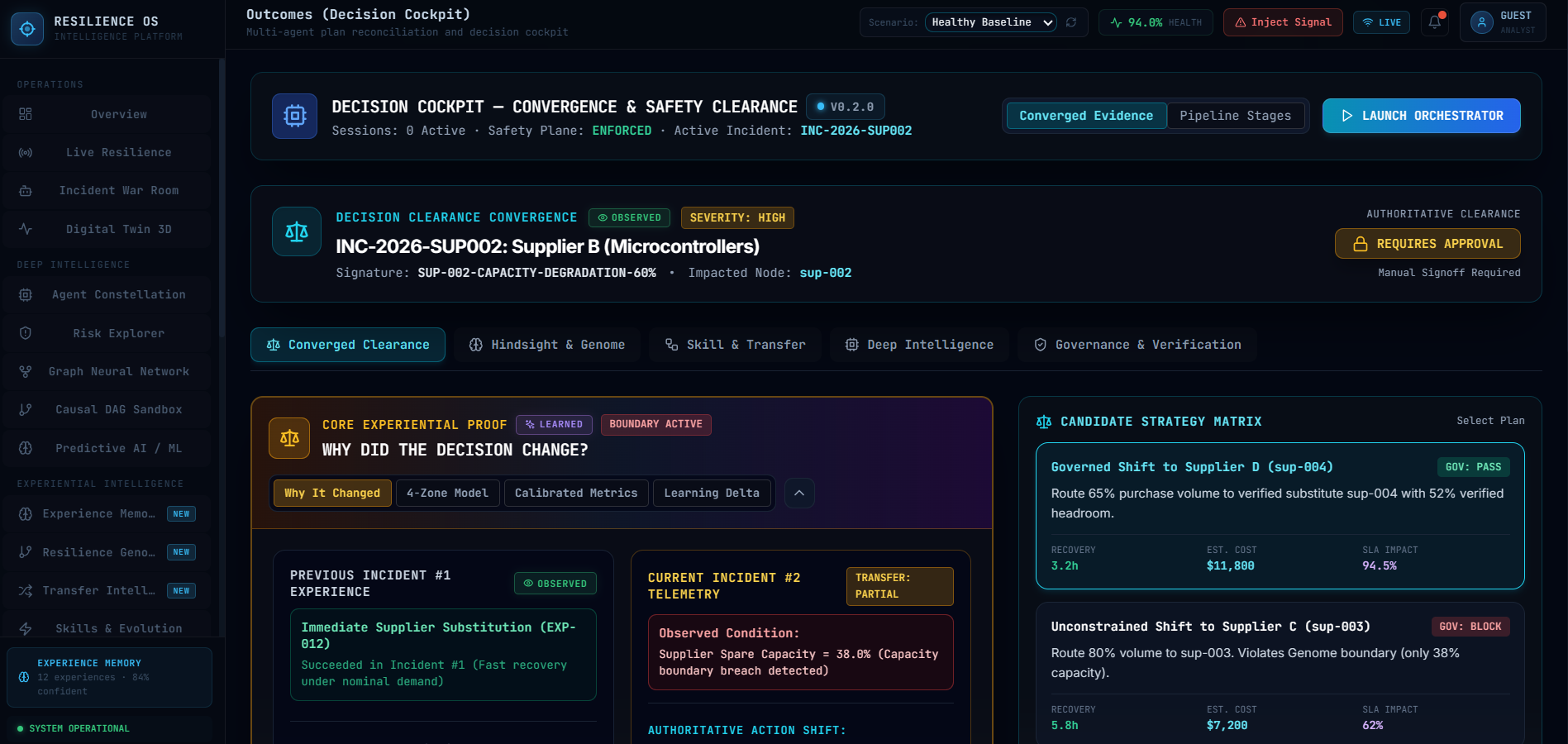
For each meaningful outcome, the system captures information such as the incident signature, environment, topology and version, symptoms, hypothesis, selected action, alternatives, observed outcome, verification result, failure reason, operational boundary, human override, skill version, confidence, timestamp, and provenance.

This changes what “memory” means.

A useful memory is not simply:

> “Emergency inventory draw worked.”

It is closer to:

> “Emergency inventory draw worked under these conditions, with these constraints, while these alternatives were available, and it became unreliable beyond a particular boundary.”

That distinction is what makes experience transferable.

I integrated [Hindsight](https://github.com/vectorize-io/hindsight) into this layer because I wanted operational experiences to become retrievable evidence for future decisions rather than simply remaining as records in an application database.

The resulting loop became:

**Experience → Recall → Reflect → Recovery Genome → Recovery Skill → Challenge → Decision → Outcome → Learning**

The important part is that the loop does not end at recall.

The recalled experience becomes evidence for reasoning.

## Where Hindsight Fits

Hindsight sits at the experience-memory layer of CASCADE.

The application does not delegate the entire decision to a language model.

Instead, the surrounding system defines the operational context, retains experience, retrieves relevant experience, reflects over it, evaluates whether learned knowledge applies to the current conditions, and sends the resulting decision through validation and governance.

At a high level, the flow looks like this:

```text
Operational Incident
        ↓
Experience Retention
        ↓
Hindsight Recall
        ↓
Reflection / Generalization
        ↓
Recovery Genome
        ↓
Recovery Skill
        ↓
Applicability / Transfer Check
        ↓
Challenge / Simulation
        ↓
Decision Governance
        ↓
Controlled Execution
        ↓
Outcome Verification
        ↓
New Experience
Most AI agents can remember what happened.
The harder problem is knowing when a previous solution should no longer be trusted.
That distinction became important while I was building FULFILL-X, an agentic fulfillment resilience system designed to reason about operational failures, recovery strategies, changing conditions, and controlled execution.
The system already had agents, simulation, governance, verification, and memory. But while working through the recovery loop, I kept running into a deeper problem:
Remembering a previous incident was not the same as learning from it.
If an agent sees that a particular recovery action worked during an earlier incident, the obvious approach is to retrieve that incident when something similar happens again.
That works until the environment changes.
A recovery strategy can be successful under one set of conditions and become unsafe under another. Two incidents can look almost identical while differing in one operational variable that completely changes whether the previous recovery is still valid.
So I changed the question.
Instead of asking:
“Have we seen something like this before?”
I wanted the system to ask:
“Why did that decision work, under what conditions did it work, and do those conditions still hold?”
That became the foundation for CASCADE.
From Incident Memory to Operational Experience
The central idea behind CASCADE is that an operational incident should not become just another item in a history log.
An experience needs context.
For each meaningful outcome, the system captures information such as the incident signature, environment, topology and version, symptoms, hypothesis, selected action, alternatives, observed outcome, verification result, failure reason, operational boundary, human override, skill version, confidence, timestamp, and provenance.
This changes what “memory” means.
A useful memory is not simply:
“Emergency inventory draw worked.”
It is closer to:
“Emergency inventory draw worked under these conditions, with these constraints, while these alternatives were available, and it became unreliable beyond a particular boundary.”
That distinction is what makes experience transferable.
I integrated Hindsight into this layer because I wanted operational experiences to become retrievable evidence for future decisions rather than simply remaining as records in an application database.
The resulting loop became:
Experience → Recall → Reflect → Recovery Genome → Recovery Skill → Challenge → Decision → Outcome → Learning
The important part is that the loop does not end at recall.
The recalled experience becomes evidence for reasoning.
Where Hindsight Fits
Hindsight sits at the experience-memory layer of CASCADE.
The application does not delegate the entire decision to a language model.
Instead, the surrounding system defines the operational context, retains experience, retrieves relevant experience, reflects over it, evaluates whether learned knowledge applies to the current conditions, and sends the resulting decision through validation and governance.
At a high level, the flow looks like this:
Operational Incident
        ↓
Experience Retention
        ↓
Hindsight Recall
        ↓
Reflection / Generalization
        ↓
Recovery Genome
        ↓
Recovery Skill
        ↓
Applicability / Transfer Check
        ↓
Challenge / Simulation
        ↓
Decision Governance
        ↓
Controlled Execution
        ↓
Outcome Verification
        ↓
New Experience
The integration itself is deliberately kept behind a small adapter.

The `retain()` path accepts a structured operational experience and sends it to Hindsight, while also providing a deterministic local fallback for development and evaluation.

Here is the actual implementation from the project:
python
async def retain(self, payload: Dict[str, Any]) -> Dict[str, Any]:
"""
Store experience payload into Hindsight.
"""
exp_id = payload.get("experience_id")
if not exp_id:
raise ValueError("experience_id required in payload")
if self.mode == "mock":
    self._memory_store[exp_id] = payload
    logger.info(
        f"HINDSIGHT_RETAIN [MOCK]: Stored experience "
        f"{exp_id} for tenant {self.tenant_id}"
    )
    return {
        "success": True,
        "experience_id": exp_id,
        "mode": "mock",
        "tenant_id": self.tenant_id,
    }

headers = {
    "Content-Type": "application/json",
    "X-Tenant-ID": self.tenant_id
}

if self.api_key:
    headers["Authorization"] = f"Bearer {self.api_key}"

try:
    async with httpx.AsyncClient(timeout=10.0) as client:
        res = await client.post(
            f"{self.endpoint}/v1/memories/retain",
            json=payload,
            headers=headers,
        )
        res.raise_for_status()
        data = res.json()

        logger.info(
            f"HINDSIGHT_RETAIN [{self.mode.upper()}]: "
            f"Stored experience {exp_id}"
        )

        return data

except Exception as e:
    logger.warning(
        f"Hindsight {self.mode} retain failed ({e}), "
        "falling back to local memory store"
    )

    self._memory_store[exp_id] = payload

    return {
        "success": True,
        "experience_id": exp_id,
        "fallback": True
    }
There are two things I care about in this implementation.

First, the application has a defined experience interface instead of spreading memory-specific logic throughout the decision system.

Second, local deterministic behavior remains available when running the system without a live Hindsight service.

That mattered during development because I wanted to test the complete learning loop repeatedly without making the experiment dependent on external service availability.

## From Experience to a Recovery Genome

Once enough experience accumulates, the system needs to extract something more reusable than individual incidents.

This is where the **Recovery Genome** comes in.

The Genome represents the reusable structure behind operational experience.

It captures concepts such as:

* learned invariants
* required conditions
* invalidating conditions
* supporting evidence
* contradictions
* confidence
* validation history

The goal is not to produce a confident-sounding summary.

The goal is to preserve what the evidence actually supports.

This distinction becomes important when the system starts turning learned experience into something that can be applied operationally.

## From Genomes to Recovery Skills

A Recovery Genome describes what has been learned.

A **Recovery Skill** describes how that knowledge can be applied.

A skill contains information such as:

* purpose
* strategy
* preconditions
* recovery steps
* expected effects
* risks
* success conditions
* failure boundaries
* transfer constraints
* supporting experiences
* confidence
* uncertainty
* governance requirements
* lifecycle state

I did not want the skill generator to simply ask an LLM to produce a plausible-looking recovery procedure.

The confidence and governance state need to come from evidence.

The actual implementation derives confidence from the Genome:
python
Determine confidence from genome
Confidence is DERIVED from genome, not invented
if genome.evidence == 0 or not genome.success_conditions:
confidence = 0.0
uncertainty = UncertaintyLevel.UNKNOWN
elif genome.contradictions > 0:
confidence = max(
0.2,
genome.confidence - genome.contradictions * 0.12
)
uncertainty = UncertaintyLevel.UNCERTAIN
elif genome.evidence >= 5:
confidence = genome.confidence
uncertainty = UncertaintyLevel.KNOWN
elif genome.evidence >= 2:
confidence = genome.confidence * 0.85
uncertainty = UncertaintyLevel.PROBABLE
else:
confidence = genome.confidence * 0.6
uncertainty = UncertaintyLevel.UNCERTAIN
Governance requirement:
low confidence or contradictions -> APPROVAL or BLOCK
if confidence < 0.4 or genome.status == GenomeStatus.CONTRADICTED:
governance = GovernanceRequirement.BLOCK
elif confidence < 0.7 or genome.contradictions > 0:
governance = GovernanceRequirement.APPROVAL
elif genome.evidence < 3:
governance = GovernanceRequirement.MONITOR
else:
governance = archetype.get(
"governance_requirement",
GovernanceRequirement.APPROVAL
)
skill_name_final = skill_name or f"Conditional {genome.strategy}"
skill = ResilienceSkill(
name=skill_name_final,
version=initial_version,
purpose=archetype["purpose"],
strategy=genome.strategy,
preconditions=preconditions,
steps=steps,
expected_effects=archetype["expected_effects"],
risks=archetype["risks"],
success_conditions=genome.success_conditions,
failure_boundaries=genome.failure_boundaries,
transfer_constraints=archetype["transfer_constraints"],
evidence=genome.evidence,
supporting_experiences=genome.supporting_experiences,
contradicting_experiences=[],
genome_id=genome.id,
confidence=round(confidence, 3),
uncertainty=uncertainty,
freshness="Generated from Genome",
lifecycle_status=SkillLifecycle.CANDIDATE,
)
The important part is that uncertainty is explicit.

A Genome with no evidence is not treated like one supported by repeated successful outcomes.

Contradictions reduce confidence.

Low-confidence or contradicted knowledge can require approval or be blocked.

This gives the system a distinction between:

**“We have a strategy.”**

and

**“We have enough evidence to trust this strategy under these conditions.”**

## Similarity Is Evidence, Not Permission

This became one of the most important principles in the system.

Suppose a supplier recovery strategy succeeds when approximately **45% spare capacity** is available.

A future incident may look almost identical.

The same supplier may be involved.

The same type of disruption may exist.

The same recovery action may have worked before.

But now the available spare capacity is only **38%**.

A similarity-based system can easily interpret this as a familiar incident and reuse the previous strategy.

CASCADE treats it differently.

The previous outcome is retained together with the conditions surrounding it. Those conditions contribute to a learned recovery boundary.

When the new incident crosses that boundary, the previous strategy is no longer treated as automatically transferable.

The transfer evaluator makes that distinction explicit:
python
Determine Transferability State
if critical_violation:
# Capacity boundary breached —
# always materially different conditions
capacity_val_str = (
f"Current capacity ({current.current_capacity*100:.1f}%)"
if current.current_capacity is not None
else "Current capacity (unknown)"
)
if transferable_conditions:
    status = TransferabilityState.PARTIAL

    reason = (
        f"Historical strategy observed under materially "
        f"different capacity conditions. {capacity_val_str} "
        "breaches the verified minimum threshold (> 40%). "
        "Logistics route intelligence transfers, but capacity "
        "logic does NOT."
    )

    recommendation = (
        "Do NOT reuse raw historical parameters. "
        "Synthesize alternative strategy "
        "(e.g. secondary buffer or multi-supplier split) "
        "and submit to Challenger stress testing."
    )

else:
    status = TransferabilityState.NON_TRANSFERABLE

    reason = (
        f"Historical strategy observed under materially "
        f"different capacity conditions. {capacity_val_str} "
        "directly triggers critical failure boundaries. "
        "No historical condition transfers safely to current "
        "operational state."
    )

    recommendation = (
        "Reject strategy. Re-route to alternative specialist "
        "or human coordinator."
    )

confidence = 0.88
requires_human_approval = True
This is where the distinction between retrieval and transfer becomes concrete.

The system is not saying:

> “I found a similar incident.”

It is saying:

> “I found a similar incident, but one of the conditions that made its recovery successful is no longer satisfied.”

That difference is the core of CASCADE.

## Challenge Mode

A learned strategy can become dangerous if nobody challenges it.

CASCADE therefore includes a challenge layer that deliberately tests learned strategies under conditions that may invalidate them.

Examples include:

* dependency failure
* topology changes
* migration conditions
* stale deployments
* resource exhaustion
* elevated traffic
* demand surges
* reduced supplier capacity

The purpose of Challenge Mode is not to randomly attack a strategy.

The challenge scenarios are designed around the conditions under which a learned strategy may stop being valid.

The system also keeps simulated evidence separate from observed operational outcomes.

If a challenge fails, the system does not silently rewrite the skill and pretend that the new version is proven.

Instead, the challenge produces evidence.

That evidence can lower confidence, expose a boundary, create a contradiction, or produce a proposal for a future skill revision.

This makes the learning process inspectable.

The principle is simple:

**A strategy should become more trusted because it survived evidence, not because an agent described it confidently.**

## The Decision Actually Changes

This was the most important test for the architecture.

It was not enough for the system to retrieve a previous experience and display it in the interface.

The retrieved experience had to affect the actual recovery decision.

When the transfer assessment returns `PARTIAL` or `NON_TRANSFERABLE`, CASCADE rejects blind reuse and selects an alternative recovery strategy.

This is the runtime branch:
python
Step 4: Behavioral Adaptation
Since transfer is PARTIAL / NON_TRANSFERABLE,
DO NOT blindly reuse historical strategy!
if transfer_assessment.status in (
TransferabilityState.PARTIAL,
TransferabilityState.NON_TRANSFERABLE
):
adapted_strategy_name = (
"Emergency Inventory Draw (Warehouse C Reserves)"
)
selected_action = {
    "type": "INVENTORY_REALLOCATION",
    "source_node": "wh-003",
    "target_node": "wh-001",
    "volume": 600,
}

behavior_note = (
    "BEHAVIOR CHANGE: Historical Supplier D substitution "
    "rejected because current capacity "
    f"({supplier_d_capacity*100:.1f}%) breaches learned "
    "Genome boundary (> 40%). System automatically "
    f"adapted to alternative strategy: "
    f"'{adapted_strategy_name}'."
)

logger.info(
    f"SKILL_SELECTED: Adapted to alternative strategy "
    f"'{adapted_strategy_name}'"
)
else:
adapted_strategy_name = "Supplier Substitution"
selected_action = {
    "type": "SUPPLIER_SUBSTITUTION",
    "source_node": "sup-002",
    "target_node": "sup-004"
}

behavior_note = (
    "Standard historical strategy transferred cleanly."
)
This is the behavior I wanted from agent memory.

A previous strategy worked.

The system remembered it.

The new conditions violated the learned boundary.

The strategy was rejected.

A different recovery was selected.

Memory changed the decision.

That is much more meaningful than simply saying that an agent has memory.

## Keeping Learning Separate From Execution

I also wanted to avoid the common pattern where an LLM generates an operational action and the application immediately executes it.

The execution path in CASCADE is deliberately constrained.

The general flow is:
text
LLM / Agent Proposal
↓
Structured Action
↓
Validation
↓
Policy Check
↓
Simulation / Verification
↓
Approval
↓
Controlled Execution
↓
Outcome Verification
During development and evaluation, a MockAdapter is used to exercise this path without requiring destructive real-world operations.

This allows the decision logic to be tested repeatedly while keeping execution controlled.

The principle is:

**The model can propose. The system must verify.**

That separation is especially important when learned strategies can influence operational actions.

A memory system should not become an implicit authorization system.

## Epistemic Boundaries

Another design decision was to explicitly represent uncertainty.

CASCADE uses four epistemic zones:
text
KNOWN
PROBABLE
UNCERTAIN
UNKNOWN
This matters because a memory system can otherwise make weak evidence look authoritative.
A recalled experience might be highly relevant but poorly validated for the current environment.
Another experience might be supported by multiple independent outcomes.
Those situations should not receive identical treatment.
The system therefore keeps concepts such as memory relevance, generalization confidence, transfer confidence, simulation confidence, and governance state separate.
In other words:
**“The system remembers this” does not automatically mean “the system knows this is safe.”**
That distinction became important as the system evolved from a memory feature into a closed learning loop.
## Evaluation
I wanted to measure whether the memory architecture actually changed behavior.
So I evaluated deterministic scenarios rather than relying only on a visual demonstration.
Across **30 deterministic episodes**, the memoryless baseline and the Hindsight-enabled system produced substantially different behavior.
| Metric | Memoryless | Hindsight |
| ------------------------ | ---------: | --------: |
| Recovery Success | 43.3% | 93.3% |
| Repeated Mistake Rate | 43.3% | 0% |
| Unsafe Action Rate | 56.7% | 3.3% |
| Boundary Avoidance | 0% | 46.7% |
| Evidence Reuse | 0% | 96.7% |
| Average Prediction Error | 2.32h | 0.39h |
The numbers are useful, but the behavior behind them is more interesting.
The system was not simply retrieving more historical information.
It was using previous outcomes to change what it considered applicable.
The evaluation also explicitly checks whether memory recall actually corresponds to divergent decisions rather than merely appearing somewhere in the system.
That was an important distinction for me.
If the Hindsight-enabled agent retrieves an experience but still makes exactly the same decisions as the memoryless baseline, then the memory is not demonstrating much causal value.
The more meaningful behavior is when recalled experience changes the selected strategy under the right conditions.
## What I Learned
### 1. Memory quality matters more than memory volume
A large collection of incidents does not automatically create useful intelligence.
Experiences need context, outcomes, boundaries, and provenance.
The useful question is not:
> “How many memories does the agent have?”
It is:
> “How much decision-relevant structure can the agent recover from those memories?”
### 2. Failure boundaries are as valuable as successful actions
If an agent only remembers what worked, it can repeatedly apply a strategy outside the conditions where it was validated.
Knowing where a strategy stops working can be more valuable than knowing where it succeeded.
The 45% versus 38% supplier-capacity example made this concrete.
The previous strategy was not useless.
It was conditionally useful.
That distinction is what the boundary represents.
### 3. Similarity is not applicability
Two incidents can look similar while requiring different responses because one important environmental condition changed.
Retrieval should therefore be treated as evidence for reasoning, not automatic authorization.
This is one of the biggest differences between “agent memory” as a history mechanism and memory as part of a decision system.
### 4. Uncertainty needs to be explicit
## Explore the Project
**FULFILL-X / CASCADE**
[https://github.com/manidharreddy0909/full-fill-x3](https://github.com/manidharreddy0909/full-fill-x3)
**Hindsight**
[https://github.com/vectorize-io/hindsight](https://github.com/vectori
ze-io/hindsight)
**Hindsight Documentation**
[https://hindsight.vectorize.io/](https://hindsight.vectorize.io/)
**What Is Agent Memory?**
A system should be able to say that evidence is weak, contradictory, or insufficient for transfer.
Forcing every memory into a binary trusted/untrusted state hides important information.
KNOWN, PROBABLE, UNCERTAIN, and UNKNOWN provide a more useful representation for downstream reasoning and governance.
### 5. Learning should remain observable
When a decision changes, I want to be able to trace that change backward:
text
Decision
↓
Skill
↓
Genome
↓
Experiences
↓
Evidence
And forward:
text
Decision
↓
Outcome
↓
New Experience
↓
Learning Delta
That trace is what turns agent memory from a black box into something that can actually be inspected and challenged.
If I cannot explain why a decision changed, I have a much harder time trusting the learning system.
## What I Would Change Next
There is still a limitation.
The system can demonstrate that structured experience and learned boundaries improve decision behavior in deterministic scenarios, but that does not mean every operational environment will produce equally reliable generalizations.
Real environments contain incomplete telemetry, changing dependencies, conflicting signals, delayed outcomes, and conditions that are difficult to reproduce in a deterministic simulator.
A learned boundary can also be too narrow.
A strategy might appear invalid because the system has not yet seen enough evidence to understand a broader set of conditions.
That means the next step is not simply “more memory.”
It is better evidence about **when a learned strategy transfers across environments**.
That includes:
* more diverse scenarios
* stronger counterfactual testing
* better contradiction handling
* improved transfer validation
* continued separation between observed and simulated evidence
* more systematic challenge generation
The goal is to make the learning loop increasingly capable of distinguishing a genuinely reusable operational pattern from an accidental correlation.
## Closing
That is ultimately what CASCADE is trying to explore.
The goal is not to build an agent that remembers everything.
It is to build an agent that can:
**remember what happened, understand why it happened, recognize where that lesson stops applying, and allow that knowledge to change its next decision.**
For me, that is the more interesting direction for agent memory.
The important question is no longer just:
> “What does the agent remember?”
It is:
> **“What should the agent do differently because it remembers?”**
That is the behavior I wanted to make visible, testable, and governable in FULFILL-X / CASCADE.
## Explore the Project
**FULFILL-X / CASCADE**
[https://github.com/manidharreddy0909/full-fill-x3](https://github.com/manidharreddy0909/full-fill-x3)
**Hindsight**
[https://github.com/vectorize-io/hindsight](https://github.com/vectori
ze-io/hindsight)
**Hindsight Documentation**
[https://hindsight.vectorize.io/](https://hindsight.vectorize.io/)
**What Is Agent Memory?**
[https://vectorize.io/what-is-agent-memory](https://vectorize.io/what-is-agent-memory)


Top comments (0)