


Building a Deterministic FinOps Intelligence Engine in C11 — IFM-CostIntel v1.0.0
Cloud billing systems eventually stop being a simple data-processing problem.
Once billing datasets become large enough, the system has to answer harder questions:
- Can financial calculations remain deterministic?
- Can baseline analysis scale with the number of resources?
- Can malformed records fail safely instead of disappearing?
- Can every allocation be mathematically reconciled?
- And can the engine process large streams without turning the hot path into a memory-management bottleneck?
I built IFM-CostIntel v1.0.0 to explore those problems at the systems-engineering level.
It is a headless FinOps computation engine written in C11 that consumes canonical Intermediate Financial Model (IFM) NDJSON records and performs deterministic cost allocation, aggregation, variance analysis, anomaly detection, and financial reconciliation.
The architecture
The engine processes records through a deterministic pipeline:
text
IFM NDJSON
│
▼
JSON Decode
│
▼
Traceability
│
▼
Schema Validation
│
▼
Priority Rule Allocation
│
▼
4D Cost Aggregation
│
▼
Baseline Lookup
│
▼
Variance Analysis
│
▼
Directional Anomaly Detection
│
▼
Financial Reconciliation
│
▼
Enriched NDJSON + Audit Telemetry
The design deliberately keeps financial computation separate from the upstream billing-ingestion layer.
That means IFM-CostIntel can be tested and benchmarked independently against a canonical financial data contract.
The interesting problem: the O(N) bottleneck
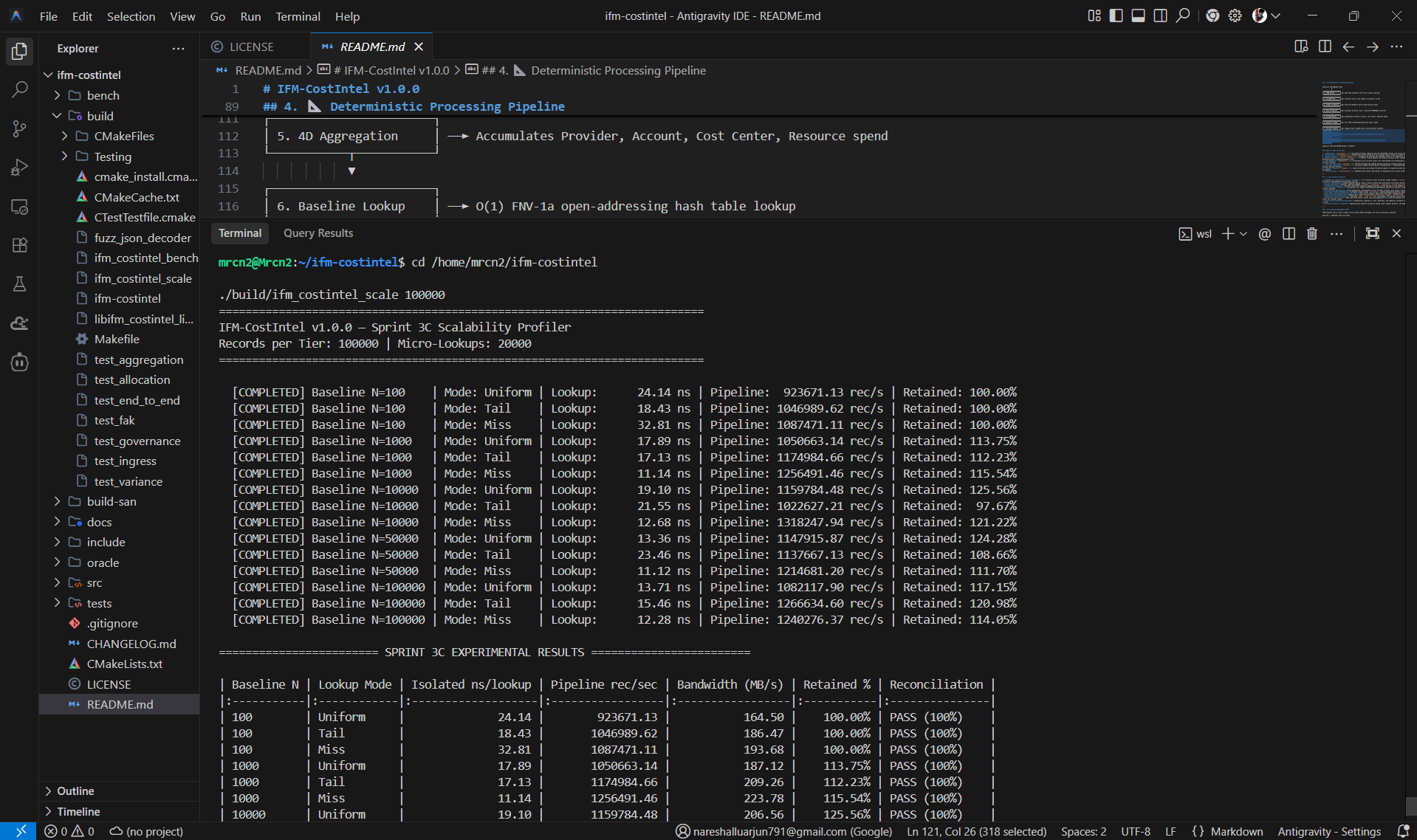
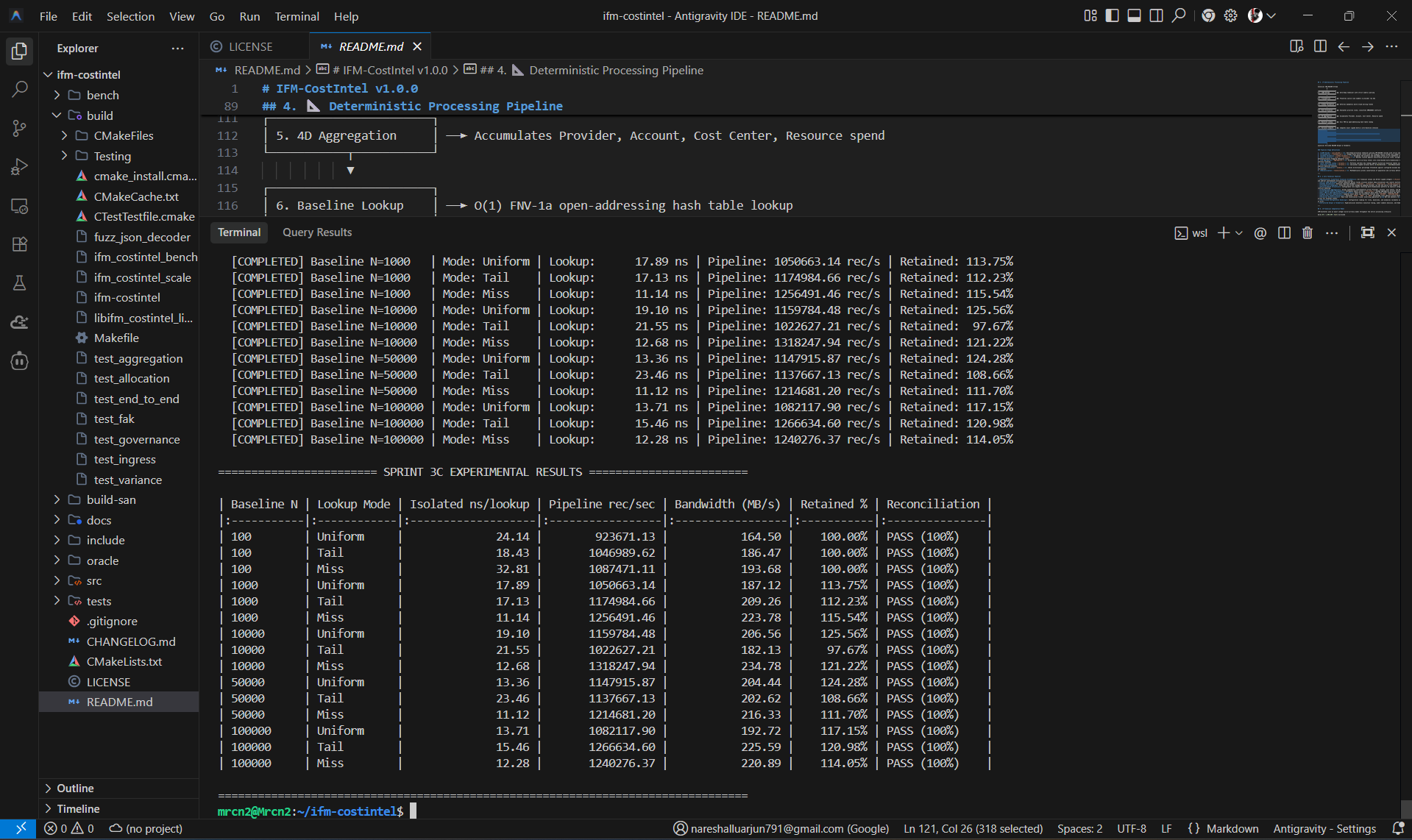
During scalability profiling, the baseline lookup became the dominant cost.
The original implementation used a linear scan.
At 100,000 baseline entries, a lookup measured:
509,525 ns
That was enough to collapse the overall pipeline throughput to roughly 1.8k records/sec under that workload.
Rather than optimizing around the bottleneck, I changed the data structure.
The baseline table was re-engineered into an O(1) open-addressing hash index using:
64-bit FNV-1a hashing
Power-of-two table sizing
Bitmask indexing
Linear probing
Explicit capacity management
At 100,000 baseline entries:
509,525 ns → 11.51 ns
That's approximately a 44,268× reduction in lookup latency for that benchmark.
The important part wasn't the number itself.
It was identifying that the algorithmic complexity of one subsystem could dominate an otherwise high-throughput pipeline.
Financial computation is treated differently
Financial arithmetic should not casually depend on IEEE-754 floating-point representation.
IFM-CostIntel uses scaled integer monetary values instead of floating-point arithmetic on its financial computation path.
The system therefore works with deterministic fixed-point representations for:
allocated cost
aggregated cost
baseline values
variance
percentage calculations
reconciliation totals
This makes the numerical behavior explicit and reproducible.
Reconciliation is an invariant, not a report
One of the design principles is that the system shouldn't simply produce an output that looks correct.
It should be able to prove that the population and monetary totals remain conserved.
The reconciliation layer checks the relationship between the input population and the resulting allocation states, including allocated, unallocated, ambiguous, and faulted records.
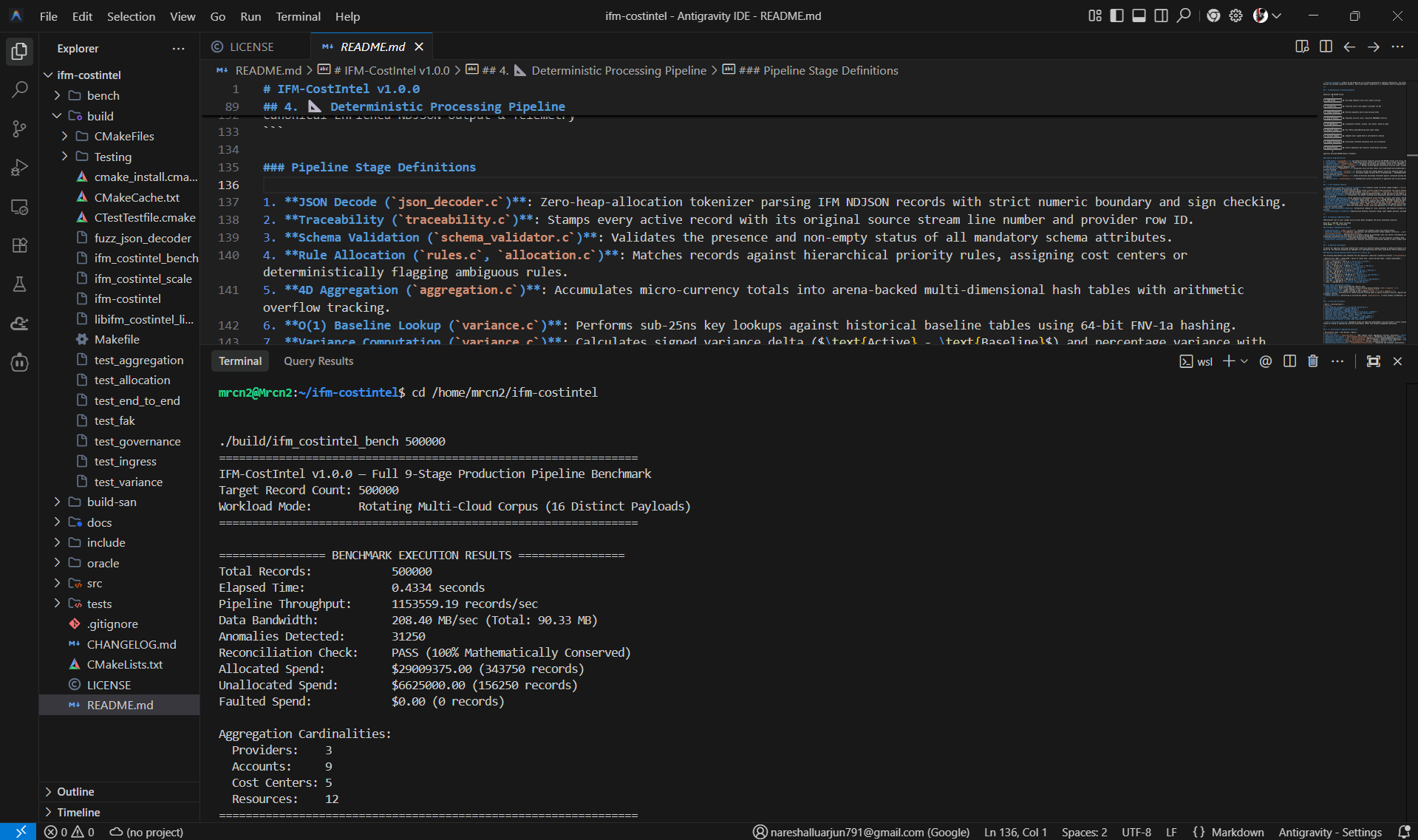
For the released benchmark workload, the conservation invariant remained:
100.000% reconciled.
Verification
The v1.0.0 baseline was subjected to several independent verification gates:
8/8 CTest targets passing
ASan/UBSan verification clean
10,000 / 10,000 differential records matching the Python reference oracle
100,000 adversarial fuzz iterations completed without crashes or undefined behavior
Full pipeline benchmark of 1,470,516 records/sec
265.67 MB/sec measured throughput on the benchmark workload
These numbers are benchmark results, not theoretical limits. The repository contains the verification and benchmarking infrastructure used to reproduce them.
Why C11?
This project wasn't about using C11 because "C is fast."
The point was having direct control over:
memory ownership
data layout
allocation behavior
integer arithmetic
parser boundaries
failure modes
cache-oriented data structures
and the cost of individual operations
That control makes performance problems much easier to see — and much harder to hide.
Where this fits
IFM-CostIntel is the second component of a larger CloudOps Financial Platform I'm building.
The upstream Billing Data Gateway handles provider-specific billing ingestion and normalization.
IFM-CostIntel consumes the resulting canonical IFM contract and performs the financial intelligence layer.
The two systems are intentionally maintained as separate products at this stage.
The integration between them is a subsequent milestone.
Open source
IFM-CostIntel v1.0.0 is now publicly available:
GitHub:
https://github.com/CloudOps-Financial-Platform/ifm-costintel
The repository includes the source, architecture documentation, tests, benchmarks, and release information.
The goal isn't just to publish another repository.
It's to make the engineering decisions, measurements, and verification process inspectable.
Build → measure → verify → ship.


Top comments (0)