


Niji Journey makes good anime art. Anyone who's used it already knows that, so this isn't a Niji Journey alternative post built on "the pictures aren't good enough." It's built on a narrower question: if you're comparing Niji Journey vs PixAI specifically for character work, where do they actually agree, and where do they genuinely split? I ran five identical prompts through both, Niji 7 on Niji Journey, Tsubaki.2 on PixAI, and logged the result of each.
The five tests, individually scored
Test 1: two characters, distinct personalities
two friends walking to a magic academy together on the first day, one tall girl with long silver hair and a confident grin, one shorter boy with messy black hair looking nervous, both in matching gray-and-blue uniforms carrying spellbooks, cherry blossom trees along a stone path, bright morning light, anime illustration
Niji: wider, more cinematic composition, clean overall scene. PixAI: followed the personality descriptions more precisely, confident grin, visible nervousness down to posture and a sweat drop, a more convincing height difference. Verdict: PixAI, since the prompt leaned on personality contrast more than setting, and that's what PixAI rendered more accurately. Both undersold the "magic" part of the academy.

Niji Journey Test 1 (left), PixAI Test 1 (right)
Test 2: single character portrait
1girl, a friendly witch-in-training with short mint-green hair, round amber eyes, a small star-shaped hairclip, wearing a navy pointed hat and a matching cape over a white blouse, holding a tiny glowing potion bottle, soft smile, plain warm background, anime illustration
Niji: slightly more literal on outfit detail. PixAI: gave the potion bottle and hairclip a stronger magical glow without losing accuracy. Verdict: tie. Both nailed the character close to exactly. This one comes down to taste, not correctness.

Niji Journey Test2 (left), PixAI Test 2 (right)
Test 3: same character, new scene, using a reference
same character, now sitting on the floor of a cozy potion shop surrounded by shelves of colorful bottles, reading an open spellbook in her lap, warm candlelight, evening mood, anime illustration
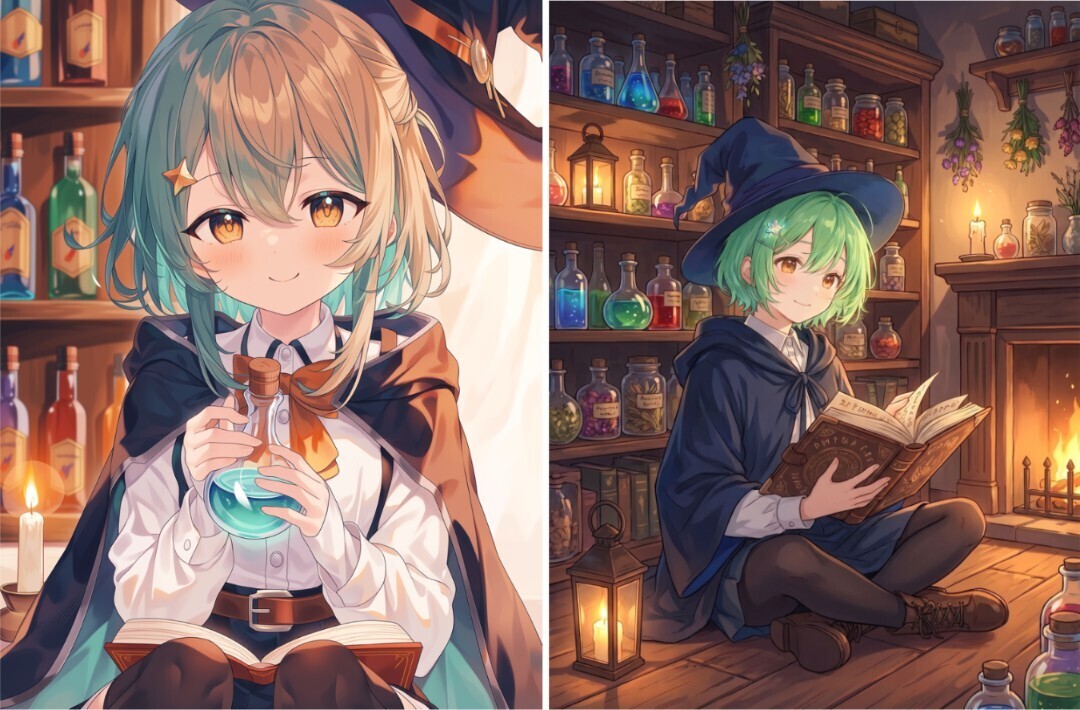
_Niji Journey Test 3 (left), PixAI Test 3 (right)_
This is the test that actually separates an anime reference image generator from a general one, whether feeding a prior image back in as a reference locks the character or just loosely inspires the next generation.
PixAI, using Reference Pro: the witch came back unmistakably herself, mint-green hair, amber eyes, star hairclip, hat, cape, all held. Niji Journey: beautiful scene, but her hair drifted toward blonde with only faint mint-green left at the tips, and the hairstyle grew longer. Same outfit, different person.
Verdict: PixAI, clearly. This isn't a rendering quality gap, both scenes were well made. It's a difference in what "reference" means to each tool. Niji appears to treat a reference image as loose inspiration; PixAI treats it as an identity lock. For a single image, that distinction is invisible. For a character you're building across a series, it's the only thing that matters.
Test 4: character plus a style LoRA
1boy, a cheerful street musician with wavy chestnut hair and freckles, wearing a mustard cardigan and a scarf, playing an acoustic guitar on a sunny park bench, autumn leaves in the air, warm afternoon light, anime illustration
Added a style LoRA (Fog) on the PixAI side. Both nailed chestnut hair, freckles, cardigan, scarf, guitar, warm light. PixAI's render was softer with more realistic guitar proportions; Niji leaned into a brighter expression. Verdict: tie, and a good demonstration that one-click LoRA style control (attach with a click, trigger words auto-added) can shift the finish without pulling the image off the described character. If you're testing an anime LoRA generator specifically, this is the behavior you want, style changes without content drift.

Niji Journey Test 4 (left), PixAI Test 4 with the Fog LoRA (right)
Test 5: emotional two-character scene
a young bride and groom sharing a quiet moment just after their wedding ceremony, the bride gently holding the groom's hands while smiling through happy tears, the groom looking at her with warmth and affection, elegant white wedding dress, classic black tuxedo, soft flower petals drifting through the air, warm golden sunset light streaming through large windows, intimate and emotional atmosphere, subtle smiles, realistic body language, highly detailed anime illustration
Niji: wider, softer, cinematic. PixAI: tighter framing, visible happy tears, sustained eye contact, natural hand placement. Verdict: PixAI, by a small margin, since the prompt was built around intimacy rather than scale, and the tighter emotional framing served that better. Both images were genuinely beautiful.

Niji Journey Test 5 next (left), PixAI Test 5 (right)
Scorecard
| Test | What it measured | Result |
|---|---|---|
| 1: two characters | Personality-driven prompt accuracy | PixAI |
| 2: single portrait | General prompt fidelity | Tie |
| 3: reference reuse | Character identity lock | PixAI, clearly |
| 4: style LoRA | Style control without content drift | Tie |
| 5: emotional scene | Framing and emotional read | PixAI, narrowly |
Across five tests, nothing here suggests Niji Journey is a weaker anime AI generator on raw output. Its images were consistently excellent, often more cinematic than PixAI's. The one test with a clear, unambiguous gap was test 3, and it happens to be the test that determines whether either tool works for building a character you'll reuse.
Why this one test matters more than the other four
Tests 1, 2, 4, and 5 are all one-shot generations. Test 3 is the only one that depends on the platform actually preserving identity across a second, independent generation. That's a fundamentally different capability than prompt-following, and it's the one that decides whether a tool functions as a real anime character generator versus just a very good anime image generator.
If your workflow is standalone pieces, tests 1 through 5 tell you these platforms are close enough that taste should decide. If your workflow involves an OC you draw on repeatedly, test 3 is the only result that should carry real weight, since it's the only one that isolates the capability you actually depend on.
The rest of the comparison, for completeness
| Niji Journey | PixAI | |
|---|---|---|
| Free tier | None, requires a Midjourney subscription | Daily free credits |
| Privacy | Public by default below higher plans | Private by default |
| Custom characters | No user-trained character models | Train your own character LoRA |
| Style control | Built-in styles | One-click community LoRAs |
Takeaway
If you want one striking, cinematic anime image and don't need to reuse the subject, Niji Journey earns its reputation, the tests above back that up plainly. If you're testing tools specifically as an OC art generator, something meant to keep a character recognizable image after image, test 3's result is the one to weight most heavily, and that's where PixAI held up. Test your own character on both before deciding, since the gap that matters here doesn't show up until the second generation.
For the workflow used in test 3, Reference Pro covers the mechanics, LoRA weight settings covers tuning style strength like in test 4, and the how to use PixAI guide covers the rest of the panel. Both platforms run as an AI anime generator online, nothing to install, so try PixAI if you want to run this same five-test comparison yourself.


Top comments (0)