


This is a submission for the Hacktoberfest Open-Source AI Challenge Week 2: Side Hustle

My friend runs a tiny candle shop on Etsy. Forty-odd listings, a day job, and a pricing
strategy she described to me, without a trace of irony, as "vibes."
She is not wrong to struggle. There is no sticker price for a hand-poured soy candle. The right number depends on the scent, the size, the wax, how long it took, the season, how many photos she shot, how her shop is rated. A dozen little things that interact. Price it $4 too high and it sits until the wax degrades. Price it $4 too low and she is paying Etsy fees to work for free. She has lost real money both ways.
The tools that promise to fix this are closed SaaS products: a monthly fee, and an upload of her entire sales history to someone else's server so they can rent her a number back. For a shop that clears maybe $300 a month, that is a bad trade twice over. There is the cost. And there is handing the one thing that is actually hers (what sells, at what margin) to a stranger's cloud.
So I built her PricePilot: a pricing copilot that runs entirely on her laptop. It predicts what an item will sell for from sold-listings data, then writes the listing. No account, no API bill, nothing uploaded anywhere.
What I Built
PricePilot turns one short form into three things a seller can act on immediately:
- A price with an honest range. Not a single false-precise number but a predicted sell price and the 10–90% band around it, plus a measured error so you know how much to trust it.
- The levers that raise it. It doesn't just score the listing; it tells her what to change and by how much: "offer personalization, about +$5", "list in the Q4 season, about +$8", "use premium materials, about +$12", ranked by dollar impact.
- A ready-to-paste listing. Title, description, and eight search tags, written to match the predicted price.
Who would pay for it: independent Etsy, eBay, and marketplace sellers. The exact "side hustle" person this week is about. The thing it fixes (what do I charge?) is the thing that most directly decides whether the hustle makes money.
Demo
🔗 Live demo (fully interactive): simplynadaf.github.io/pricepilot
🎥 Video walkthrough: watch on YouTube
The hosted demo is interactive end to end: every field is editable and the price updates instantly, powered by an in-browser estimate that mirrors the model. For the actual TabPFN-v2 prediction with Gemma 3 writing the listing, clone the repo and
python run.py, fully offline. That is the whole point of PricePilot.
Describe an item the way you'd list it (category, materials, size, hours to make, condition,
photos, season) and PricePilot prices it and drafts the listing in one shot.

Code
 simplynadaf
/
pricepilot
simplynadaf
/
pricepilot
💸 A local pricing copilot for marketplace sellers. TabPFN-v2 predicts the sell price from your own sales data; Gemma 3 writes the listing — on your laptop, $0 per listing, data never leaves your machine. Hacktoberfest 2026 Week 2: Side Hustle.
💸 PricePilot
Price It Right, Then Watch It Sell





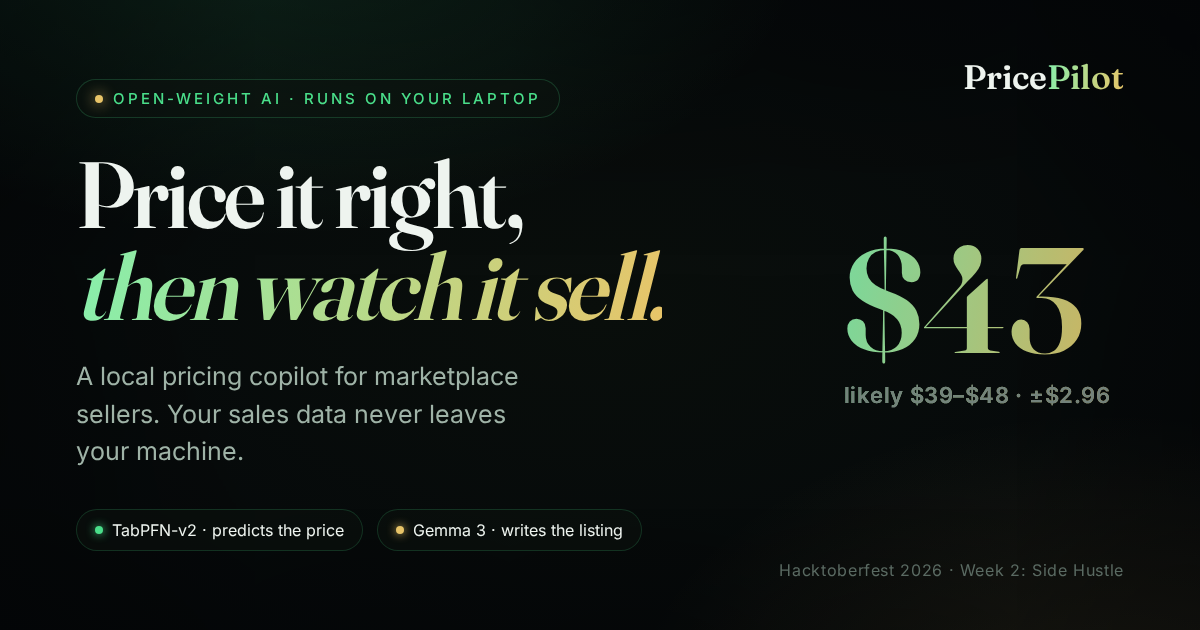
Most Etsy and eBay sellers price by gut, and get it wrong.
Too high, it sits. Too low, you work for free.
I built an open-weight model that prices it from data, on your own laptop.
Live Preview → | Watch Demo → | Read Article → | How It Works →
🎬 Demo

Three real seller use cases (pendant, candle, leather wallet). Every input changes the price, because the model is predicting, not looking up a table. Watch on YouTube → · Try the live demo →
🎯 One Form, Three Answers a Seller Can Act On
| Output | What You Get |
|---|---|
| 🎯 A price you can defend | A predicted sell price with an honest 10–90% range (the risk, not a false-precise single number), plus a measured error so you know how much to trust it. |
| 🔼 The levers that raise |
How I Built It
PricePilot is two open-weight models doing one honest job each, locally.

The price: TabPFN-v2 as a prediction agent
Pricing is a textbook small-data tabular problem (a few hundred past sold listings, ten features, one continuous target), which is exactly what TabPFN-v2, Prior Labs' open-weight tabular foundation model, is built for. It predicts in a single CPU forward pass with no per-dataset training.
But Prior Labs explicitly favors TabPFN used inside a wider prediction agent, not as a one-shot regressor, so that's what I built. PricePilot:
- predicts the sell price with a calibrated 10–90% range from TabPFN's output quantiles,
- then runs a small what-if loop: it re-queries TabPFN under single-feature changes a seller actually controls (more photos, personalization, Q4 timing, better condition, premium materials) and ranks them by the dollar delta, all in one batched forward pass so it stays fast on CPU,
- and reports a held-out mean absolute error so every number is measured, not asserted.
On the sample dataset, TabPFN predicts held-out sold prices with an MAE of about $2.90 on items averaging ~$54. That is roughly 5% error, with zero training time. The honesty number is the whole point: she can see how much to trust it.
# the prediction agent, simplified: predict, then re-query to explain the number
mean, low, high = self._predict_one(feats)             # price + 10-90% range
preds = self._predict_rows(whatif_rows)                # ONE batched pass for every lever
levers = sorted(
    (WhatIf(label, round(p - mean, 2)) for label, p in zip(labels, preds)),
    key=lambda w: w.delta, reverse=True,
)
The listing: Gemma 3, grounded on the number
A local Gemma 3 model (open-weight, served by Ollama) turns the item and that exact predicted price into a title, description, and tags. It is told the price and told never to invent a different one. The number is always TabPFN's. Gemma just writes the copy around it.
The safety net
If Ollama isn't running, a deterministic template writes a correct listing from the same price, so she is never staring at a spinner. The whole stack (FastAPI, a no-build premium front end, both models) runs on localhost. I verified the offline path by pointing the Ollama host at a dead port and confirming the listing still came back.
Why Does Open Innovation Matter?
This is the part that made the project worth building, and every point is something a closed API would have taken away:
- Her sales data stays hers. What sells, at what margin, is her entire edge. PricePilot never uploads it. A closed pricing tool would turn her shop's history into its training data.
- $0 per listing. Open weights mean no per-call fee. She can reprice her whole shop every week and the bill is nothing. A subscription would eat the margin the tool is supposed to protect.
- It can learn her niche. She can drop in her own exported Etsy sales CSV and the model fits her corner of the market (soy candles in her price band) where a general API trained on "everything" is mediocre. The open approach is what lets the long tail have a model that fits it.
- No lock-in. The listing writer points at any open-weight model Ollama runs; the predictor can be retrained. She owns the stack, not a line on someone's pricing page.
A frost date, a race time, a candle price: the pattern that keeps winning this Hacktoberfest is the same. A small, open model, running where your data already lives, beats a big closed one you have to pay and trust.
My Agent Session
I built PricePilot with an AI coding agent, and the honest story of the build is that the two hard problems were both about trust in the numbers, not wiring. First, TabPFN on CPU was slow enough to feel broken until I batched every what-if scenario into a single forward pass (the per-request time dropped from minutes to seconds). Second, I had to stop the language model from ever emitting its own price, so the agent and I settled on a rule the whole design now rests on: Gemma is told the number and never produces one. The repo's commit history tracks that path from a bare TabPFN spike to the batched prediction agent.
My First User
I built PricePilot for a real person: a friend who runs a small candle shop on Etsy and genuinely prices by "vibes." I have not sat her down with the finished build yet (that is my next step, and I will update this post with what she says), so I will not invent a reaction here. What I can say honestly is why I think she, and sellers like her, would pay:
- The pain is the money. Pricing is the single decision that most directly sets whether a handmade shop earns or loses on each sale. A tool that gives a defensible number, with a range and a measured error, targets the exact spot where a side hustle leaks money.
- The alternative already costs money. Sellers pay $10–30/month for closed pricing SaaS that also wants their sales history uploaded. PricePilot does the same job for $0 and keeps the data on their laptop. "Same outcome, free, private" is an easy yes.
- It answers a question they ask constantly. "What do I charge, and what do I write?" is a daily question for an active seller. PricePilot answers both in one shot.
My honest take: I would not charge for the current build, because the whole point is that it runs free on the seller's own machine. The thing a seller would actually pay for is the time and the second-guessing it removes, and that is what I will test with her next.
Prize Categories
- Best Use of TabPFN: TabPFN-v2 is the core: it predicts the price, provides the calibrated range, and is wrapped in a what-if prediction agent that re-queries the model to explain which levers move the number. Accuracy is reported as a held-out MAE (~$2.90), so the claim is measured, not asserted.
Built with open weights, on a laptop, for a friend who prices by vibes. Made with 🤍 by
Sarvar.


Top comments (0)