


OK so . . . The story is very long, I will start with the beginning:
How It all began
I was working as a WordPress Website Creator/Web Developer, when I heard that Matt Mullenweg, the creator of WordPress, and the WP Engine company had a lawsuit. It freaked me out, as I didn't know if this would affect me in the future.
Out of freak and curiosity, I decided to start learning Symfony Web Development.
At first, it was just a website in html/twig + an admin dashboard for customers to manage some data. At that time I was working with a team that didn't have the same thirst to tweak in code and learn on the go. To which extent, I became the only maintainer of the codebase for a long time. To which, I had to add some features, correct some bugs and add some web pages.
But I was frustrated that my colleague, a great Designer, couldn't work on the website. So I had 2 choices:
- Keep on solo, with the opportunity to grow (recreating the app in Scala, because of fun).
- Or integrate my colleague as much as I could, so that we could work together.
At first, I wanted very hard to try Scala, but then I decided it would be better the second option
So, I don't have an enormous knowledge of JavaScript to create complex interfaces without use of libraries and framework such as React, Vue, Angular, and others related. In the search of a quick to integrate alternative, I found out about the open source version of Grapes js.
 GrapesJS
/
grapesjs
Free and Open source Web Builder Framework. Next generation tool for building templates without coding


If you looking to embed the Studio editor in your application, we now offer the Studio SDK, a ready-to-use visual builder that's easy to embed in external applications, with GrapesJS team support included.
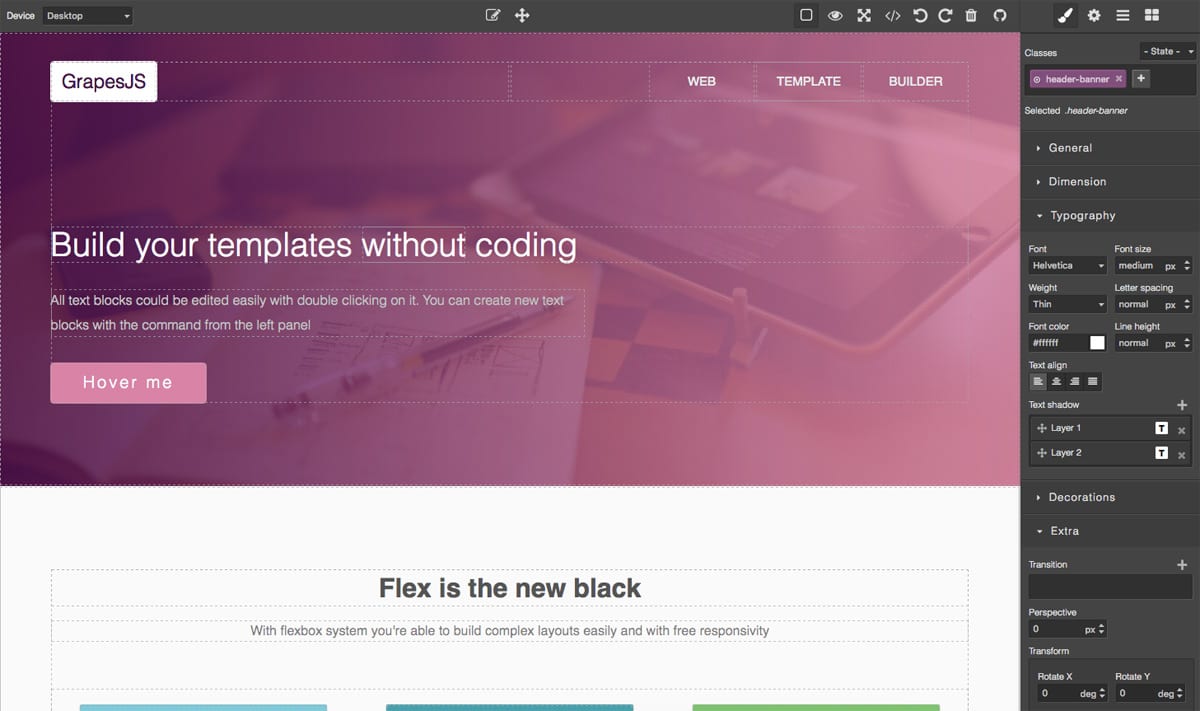
GrapesJS is a free and open source Web Builder Framework which helps building HTML templates, faster and easily, to be delivered in sites, newsletters or mobile apps. Mainly, GrapesJS was designed to be used inside a CMS to speed up the creation of dynamic templates. To better understand this concept check the image below
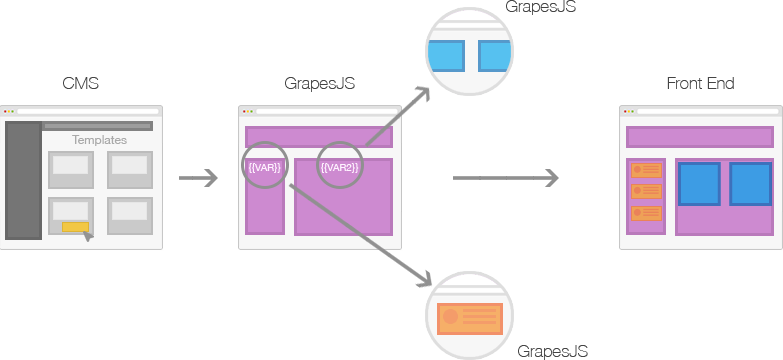
Generally any 'template system', that you'd find in various applications like CMS, is composed by the structure (HTML), style (CSS) and variables, which are then replaced with other templates and contents on server-side and rendered on client.
This demos show examples of what is possible to achieve:
Webpage Demo - http://grapesjs.com/demo.html
Newsletter Demo - http://grapesjs.com/demo-newsletter-editor.html
Table of contents
So I passed a very long time to integrate a Symfony app with grapesjs. Then I finally did it.
And after some very long time, I decided to split my app into many bundles:
- Security: Auth bundle
- Web: Website Builder bundle
- Multimedia: Image handling and optimisation bundle
- Framework: Admin panel, and "glue" bundle
So from there, everything was fine.
Concerns about documentation
Documentation is key to a Good software. Nowadays, I pass more time reading documentation then watching or reading tutorials as I used to.
So I set a CI pipeline that generates a PHP API documentation of the entire code using phpdocumentor. I also have a code metrics documentation generation using phpmetrics.
Concerns about code quality
Time passed, I wanted to propose this software to enterprises. But I was thinking:
is there a way, as a sales pitch, to prove that this app meet high code quality standard?
What I meant by quality standard is the following:
Can I prove that my App, under normal and documented usage, won't ever break?
I did some research and found out that there are tools that try to assess the code Quality Standard. Being Symfony project, I have to focus on tools for PHP. I first integrated Psalm. Then I thought that, having only 1 tool wouldn't be enough: So I decided that I would add another one called PHPStan.
Both of these are set into the highest level of code quality, and I can tell that it hurts my developing speed a lot. Because I have it running on local with git hooks (in every code commits) and in the Gitlab Pipeline. Now I pass more time proving that my code is correct, then programming a feature. However, when I deploy my code, let me tell you that it runs, and I can use it with all confidence in it.
Concerns about security
Last week, I saw with, my bare eye, a pretty clever phishing attempt. A mail sent through the owners email (something only available when you have the creds of the app).
Then I thought to myself: the only viable way to access it, is by having infiltrated an insecure webapp and grab the SMTP credentials.
The credentials were changed, the service and the service was shutdown.
Then I thought to myself: What if that happened to a customer of mine? What if it was my app that was compromised?
So I decided to learn a lot more about cybersecurity options for development and deployment. I saw things such as Web Application FireWalls (WAFs), attacking honeypots . . . and then I found out about the OWASP Application Security Verification Standard (ASVS). Which is a set of standard to secure web applications.
I started reading each one of them (from the most essential test (l1), to the most hard (l3)). And I thought:
Those are things I take for granted. But, can I prove it? Am I 100% sure that I'm protected from these kind of attacks?
So now, I am on my way to secure my bundles.
If you are interested, you can check my projects on packagist.org looking for seigicms. Some of these bundles have near 1000 downloads, which I think is AI testing my code (by the way, I don't use LLM, a.k.a AI, to write blog posts, nor my codes).
Also, talking about AI, some AI companies have checked my code and commented on it for security purpose. I think it is now time to secure my bundles.
Some interesting though
In the era of AI, does AI even take this into consideration? Security concerns? Some news article, like one from then National Cyber Security Centre, suggest to now vibe code, and use a manual approach, when:
- building authentication or authorisation logic
- processing sensitive personal data
- handling secrets, tokens, or credentials.
- anything safety critical, for example in Critical National Infrastructure (CNI).
- the consequences of a security flaw would be significant
Can you prove that your tool, built by AI, respect these concerns? I think it is very hard...
Attibutions
A big thanks to @cottonbro for the pexels for this image.
And a big thanks to all who have read the article.


Top comments (0)