


This is a submission for the Built with Google Gemini: Writing Challenge
Turning curiosity into action has always been my driving force. For the Kaggle Agentic AI challenge, that drive led me to create MentorAI — an AI system that doesn’t just answer questions, but guides, reasons, and adapts.
What I Built with Google Gemini
I built MentorAI, an agentic AI system designed to simulate structured mentorship conversations. Unlike most AI tools that simply answer questions, MentorAI guides users through reasoning, asks clarifying questions, and encourages reflection — creating a mentor-like experience instead of a simple Q&A system.
When I started building MentorAI, I didn’t start with confidence. I started with doubt.
I submitted the project to a Kaggle competition under the Agentic AI track, but internally I kept asking:
“Am I ready for this level?”
I’m not from a traditional AI research background. I didn’t go through a structured machine learning curriculum. Most of what I know came from hands-on experimentation — breaking things, rebuilding them, and staying curious long after frustration kicked in.
And this project pushed every limit I had.
How It Started
MentorAI began with a simple frustration:
Most AI tools answer questions.
But real mentorship doesn’t just give answers. It guides, challenges, pauses, and asks back.
I wanted to build something that felt less like a search engine and more like a mentor sitting beside you — helping you think. That was the spark.
Google Gemini became the engine behind it. I didn’t want to just call an API and get responses. I wanted a structured agent that could:
- Break down complex questions
- Ask clarifying follow-ups
- Provide step-by-step reasoning
- Encourage reflection instead of spoon-feeding
That ambition quickly collided with reality.
The Struggle Phase
The first version worked… but only technically:
- It responded.
- It sounded intelligent.
- It generated paragraphs.
But it wasn’t mentoring. It was answering. And that difference bothered me.
There were nights I stared at outputs thinking:
“Why does this feel shallow?”
“Why is it fluent but not structured?”
“Why does it drift?”
I rewrote prompts. Then rewrote them again. Redesigned the agent flow. Then broke it.
At one point, I genuinely considered simplifying the project just to submit something safe.
The deadline was approaching. The mental fatigue was real. And self-doubt was louder than the code editor.
But I didn’t want to submit something average. I wanted to understand why it wasn’t working.
The Turning Point
The breakthrough didn’t come from better prompting.
It came from changing how I thought.
I stopped asking:
“How do I make Gemini give better answers?”
And started asking:
“How do I design a system that guides Gemini toward structured reasoning?”
That shift changed everything.
I began thinking in terms of:
- Decision branches
- Context retention
- Controlled reasoning steps
- When to ask vs. when to explain
MentorAI became less of a chatbot and more of an orchestrated workflow. Slowly — it started to feel different.
Not perfect. But intentional.
What Google Gemini Taught Me
The Good
- Gemini’s fluency is strong.
- When guided clearly, it can reason surprisingly well.
- It handled multi-step explanations effectively when I structured the prompt layers properly.
- Adaptable, responsive, and capable of holding context better than I initially expected.
The Friction
- Responses sometimes drifted or lacked depth.
- Reasoning occasionally skipped steps.
- Structure collapsed after multiple turns.
Debugging that wasn’t straightforward — was it the prompt? The workflow logic? The context window? My own assumptions?
That friction forced me to slow down and analyze instead of react, and honestly — that struggle was the most valuable part of the project.
What I Learned (Beyond Code)
Architecture > Output
The intelligence of the system came more from orchestration than from the model itself. A powerful model defaults to surface-level responses without structure.Doubt Is Part of Building
There was a moment I almost gave up — not because the code failed, but because I questioned whether I belonged in the competition. Finishing wasn’t just technical; it was psychological.I Think Like a Systems Builder
Somewhere in the process, I stopped thinking like a “user of AI” and started thinking like a designer of AI behavior. MentorAI became proof that I could architect something complex from scratch.
Where I’m Headed Next
MentorAI sparked something bigger. I’m now thinking about:
- Multi-agent systems
- Persistent memory layers
- Hybrid reasoning architectures
- AI systems that evolve over time
I don’t want to just build apps that use AI. I want to build systems that think structurally.
I’m still learning. Still experimenting. Still sometimes doubting.
But now I know something important:
Struggle isn’t a sign to quit. It’s usually a sign you’re building at the edge of your current capability. That’s exactly where growth lives.
Explore MentorAI
-
 CodeExplorerRay
/
MentorAI
CodeExplorerRay
/
MentorAI
A multi-agent AI that builds bespoke 30-day curricula and ensures mastery via real-time multimodal coaching.

Personalized Learning Mentor: MentorAI 🎓
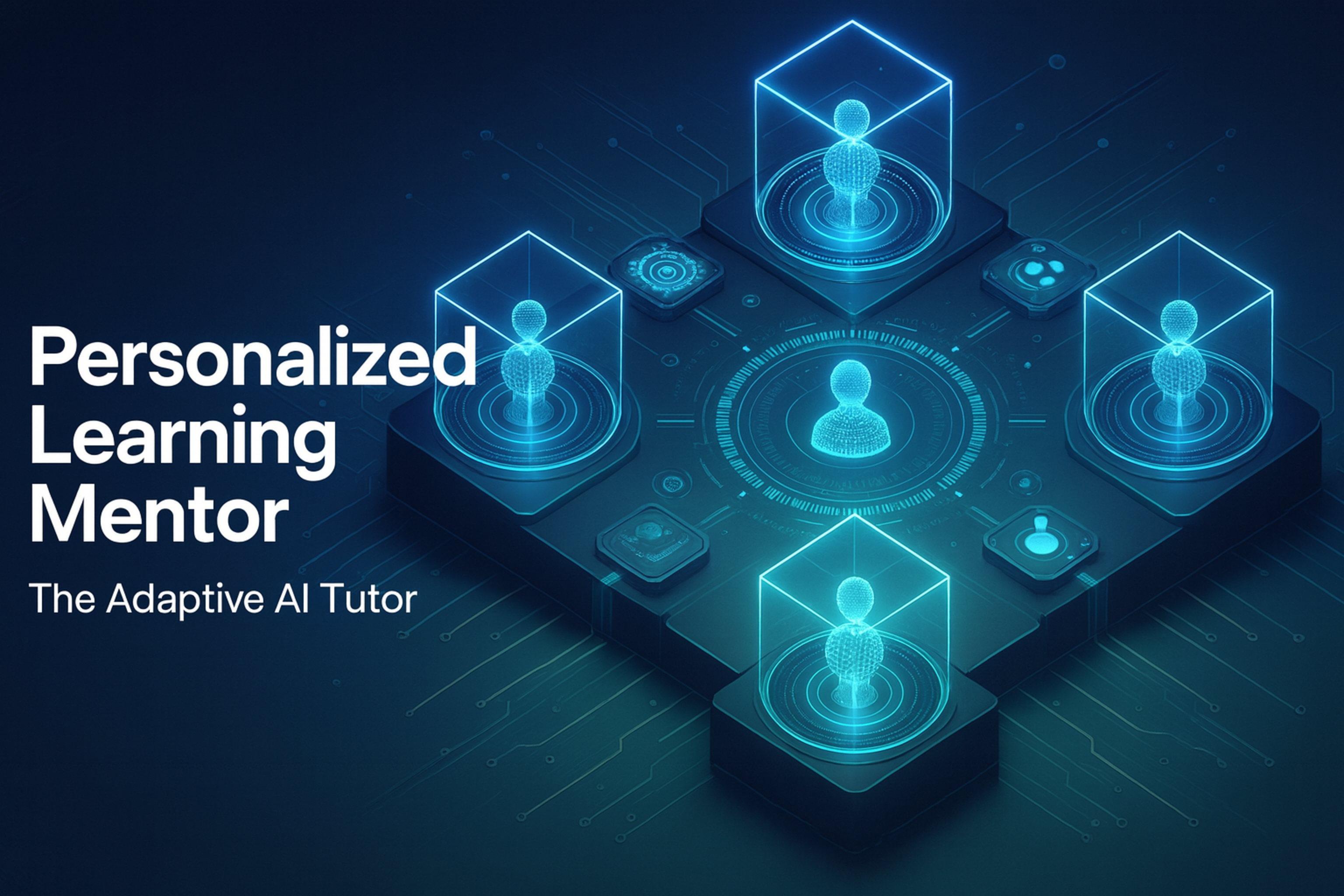
A multi-agent AI system that builds bespoke 30-day curricula, adapts to your learning style, and ensures mastery through real-time multimodal coaching.
1. The Problem 🚨
Self-directed learning is often overwhelming and inefficient due to:
- Too much content with no clear path (“analysis paralysis”).
- Lack of personalized guidance and feedback.
- Static curricula that fail to adapt to prior knowledge and learning style.
2. The Solution 💡
MentorAI is a multi-agent AI system that acts as a personalized tutor. It:
- Builds a 30-day adaptive curriculum for each learner.
- Maintains long-term memory of skills, goals, and learning style.
- Interacts via text, voice, and visuals, providing guidance, quizzes, and feedback.
MentorAI empowers learners by providing structured, adaptive learning plans that improve engagement and skill mastery without the need for human tutors.
3. Value Proposition
- For Learners: Provides a clear, structured, and adaptive path to mastering new skills, moving…
- Kaggle Project: Agents Intensive Project





Top comments (0)