


This is a submission for the DEV April Fools Challenge
I turned Hello World into a nine-service, six-language, Gemini-powered enterprise incident factory with a ceremonial teapot.
Some people write:
console.log("Hello, World");
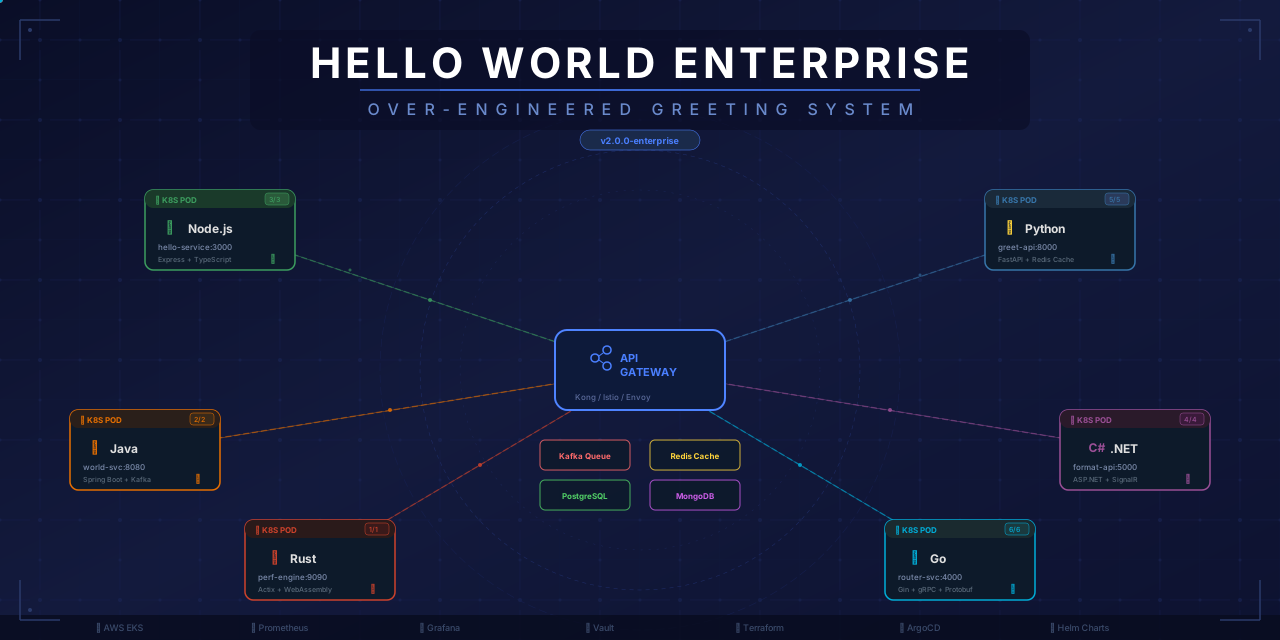
I wrote a Vercel frontend that calls an API gateway, which consults feature flags, asks Gemini whether the vibes support "Hello" or "Greetings", A/B tests punctuation, routes through Java to capitalize the first letter, uses C# to concatenate strings, lets Rust add punctuation safely, and then checks with a teapot before showing two words on screen.
This solved no user problems.
It did, however, create a platform.
What I Built
I built HelloWorld Enterprise Edition, a delightfully useless web app that displays Hello World with the kind of architectural seriousness normally reserved for payment rails, spacecraft, or the LinkedIn feed.
From the outside, it looks like a polished internal dashboard.
From the inside, it is a cry for help with very good typography.
Behind one greeting, there are:
- 9 microservices
- 6 programming languages
- a Gemini-powered Chief Greeting Officer
- feature flags
- A/B testing for punctuation
- 47 Architecture Decision Records
- incident reports for greeting-related disasters
- a teapot service that refuses coffee on standards-compliant principle
The app does not merely display Hello World.
It orchestrates Hello World.
Live demo: helloworld-enterprise
GitHub repo: https://github.com/CodeExplorerRay/hello-world-enterprise
Demo
Here is what the demo actually does:
- You open the site and are greeted by an unnecessarily dramatic loading screen.
- The UI cycles through deeply reassuring enterprise status messages like:
Consulting feature flags...Checking the moon phase and the vibes...Reviewing Architecture Decision Record #47...
- The backend assembles your greeting through a distributed system that absolutely should not exist.
- The frontend presents the result like a real observability dashboard, including:
- routing authority
- latency
- token usage
- feature-flag posture
- teapot status
- cost-per-greeting
- whether any of this was worth it
There is also an April 1st override that can replace the normal output with APRIL FOOLS, because governance never sleeps.
Code
The whole repo is here:
- GitHub:
 CodeExplorerRay
/
hello-world-enterprise
CodeExplorerRay
/
hello-world-enterprise
Over-engineered Hello World for DEV April Fools Challenge 2026


The World's Most Over-Engineered Greeting
"Because saying 'Hello World' should require at least 47 microservices, an AI decision engine, and a teapot."
Welcome to HelloWorld Enterprise Edition™ — the pinnacle of software over-engineering. This project demonstrates how to take the simplest possible task (displaying "Hello World") and turn it into a distributed system with 9 microservices, 6 programming languages, cloud infrastructure, CI/CD, monitoring, and 47 architecture decision records.
Why This Exists
In the world of enterprise software, complexity is a virtue. Simplicity is for amateurs. This project proves that even "Hello World" deserves:
- A microservices architecture
- AI-powered decision making
- A/B testing for punctuation
- Feature flags for greeting words
- A teapot health check (HTTP 418)
- 24/7 monitoring and alerting
- Railway service sprawl
- Docker containers
- Vercel preview deployments
- And much more!
Demo Highlights
- A live request form that sends user context through the API gateway
- Cost-per-greeting accounting in the frontend
- An April…



Some of my favorite receipts:
Gemini really is in the loop
const { GoogleGenAI } = require("@google/genai");
const MODEL_NAME = "gemini-flash-lite-latest";
Yes, I genuinely wired Google AI into the critical business decision of whether the app should say Hello, Hi, Hey, or Greetings.
The teapot really does exist
http.HandleFunc("/brew", func(w http.ResponseWriter, r *http.Request) {
    w.WriteHeader(http.StatusTeapot)
    fmt.Fprintf(w, "Still a teapot. Nice try though.")
})
This project contains a real Go microservice dedicated to the proposition that some servers simply are not meant to brew coffee.
We wrote incident reports for greeting drift
One of the incident reports is literally about a user receiving Hi World! instead of Hello World!.
Severity: P0
Users impacted: 1
Institutional dignity impacted: all of it
The Architecture (A Cry for Help)
User
  -> Next.js frontend on Vercel
  -> API Gateway (Node.js/Express)
  -> Feature Flag Service
  -> AI Decision Engine (Gemini)
  -> A/B Testing Service
  -> Capitalization Service (Spring Boot)
  -> Concatenation Service (.NET)
  -> Punctuation Service (Rust)
  -> Teapot Service (Go)
  -> back to the frontend so it can present two words with executive confidence
If you are wondering whether this could have been one function:
Yes.
If you are wondering whether I chose peace:
No.
How I Built It
Frontend
The frontend is built with Next.js 14, React, TypeScript, and CSS Modules.
I wanted it to look less like a joke landing page and more like a beautifully overfunded internal control room. So instead of a basic Hello World, the UI renders:
- a loading experience with orchestration stages
- status badges for live AI, fallback, or policy-driven routing
- a service-flow visualization
- narrative and experiment panels
- teapot protocol reporting
- a raw metadata drawer for people who enjoy opening JSON and making eye contact with their own bad decisions
Backend
The backend is a proper federation of nonsense:
- API Gateway in Node.js/Express receives the request.
- Feature flags decide whether AI is enabled and which greeting word is approved.
- Gemini Flash-Lite acts as the Chief Greeting Officer when AI routing is enabled.
- Python/Flask A/B tests whether your punctuation should be enthusiastic or professionally dead inside.
- Java/Spring Boot capitalizes the greeting because apparently title case is an enterprise concern.
- C#/.NET concatenates strings with Microsoft-grade ceremony.
- Rust appends punctuation with the kind of memory safety usually reserved for nuclear facilities.
- Go powers the teapot service, because it felt spiritually correct.
Deployment
The live shape of the project is:
- Vercel for the frontend
- Railway for the backend services
- Docker Compose for local multi-service development
And because restraint is for other people, I also documented a Google Cloud Run + Cloud Build deployment path for the backend.
Governance, for a two-word app
This repo includes:
- 47 ADRs
- a changelog
- monitoring assets
- an API specification
- a runbook
- incident reports
I did not stop when the joke was clearly already working.
I continued until the joke had compliance overhead.
Why Google AI Is Here
This project is not using AI as a sticker.
Gemini is directly part of the bit.
The AI decision engine helps choose the greeting word and generate the reasoning around that decision. In other words, I used a modern generative model to answer one of the least urgent questions in software history:
Should this website say "Hello" or "Greetings" today?
The answer depends on rollout policy, request context, and whether the AI layer feels emotionally aligned with the moment.
That is the most serious misuse of useful technology I have produced all year.
Ode to Larry Masinter
I also feel morally obligated to mention the teapot.
The project includes a dedicated HTCPCP-inspired teapot service with:
- a
/brewendpoint that returns418 I'm a Teapot - a
/brew/additionsendpoint withAccept-Additions - philosophical teapot musings
- a sincere dedication to Larry Masinter
Even better: the /health payload reports the teapot's 418 identity in JSON, because returning an actual 418 for health checks made load balancers behave like cowards.
This may be the most emotionally complete microservice I have ever written.
Favorite Internal Lore
My favorite part of this repo is that it has canon.
Examples:
- There is an incident report for the time the greeting said
Hiinstead ofHello. - There is an ADR defending the use of microservices for
Hello World. - There is a formal decision around using HTTP 418 as a health check identity.
- The system keeps track of whether all this was worth it.
- The answer is usually
false.
Prize Category
Best Google AI Usage
I’m choosing this because Gemini is not just mentioned in the README. It is actually wired into the product experience as the Chief Greeting Officer and materially affects the greeting path, reasoning, and metadata returned by the system.
That said, I would also like to submit this spiritually for Best Ode to Larry Masinter, because the teapot service is one of the most important and least employable components in the stack.
Final Thoughts
I started with Hello World and accidentally built a tiny enterprise.
If your app currently has too many services, too many dashboards, too many committees, or too much AI, I hope this post makes you feel seen.
And if not, I hope it at least makes you feel better about your architecture.
What is the most over-engineered thing you have ever built?


Top comments (2)
lolol
had to make sure “Hello World” meets compliance standards 😄