

Welcome to Game Design Bites - a personal take on game design, straight from years of experience in the industry!
If this interests you, subscribe to get game design insights straight to your inbox for free!

The brainrot-ification of everything is in progress. As I started looking at the mobile game market with this lens, I’ve had a bunch of thoughts.
I posted some opinions on this earlier; you can read them here if you haven't already.
💸Economy Design?
It might sound complex, but at its core, economy design is about managing how resources—like currency, items, and progression—are earned, spent, and balanced in a game.
The term can be broad, covering everything from basic progression systems to intricate economies with multiple currencies.
For this post, I’ll focus on key aspects of economy design in modern games, specifically within mobile gaming. This keeps things structured and aligns with my experience in the field.
✨The Basics
Some key aspects of a game economy can be broken down into a few main components.
🪙Currencies
Most games have at least one, often multiple, currencies that players work toward. These include coins, gems, diamonds, keys, and more.
Soft Currency: Earned easily through gameplay.
Hard Currency: Scarce and possibly requires real-money purchases.
Some games feature multiple soft and hard currencies, and the difficulty of obtaining hard currencies can vary depending on the game’s design.
🛁Source and Sinks
Every currency needs a source , where players earn it, and a sink , where they spend it.
The balance between sources and sinks determines the currency’s value. If too much is earned without enough ways to spend it, its value drops. If it is too scarce, progression can feel slow or frustrating. This follows the basic principles of supply and demand, similar to real-world economies.
📈Progression
Games create a sense of progress, and the economy scales alongside it. As players advance, the economy would evolve to ensure their efforts feel meaningful. A well-designed economy reinforces a sense of purpose and achievement, making it a core part of the game's progression.
🔴Live Operations
For games that rely on regular content updates to keep players engaged, the economy is designed to support ongoing changes. New updates can introduce fresh resources or sinks to maintain balance and sustain player interest. Live operations play a crucial role in keeping a game relevant over time. Many of today’s most successful games depend on live operations, with economy balance as a key factor in their longevity.
⌛Conventional Approach
Multiple currencies in games, especially mobile games, are common. They are typically divided by value, with soft currency forming the foundation of progression and other currencies adding layers of complexity.
The value of a currency is usually defined by:
Conversion rates between soft and hard currency.
The effort required to obtain it.
Rarity-based scarcity that affects availability.
Limits on how it is earned or stored.
These elements help designers control the economy and guide player engagement. Many successful games use these tools effectively:
Strategy games like Clash of Clans casually introduce multiple currencies tied to different mechanics over time.
4X strategy games feature even more complex economies where understanding currency interactions is key to progression.
RPGs like Summoners War and AFK Arena use multiple currencies and gacha mechanics with rarity-based rewards.
Puzzle games like Candy Crush Saga and Gardenscapes use soft and hard currencies, such as gold bars and lives, to control progression.
A common way in economy design is to avoid currency loops where players spend a currency to generate more of the same. Designers also make conversions and effort levels slightly opaque, encouraging players to engage and figure things out.
Recently, there has been a slight shift in this approach, and the results have been promising.
📉New Normal?
While traditional economy strategies continue to be successful, evidenced by the continued success of many of the games mentioned, there's a noticeable shift toward simpler, more straightforward economy designs that require less mental effort from players.
I’ll highlight some games and genres that, in my observations, are experimenting with simplified economy designs and finding success. These are just high-level summaries, as each example could easily warrant a deep dive of its own.
🏰Merge Mansion

Games like Merge Mansion and Gossip Harbor are part of a growing genre, driven largely by their strong revenue potential.
A key design hook in these merge-based games is how they obscure the grind. Since merging requires two of the same item to upgrade, the numbers scale quickly. Upgrading an item to Level 10 from Level 9 may feel achievable, but in reality, it takes twice the effort of reaching Level 9, which itself took twice the effort of reaching Level 8, and so on.
Additional constraints like energy limits, generator cooldowns, and limited board space gradually increase complexity without making the mechanics feel overwhelming. The game remains easy to grasp while subtly guiding players into deeper engagement.
Another smart approach is how these games handle rewards. Coins, for example, are mainly used to progress the narrative rather than for multiple in-game functions. By simplifying currency use, the game can give out meaningful rewards without disrupting the core gameplay loops. Limited-time events and rewards then feel even more valuable, as they provide the items and power-ups needed for faster progression.
By streamlining currency systems and hiding complex calculations within an engaging core mechanic, these games have become some of the biggest recent successes in mobile free-to-play.
👑Royal Match
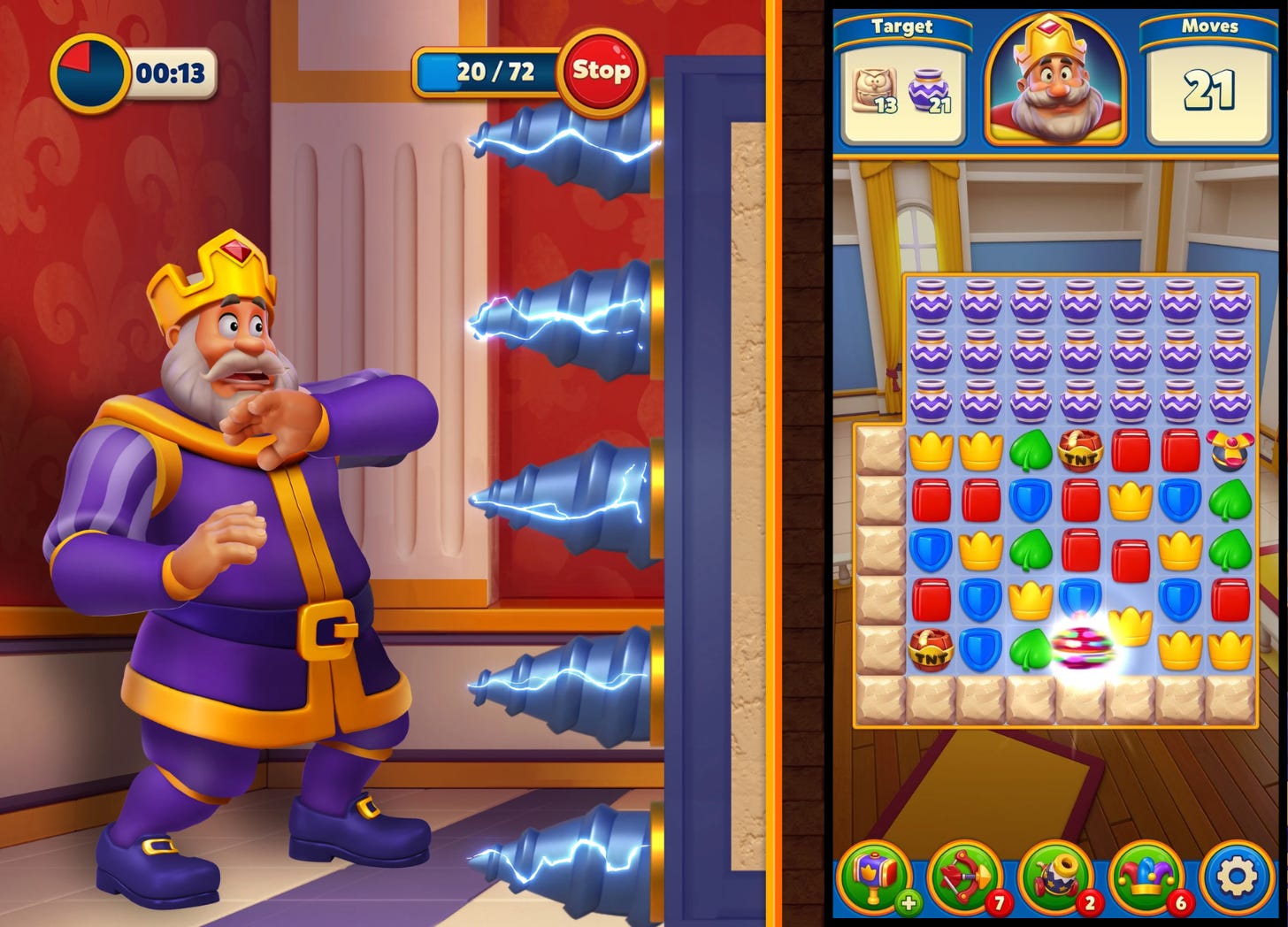
Many modern match-3 and puzzle games, like Royal Match, have streamlined their economies compared to earlier titles.
It’s easy to attribute Royal Match’s success to massive user acquisition spending (you’ve probably seen that crying King ad somewhere) but its place in the top tiers of the grossing charts suggests that players are not only engaging but also monetizing well.
On the surface, Royal Match is similar to Candy Crush Saga or Gardenscapes, but it has introduced subtle yet effective design tweaks to improve engagement. While the game does have a “lives” system, it is extremely generous with lives early on. This makes the early experience feel frictionless, allowing players to focus on coins, which are primarily used to buy extra moves when failing a level.
By creating an early illusion where lives don’t feel like a constraint, players ease into the game without worrying about restrictions. The accessible level design reinforces this feeling, keeping players engaged without frustration. Additionally, the game frequently offers free lives through limited-time events, which trigger a sunk cost fallacy—players stay longer to make the most of their free playtime. Meanwhile, short-term events that rely on maintaining streaks subtly push players to spend coins, making those moments feel more impactful.
This combination of well-tuned level design, a massive content pipeline, and a reduced emphasis on in-game gates and multiple currencies has made Royal Match one of the most engaging and successful puzzle games today.
🎲Monopoly Go!
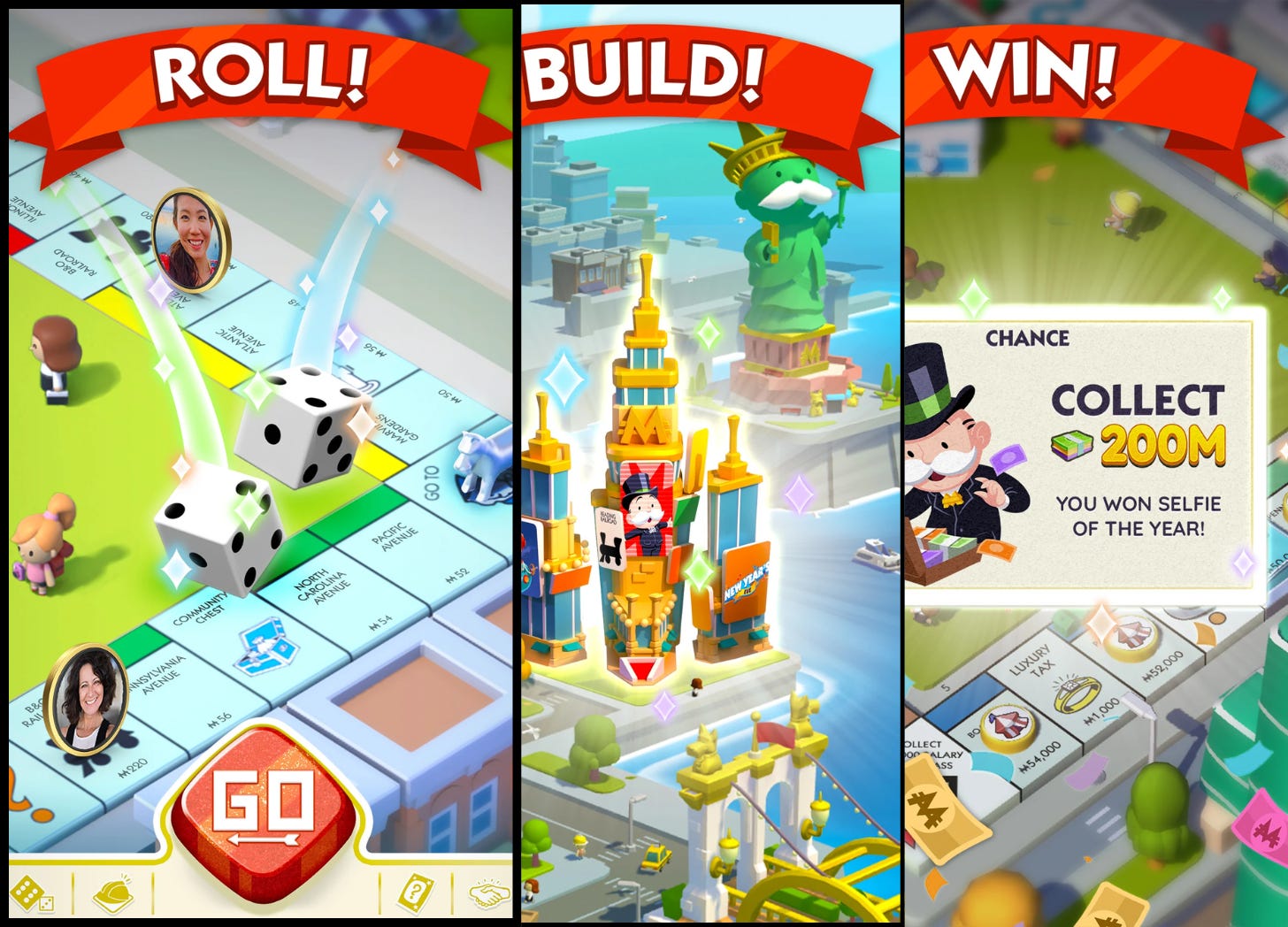
Another massive revenue-generating game, Monopoly Go!, takes economy simplification even further.
At its core, the game follows a straightforward "numbers go up" design, making it instantly understandable to any player. It borrows heavily from social casino games like Coin Master, operating on a slot-machine-like loop where a random number determines a random reward. In this case, rolling dice serves as the slot mechanic, while progression is visualized through the Monopoly board.
Since the goal is simply to earn more rewards, the best way to do that is to roll more dice. This makes dice rolls the game’s most valuable currency, as they are directly tied to how much a player can engage with the game.
On paper, a loop where you spend a currency just to earn more of that same currency might seem redundant. However, games like Monopoly Go! make it compelling by increasing the reward values as players progress. Watching numbers scale up rapidly creates a strong sense of achievement, reinforcing the desire to keep playing.
By tying key rewards to progression layers, the game strengthens the incentive to move forward. The act of spending dice rolls is also the core game action, making the currency sink extremely effective. Additionally, the game introduces players gently, offering generous dice rolls early on. This allows them to get hooked on the loop without friction.
Wrapping a simple slot-based mechanic inside the familiar and friendly Monopoly theme makes the game highly accessible. Even if players don’t fully grasp everything happening on the board, the core action remains clear and engaging. Like Royal Match, this combination of ease of play, strong progression incentives, and well-balanced economy sinks has driven Monopoly Go! to massive financial success.
🐻Capybara Go!
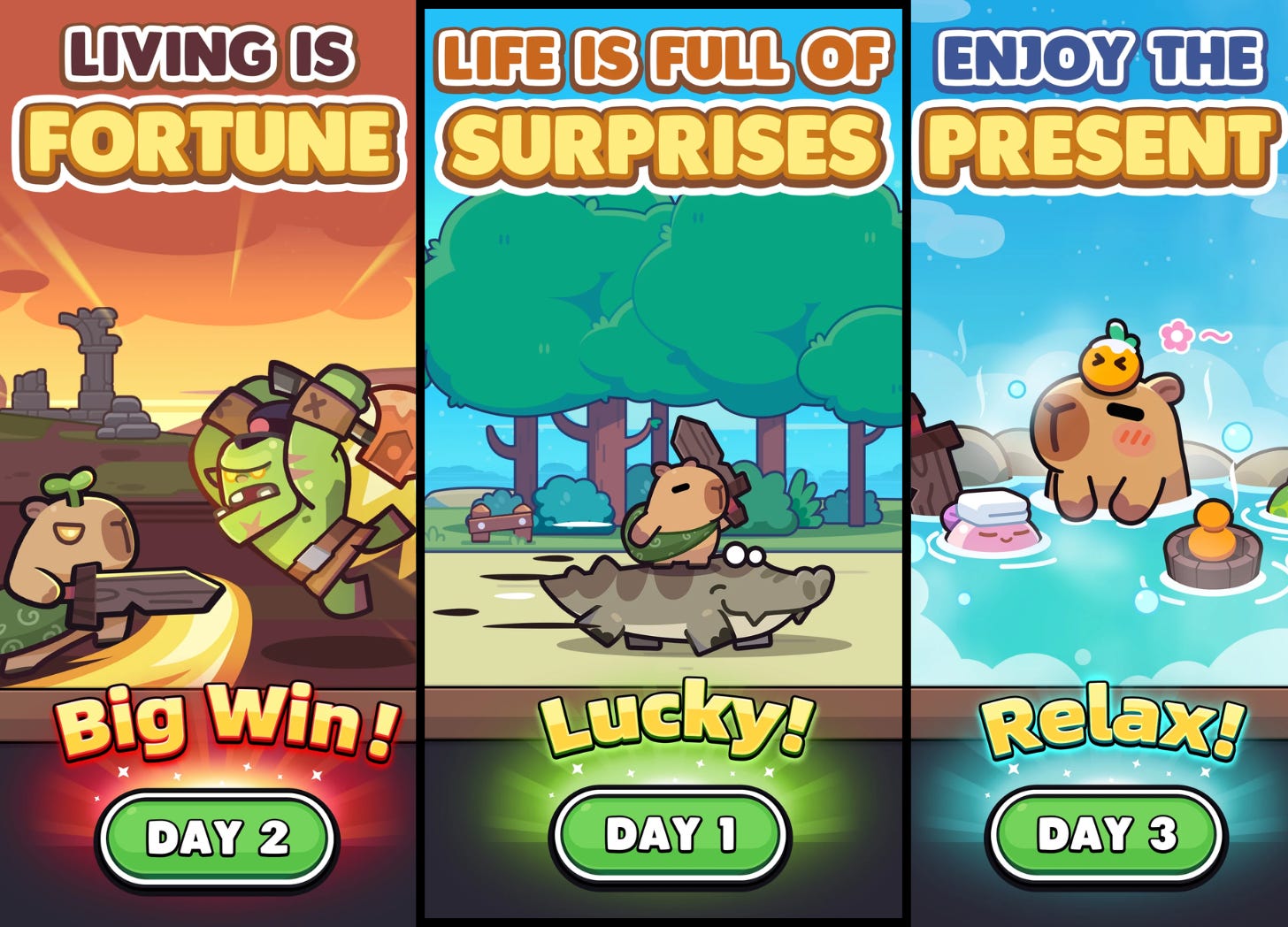
This is a relatively recent game compared to the others I’ve mentioned.
At first glance, it feels like a simple "just press this one button" game, but as you play, it gradually evolves into something much deeper. Over time, it introduces heavier mechanics like gacha drops, upgrades, merging, and leveling systems.
The way this game unfolds is fascinating from a design perspective. It starts off with a progression loop similar to Monopoly Go!, where you repeatedly take the same action to advance. However, unlike Monopoly Go!, there is no immediate limit to how many times you can press the button. Instead, progression is controlled by random events triggered with each press, with outcomes influenced by various internal stats.
As the game expands, players uncover layers of mechanics, making it more comparable to complex mid-core titles. However, the way these systems interact is designed to keep the experience accessible for new players.
The economy follows a similar philosophy. At first glance, the game appears to have a lot of different currencies, which could seem overwhelming. But in practice, each currency has a highly specific and limited use. For example:
Coins are primarily used for leveling up your capybara.
Chests require unique keys that are only used for that specific chest.
Other upgrade or event-based currencies have restricted sinks, ensuring they don’t create confusion.
This structure allows the game to introduce complexity without overwhelming players. Those who enjoy min-maxing and strategic planning can dive deep, while more casual players can still make progress without worrying about every system.
It’s a great example of how a complex economy can be wrapped in an experience that feels simple and approachable. A similar design approach is also evident in Archero 2 from the same studio, which applies this style of progression to a different core gameplay loop.
🃏Candy Crush Solitaire
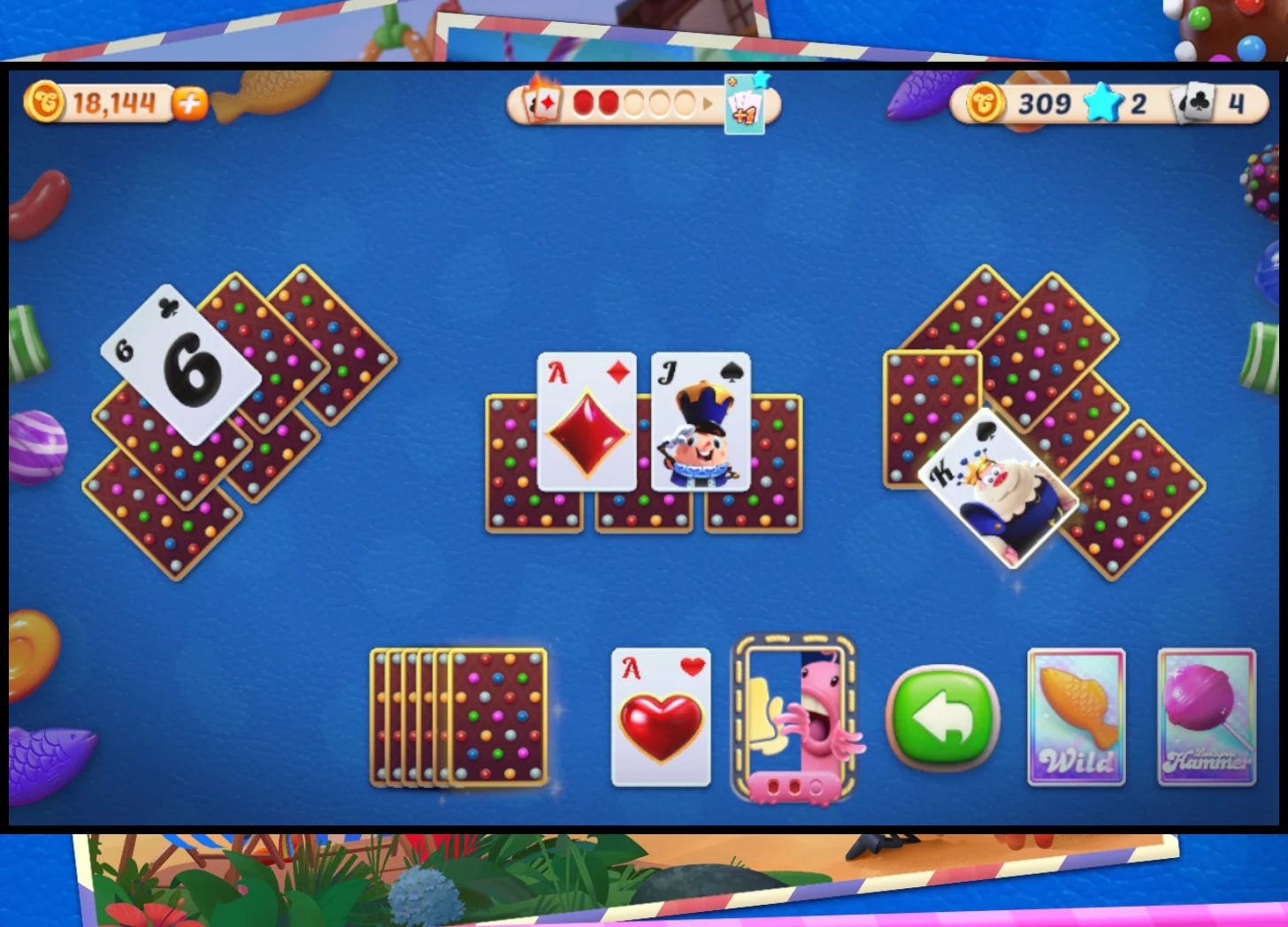
This game is the latest release in the Candy Crush franchise, which had a global launch just a couple of months ago. While it's still too early to draw any definitive conclusions about its success, I’ve noticed an interesting simplification of its economy in the few levels I’ve played.
One of the most noticeable features is that the game charges a currency cost upfront before you even start a level. If you win, you’re rewarded with the same currency, but in greater amounts than you spent to play.
This approach—requiring currency to access a level—might seem radical, but it addresses some value and perception issues in a clever way. It makes each attempt feel more meaningful, as you know that losing means you’ve spent currency for no gain. On the flip side, losing the currency also means you can’t play any further until you either win or earn more currency.
Although it might seem restrictive at first that you can’t play without spending soft currency, the game rewards you generously as you progress, encouraging continued engagement.
From a design perspective, requiring a specific amount of currency to play each level adds flexibility. The game can adjust the currency cost to make certain levels feel more, or less valuable. As you move through the game, the increasing coin cost serves to reinforce the idea that higher levels hold greater value.
This is a fascinating approach, and while it may not be entirely novel to this solitaire genre, it's still an interesting twist. Since the game is so new, only time will tell how successful it will become.
💀The Brainrot Effect
In the economy of action, effort is a cost, and the acquisition of skill is driven by the balance of benefits and costs. Laziness is built deep into our nature.
- Daniel Kahneman (Thinking, Fast and Slow)
As the amount of content continues to grow exponentially, players have more choices than ever. This applies not just to games but to all forms of entertainment. With so many options, the effort required to engage becomes a crucial barrier. This is why engagement mechanics that embrace "endless scroll" and the "TikTok-ification" of content consumption have been so successful.
When it comes to game economies—especially in mobile games, which are designed for quick, snackable engagement—this ease of entry becomes even more important. Many players discover these games through casual ad scrolls or passing mentions rather than active searches. The days when a only a handful of standout games were available on the app stores are long gone. Now, the games that succeed are often the ones that make it effortless for players to engage right away.
Mobile games also function as "second-screen" experiences. People play them while watching TV, commuting, or multitasking. This means that the engagement hooks need to work fast to capture attention.
Designing "laziness-friendly" systems—ones that require minimal initial effort but gradually reel players in—has become a key strategy. Not every game using this approach will be a breakout success, but it’s clear that the ones driving strong engagement metrics are often the ones that get this part of the design right.
📜TL,DR
Game Economies Are Designed for Control – Mobile games use multiple currencies, earnings (sources), and spending (sinks) to shape progression, balance resources, and encourage monetization.
A Shift Toward Simplicity – Modern games are moving away from complex economies, favoring streamlined systems that reduce cognitive load while maintaining engagement depth.
Hidden Complexity Drives Engagement – Merge-based games obscure grind through scaling mechanics, limited space, and energy systems, making progression feel natural and rewarding.
Frictionless Play Keeps Players Hooked – Some puzzle and match-3 games reduce early-game barriers with generous resources, free lives, and soft progression limits, making play sessions last longer.
Effortless Loops Create Addictive Progression – Games with simple, slot-machine-like mechanics use escalating rewards and progression incentives to keep players invested with minimal effort.
Brainrot Design Prioritizes Accessibility – Mobile games increasingly focus on "lazy-friendly" engagement, requiring minimal effort while maximizing retention, mirroring trends in broader digital consumption.
That was another one of my attempts at thought-posting here. It turned out lengthier than I imagined, and I feel like I could’ve gone even further. It’s tough for me to judge my own ideas, I often feel like that meme of a person over-explaining. Let me know your thoughts on my thoughts! And if there’s anything else you’d like my perspective on, feel free to reach out—I’d love to explore more!
Thanks for reading Game Design Bites! Subscribe for free to receive new posts and support my work.


Top comments (0)