

May 18, 2026
Most Ruby developers use ranges every day:
(1..5)
('a'..'z')
(1...)
(..10)
They feel lightweight, expressive, and almost deceptively simple.
 <!-- CONTENT + GRADIENT OVERLAY -->
Built for Ruby on Rails
Build Maps Without
Google APIs
Generate beautiful production-ready maps directly from your Rails backend. Fast rendering, zero external dependencies, full control.
✓ No API fees✓ Self-hosted✓ Rails Native✓ Fast Rendering
Why developers switch
Replace expensive map stacks.
Stop relying on third-party map billing and bloated JS libraries. Render static or dynamic maps directly in Ruby.

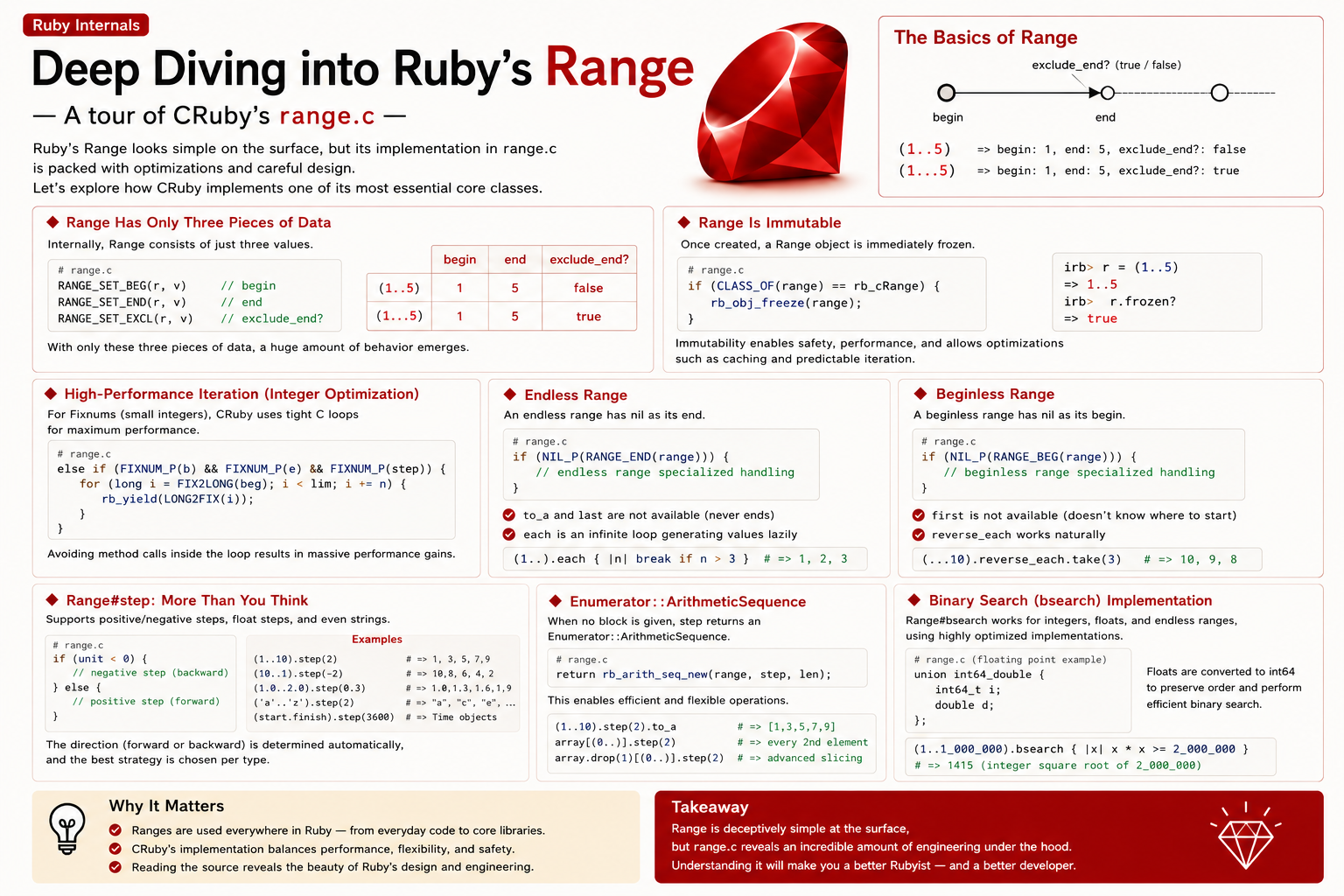
But under the hood, Ruby’s Range implementation is one of the most optimized and feature-rich parts of CRuby.
Inside range.c, the Ruby core team handles:
- endless ranges
- beginless ranges
- arithmetic sequences
- binary search
- Fixnum optimizations
- Bignum overflow
- float stepping
- string iteration
- symbol iteration
- enumerator integration
All behind a syntax most developers learn on day one.
Let’s open the hood.
Read full content:

Inside Ruby’s Range: A Tour Through range.c – Linking Ruby knowledge from the most remote places in the world.
May 18, 2026 Most Ruby developers use ranges every day: (1..5) ('a'..'z') (1…) (..10) They feel lightweight, expressive, and almost deceptively simple. Built for Ruby on R…
 rubystacknews.com


Top comments (0)