


Hey Devs 👋
Over the past few months, I’ve been building my solo SaaS project and wanted to share some reflections — especially about the tech stack I chose.
While most indie hackers lean on lightweight setups like Node.js or Python, I decided to take a less-traveled path: combining Next.js and Spring Boot.
Here's why I went with this setup — and what I learned along the way.
1️⃣ Why I Still Used Full-Stack Next.js 🤗
Even though my backend is built with Spring Boot, I still made full use of Next.js’s server actions and full-stack features.
Rather than calling the Spring Boot API directly from the browser, I routed all API calls through Next.js server components.
This approach gave me:
- ✅ Server-side execution only (no client-side leaks)
- ✅ Invisible API calls in the browser network tab
- ✅ No CORS headaches
This helped me build a more unified and secure architecture.
But of course, there’s a tradeoff:
The frontend logic became more complex, and managing cookies/headers required extra attention.
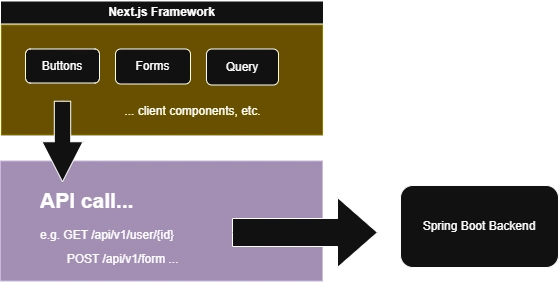
(Rough flow of how I handle requests in Next.js + Spring Boot)
2️⃣ Why I Chose Spring Boot 🤔
I’m fluent in both Java and Python, but when building a product I plan to maintain, I leaned toward a strongly typed, structured framework.
Spring Boot stood out for:
- ✅ Well-defined RESTful APIs
- ✅ Industry-grade security via Spring Security
- ✅ Easy integrations with cloud services
It’s not the fastest way to prototype, but the structure forced me to think deeply about architecture and domain modeling.
I also modularized key logic into Spring Boot starters, so I can reuse them in future projects regardless of this product’s outcome.
3️⃣ Pitfalls Along the Way 😵
It wasn’t all smooth sailing. Some surprises:
🍪 Setting cookies from Spring Boot didn’t work
I had to proxy responses through Next.js API routes to manually set JWT cookies.🔁 Server-Sent Events (SSE) support is messy in this setup
Not a dealbreaker, but definitely a constraint to watch out for.
4️⃣ Solo Deployment with Terraform 🧱
I have an AWS SAA cert, but deployment is still... painful 😅
To manage infra cleanly, I used Terraform, which helped me:
- Keep dev/prod environments consistent
- Easily destroy and rebuild the stack (save AWS costs)
I ended up putting Fargate tasks in a public subnet, because VPC endpoints were too expensive for my MVP.

5️⃣ Final Thoughts ✨
Would I do it again? Mostly yes.
But next time I’d consider simplifying the frontend architecture — especially around auth and API routing.
Still, I’m glad I chose this stack. It gave me deeper experience with both frameworks and left me with reusable modules for future projects.
🚀 I'm building Fenixs, an AI-powered platform for storytellers and filmmakers — helping them go from idea 💡 to script ✍️ to visual layout 🎞️.
Thanks for reading! Would love to hear how others have approached similar stacks or tackled API routing with hybrid architectures like this 🙌


Top comments (0)