


Accelerating Insurance Innovation with Faster Software Development
The insurance industry has always been cautious, but today it faces big changes.
Customers now expect faster, more personalized services, and competition from innovative startups is increasing. Insurers need to adapt quickly and find new ways to deliver products and services more efficiently.
In 2026 innovation in insurance is all about changing how your products are built, updated, and delivered.
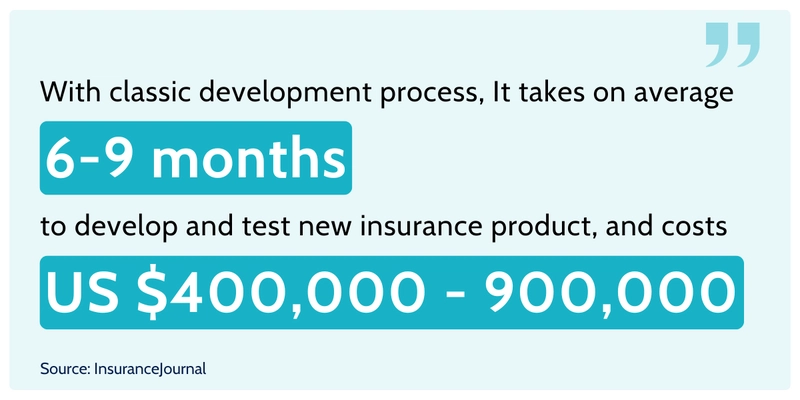
After all, what's the point of launching a new, innovative insurance product if a lengthy and resource-consuming development process eats into the ROI—only to discover that two competitors have already launched similar services?
Being able to launch new insurance products quickly, adapt existing offerings easily, and streamline complex workflows is now essential.
Insurance companies that can’t move fast enough risk falling behind.
Insurtech development and low-code platforms have become key tools for insurers looking to speed up their digital transformation.
These platforms simplify app development with easy-to-use visual interfaces, drag-and-drop features, and pre-built templates specifically made for insurance tasks. This means business and tech teams can build solutions faster, without needing deep technical expertise.
For insurers, low-code brings clear advantages.
They can launch new apps quicker, respond faster to market changes, personalize their services easily, and make better use of their existing resources.
By adopting low-code platforms, insurance companies not only handle today’s challenges more effectively, but also set themselves up for future growth and innovation.
Top Insurance Low Code Platforms in 2026
Mendix

Mendix is a low-code platform known for improving the efficiency of insurance software development processes.
Its strength lies in its ability to smoothly integrate with existing legacy insurance systems.
Mendix simplifies the complexities of insurance processes, allowing companies to accelerate underwriting and policy management tasks.
Key features specifically beneficial for insurance
- Accelerated underwriting processes
- Integration with legacy insurance systems
- Advanced analytics for risk assessment and fraud detection
- Scalability through cloud-native architecture
Unique selling points
- Strong community support and reusable components
- Ease of integration with existing systems
For who
- Mid to large-sized insurance firms
- Companies with complex legacy system integration needs
OutSystems

OutSystems is a highly user-friendly low-code platform headquartered in Boston, Massachusetts.
It excels at providing intuitive interfaces and tools that enable even non-technical users to build robust applications easily.
With a strong focus on user experience, OutSystems is ideal for insurance companies looking to quickly scale their solutions without sacrificing quality or usability.
Key features specifically beneficial for insurance
- Enhanced user experience through pre-built templates
- Automation of policy administration and claims processing
- Seamless mobile application development
- Integration capabilities via APIs and connectors
Unique selling points
- Extensive pre-built templates and workflows
- Rapid scalability and ease of use
For who
- Fast-growing insurance companies
- Companies emphasizing user experience
Appian

Appian offers a robust low-code platform specializing in workflow automation and real-time data analytics.
It is especially suited for complex insurance operations requiring precision, speed, and reliable data insights. Appian streamlines business processes, reduces manual work, and enables faster decision-making.
Key features specifically beneficial for insurance
- Robust workflow automation
- Real-time data analytics and predictive modeling
- Compliance and audit-ready capabilities
- Secure, role-based data management
Unique selling points
- High performance in workflow automation
- Strong analytical capabilities
- Enterprise-level security and compliance
For who
- Large insurers handling complex processes
- Insurance companies prioritizing operational efficiency
Pega

Pega is a **versatile low-code platform highly valued by insurers aiming for exceptional customer relationship management **and intelligent automation.
Its platform provides advanced tools for automating customer interactions and improving overall client experience.
Pega is well-suited for companies wanting comprehensive, intelligent automation solutions.
Key features specifically beneficial for insurance
- Strong capabilities in customer relationship management
- Integration of intelligent automation
- Predictive analytics and decision-making tools
Unique selling points
- Advanced CRM and customer interaction tools
- Comprehensive intelligent automation features
For who
- Insurers focused on customer experience
- Companies needing robust automation and integration
Beyond Low-Code: A Customizable PAS as the Foundation for Core Insurance Operations
Low-code platforms are a fast way to build workflows, portals and internal apps. But for core insurance operations, they leave the hardest part to you. Policy lifecycles, rating, underwriting, claims, billing and carrier reporting still have to be designed, built and tested on top of a generic app builder.
There's another starting point: a policy administration system that already runs the insurance lifecycle and is designed to be reshaped.
Openkoda is a highly customizable, AI-enabled policy administration system. Product and rating, underwriting, policy administration, claims, billing, documents, bordereaux and reporting are in place from day one, on one data model. Instead of assembling an insurance system from components, your team configures a working one.

Two things make it practical as the foundation for core operations:
- The AI Product Builder. Describe a new product or a change in plain English, or upload a requirements document, and the AI Product Builder drafts the coverages, rating tables, underwriting rules, quote form and workflow. Your team reviews each change before it's applied, and every change creates a new version, so policies in force keep their terms.
- Easy access to integrations. REST APIs, webhooks and a submission API on every form connect carriers, brokers, payment providers and data services. Embeddable quote forms put products inside partner sites, and an MCP server lets AI assistants work with live policy data within each user's permissions.

Where configuration isn't enough, Openkoda's team extends the platform on the same foundations. It runs on managed cloud or on-premise, with flat, published pricing and unlimited users.
Low-code still has its place around the edges of an insurance business. For the core itself, starting from a customizable PAS gets you to a working product faster, with far less to build and maintain.


Top comments (1)
If you want to see how your organization's software development can be speed up with the right tools, book your own personalized live demo in the link below:
Book a demo