


This article is a translation of the Japanese article: JSer.info 15周年: 15年間のJavaScriptを振り返る
What is JSer.info?
JSer.info is a weekly JavaScript newsletter that has been running since January 16, 2011. It curates and summarizes the latest JavaScript-related articles, libraries, and tools from around the web, delivering them to readers every week. The goal is to "organize JavaScript information and deliver it accurately."
JSer.info, which started on January 16, 2011, celebrates its 15th anniversary on January 16, 2026 🎉
Over 15 years, JSer.info has published 820 articles and introduced 13,606 sites/articles/libraries. Weekly updates have continued for 15 years straight.
In this article, we'll look back at JSer.info's data over 15 years and see how the JavaScript ecosystem has changed.
Note that the data in this article reflects trends in articles introduced on JSer.info and doesn't represent the entire JavaScript ecosystem.
Also, please note that JSer.info's posting frequency decreased in 2024-2025, which affects the 2025 data showing a declining trend.
Basic Statistics Over 15 Years
| Item | Value |
|---|---|
| Total Posts | 820 |
| Total Articles Introduced | 13,606 |
| Operating Period | January 2011 - January 2026 (15 years) |
| Average Update Frequency | Weekly |
Looking at articles introduced per year, the peak was 1,269 in 2013, and recent years have stabilized around 600-700. Meanwhile, the average length of article descriptions has roughly doubled over 15 years, showing a shift from "quantity to quality."
| Year | Articles Introduced | Posts | Per Post | Avg. Description Length |
|---|---|---|---|---|
| 2011 | 915 | 65 | 14.1 | 62 chars |
| 2013 | 1,269 | 57 | 22.3 | 58 chars |
| 2017 | 1,068 | 54 | 19.8 | 79 chars |
| 2019 | 790 | 53 | 14.9 | 90 chars |
| 2021 | 789 | 53 | 14.9 | 101 chars |
| 2025 | 552 | 41 | 13.5 | 108 chars |
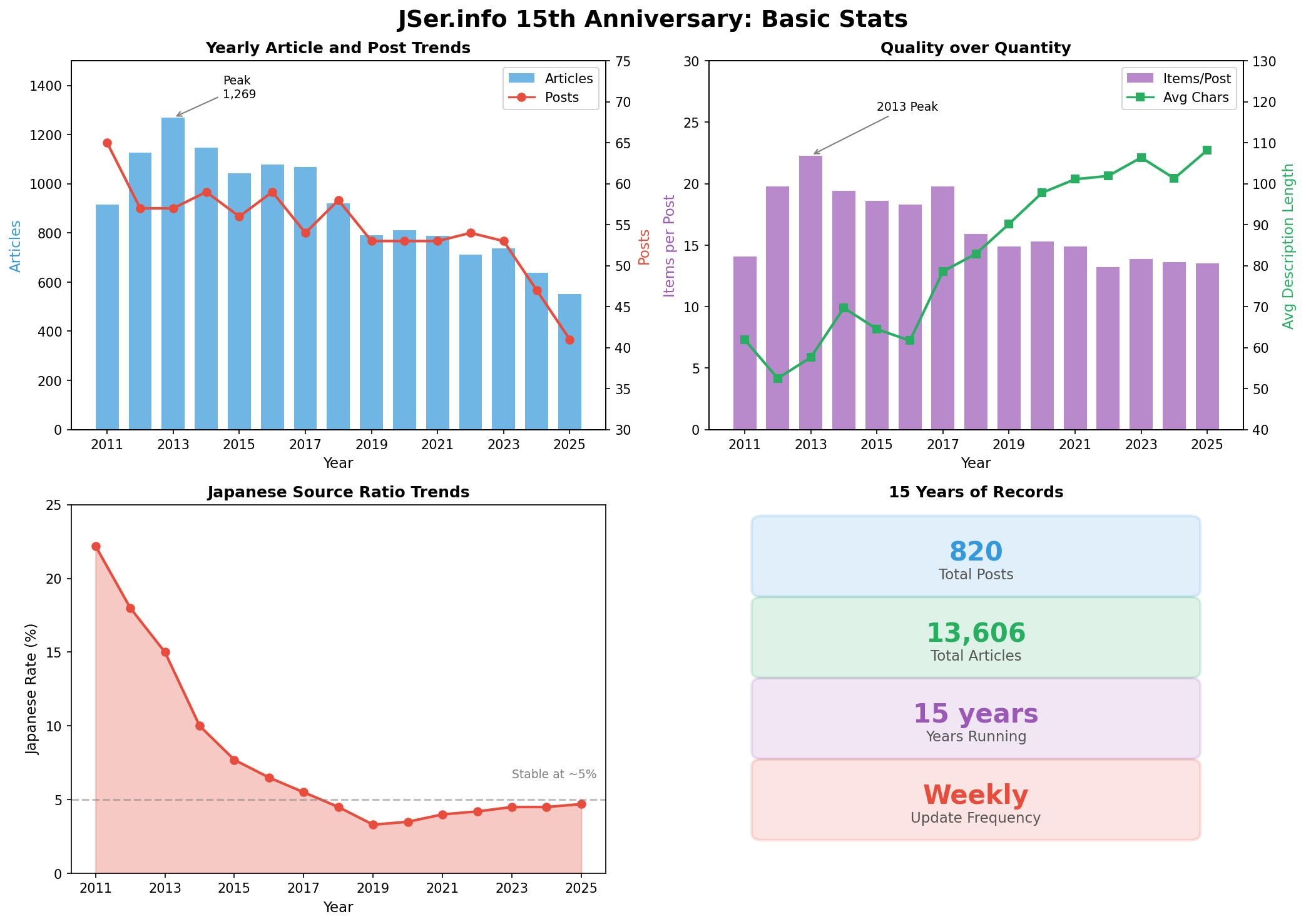
Also, the posting pace dropped slightly in 2025, reducing the number of posts.
Therefore, please note that the subsequent data also shows a declining trend in 2025.
Changes in Information Sources: From Personal Blogs to Official Documentation
The most significant change over 15 years is the composition of information sources.
Early Period (2011-2013) Main Sources
- github.com (327)
- d.hatena.ne.jp (154)
- slideshare.net (147)
- amazon.co.jp (98)
- amazon.com (83)
Middle Period (2017-2019) Main Sources
- github.com (828)
- medium.com (134)
- developers.google.com (103)
- webkit.org (69)
- nodejs.org (64)
Late Period (2023-2025) Main Sources
- github.com (568)
- nodejs.org (98)
- bun.sh (62)
- zenn.dev (56)
- developer.chrome.com (55)
While GitHub has consistently been the largest information source, the surrounding landscape has changed significantly.
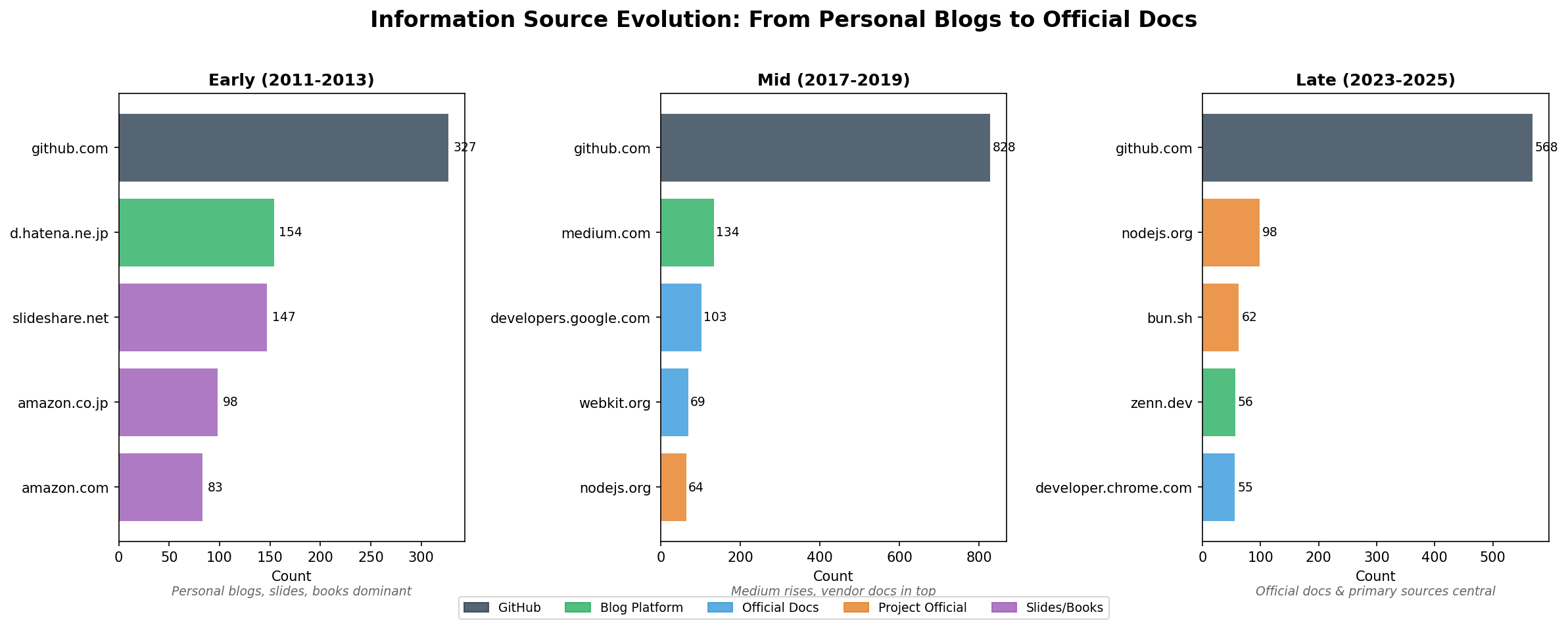
In the early period, Hatena Diary, SlideShare, and Amazon (books) ranked high. It was an era when personal blogs, conference slides, and books were primary information sources.
In the middle period, Medium became prominent, and browser vendors' official documentation/blogs (like developers.google.com and webkit.org) entered the top ranks. Personal blog platforms shifted from Hatena to Medium, while primary information from browser vendors became more valued.
In the late period, official documentation/blogs (nodejs.org, developer.chrome.com, bun.sh) and zenn.dev rank high. Medium has disappeared, and direct access to primary sources has increased.
Changes in Content Types
| Type | 2011-2013 | 2014-2016 | 2017-2019 | 2020-2022 | 2023-2025 |
|---|---|---|---|---|---|
| Release Notes | 560 | 750 | 862 | 937 | 986 |
| Tutorial Articles | 719 | 692 | 813 | 617 | 526 |
| Libraries/Tools | 371 | 599 | 446 | 397 | 191 |
| Slides/Videos | 292 | 309 | 170 | 60 | 49 |
| Book-related | 192 | 203 | 135 | 73 | 45 |
| Tutorials | 97 | 154 | 93 | 33 | 14 |
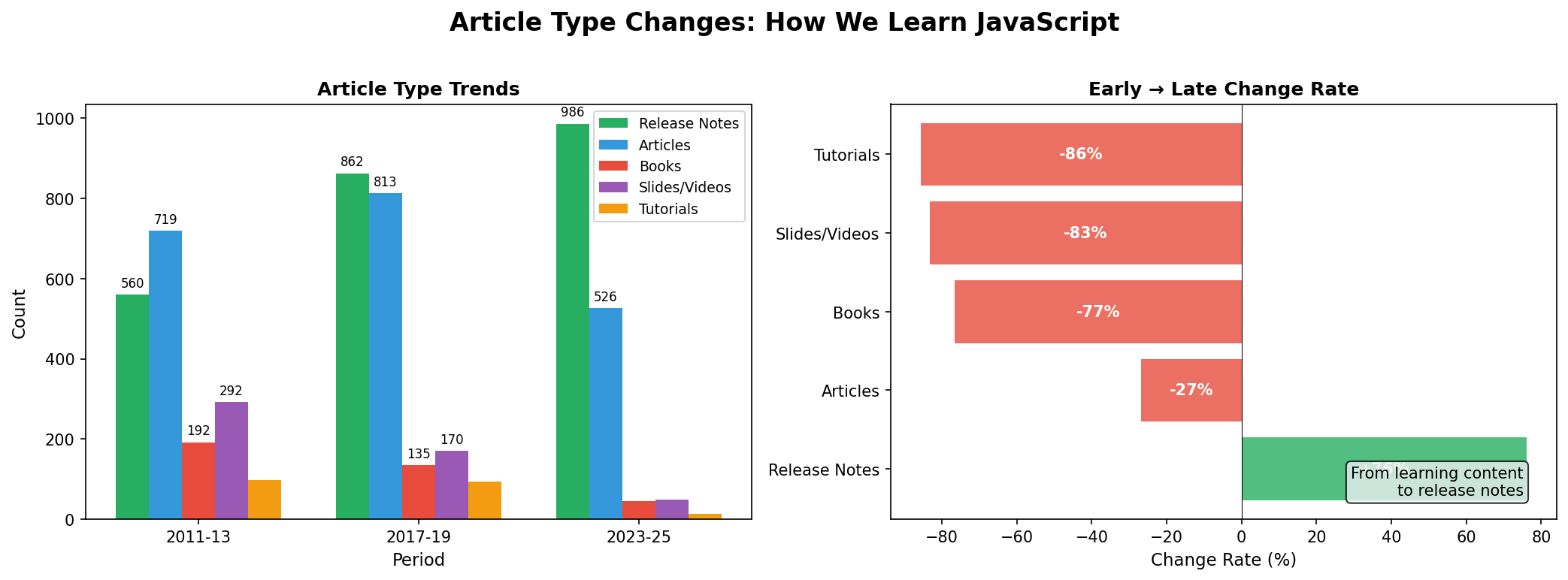
Release notes have consistently increased. Meanwhile, learning content like slides/videos, books, and tutorials has decreased. This reflects how official documentation has become richer and GitHub release notes have become the center of information sharing, reducing the introduction of conference slides and books.
Evolution of Japanese Blog Platforms
Japanese tech blogs introduced on JSer.info have seen major platform shifts over 15 years.
| Year | Hatena | Qiita | Zenn |
|---|---|---|---|
| 2011 | 92 | 0 | 0 |
| 2014 | 29 | 19 | 0 |
| 2016 | 10 | 45 | 0 |
| 2020 | 3 | 4 | 3 |
| 2021 | 1 | 1 | 22 |
| 2024 | 2 | 1 | 24 |
The platform flow has been Hatena Diary/Hatena Blog → Qiita → Zenn.
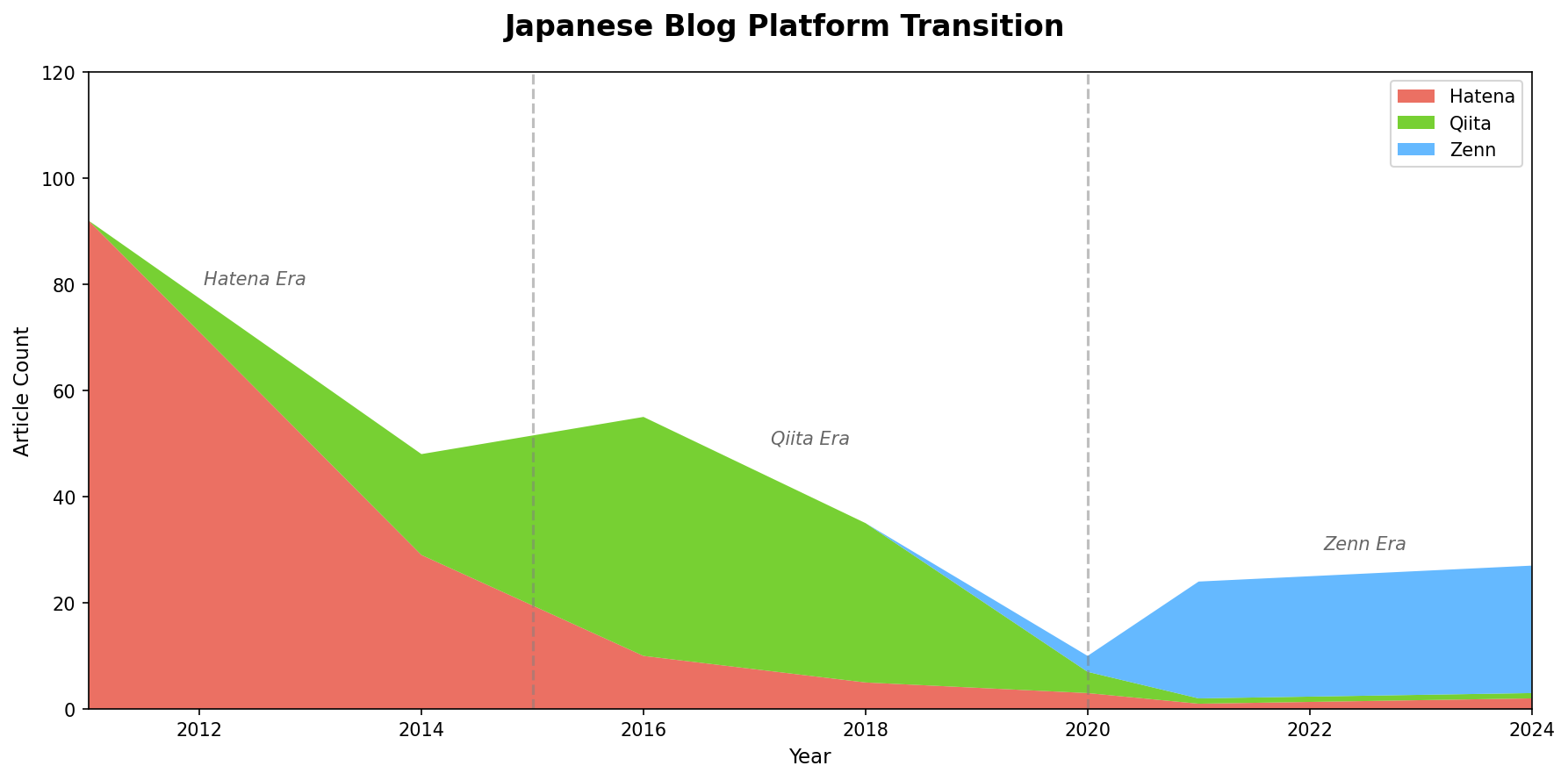
However, the proportion of Japanese sources overall has gradually decreased, stabilizing around 5%.
(This is based on titles only, so the actual percentage might be slightly higher.)
| Year | Japanese Sources | Total | Percentage |
|---|---|---|---|
| 2011 | 203 | 915 | 22.2% |
| 2012 | 194 | 1126 | 17.2% |
| 2013 | 150 | 1269 | 11.8% |
| 2014 | 114 | 1147 | 9.9% |
| 2015 | 80 | 1043 | 7.7% |
| 2016 | 93 | 1078 | 8.6% |
| 2017 | 67 | 1068 | 6.3% |
| 2018 | 64 | 921 | 6.9% |
| 2019 | 26 | 790 | 3.3% |
| 2020 | 25 | 810 | 3.1% |
| 2021 | 43 | 789 | 5.4% |
| 2022 | 33 | 712 | 4.6% |
| 2023 | 42 | 737 | 5.7% |
| 2024 | 44 | 638 | 6.9% |
| 2025 | 26 | 552 | 4.7% |
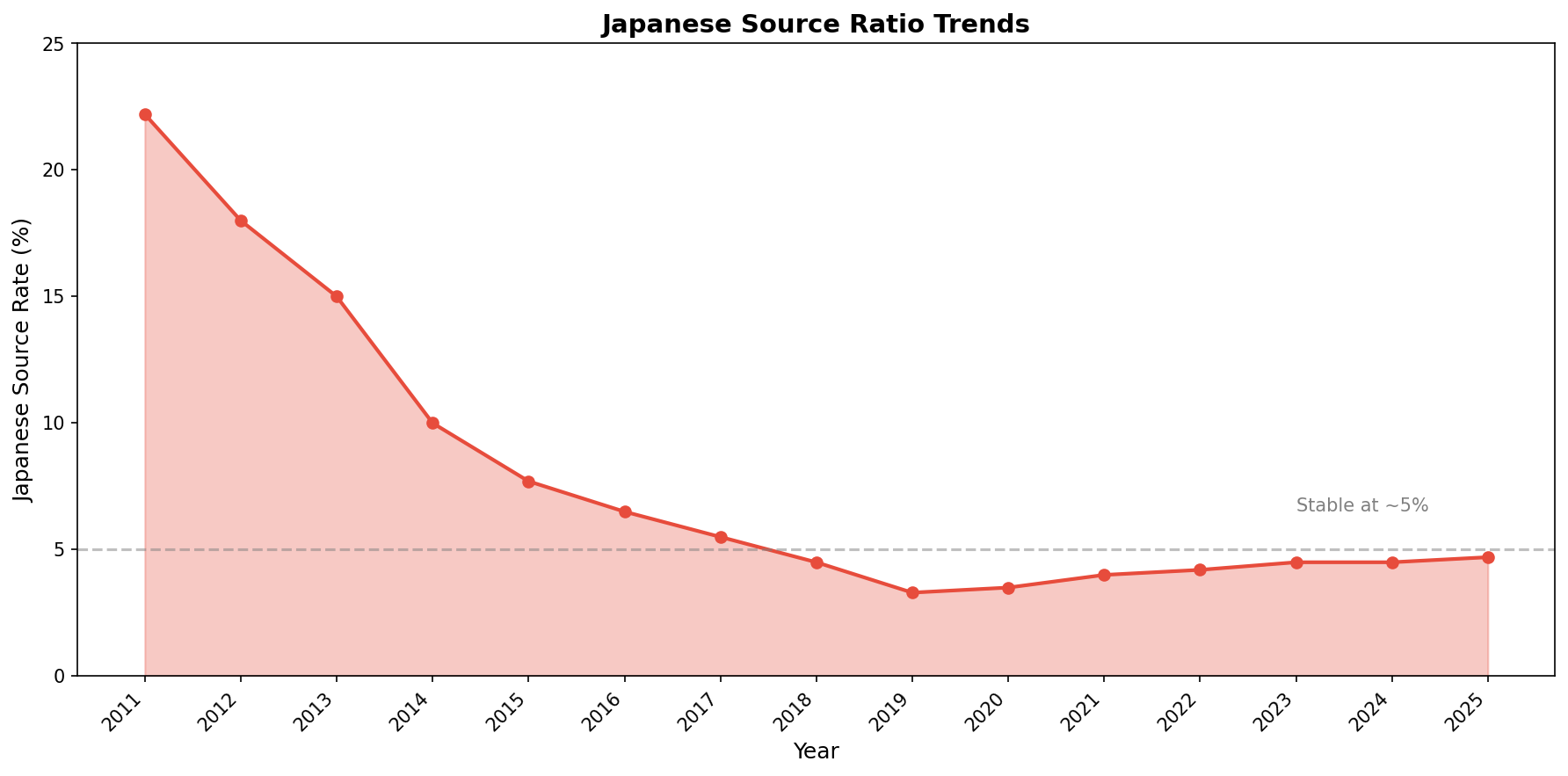
This isn't because JSer.info intentionally avoids Japanese sources, but rather reflects that primary JavaScript information sources are almost entirely in English. Browser vendors, official sites/projects, and maintainers of major libraries almost always publish information in English.
Technology Trend Changes
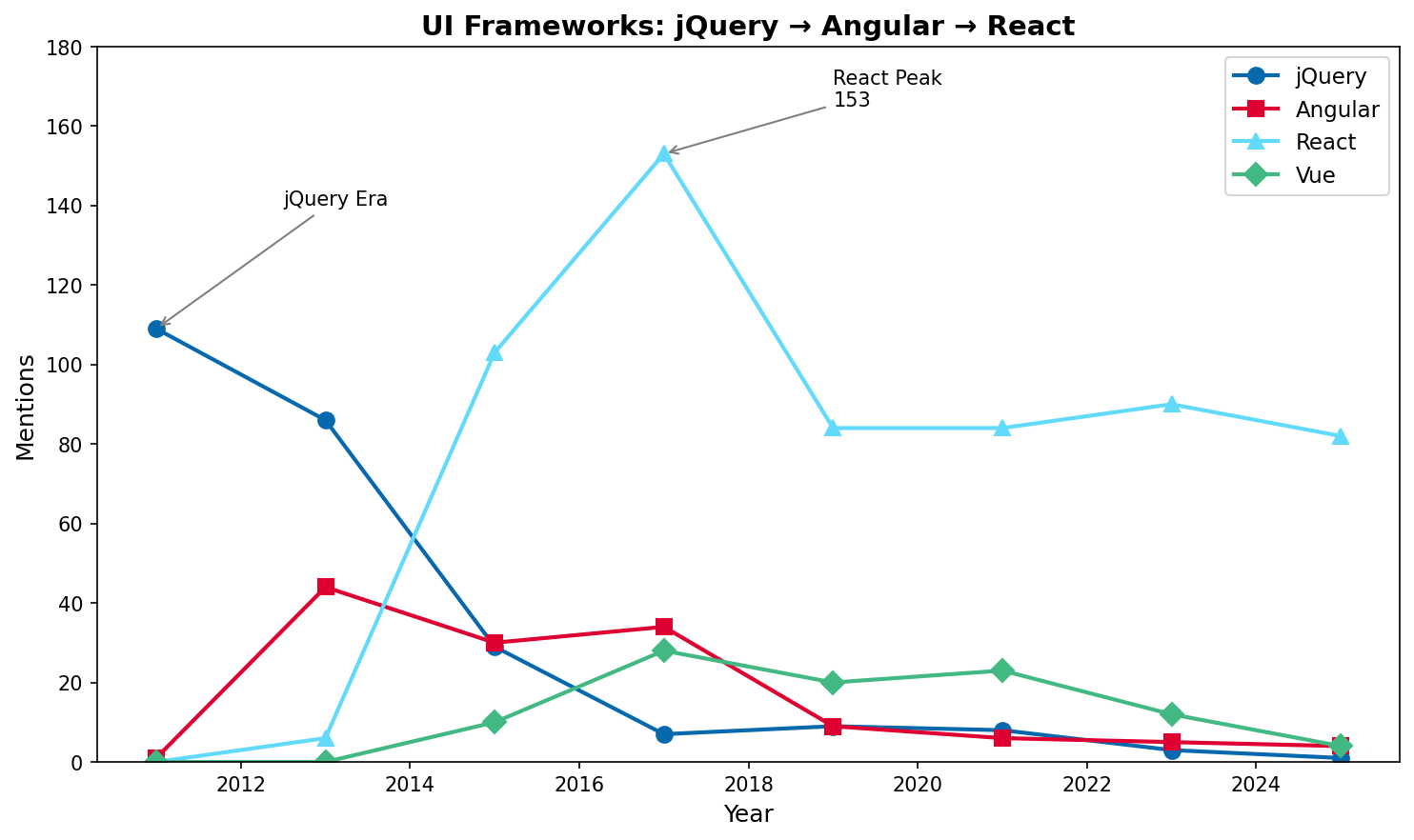
UI Frameworks: jQuery → Angular → React
| Year | jQuery | Angular | React | Vue |
|---|---|---|---|---|
| 2011 | 109 | 1 | 0 | 0 |
| 2013 | 86 | 44 | 6 | 0 |
| 2014 | 35 | 49 | 52 | 11 |
| 2015 | 29 | 30 | 103 | 10 |
| 2017 | 7 | 34 | 153 | 28 |
| 2019 | 9 | 9 | 84 | 20 |
| 2021 | 8 | 6 | 84 | 23 |
| 2025 | 1 | 4 | 82 | 4 |
jQuery was most mentioned in 2011, Angular/React/Vue started increasing around 2013/2014, and React grew significantly in 2015. React peaked at 153 mentions in 2017, then entered a stable period.
In 2025, React mentions are about half of the peak, indicating that React itself has matured and there's less weekly news to cover.
Build Tools: webpack → Vite
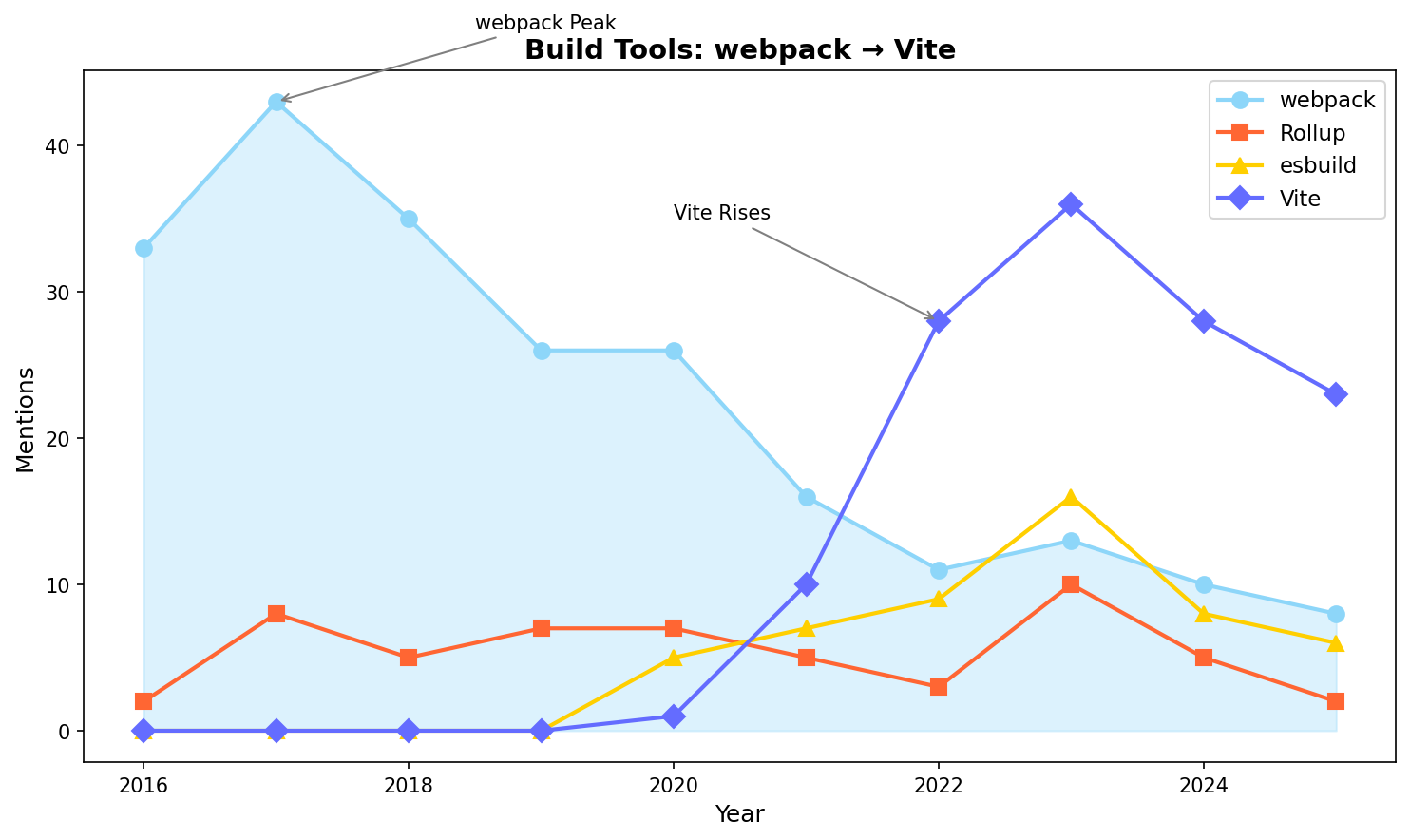
| Year | webpack | Rollup | esbuild | Vite |
|---|---|---|---|---|
| 2016 | 33 | 2 | 0 | 0 |
| 2017 | 43 | 8 | 0 | 0 |
| 2020 | 26 | 7 | 5 | 1 |
| 2022 | 11 | 3 | 9 | 28 |
| 2023 | 13 | 10 | 16 | 36 |
| 2025 | 8 | 2 | 6 | 23 |
webpack peaked in 2017 and was frequently discussed until 2020.
Meanwhile, esbuild emerged in 2020, and by 2022, Vite mentions surpassed webpack.
Since esbuild's emergence, JSer.info has introduced more tools written in Rust and Go. This reflects a change in expectations around performance, breaking the assumption that "JavaScript tools are written in JavaScript."
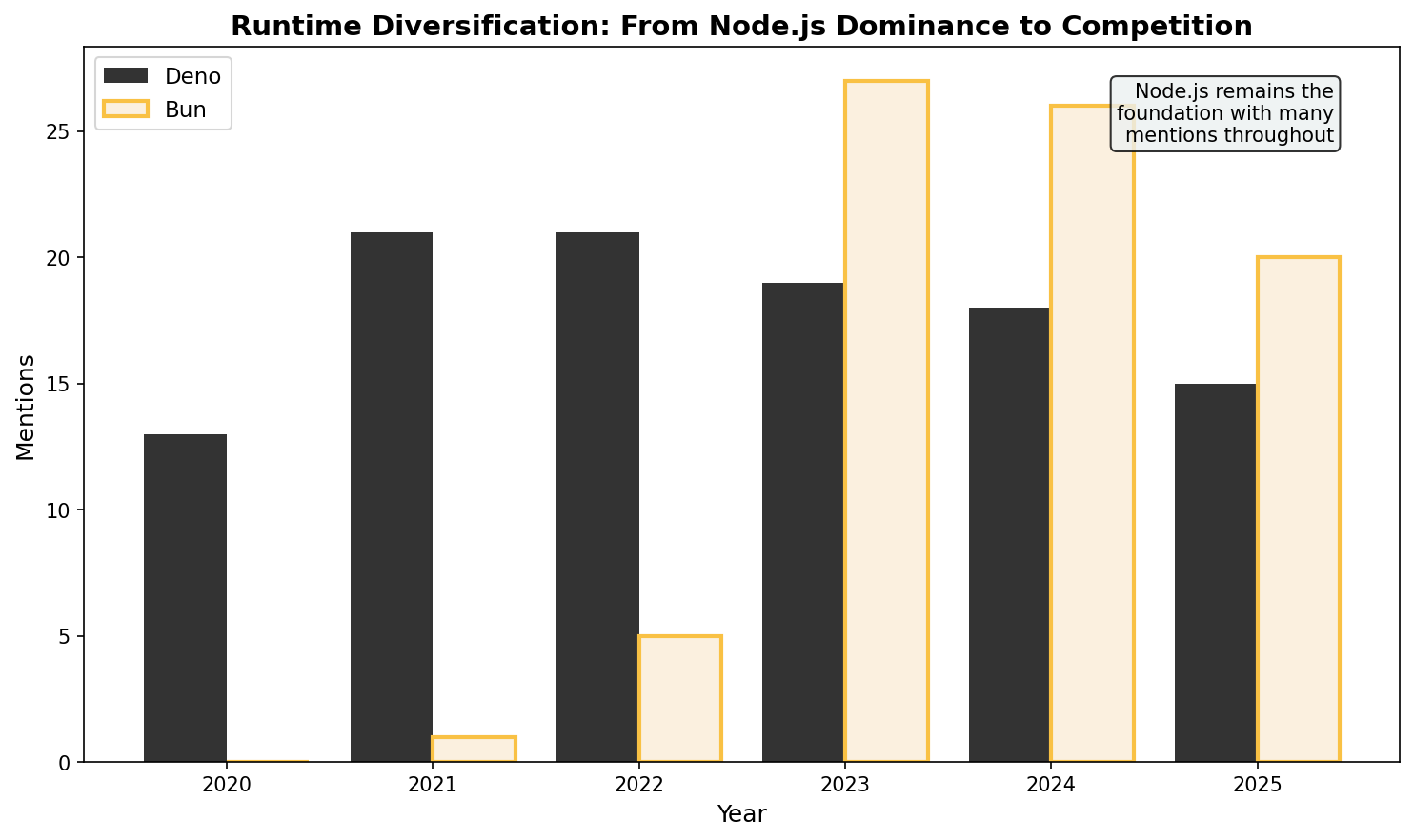
Runtimes: From Node.js Dominance to Diversification
| Year | Deno | Bun |
|---|---|---|
| 2020 | 13 | 0 |
| 2021 | 21 | 1 |
| 2022 | 21 | 5 |
| 2023 | 19 | 27 |
| 2024 | 18 | 26 |
Deno 1.0 was released in 2020, and Bun emerged in 2022. The era transitioned from Node.js dominance to multiple competing runtimes.
Particularly Bun, with regular releases since its 1.0 release in 2023, has been frequently introduced on JSer.info.
Technologies with Changed Mentions on JSer.info
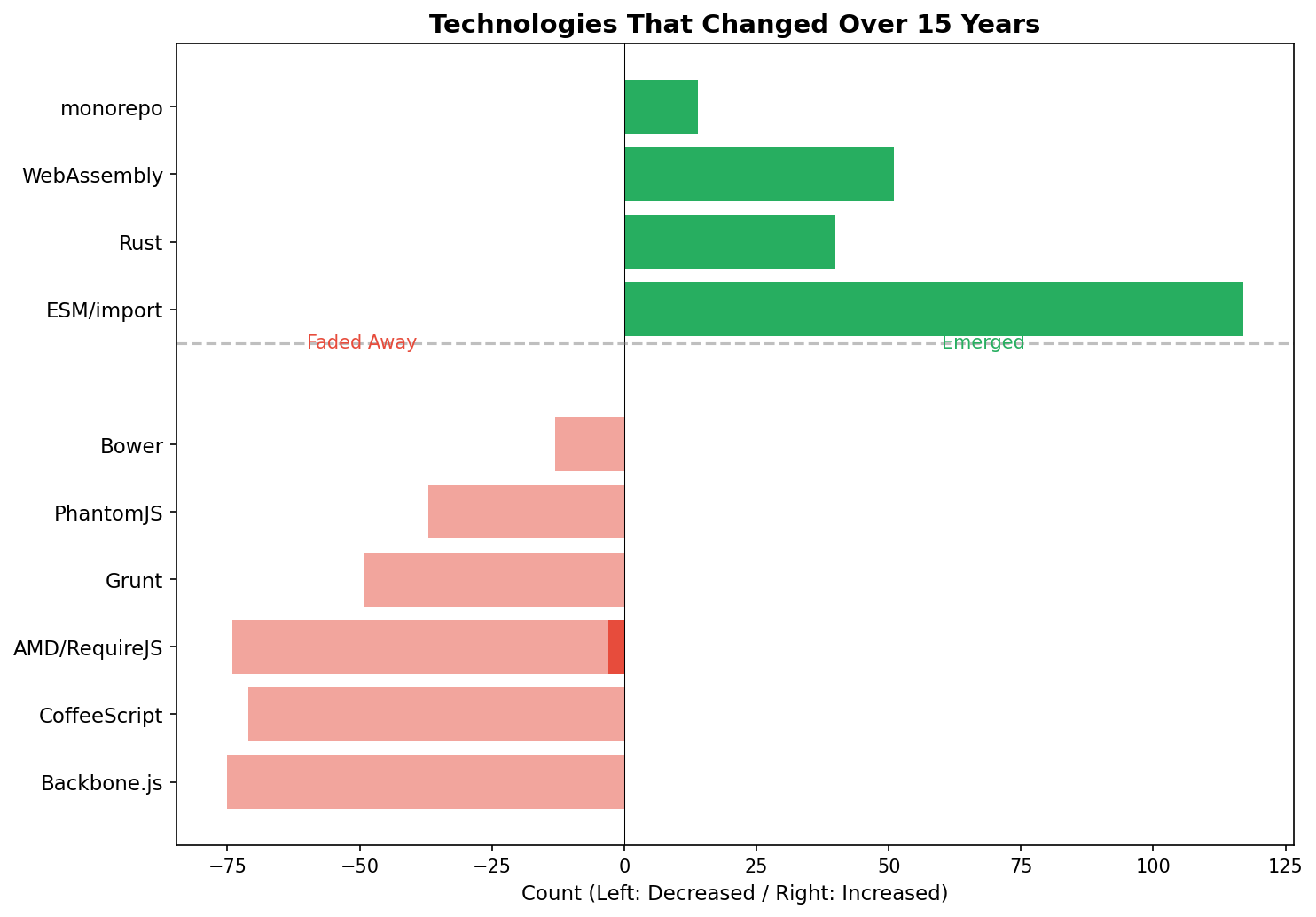
Technologies That Disappeared (2011-2013 → 2023-2025)
| Technology | Early | Late |
|---|---|---|
| Backbone.js | 75 | 0 |
| CoffeeScript | 71 | 0 |
| AMD/RequireJS | 74 | 3 |
| Grunt | 49 | 0 |
| PhantomJS | 37 | 0 |
| Bower | 13 | 0 |
These technologies were widely used at the time but are no longer covered on JSer.info.
Backbone.js and CoffeeScript were frequently introduced around 2011-2012. AMD and RequireJS pioneered module systems but completed their role with ES Modules standardization. Grunt/Gulp were replaced by npm scripts and build tools, and PhantomJS was superseded by Puppeteer/Playwright.
Technologies with Increased Mentions
| Technology | Early | Late |
|---|---|---|
| ESM/import | 2 | 117 |
| Rust | 1 | 40 |
| WebAssembly | 0 | 51 |
| monorepo | 0 | 14 |
ECMAScript Modules were specified in ES2015, but became practically usable in both browsers and Node.js after 2020.
Rust mentions relate to toolchains like SWC/Rspack/Biome/OxC. Performance-critical parts of the JavaScript ecosystem are increasingly written in Rust or Go.
In 2025, TypeScript compiler itself was announced to be rewritten in Go.
WebAssembly was announced in 2015, and JSer.info mentions increased around 2017. While the monorepo concept existed long before, it gained attention in the JavaScript ecosystem after Lerna (2016) and npm/yarn workspaces.
Now, package managers like npm/yarn/pnpm officially support monorepos.
Changes in Cross-Cutting Topics
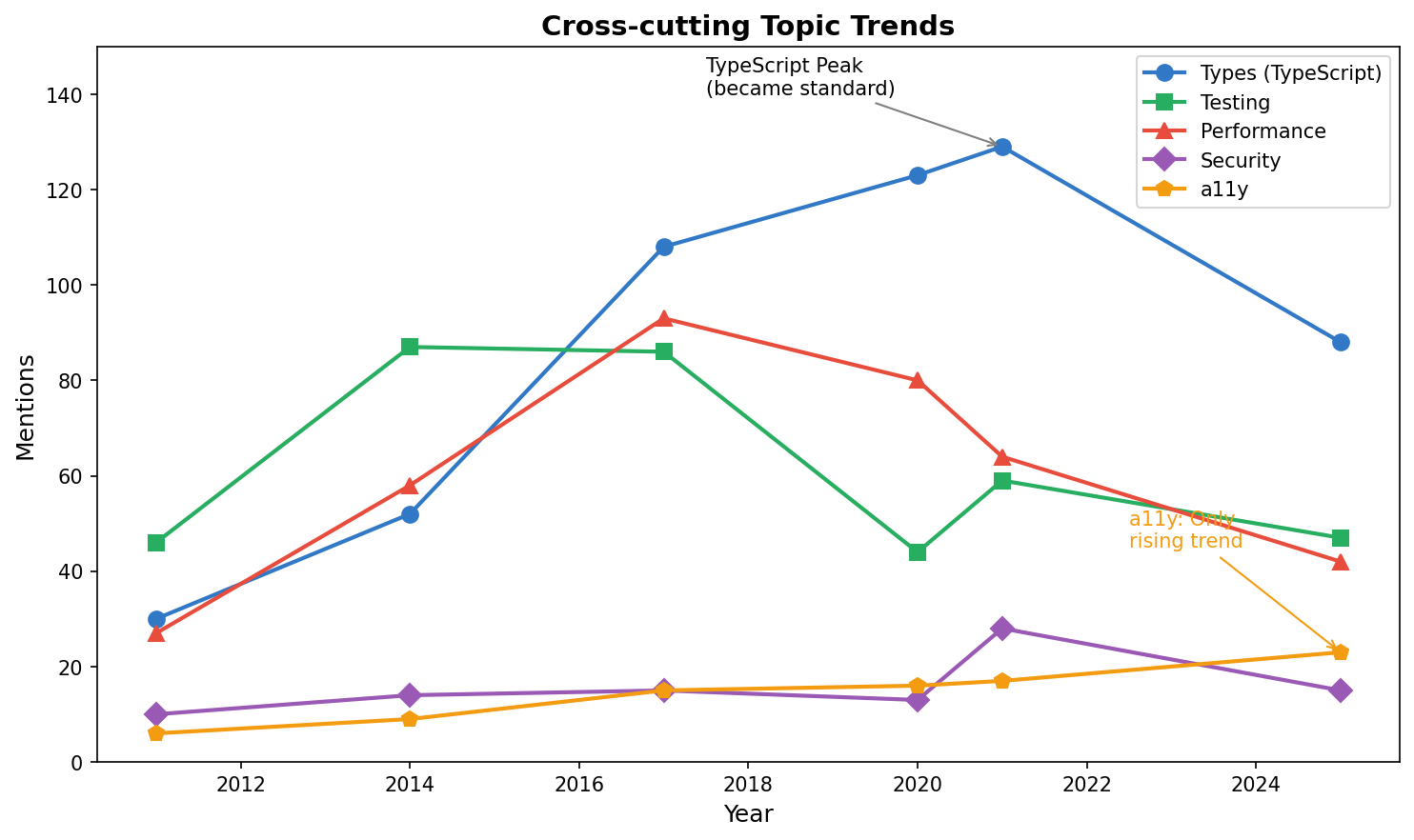
Let's look at the trends of technology-agnostic, cross-cutting topics.
| Year | Types | Testing | Performance | Security | a11y |
|---|---|---|---|---|---|
| 2011 | 30 | 46 | 27 | 10 | 6 |
| 2014 | 52 | 87 | 58 | 14 | 9 |
| 2017 | 108 | 86 | 93 | 15 | 15 |
| 2020 | 123 | 44 | 80 | 13 | 16 |
| 2021 | 129 | 59 | 64 | 28 | 17 |
| 2025 | 88 | 47 | 42 | 15 | 23 |
Types (TypeScript) mentions peaked in 2021 (129) and have since declined. This is likely because TypeScript has become "standard," making "using TypeScript" itself less newsworthy.
Testing mentions peaked in 2014 (87). This was when many test frameworks like Jasmine, Mocha, and Karma were competing, and JSer.info frequently covered them. Now they've converged to Jest, Vitest, Playwright, etc.
Performance mentions peaked in 2017 (93). This was when JSer.info frequently covered webpack optimization, Tree Shaking, and code splitting.
a11y (Accessibility) has consistently increased, growing from 6 to 23 mentions—about 4x.
Changes in Information Source Types
We classified article sources into "Official (Project/Documentation)," "GitHub," and "Personal Blogs."
| Source | 2011-2013 | 2014-2016 | 2017-2019 | 2020-2022 | 2023-2025 |
|---|---|---|---|---|---|
| Official | 204 | 294 | 467 | 471 | 479 |
| GitHub | 506 | 1,015 | 910 | 903 | 596 |
| Personal Blogs | 213 | 194 | 141 | 76 | 70 |
- Official: Official sites/documentation like nodejs.org, webkit.org, reactjs.org, eslint.org
- GitHub: github.com, github.io
- Personal Blogs: Hatena, Qiita, Zenn, medium.com/@personal, etc.
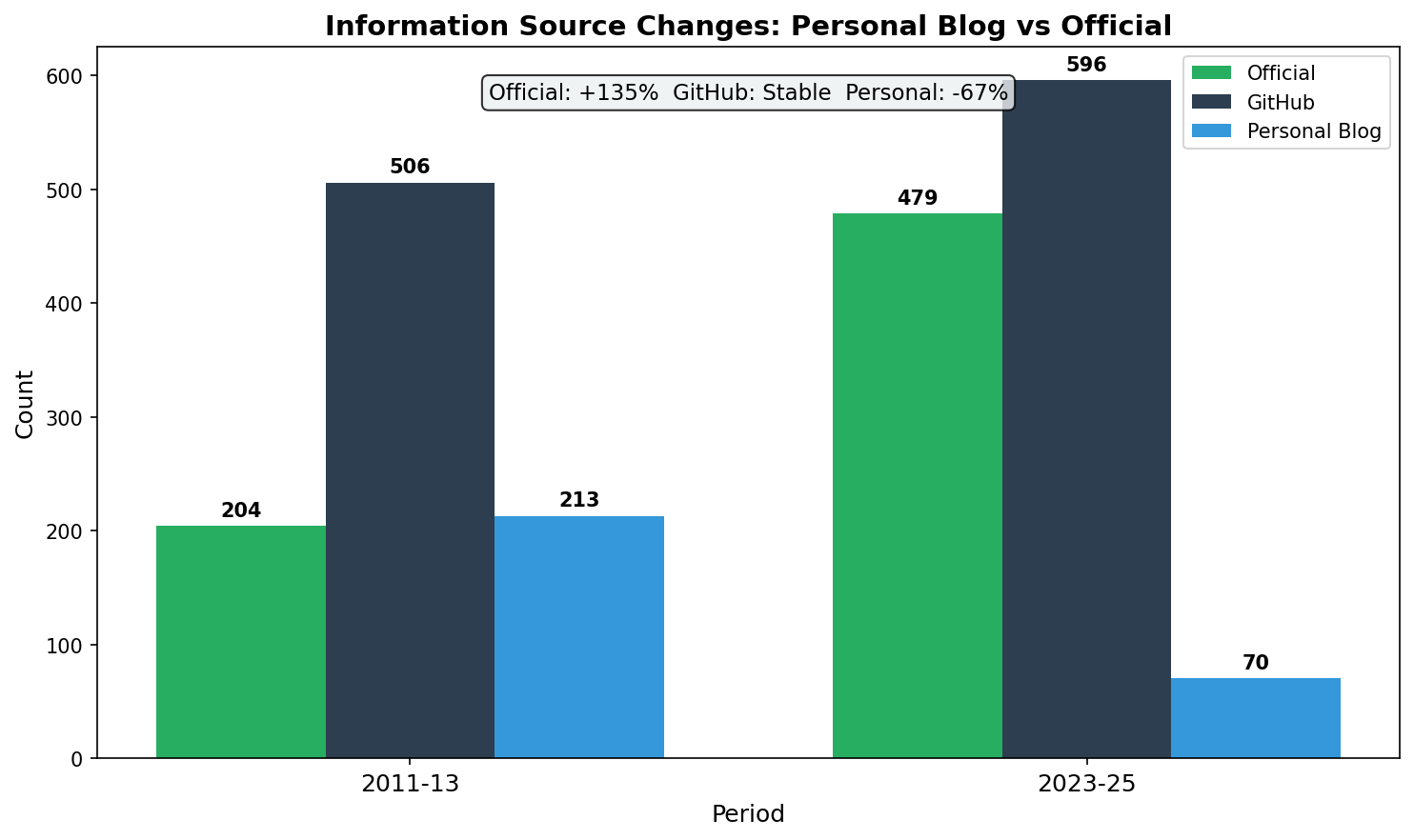
In comparison, in 2011-2013, personal blogs and official sources were almost equal (213 vs 204), but in 2023-2025, official blogs/documentation is about 7x personal blogs (479 vs 70). As official documentation and project sites have enriched their information sharing, JSer.info's featured sources have become centered on official sites.
Changes in Development Practices
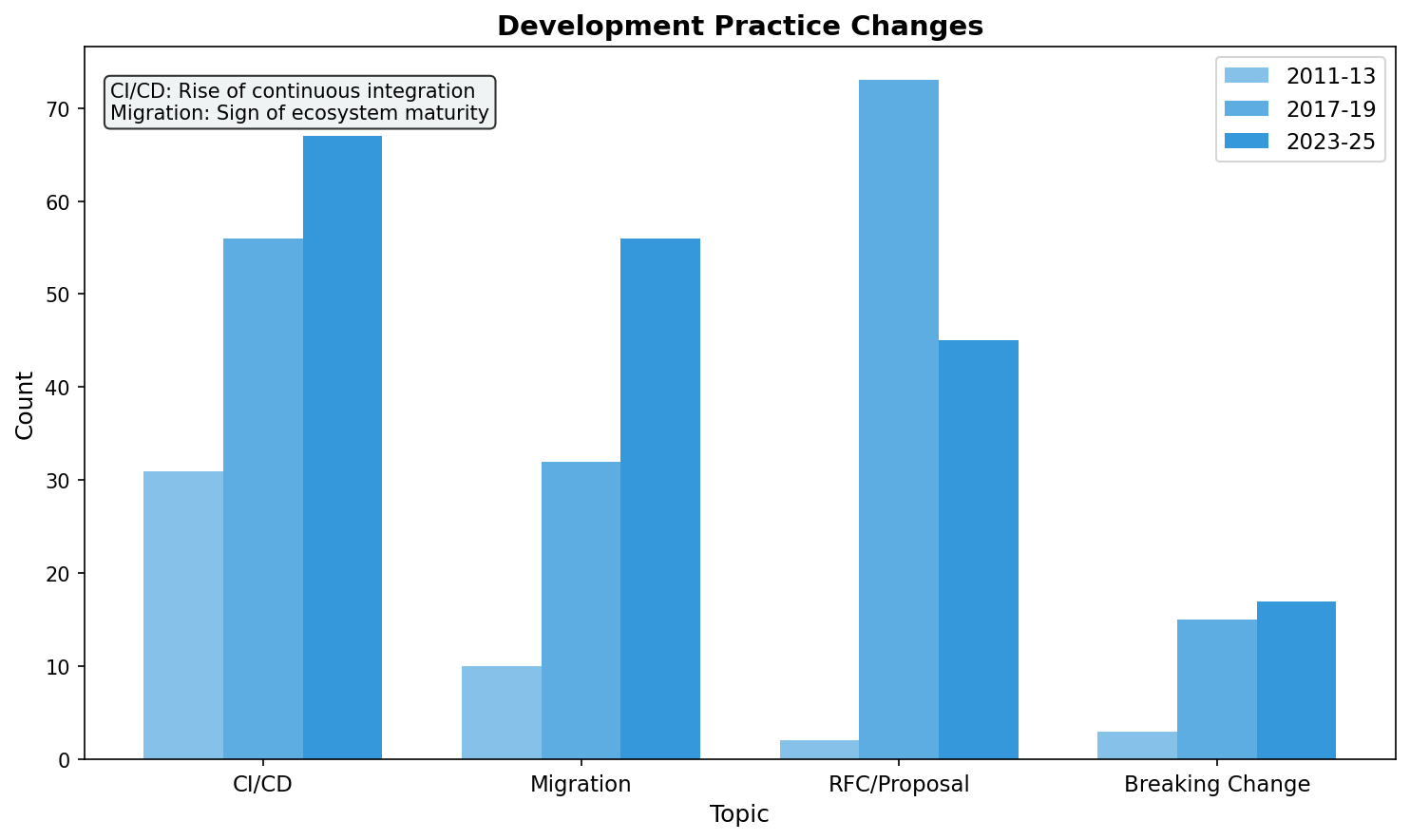
Topics related to development methods have also changed.
| Practice | 2011-2013 | 2017-2019 | 2023-2025 |
|---|---|---|---|
| CI/CD | 31 | 56 | 67 |
| Migration | 10 | 32 | 56 |
| RFC/Proposal | 2 | 73 | 45 |
| Breaking Change | 3 | 15 | 17 |
Increased RFC/Proposal mentions reflect ECMAScript adopting the Stage system in ES2015, making Proposals more frequently introduced, and more libraries/frameworks adopting RFC processes.
Increased Migration mentions indicate ecosystem maturity. "How to update existing codebases" has become an important theme—migration to new technologies, major version upgrades, and legacy code renewal.
Summary of 15 Years of Change
Here's a summary of changes visible from JSer.info's 15 years of data.
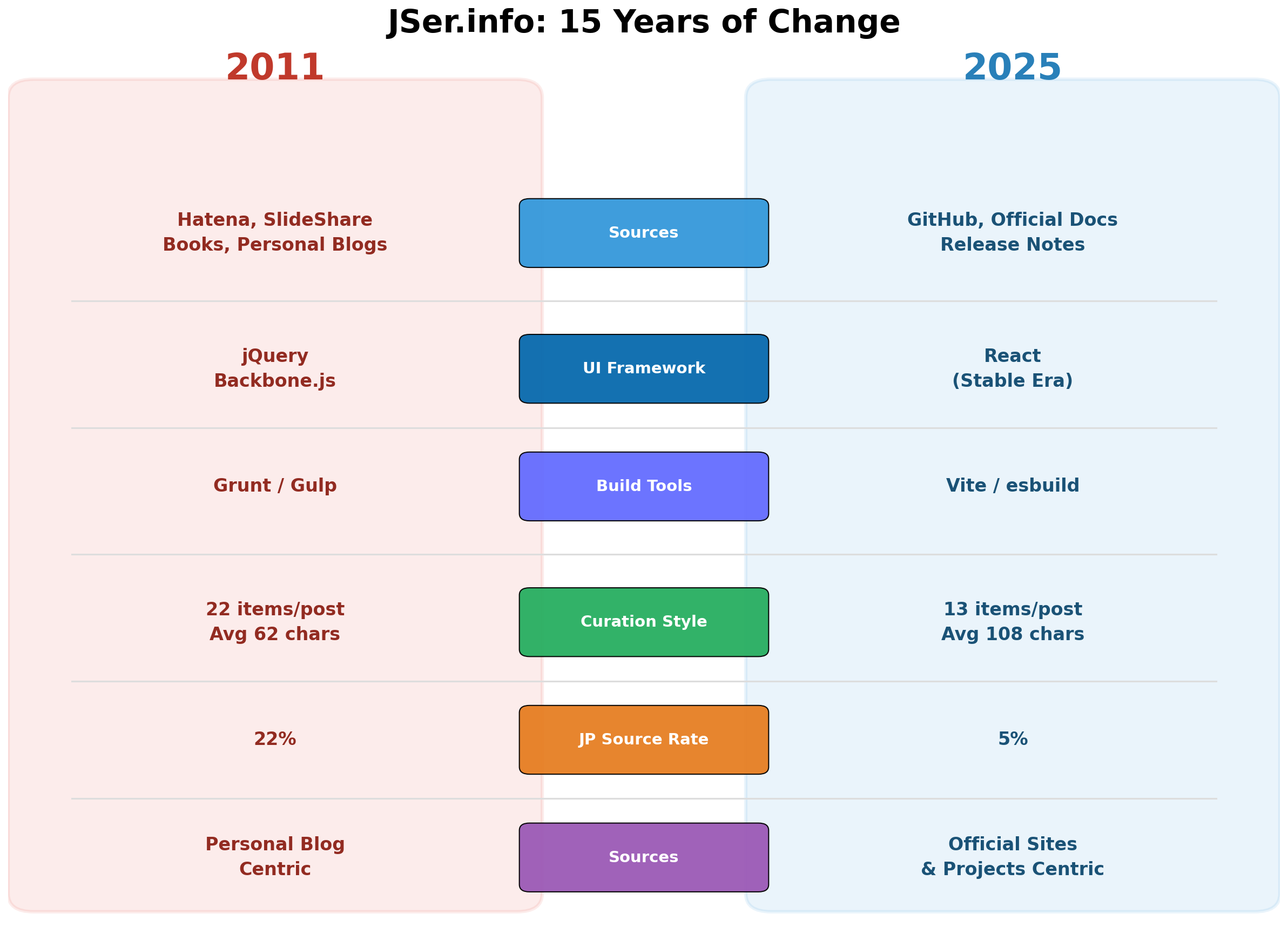
Changes to JSer.info Itself
JSer.info itself has changed over 15 years.
Technical Changes
- 2014: Migrated from Tumblr to GitHub Pages
- 2015: Realtime JSer.info launched
- 2016: HTTPS enabled, Ping feature added
- 2021: JSer.info Policy published
- 2023: JSer.info Watch List published
- 2025: MCP writing assistance, AI-generated headlines introduced
Operational Changes
- Weekly updates maintained for 15 years
- Workflow built entirely on GitHub
- Introduced automatic categorization, auto-tagging, and headline generation
- Article posting via postem
- Korean version translation (thanks to @uyeong, @rewrite0w0, and @Serzhul)
Progress on the "Make It Replaceable" Goal
In JSer.info 11th Anniversary, we set a goal to "make it replaceable by 2025." While complete replaceability hasn't been achieved, the update workflow has changed significantly through AI utilization.

JSer.info Update Flow 2025 - From YAPC::Fukuoka 2025 presentation
In About JSer.info, we wrote "minimizing the burden on me for updates and enabling smooth operation is key to continuity." Current JSer.info has automated many parts from information gathering to PR creation, tagging, grouping, and headline generation. Human focus has shifted to information judgment—what to introduce and how to communicate it.
Boring tasks are automated, allowing concentration on the valuable part: judgment.
For details, see the YAPC::Fukuoka 2025 presentation.
About 2025 Update Frequency
Update frequency has dropped slightly in 2025. Analyzing personal bookmarks (input for information gathering), we've identified some causes.
| Year | Bookmarks | Posts | Post Interval |
|---|---|---|---|
| 2021 | 2,862 | 53 | 6.9 days |
| 2023 | 2,373 | 53 | 6.9 days |
| 2025 | 1,033 | 41 | 8.9 days |
Bookmarks (input) have decreased 64% from the 2021 peak. Meanwhile, the bookmark-to-article rate has more than doubled. In 2021, 4 bookmarks led to 1 article; in 2025, 2 bookmarks lead to 1 article. As a result, while input decreased 64%, posts only decreased 23%.
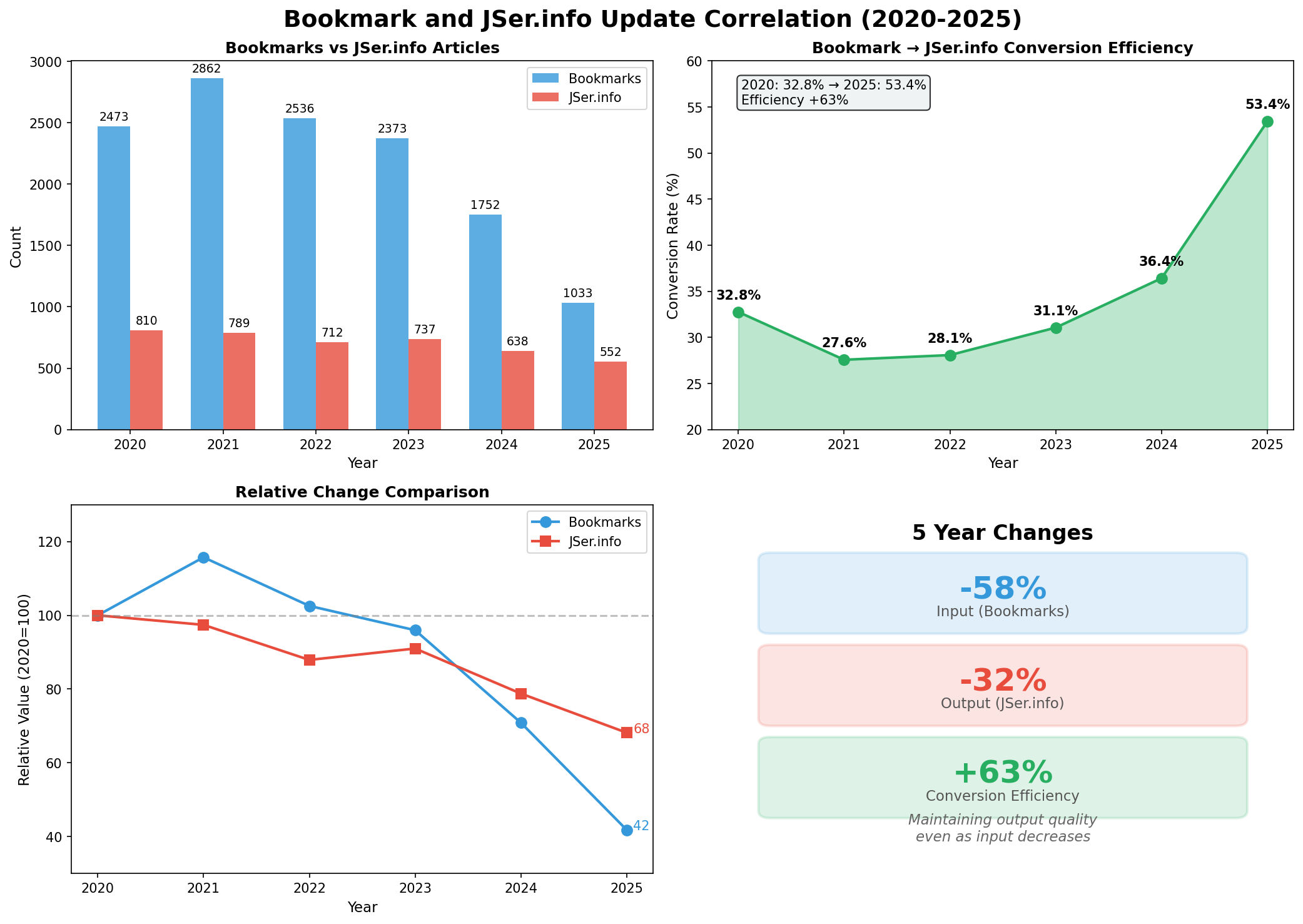
The cause of decrease seems to be that while I read articles, the burden of writing descriptions during bookmarking causes some to be missed.
Now that we have numerical data, we hope to track and improve this.
Recently, we've been adding Claude integration and other bookmark assistance features to tools like postem, so we expect improvements.
Also, I've been building an RSS reader recently, allowing JSer.info's entire information system—from RSS to collection to judgment to publication—to run on code I wrote myself.
General flow of JSer.info's information system:

RSS Feeds → Collection → Judgment → Publication

This should make it technically easier to remove friction points that existed before.
Conclusion
JSer.info started on January 16, 2011, and 15 years have passed.
15 years ago, JavaScript was in the era of jQuery (jQuery celebrated its 20th anniversary on January 14, 2026!) and Backbone.js/CoffeeScript. Now React, TypeScript, and Vite are frequently featured, and runtimes other than Node.js are viable options.
The information sources featured on JSer.info have also changed. From conference slides and books to official documentation and GitHub release notes.
In the ever-changing JavaScript ecosystem, we hope JSer.info has fulfilled its role of "organizing JavaScript information and delivering it accurately."
For opinions and feedback about this article or JSer.info, please share at:
- X/Twitter: #jserinfo
- JSer.info Slack
Thank you to everyone who has been reading for 15 years and those who have supported us!
JSer.info Sponsors
We thank those who support JSer.info through GitHub Sponsors.
Special thanks to Cybozu, Inc. for their long-term support.
Related Links
The JSer.info dataset used to write this article is available at jser/dataset.
The DuckDB queries used for analysis are available at jser/jser.github.io#1343.
Example of a query using DuckDB to directly load the JSer.info dataset and aggregate cross-cutting topics by year:
duckdb -c "
SELECT
    YEAR(CAST(date AS TIMESTAMP)) as year,
    SUM(CASE WHEN LOWER(content) LIKE '%security%' OR LOWER(content) LIKE '%セキュリティ%'
        OR LOWER(content) LIKE '%脆弱性%' THEN 1 ELSE 0 END) as security,
    SUM(CASE WHEN LOWER(content) LIKE '%performance%' OR LOWER(content) LIKE '%パフォーマンス%'
        OR LOWER(content) LIKE '%高速化%' THEN 1 ELSE 0 END) as performance,
    SUM(CASE WHEN LOWER(content) LIKE '%accessib%' OR LOWER(content) LIKE '%a11y%'
        OR LOWER(content) LIKE '%アクセシビリティ%' THEN 1 ELSE 0 END) as a11y,
    SUM(CASE WHEN LOWER(content) LIKE '%test%' OR LOWER(content) LIKE '%テスト%' THEN 1 ELSE 0 END) as testing,
    SUM(CASE WHEN LOWER(content) LIKE '%型%' OR LOWER(content) LIKE '%type%' THEN 1 ELSE 0 END) as typing
FROM read_json_auto('https://jser.info/source-data/items.json', ignore_errors=true)
GROUP BY year
ORDER BY year;
"

┌───────┬──────────┬─────────────┬────────┬─────────┬────────┐
│ year  │ security │ performance │  a11y  │ testing │ typing │
│ int64 │  int128  │   int128    │ int128 │ int128  │ int128 │
├───────┼──────────┼─────────────┼────────┼─────────┼────────┤
│  2010 │        0 │           0 │      0 │       0 │      0 │
│  2011 │        6 │          19 │      3 │      34 │     29 │
│  2012 │        7 │          31 │      2 │      98 │     43 │
│  2013 │       11 │          28 │      7 │     118 │     69 │
│  2014 │        6 │          39 │      4 │      82 │     52 │
│  2015 │        9 │          20 │      8 │      66 │     72 │
│  2016 │       10 │          39 │     22 │      60 │     75 │
│  2017 │       13 │          69 │      5 │      72 │    104 │
│  2018 │       11 │          68 │     14 │      50 │     90 │
│  2019 │       20 │          54 │     14 │      55 │    103 │
│  2020 │       11 │          65 │      9 │      34 │    117 │
│  2021 │       23 │          54 │      8 │      39 │    124 │
│  2022 │       18 │          39 │      7 │      57 │    114 │
│  2023 │       13 │          66 │      6 │      57 │    111 │
│  2024 │       12 │          36 │      9 │      46 │     90 │
│  2025 │       14 │          30 │      9 │      34 │     86 │
│  2026 │        2 │           4 │      1 │       2 │      5 │
├───────┴──────────┴─────────────┴────────┴─────────┴────────┤
│ 17 rows                                          6 columns │
└────────────────────────────────────────────────────────────┘


Top comments (0)