


What is the Spring Boot?
Spring is a powerful java-based open-source framework that is widely used for enterprise web applications. It is developed by Pivotal Team and is utilized to construct stand-alone and production prepared spring applications. Spring Boot may be a portion of the spring framework and contains all the highlights and ideas of the spring framework. In Spring Boot, everything is auto-configured, and there is no requirement for XML configuration and server (e.g. Tomcat) to create a spring boot web application.
What do we need to know?
- Core Java
- Basic knowledge of Spring Framework
- MVC pattern
Advantages of Spring Boot
- We can create a stand-alone application and production-grade spring-based application easily.
- It reduces a lot of development time and we can quickly create web applications and microservices.
- It is easy to understand.
- It is no need to configure XML because it is configured and wired automatically.
- Spring boot provides production-ready features such as metrics,health-checks, and externalized configuration.
- It is easy to customize application properties and dependency.
Spring Boot Flow Architecture
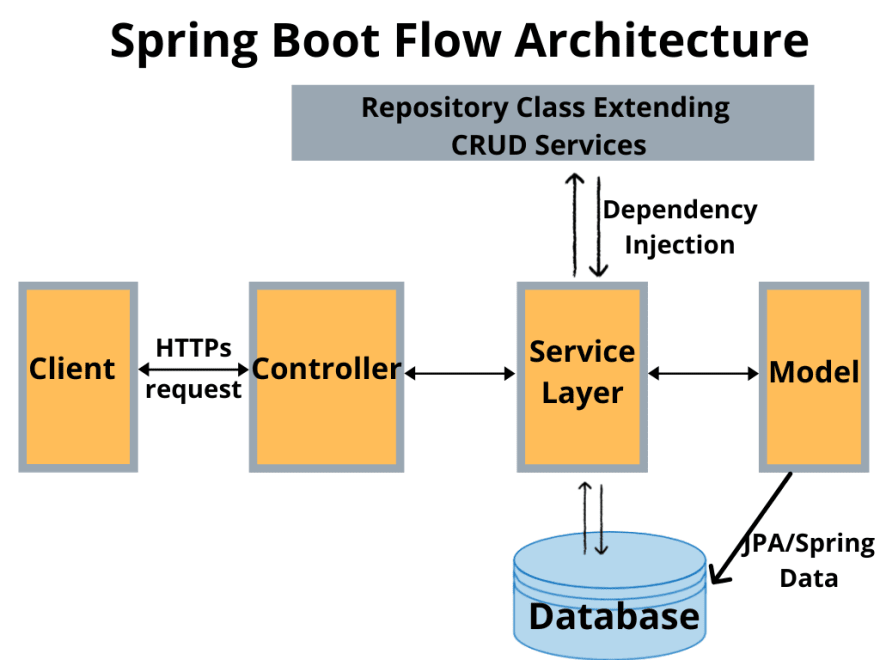
- The client makes the HTTP requests (POST or GET). Please refer to the HTTP request methods in the following link. HTTP Request Method
- The request is forwarded to the controller, and it maps the request and processes it.
- If needed, it also calls a service layer.
- All the business logic will be performed in the service layer and it performs the logic on the data and is mapped to JPA with model classes.
- If there is no error has occurred, the web page (JSP, HTML) is returned to the user.
Goals of Spring Boot
The main goal of Spring Boot is to reduce development, unit test, and integration test time and to ease the development of Production-ready web applications very easily compared to existing Spring Framework, which really takes more time.
To provide the Opinionated Development approach
To avoid defining more Annotation Configuration
To avoid confusing XML configuration and manual lots of import statements
What can we create if we can do Spring Boot?
You can develop a great web application like below. A famous service using Spring Boot is described in the following table.
| URL | Description |
|---|---|
| SAP Customer Review and Stories | SAP's Hybris eCommerce platform uses Spring |
| Yatra | Indian travel website Yatra.com is made in spring MVC (backend services) |
| Every Dollar Budgeting App | Uses Spring Boot on the back end ReactJS on the front end. |
References:
https://www.tutorialspoint.com/spring_boot/spring_boot_introduction.htm
https://www.geeksforgeeks.org/introduction-to-spring-boot/
https://www.javatpoint.com/spring-boot-tutorial


Top comments (1)
This is a great introduction!
I've been researching how AI, LLMs, and AI agents might reshape software engineering over the next decade. One observation I've come to is that Java and Spring Boot may remain highly relevant for enterprise development because so many mission-critical systems have been built on them over the last 20+ years.
My thinking is that AI will automate more of the repetitive coding, but companies will still need engineers who deeply understand architecture, distributed systems, performance, security, debugging, and maintaining large codebases. The value may shift from writing boilerplate code to understanding and evolving complex systems.
I also wonder if this could lead to fewer entry-level Java roles but greater demand—and potentially higher compensation—for experienced backend engineers who can work confidently on large enterprise systems.
I'd love to hear what others think. Do you see AI reducing demand for Java/Spring Boot engineers, or changing what companies expect from them?