


Welcome back to Onboarded! 👋
Today let’s explore that very specific, sinking feeling that hits when you find out someone doing the exact same work with the exact same title is making $30,000 more than you.
It stings.
The biggest lesson I've learned? In our first five years in tech, our compensation trajectory isn’t just about how hard we work. It’s largely dictated by the information we have and how much we are willing to stand up for ourself.
The companies we work for have entire teams of compensation analysts looking at market data. We, on the other hand, are usually left guessing in a vacuum. That’s the problem.
Back when I worked at Amazon, I saw firsthand that the folks sitting at the top of the pay bands weren’t always the ones working the longest hours. They were the ones who treated their compensation like a data project.
They didn’t guess their worth, they researched it. And then they had an educated conversation about compensation with their recruiter when they got the offer. [Read more about how to do that here].
If you have a lingering feeling that you might be underpaid, here is how you find out for sure, no guessing required 👇
1️⃣ Stop Looking at the Wrong Metrics
The biggest mistake early-career tech professionals make is focusing purely on base salary. Tech compensation is about Total Compensation (TC).
If you are comparing your $110k base salary to someone else’s $110k base, you might feel fine. But if they are getting a 15% annual bonus and $40k a year in vested Restricted Stock Units (RSUs), you are actually massively underpaid. When you research your worth, you need to calculate the value of base, standard bonuses, and equity combined.
2️⃣ Use High-Signal Data Sources
Stop using generic salary aggregators like Glassdoor. That data is often years out of date and blends vastly different tiers of companies together.
To find out what you should actually be making right now, rely on these three amazing sources:
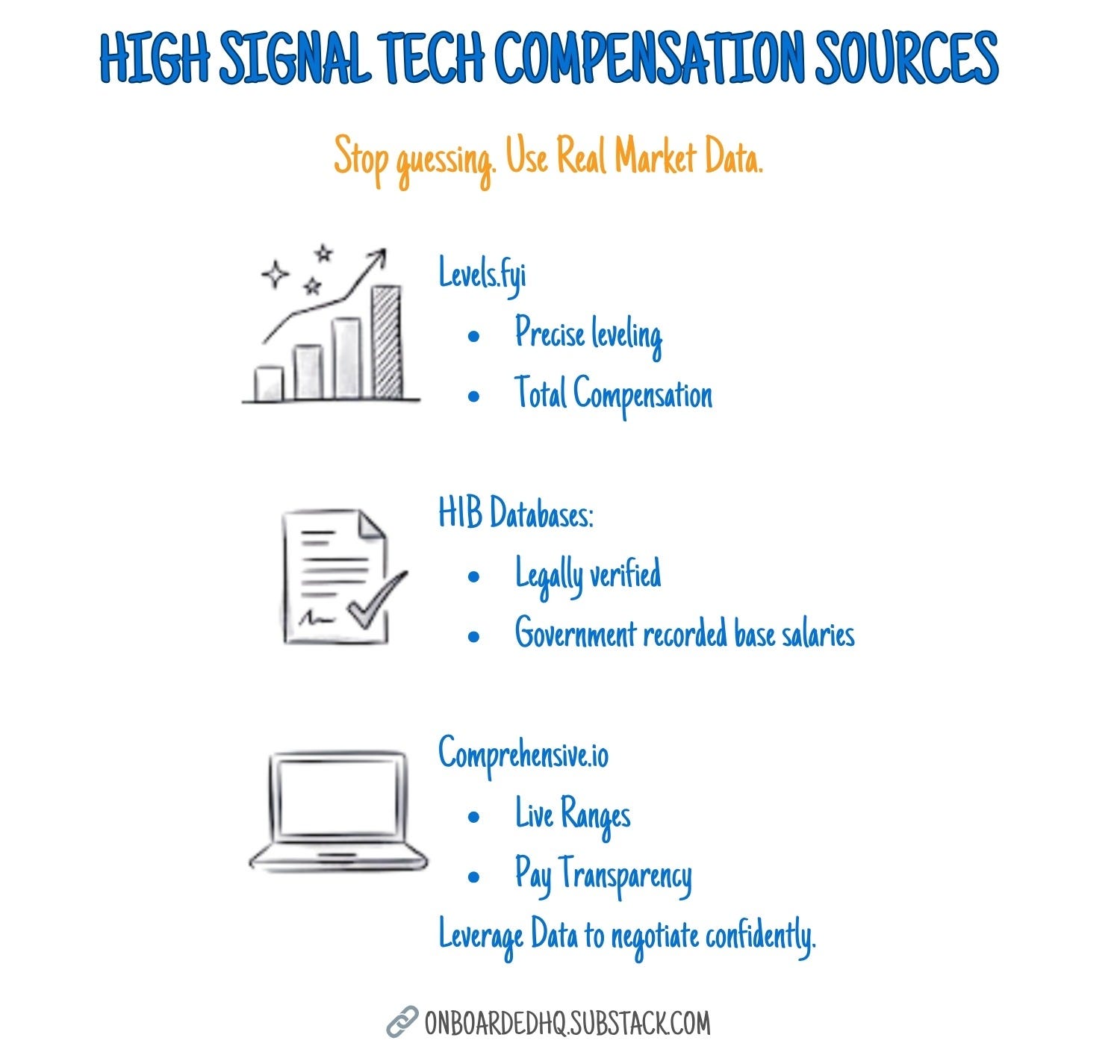
Levels.fyi : Tech-specific Total Compensation by exact leveling.
Caveat: Data skews heavily toward Big Tech and high-cost-of-living (HCOL) areas like San Francisco and New York.
H1B Salary Database : Finding the legal, verified base salaries companies are actually paying.
Caveat: Does not include equity or bonuses.
Comprehensive.io : Track live salary ranges from current tech job postings.
Caveat: Only reflects base salary bands mandated by pay transparency laws.
3️⃣ Normalize the “Awkward” Conversation
The fastest way to get real data is to ask real people, but I also will be clear with you that asking “How much do you make?” directly makes most people freeze up and avoid you.
Instead, ask structurally. Reach out to a trusted former colleague or a mentor who has been in the industry a bit longer and ask:
“I’m trying to benchmark my compensation for my next review. For a mid-level engineer at our tier of company, does a total comp of $140k sound like market rate, or am I off?”
People are much more willing to tell you if a number is high or low than they are to offer up their own W-2 number.
4️⃣ Read The Market
Databases are great, but your true market value is exactly what someone else is willing to pay you today.
The single best way to find out if you are underpaid is to take one or two interviews a year, even if you love your job.
You don’t have to accept the offers. But getting an offer letter in hand gives you undeniable leverage and a stark reality check of exactly what the broader market thinks your skills are worth right now.
📝 HQ Tip: If you do test the market, know that recruiters are highly trained to read between the lines. Avoid the “Desperation Tax”. If you signal that you need this job right now, you inadvertently give them permission to anchor your offer at the absolute bottom of the pay band.
There are three subtle (but obvious to recruiters) tells that strip away your negotiation power:
❌ Giving a premature “Yes”
Reacting to a verbal offer with immediate, overwhelming enthusiasm (e.g., “That sounds amazing, I accept!”) instead of a neutral, “Thank you for the offer, I’d love to review the written details.”
❌ Oversharing your runway
Venting about a toxic manager, mentioning that your severance is running out, or emphasizing how urgently you need to leave. Maintain leverage by keeping your timeline professional, not personal.
❌ Giving away your current salary
Volunteering your current salary before they even ask, or using phrases like, “I’m currently making $250k, but honestly, I’m flexible for the right opportunity.” You just told them your floor is their ceiling.
You cannot navigate your career effectively if you are driving blind. Spend an hour this weekend pulling your actual numbers.
Best case scenario? You realize you are compensated perfectly.
Worst case? You know exactly what gap you need to close.
I do a quick personal ROI calculation every year and seriously evaluate 3 things:
➡️ Am I learning new things?
➡️ Is my comp keeping up with the market?
➡️ Do I see a clear path to the next level here?
If the answer to 2 of those is no, it’s time to explore.
Keep growing, 🌱
Find your worth,🏅
Let real data guide your search. 📊
Thanks for reading so far! Support my work and get your free guide on how to make a great first impression 👇
For those of you who are already in the Onboarded community, I am so glad to have you on board! Reach out by replying to this email or dropping a comment.
If this issue helped you understand your worth, share it with one friend in tech who needs to read it. Let’s grow the Onboarded community together 🙏
I wish you a great week!
Until next time,
Sonika


Top comments (0)