


This is a submission for the Hacktoberfest Open-Source AI Challenge Week 1: Touch Grass
FieldLens 🌿 — Gemma-Powered Nature Identifier
“Step outside. Discover what's around you.”
What I Built
FieldLens is a lightweight, privacy-preserving nature observation web application designed to encourage people to close their laptops, step outside, and engage with the living world around them.
Whether exploring a local trail, walking through a neighborhood park, or examining flora and fauna in your backyard, FieldLens lets you photograph any plant, flower, tree, bird, mushroom, or insect and receive grounded, cautious insights powered by Google Gemma.
Key Features
-
Mobile-First Field Capture: Take photos directly through your smartphone camera (
capture="environment") or upload existing images (JPEG, PNG, WebP) with automatic client-side compression. - Grounded, Cautious Identification: Unlike generic chatbots that hallucinate species names, FieldLens is instructed to distinguish visible morphological evidence from assumptions. When diagnostic traits are ambiguous or missing, it identifies the broadest defensible category (flowering plant, bird, tree, mushroom, insect, or unknown organism).
- Calibrated Uncertainty Ratings: Honest qualitative uncertainty levels (Low, Moderate, High) with clear explanations—no fabricated percentage scores.
- Actionable Outdoor Guidance: Practical outdoor observation tips (e.g. leaf arrangement, bark texture, scent check) and safety warnings.
-
Offline Personal Nature Journal: Save sightings directly to your browser's local memory (
localStoragefor metadata,IndexedDBfor high-resolution images). Persists across page refreshes with zero tracking and zero login requirements. - Zero Server Retention: Uploaded images are processed in-memory and discarded immediately upon analysis.
Demo
Watch FieldLens in action analyzing specimens and saving observations in real time:
Direct Video Link: https://youtu.be/YIhn4hLXFb0?si=0_rFT6y7QsZZdGr9
Walkthrough & User Journey
- Landing & Ethics: Introduces Leave No Trace outdoor ethics and transparency disclosures.
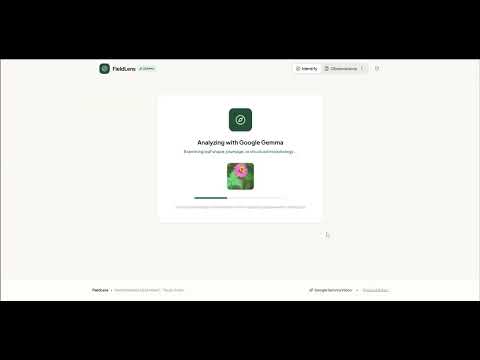
- Capture & Analyze: Select or photograph a specimen; Google Gemma Vision evaluates leaf structure, plumage, or growth habit in real time.
- Structured Card: Renders common name, scientific name (if warranted), uncertainty rating, visual evidence, outdoor tips, and cautions.
- Field Journal: Browse, search, filter, and inspect your saved observations over time.
Code
The complete source code is public and open-source:

FieldLens 🌿 — Gemma-Powered Nature Identifier
“Step outside. Discover what's around you.”
Built for Hacktoberfest 2026 Week 1 DEV Community Challenge: “Touch Grass”
FieldLens is a lightweight, privacy-preserving nature observation web application that uses Google's open-weights Gemma vision-language models to help outdoor explorers, hikers, and curious backyard observers identify and learn about plants, flowers, birds, trees, mushrooms, and insects in their environment.
Unlike generic image classifiers or ungrounded chatbot wrappers, FieldLens is designed around a cautious observation philosophy: it examines visible morphological traits, distinguishes evidence from assumptions, qualifies its uncertainty honestly, provides practical outdoor tips, and reminds users never to consume or disturb unknown wildlife.
📺 Video Demo
Watch FieldLens in action identifying specimens and saving observations:
🍃 Connection to “Touch Grass”
The theme of Hacktoberfest Week 1 is “Touch Grass”: leveraging open-source AI to encourage people to disconnect from repetitive digital routines and…
Repository: https://github.com/srijan-0-7/hacktoberfest-dev-1
How I Built It
1. Open-Source AI Model: Google Gemma Vision
FieldLens is powered by Google Gemma 4 Vision (models/gemma-4-26b-a4b-it), an open-weights multimodal vision-language model developed by Google DeepMind.
- System Prompt Design: The model is bound by a strict persona prompt as FieldLens, a cautious nature assistant that refuses to invent Latin binomials or claim species certainty unless distinguishing morphological traits are visibly present in the photograph.
-
Resilient Multi-Tier JSON Parsing: To handle reasoning traces and varying response patterns, the parser dynamically extracts valid schemas from direct JSON, markdown-fenced code blocks (
`json), and structured key-value bullet points.
2. Frontend & Local Persistence
- React 18 + TypeScript + Vite: Clean, responsive, and mobile-friendly interface styled with Tailwind CSS and Lucide icons.
-
Hybrid Browser Storage: Solved browser storage quota issues by using
localStoragefor structured observation metadata andIndexedDB(viaidb-keyval) for storing full-resolution photograph blobs locally.
3. Serverless API Architecture
-
Serverless API Handler (
api/identify.ts): Lightweight Node.js endpoint with built-in retry logic and timeout safeguards, ensuring API keys stay strictly server-side. -
Integrated Vite Dev Middleware: The local Vite development server automatically intercepts
/api/identifyusingdotenv, offering a unified developer experience with single-command startup (npm run dev).
Why Does Open Innovation Matter?
- Scientific Grounding over Marketing Hype: Closed commercial APIs often push conversational models to appear authoritative, leading to dangerous hallucinations in the natural world (such as incorrectly declaring a wild fungus edible). Open-weights models like Gemma allow us to carefully craft system boundaries, inspect behavioral characteristics, and build tools centered on scientific caution.
- Democratizing Outdoor Literacy: Nature belongs to everyone. Open innovation makes it possible to build free, privacy-first field companions without locking basic biological education behind monthly paywalls, tracking cookies, or mandatory user accounts.
- Auditability & Longevity: An open-weights ecosystem guarantees that research tools and conservation applications can be audited, adapted, and run independently without reliance on a single proprietary vendor.
My Agent Session
FieldLens was architected and built in collaboration with Antigravity, an autonomous agentic pair-programmer powered by Gemini:
- End-to-end multimodal API testing and prompt calibration with real botanical specimens.
- TypeScript schema design and multi-tier extractor implementation.
- Automated testing suite (
scripts/test-api.mjs) verifying inference and response validity.
Prize Categories
- Touch Grass Challenge (Week 1): Encouraging real-world outdoor engagement, nature observation, and Leave No Trace ethics through open-source AI.
- Google Gemma Challenge: Practical application of Google Gemma open-weights multimodal vision models to solve a real-world environmental education challenge.


Top comments (1)
Official Platform Update
Security protocols have been updated for all developer accounts.