

I live in India, and real estate agents here have a massive problem — they track leads in notebooks, WhatsApp chats, and random Excel sheets. I asked a few agents why
they don't use a CRM. The answers were always the same:
- "Too expensive — I can't pay ₹2,000/month for software"
- "Too complicated — I just need to remember who to call"
- "Doesn't work without internet — I'm always in the field"
So I decided to build something dead simple.
** ## Meet Boring CRM**
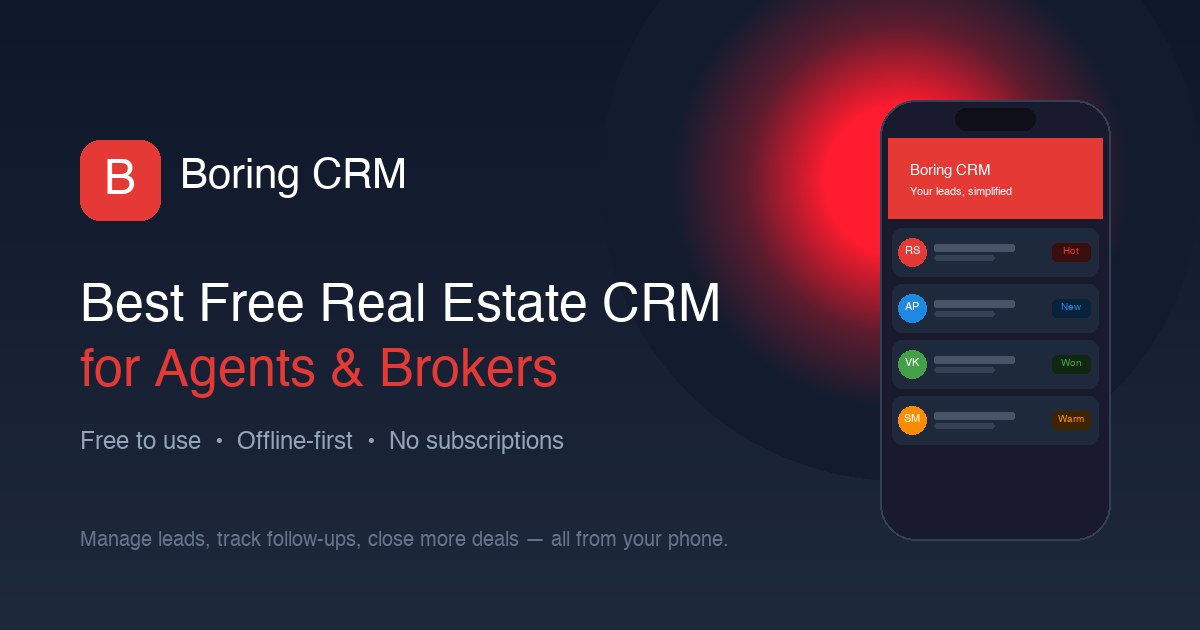
Boring CRM is a free, offline-first CRM built specifically for real estate agents. The name says it all — it's intentionally boring. No AI, no
integrations, no dashboards with 47 charts. Just the basics done right.
Core features:
- Add and manage unlimited leads
- Color-coded sales pipeline (New → Contacted → Follow-up → Negotiation → Closed)
- Follow-up reminders with push notifications
- Call logging and interaction history
- CSV import/export for bulk lead management
- Import contacts directly from your phone
- Link properties to leads
- Notes and activity tracking per lead
What makes it different:
- 100% offline — works without internet, always
- Zero sign-up — download, open, start adding leads
- Free forever — no subscriptions, no trial expiry
- Data stays on your device — complete privacy
## The Tech Stack
Here's what I used to build it:
- Flutter — Cross-platform framework (currently Android only)
- SQLite — Local database for offline-first storage
- sqflite package — SQLite wrapper for Flutter
- flutter_local_notifications — For follow-up reminders
- Firebase Analytics — To understand usage patterns
- shared_preferences — For app settings
### Why Flutter + SQLite?
The biggest decision was going offline-first. Most CRMs use cloud databases (Firebase Firestore, Supabase, etc.), but my target users often work in areas with poor
connectivity. SQLite was the obvious choice — fast, reliable, zero network dependency.
The data model is straightforward:
dart
// Lead model - kept intentionally simple
class Lead {
int? id;
String name;
String phone;
String email;
String status; // new, contacted, follow_up, negotiation, closed
String source;
String propertyInterest;
DateTime? followUpDate;
DateTime createdAt;
List<Note> notes;
List<Activity> activities;
}
Handling Follow-up Reminders
This was the trickiest part. Real estate agents live and die by follow-ups. Miss one call, lose a deal. I used flutter_local_notifications with scheduled notifications:
- When an agent sets a follow-up date, a local notification is scheduled
- Works completely offline — no server needed
- Notifications persist even after app restart
What I Learned Building This
1. Simple beats feature-rich
My first version had charts, analytics, and export-to-PDF. I removed all of it. Agents wanted to add a lead in 5 seconds, not analyze data.
2. Offline-first is harder than it sounds
Even without a server, you need to think about data migration when the schema changes, backup/restore flows, and CSV import edge cases.
3. Free is a distribution strategy
Competing with Zoho and HubSpot on features is impossible. Competing on price (free) and simplicity (offline, no sign-up) gave me a niche they'll never care about.
4. The Indian market is underserved
Most global CRMs are priced for US/EU markets. A solo real estate agent in a tier-2 Indian city won't pay $20/month. But they desperately need a lead tracker.
Current Stats
- 100+ downloads on Google Play Store
- 4.9 star rating
What's Next
- iOS version
- WhatsApp integration (huge in India)
- Team features for small brokerages
- Multi-language support (Hindi, Telugu, Tamil)
Try It Out
- Website: https://boringcrm.in
- Google Play Store: https://play.google.com/store/apps/details?id=com.boringcrm.app
If you're a developer thinking about building for underserved markets do it. The big players ignore these niches, and real people need real solutions.
I'd love to hear your feedback. What would you build differently? What features would you add?


Top comments (4)
This is a great example of building software around real user needs instead of adding unnecessary complexity. The offline-first approach using SQLite is especially valuable since many agents work in areas with unreliable connectivity, and keeping data locally also improves privacy and control. Simplicity, zero sign-up, and essential features like follow-up reminders show that practical solutions often matter more than feature-heavy platforms. Really inspiring project for developers targeting underserved markets.
Thank you! 🙌 I really appreciate that. My goal was to keep it practical and offline-first.
hey tell me that what is that? and what you can *build *
It’s a lightweight offline CRM for real estate agents. Built to be simple and practical 👍