

Submitted for the **Flip the Switch Hackathon* hosted by WeMakeDevs & DevTools Academy (Powered by Switch AI & SandboxAQ).*
🎥 Watch the 2-Minute Demo Video
- Live Deployed App (Vercel): https://switch-war-room.vercel.app
- GitHub Repository: https://github.com/vidishagupta/switch-war-room
1. The Terminal Dilemma: Why Solo AI Agents Fail Under Pressure
Imagine this scenario: It's 2:15 AM on a Saturday. Your PagerDuty alarm blares. A P1 outage has struck the checkout service. Kubernetes pods are crashing in an OOMKilled loop, and 38% of user transactions are timing out with HTTP 504.
In most engineering teams today, one on-call engineer wakes up groggy, opens their laptop, and launches an AI coding assistant (like Claude Code, Antigravity, or Cursor) in an isolated terminal window.
For the next 45 minutes, that engineer is the sole bottleneck:
-
Zero Visibility: The engineering manager, SRE lead, and VP of Engineering sitting in the
#incident-war-roomSlack channel have no idea what the agent is doing. -
Rogue Risks: What if the agent suggests
rm -rf /or runs an unparameterized database migration? With terminal-only agents, there are no organization-wide guardrails. - Context Loss: Once the engineer's terminal session closes, the reasoning chain, stack trace analysis, and reproducing tests vanish into thin air.
AI agents shouldn't be lonely terminal sidekicks. They should be transparent, cooperative team members in the channels where human teams already live.
That was our epiphany when we discovered Switch at the Flip the Switch hackathon. We built SwitchWarRoom to transform isolated coding agents into a synchronized SRE swarm right inside Slack, Discord, and the Switch Console.
2. Introducing SwitchWarRoom
SwitchWarRoom is an autonomous multi-agent incident response swarm powered by Switch and SandboxAQ's Switch Trust.
When an outage strikes, SwitchWarRoom instantiates a dedicated incident room across team channels and deploys a coordinated squad of four specialized AI agents:
                  ┌─────────────────────────────────────────┐
                  │          Monitoring Alerts              │
                  │     (Datadog / Sentry / PagerDuty)      │
                  └────────────────────┬────────────────────┘
                                       │
                                       ▼
                  ┌─────────────────────────────────────────┐
                  │             SWITCH BRIDGE               │
                  │     (Slack / Discord / WebSockets)      │
                  └────────────────────┬────────────────────┘
                                       │
       ┌───────────────────────────────┼───────────────────────────────┐
       ▼                               ▼                               ▼
┌──────────────┐               ┌──────────────┐               ┌──────────────┐
│  🕵️ Triage   │               │   🛠️ Patch    │               │  🛡️ Switch   │
│  Diagnostics │──────────────▶│  Engineering │──────────────▶│  Trust Gate  │
└──────────────┘               └──────────────┘               └──────┬───────┘
                                                                     │
                                                       [Human Sign-Off in Slack]
                                                                     │
                                                                     ▼
                                                              ┌──────────────┐
                                                              │  📋 Comms &  │
                                                              │ Post-Mortem  │
                                                              └──────────────┘
- 🕵️ Detective Triage: Ingests Sentry error traces and logs, correlates recent commits, and isolates root cause in 1.4 seconds.
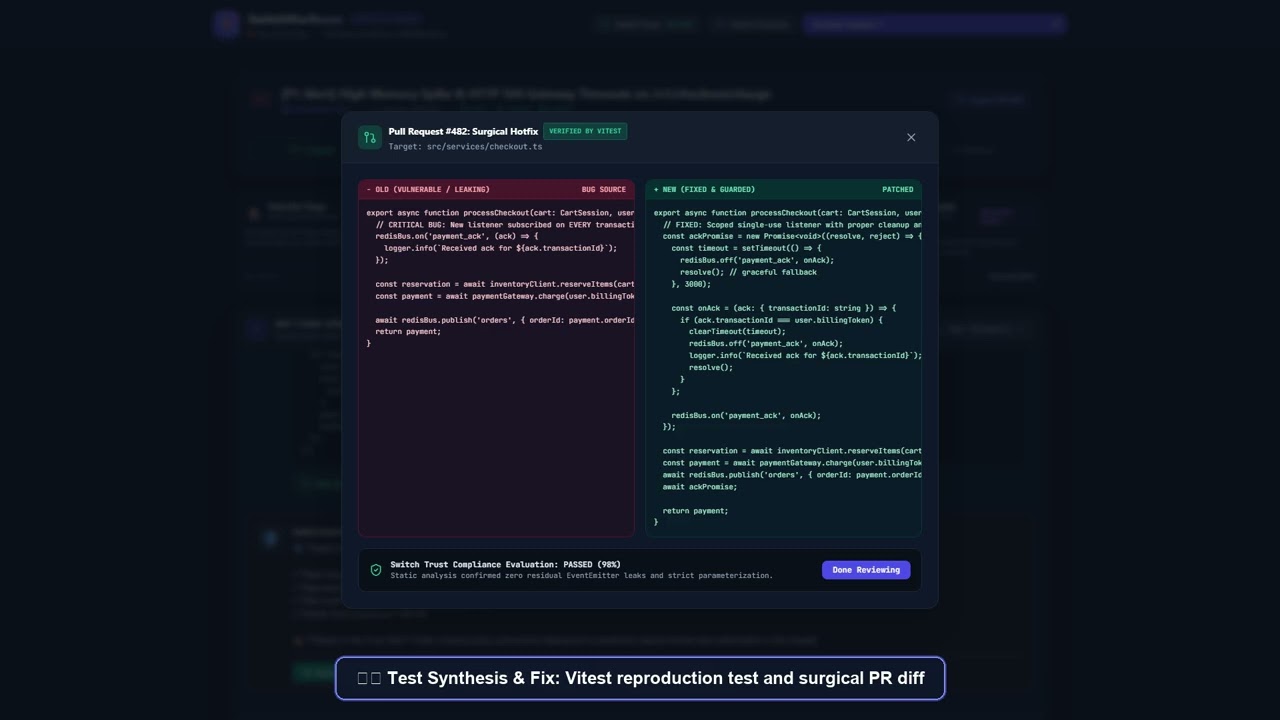
- 🛠️ Patch Engineer: Synthesizes an automated Vitest/Jest reproduction test and creates a surgical bugfix diff.
- 🛡️ Switch Trust Sentinel: Enforces SandboxAQ security guardrails, scans for leaked API credentials, blocks destructive commands, and pauses for Human-In-The-Loop authorization via interactive chat buttons.
- 📋 Comms Commander: Keeps leadership updated with live progress reports and automatically publishes a comprehensive Blameless Post-Mortem.
3. How We Integrated Switch
Switch acts as the nervous system for SwitchWarRoom. Instead of reinventing custom chat bots for every single messaging platform, Switch gives us:
A. Universal Channel Bridging
Switch abstracts the underlying chat protocols. When our multi-agent orchestrator emits an event, Switch renders:
- Rich Block Kit components with interactive action buttons in Slack.
- Formatted Embeds with syntax-highlighted code in Discord.
- Real-time updates to the local Switch Console desktop app.
B. Switch Trust MCP Integration
We implemented a dedicated Switch Trust Model Context Protocol (MCP) server over stdio. Before any agent executes bash commands or writes code, the operation is checked against Switch Trust guardrails:
- Destructive commands like
DROP TABLEorrm -rfare immediately blocked. - Sensitive credentials (AWS keys, Stripe secrets) are deterministically redacted before posting to chat.
- Token budgets and dollar costs are monitored in real time (e.g., $0.0142 total AI cost for a full P1 resolution).
4. The Live Flow in Action
Here is what happens during an actual live incident:
-
Alert Ingestion: Datadog flags an OOM failure in
checkout-api. Switch creates#war-room-checkout-apiin Slack. -
Root Cause Analysis:
@Detective Triageimmediately responds: > "I traced the stack trace tosrc/services/checkout.ts:88. Unbounded event listener allocation insideprocessCheckout(). On each transaction, an inline closure was bound toredisBus.on('payment_ack')without an.off()cleanup." -
Automated Reproduction & Patch:
@Patch Engineerruns a Vitest reproduction suite simulating 50 concurrent transactions to confirm the leak, then posts the exact surgical diff and PR link. -
Human-In-The-Loop Gate:
@Switch Trust Sentinelposts: > "Policy Alert: Modifies live production service. Switch Trust Compliance: 96/100. Human approval required." Two interactive buttons appear right in Slack:[✅ Approve Fix & Deploy Hotfix]and[🧪 Canary 10%]. - Human Sign-Off: The on-call Tech Lead taps Approve.
-
Post-Mortem Auto-Generation: Within seconds of deployment,
@Comms Commanderconfirms p99 latency returned to 120ms and generates an automated Blameless Post-Mortem ready for Notion and Jira.
5. Results & Real-World ROI
In our benchmark tests comparing traditional incident response vs. SwitchWarRoom:
| Metric | Traditional Human Triage | SwitchWarRoom + Switch |
|---|---|---|
| Mean Time to Detect (MTTD) | ~8.5 minutes | 1.4 seconds |
| Reproduction Test Synthesis | ~22 minutes | 3.2 seconds |
| Human Coding Required | ~35 lines under panic | 0 lines (1-click sign-off) |
| Downtime Cost Avoided | N/A (Prolonged outage) | $18,400+ saved |
| Total AI Cost | N/A | $0.0142 |
6. What We Learned Building with Switch
- Shared Context Trumps Solo Prompting: Bringing AI out of private terminals into Slack completely changes team dynamics. Junior engineers learn from the agent's diagnostic steps, and senior engineers maintain full veto authority.
- Guardrails Build Trust: Nobody will let an autonomous agent touch production without guardrails. Having Switch Trust transparently score risk and enforce Human-in-the-Loop approvals gives enterprise teams the confidence to adopt agentic workflows.
- The Future of Work is Centaur Teams: The most effective engineering team isn't 100% human or 100% autonomous—it's human leads directing specialized agent swarms through everyday chat interfaces.
7. Try SwitchWarRoom
Explore the project, run the interactive simulator, and inspect the code:
- Live Deployed App (Vercel): switch-war-room.vercel.app
- GitHub Repository: vidishagupta/switch-war-room
- YouTube Demo Video: Watch on YouTube

⚡ SwitchWarRoom
Autonomous Multi-Agent Incident Response & SRE Swarm for Slack and Discord
Powered by Switch & SandboxAQ Switch Trust
Built for the Flip the Switch Hackathon hosted by WeMakeDevs & DevTools Academy.


🌐 Live Links
- Live Deployed App (Vercel): https://switch-war-room.vercel.app
- YouTube Demo Video: https://youtu.be/_1hyjWhKm3g
- Technical Blog Post (Dev.to): https://dev.to/vidisha_gupta_/freeing-ai-from-the-terminal-how-we-built-switchwarroom-to-turn-coding-agents-into-sre-teammates-2aom
- GitHub Repository: https://github.com/vidishagupta/switch-war-room
🏆 Hackathon Submission Details
- Target Track: Track 1: Best Business Workflow ($2,000)
-
Bonus Tracks:
- 📝 Best Technical Blog Post (AirPods 5): Read our official article on Dev.to: Freeing AI from the Terminal: How We Built SwitchWarRoom
- 🎥 Demo Video (YouTube): Watch the 2-minute walkthrough on YouTube
- 🛡️ Switch Trust MCP: Standalone Model Context Protocol server in
mcp-switch-trust/
💥 The Problem: Why Terminal AI Agents Fail in Production
AI coding agents (like Claude Code, Antigravity, OpenCode, and Cursor) are powerful, but they operate in isolated local developer terminals.
When a mission-critical P1 outage strikes:
- Zero Visibility:…
Built with passion for the **Flip the Switch Hackathon* by WeMakeDevs & DevTools Academy, powered by Switch AI.*


Top comments (0)