



Originally published on Build With AWS. Subscribe for weekly AWS builds.
A customer support team deployed a Bedrock-powered chatbot last quarter.
It answered questions from a knowledge base, handled basic FAQs, and saved about 15 hours per week.
Thanks for reading Build With AWS! Subscribe for free to receive new posts and support my work.
Solid win.
Then someone asked:
“Can it also check order status, issue refunds, and escalate to the right team based on sentiment?”
That question marks the exact boundary between a GenAI feature and an AI agent.
This is the first edition of a five-part series cataloging real AI architecture patterns running on AWS right now.
Each edition covers 20-25 use cases with enough detail to evaluate whether they fit your organization: what the agent does, which services power it, and a reference architecture you can adapt.
Patterns you can take to your next architecture review, not slides about the future of AI.
But first, two quick mental models so the cards land with full context.
Agent or Not? Five Questions
Every AI project starts with someone saying “we should build an agent for that.”
Most of the time, a well-configured prompt with RAG handles the job.
The distinction matters because agents cost more to build, run, and debug.
How predictable is the workflow?
Same steps, same order, every time?
A Lambda function with a Bedrock call handles it.
Agents earn their keep when each request requires different steps based on context.
A refund request that needs to check inventory, verify purchase history, calculate partial credit, and decide whether to escalate, all conditionally, that is agent territory.
Does it require multi-step reasoning?
Single-turn Q&A works fine as a RAG pipeline.
When the system needs to analyze options, weigh trade-offs, decide, and then act on that decision across multiple systems, you need agentic reasoning.
Does it need tool access?
Reading from a knowledge base and generating text is retrieval-augmented generation.
Calling APIs, writing to databases, triggering workflows, interacting with external systems, that requires an agent’s orchestration layer.
Does it interact conversationally?
Multi-turn dialogue with context retention, clarifying questions, and adaptive responses points toward agentic design.
Form-style inputs do not.
Does it need to improve over time?
Static systems return the same quality output indefinitely.
Agents that learn from feedback and adapt to new scenarios justify the additional infrastructure.
Score each 1-5.
Below 10? Standard GenAI.
Between 10 and 18? Evaluate whether basic GenAI plus automation gets you 80% of the value at 30% of the cost.
Above 18? Build the agent.
AgentCore vs Quick in 30 Seconds
AgentCore is the developer platform. Modular services (Runtime, Gateway, Memory, Identity, Policy, Observability) you compose into custom architectures.
You write code, pick your framework (LangGraph, CrewAI, Strands), and control everything.
Best for custom agent logic, multi-agent orchestration, VPC-internal integrations, and fine-grained security scoping.
Amazon Quick is the business user platform.
Five pre-built products:
- Quick Sight (visualization)
- Quick Flows (workflow automation)
- Quick Automate (process automation)
- Quick Index (enterprise search)
- Quick Research (deep analysis).
Best for data analysis, report generation, document search, and SaaS integrations where speed to deployment beats architectural control.
Some patterns in this series use both.
An AgentCore agent handles backend orchestration while Quick provides the analytics layer.
They complement each other.
How to Read the Cards
Every use case follows this structure:
- Pattern - Where this agent comes from in your org: net-new capability, upgrade from an existing chatbot, or replacement for an RPA workflow. This describes the migration path, not the audience - all 25 patterns in this edition are customer-facing
- Platform - AgentCore, Quick, or both
- Complexity - Quick Win (weeks, high confidence), Strategic Bet (months, higher value), or Foundation Build (prerequisites needed first)
- Reference Architecture - Points to one of the three diagrams below
- What the agent does - The actual workflow, triggers, systems, decisions
- AWS services - Specific services involved
- You need this if - One signal that this use case applies to you
Reference Architecture A - Single Agent with Tool Access
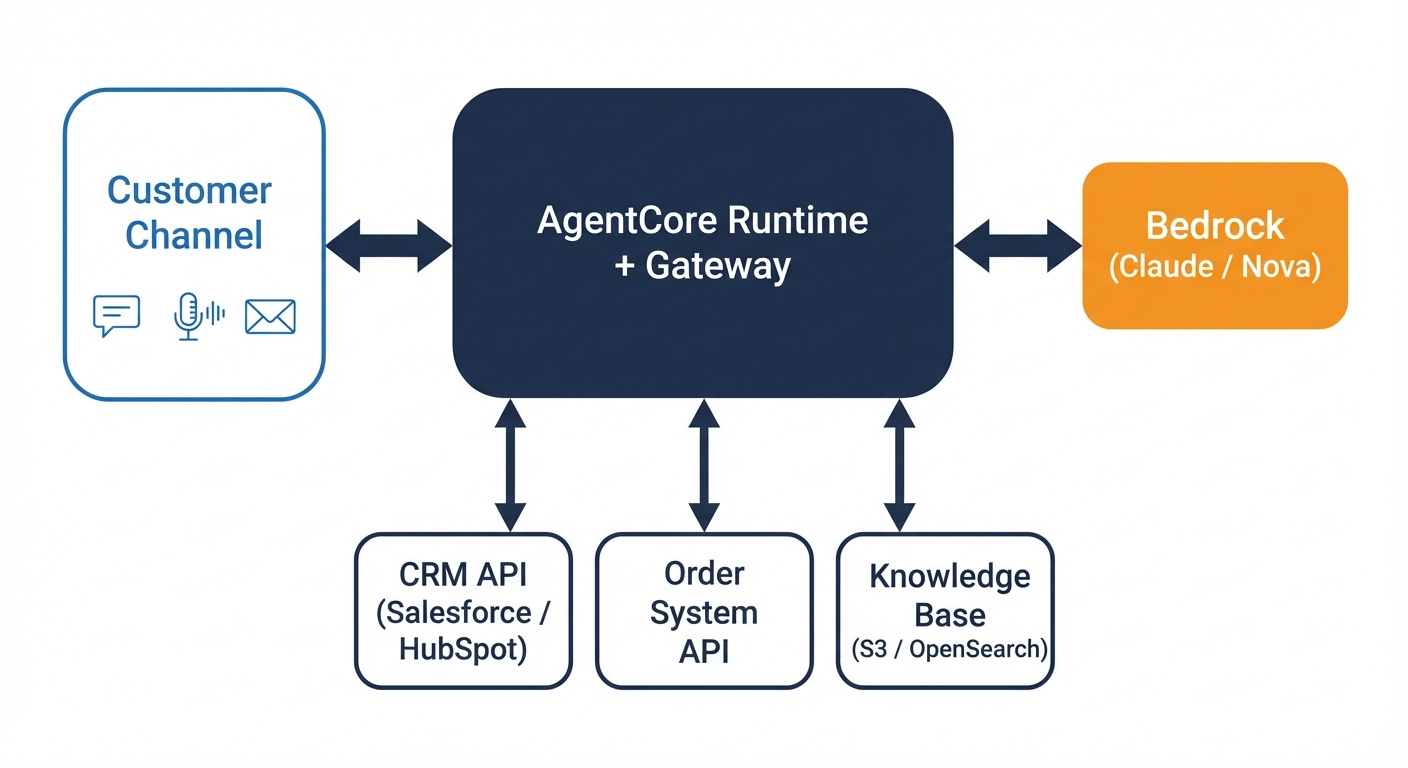
Platform: AgentCore
When to use: The agent reasons about which tools to call, in what order, based on customer context. One agent handles the full conversation with 3-8 tools.
Covers most customer service, sales, and account management agents.
The Gateway handles tool discovery, authentication, and rate limiting.
The Runtime manages session state.
Bedrock provides the foundation models used for reasoning and generation.
Reference Architecture B - Quick Workspace for Customer Intelligence
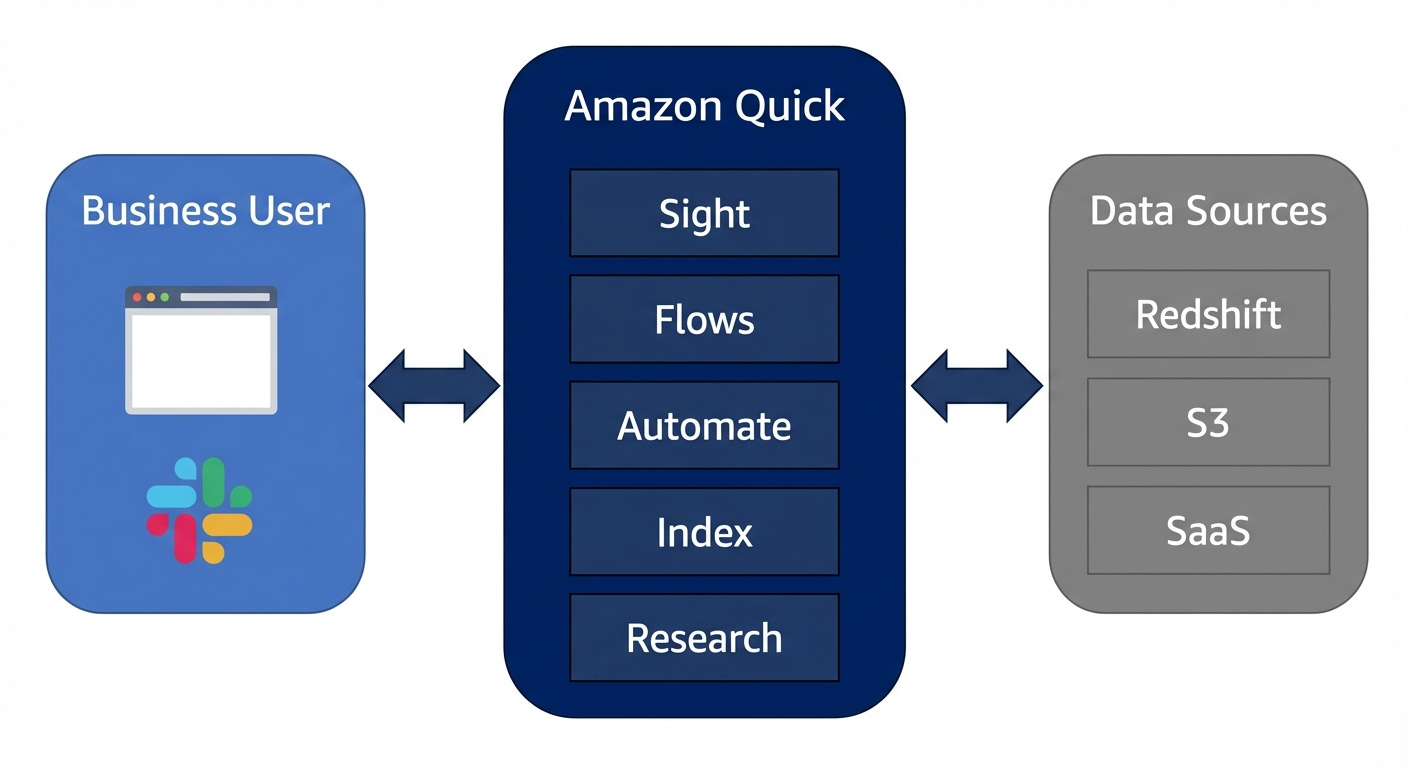
Platform: Quick
When to use: Internal teams need AI-powered analysis of customer data, behavior patterns, or support metrics without writing code.
Covers customer analytics, churn prediction dashboards, support quality monitoring, and self-service reporting for customer success teams.
Reference Architecture C - Multi-Agent Customer Workflow
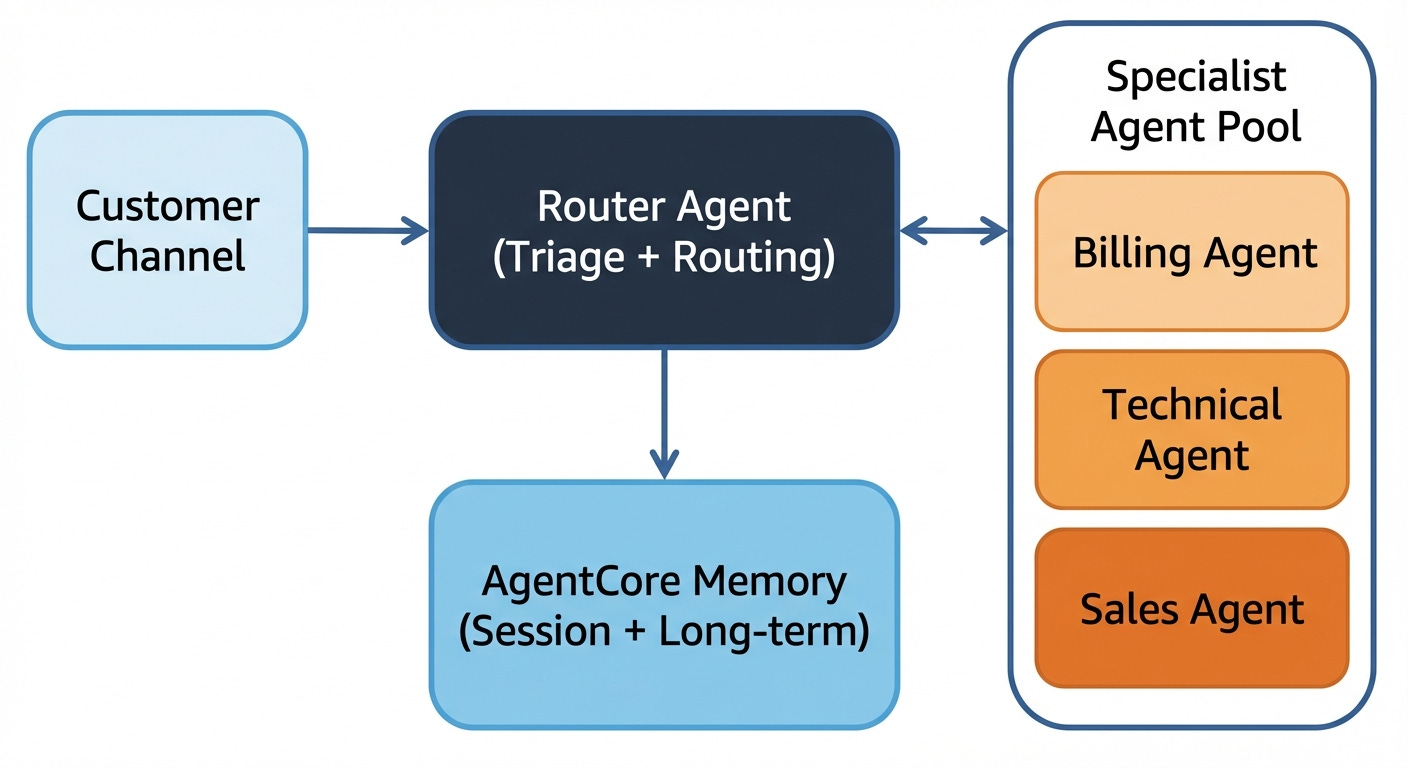
Platform: AgentCore (multi-agent)
When to use: Different customer intents need different tools, knowledge bases, and reasoning patterns.
A single agent with 20+ tools becomes unreliable.
Specialized agents with a router perform better.
The 25 Use Cases
Customer Support and Service
#001 - Intelligent Ticket Resolution Agent
Pattern: Modernization from chatbot
Platform: AgentCore
Complexity: Quick Win
Reference Architecture: A
What the agent does:
- Receives incoming support tickets via API or chat widget.
- Pulls customer history from CRM, checks recent orders and transactions, searches the knowledge base for relevant solutions, and either resolves the ticket directly or drafts a response for human review.
- Handles password resets, order status checks, return initiations, and FAQ-level questions autonomously.
- Escalates to human agents when confidence drops below a configured threshold.
AWS services: Bedrock (Claude), AgentCore Runtime, AgentCore Gateway, OpenSearch Serverless (knowledge base), Bedrock Guardrails
You need this if: Your support team spends more than 40% of their time on repetitive tickets that follow predictable resolution patterns.
#002 - Multi-Channel Support Orchestrator
Pattern: New build
Platform: AgentCore (multi-agent)
Complexity: Strategic Bet
Reference Architecture: C
What the agent does:
- A router agent receives customer messages from chat, email, voice (transcribed via Amazon Transcribe), and social channels.
- It classifies intent, detects sentiment, pulls conversation history from AgentCore Memory, and routes to a specialist agent.
- The billing agent handles payment disputes and invoice questions.
- The technical agent troubleshoots product issues with access to diagnostic APIs.
- The account agent manages subscription changes.
- Each specialist has its own tool set and knowledge base, keeping context windows focused and tool selection reliable.
AWS services: Bedrock (Claude), AgentCore Runtime, AgentCore Memory, AgentCore Gateway, Amazon Transcribe, Amazon Connect, EventBridge
You need this if: You support customers across 3+ channels and your agents need different tools for billing, technical, and account questions.
#003 - Proactive Customer Health Monitor
Pattern: New build
Platform: Both (AgentCore backend + Quick analytics)
Complexity: Strategic Bet Reference
Architecture: A + B
What the agent does:
- Runs on a schedule (daily or triggered by events).
- Analyzes customer usage patterns, support ticket frequency, NPS scores, and billing data.
- Identifies accounts showing early churn signals: declining usage, increasing ticket volume, missed payments, or negative sentiment trends.
- Generates a risk score and recommended intervention for each flagged account. Customer success managers review the output through Quick Sight dashboards and receive alerts via SNS.
AWS services: Bedrock (Claude), AgentCore Runtime, Amazon Quick Sight, EventBridge (scheduler), Redshift (customer data warehouse), SNS
You need this if: Your customer success team manages 100+ accounts and discovers churn risk reactively, after the customer complains or leaves.
#004 - Returns and Refund Processing Agent
Pattern: Modernization from chatbot
Platform: AgentCore
Complexity: Quick Win
Reference Architecture: A
What the agent does:
- Handles return requests end-to-end.
- Verifies purchase eligibility against return policy rules, checks inventory status for exchanges, calculates refund amounts (including partial refunds, restocking fees, and promotional adjustments), initiates the refund through the payment gateway API, generates return shipping labels, and sends confirmation to the customer.
- For edge cases outside policy parameters, it drafts a recommendation and routes to a human supervisor.
AWS services: Bedrock (Nova), AgentCore Runtime, AgentCore Gateway, AgentCore Policy (action restrictions), payment gateway API, shipping API
You need this if: Returns processing involves manual lookups across 3+ systems and takes your team more than 10 minutes per request on average.
#005 - Warranty Claims Adjudication Agent
Pattern: Migration from RPA
Platform: AgentCore
Complexity: Foundation Build
Reference Architecture: A
What the agent does:
- Receives warranty claims with product photos, purchase receipts, and damage descriptions.
- Uses multimodal Bedrock models to analyze product images and assess damage.
- Cross-references the serial number against the warranty database for coverage verification.
- Applies claim rules (coverage period, damage type, prior claims history) and either approves, denies, or flags for manual review.
- Approved claims trigger replacement shipment or repair scheduling through the fulfillment system.
AWS services: Bedrock (Claude with vision), AgentCore Runtime, Amazon S3 (document/image storage), DynamoDB (warranty database), Step Functions (fulfillment orchestration)
You need this if: Your warranty claims process involves manual image review, policy lookup across multiple systems, and takes 24-48 hours for straightforward claims.
Sales and Revenue
#006 - Lead Qualification and Routing Agent
Pattern: New build
Platform: AgentCore
Complexity: Quick Win
Reference Architecture: A
What the agent does:
- Engages inbound leads from web forms, chat widgets, or landing pages.
- Asks qualifying questions conversationally (budget range, timeline, company size, use case).
- Enriches lead data by calling company information APIs.
- Scores the lead against ICP criteria and routes qualified leads to the appropriate sales rep based on territory, deal size, and product interest.
- Unqualified leads receive automated nurture sequences.
- All interactions sync back to the CRM.
AWS services: Bedrock (Claude), AgentCore Runtime, AgentCore Gateway, CRM API (Salesforce/HubSpot), company enrichment API (Clearbit/ZoomInfo)
You need this if: Your SDR team spends more than half their day qualifying leads that turn out to be poor fits, and qualified leads wait hours for first response.
#007 - Personalized Product Recommendation Agent
Pattern: Modernization from chatbot
Platform: AgentCore
Complexity: Quick Win
Reference Architecture: A
What the agent does:
- Interacts with customers browsing your product catalog.
- Asks about preferences, use cases, and constraints through natural conversation.
- Queries the product database with semantic search, filters by availability and pricing, and recommends products with specific reasons tied to what the customer described.
- Handles comparison requests across multiple products.
- Tracks which recommendations led to add-to-cart events and feeds that data into downstream analytics or recommendation systems.
AWS services: Bedrock (Claude), AgentCore Runtime, OpenSearch Serverless (product catalog with vector search), Amazon Personalize, DynamoDB (interaction history)
You need this if: Your product catalog has 500+ SKUs and customers abandon the site because they cannot find what matches their specific needs.
#008 - Quote Generation and Pricing Agent
Pattern: Migration from RPA
Platform: AgentCore
Complexity: Strategic Bet
Reference Architecture: A
What the agent does:
- Takes customer requirements (quantity, specifications, timeline, delivery location) and generates formal price quotes.
- Pulls current pricing from the ERP system, applies volume discounts, checks contract-specific pricing for existing customers, calculates shipping costs based on logistics APIs, and factors in promotional offers.
- Generates a formatted PDF quote and sends it to the customer.
- Non-standard requests outside pricing rules route to the sales manager with a recommended price and margin analysis.
AWS services: Bedrock (Claude), AgentCore Runtime, AgentCore Gateway, ERP API (SAP/Oracle), Lambda (PDF generation), SES (email delivery)
You need this if: Generating a custom quote takes your sales team 2+ hours and involves pulling data from 3 or more systems manually.
#009 - Contract Renewal Intelligence Agent
Pattern: New build
Platform: Both
Complexity: Strategic Bet
Reference Architecture: A + B
What the agent does:
- Monitors contract expiration dates across the customer base.
- Sixty days before renewal, it compiles a customer health profile: usage trends, support ticket history, feature adoption, billing history, and NPS scores.
- Generates a renewal risk assessment and recommended pricing strategy (upsell opportunity, standard renewal, at-risk discount needed).
- Sales reps review renewal briefs through Quick dashboards.
- The agent drafts personalized renewal communications based on each account’s specific usage patterns and value received.
AWS services: Bedrock (Claude), AgentCore Runtime, Amazon Quick (Sight + Research), Redshift, EventBridge (scheduler), SES
You need this if: Your renewal process starts too late, relies on generic outreach, and your team lacks a consolidated view of customer health at renewal time.
#010 - Real-Time Sales Coaching Agent
Pattern: New build
Platform: AgentCore
Complexity: Foundation Build
Reference Architecture: A
What the agent does:
- Listens to live sales calls via Amazon Connect integration and Amazon Transcribe streaming.
- Analyzes the conversation in real-time and provides the sales rep with contextual prompts: competitor objection responses, relevant case studies, pricing flexibility guidelines, and technical specifications.
- After the call, generates a summary, identifies follow-up actions, updates the CRM, and scores the call against your sales methodology framework.
AWS services: Bedrock (Claude), AgentCore Runtime, Amazon Connect, Amazon Transcribe (streaming), Bedrock Knowledge Bases, CRM API
You need this if: Your sales team handles complex technical sales where having the right information during the call directly impacts close rates.
Onboarding and Activation
#011 - Customer Onboarding Orchestrator
Pattern: Modernization from chatbot
Platform: AgentCore
Complexity: Quick Win
Reference Architecture: A
What the agent does:
- Guides new customers through product setup step by step.
- Adapts the onboarding flow based on the customer’s plan tier, industry, and stated goals.
- Configures initial settings, imports data from previous tools via API, creates sample content or workflows, and schedules check-in milestones.
- Tracks completion of onboarding tasks and sends reminders for incomplete steps.
- Escalates to a customer success manager when the customer gets stuck or expresses frustration.
AWS services: Bedrock (Claude), AgentCore Runtime, AgentCore Memory (onboarding state), product API, SES/SNS (notifications)
You need this if: Your time-to-value exceeds 14 days for new customers and onboarding completion rate sits below 70%.
#012 - Document Collection and Verification Agent
Pattern: Migration from RPA
Platform: AgentCore
Complexity: Strategic Bet
Reference Architecture: A
What the agent does:
- Manages the document collection process for customer applications (financial services, insurance, healthcare enrollment).
- Sends document requests, receives uploads, uses Amazon Textract to extract information, validates extracted data against application requirements, flags discrepancies, and requests corrections or additional documents.
- Maintains a real-time status dashboard showing which documents are complete, pending, or require resubmission.
AWS services: Bedrock (Claude), AgentCore Runtime, Amazon Textract, Amazon S3, DynamoDB (application state), SES (communications)
You need this if: Your customer application process requires 5+ documents, average collection time exceeds 2 weeks, and your team spends hours chasing missing or incorrect paperwork.
#013 - KYC and Identity Verification Agent
Pattern: Migration from RPA
Platform: AgentCore
Complexity: Foundation Build
Reference Architecture: A
What the agent does:
- Conducts Know Your Customer verification for financial services onboarding.
- Collects identity documents, extracts data with Textract, verifies against government databases and sanctions lists via API, performs facial comparison between ID photos and selfies using Amazon Rekognition, runs PEP (Politically Exposed Persons) screening, and generates a risk assessment score.
- Clean cases auto-approve.
- Flagged cases route to compliance analysts with a detailed findings summary.
AWS services: Bedrock (Claude), AgentCore Runtime, AgentCore Policy (compliance rules), Amazon Textract, Amazon Rekognition, third-party verification APIs, DynamoDB
You need this if: Your KYC process takes 3+ business days for standard applications and your compliance team manually reviews documents that could be auto-verified.
#014 - Insurance Quoting and Binding Agent
Pattern: New build
Platform: AgentCore
Complexity: Strategic Bet
Reference Architecture: A
What the agent does:
- Walks prospective customers through an insurance application conversationally.
- Collects required information (property details, driving history, health information depending on product line) through natural dialogue instead of static forms.
- Calls underwriting APIs to generate real-time premium quotes.
- Explains coverage options, deductible trade-offs, and exclusions in plain language.
- Standard-risk profiles complete binding and get policy documents.
- Non-standard risks route to an underwriter with the completed application and preliminary risk assessment.
AWS services: Bedrock (Claude), AgentCore Runtime, Bedrock Guardrails (PII handling), underwriting API, document generation API, payment gateway
You need this if: Your online quote-to-bind conversion rate is below 15% and customers abandon applications because the process is too long or confusing.
#015 - Patient Intake and Pre-Visit Agent
Pattern: New build
Platform: AgentCore
Complexity: Foundation Build
Reference Architecture: A
What the agent does:
- Contacts patients before scheduled appointments to collect intake information.
- Gathers medical history updates, current medications, symptoms, and insurance details through a conversational interface.
- Verifies insurance eligibility in real-time via payer APIs.
- Pre-populates the EHR with collected information so the provider has context before the visit.
- Sends appointment reminders and preparation instructions (fasting requirements, documents to bring).
- Handles rescheduling requests by checking provider availability.
AWS services: Bedrock (Claude), AgentCore Runtime, AgentCore Policy (HIPAA compliance), Bedrock Guardrails (PHI protection), EHR API (Epic/Cerner), insurance verification API
You need this if: Your front desk staff spends 15+ minutes per patient on intake paperwork and your no-show rate exceeds 10%.
Self-Service and Account Management
#016 - Account Configuration Agent
Pattern: Modernization from chatbot
Platform: AgentCore
Complexity: Quick Win
Reference Architecture: A
What the agent does:
- Handles account management requests that currently require support tickets or phone calls.
- Changes billing information, updates contact details, modifies subscription plans, adds or removes users, adjusts notification preferences, and manages API keys.
- Validates changes against account policies before executing.
- Requires additional verification (MFA challenge) for sensitive changes like payment method updates or admin role assignments.
AWS services: Bedrock (Nova), AgentCore Runtime, AgentCore Identity (user verification), AgentCore Policy (change authorization), account management API
You need this if: More than 30% of your support tickets are account modification requests that follow standard procedures and require no human judgment.
#017 - Billing Dispute Resolution Agent
Pattern: Modernization from chatbot
Platform: AgentCore
Complexity: Quick Win
Reference Architecture: A
What the agent does:
- Investigates billing disputes by pulling invoice details, payment history, usage records, and contract terms.
- Identifies the root cause: duplicate charge, incorrect rate, usage miscalculation, or failed payment.
- For clear-cut errors, applies the credit automatically and confirms with the customer.
- For ambiguous disputes, presents findings with supporting data and offers resolution options.
- Complex disputes involving contract interpretation route to the billing team with a complete investigation summary.
AWS services: Bedrock (Claude), AgentCore Runtime, billing system API, payment processor API, DynamoDB (dispute tracking)
You need this if: Billing disputes take your team an average of 45+ minutes to investigate because the relevant data lives in 4 or more systems.
#018 - Subscription Optimization Advisor
Pattern: New build
Platform: AgentCore
Complexity: Quick Win
Reference Architecture: A
What the agent does:
- Analyzes a customer’s actual usage patterns against their current subscription tier.
- Identifies underused features the customer is paying for, features they need but lack access to, and usage trends suggesting a plan change would save money or deliver better value.
- Proactively reaches out (or responds when asked) with a specific recommendation backed by the customer’s own data.
- Handles plan changes directly when the customer agrees.
AWS services: Bedrock (Claude), AgentCore Runtime, usage analytics API, billing API, SES (proactive outreach)
You need this if: Customers churn because they feel they are overpaying, or they hit plan limits and leave instead of upgrading because no one showed them the value of the next tier.
Scheduling and Coordination
#019 - Appointment Scheduling Agent
Pattern: Modernization from chatbot
Platform: AgentCore
Complexity: Quick Win
Reference Architecture: A
What the agent does:
- Manages appointment booking across multiple providers, locations, and service types.
- Understands natural language requests (”I need to see Dr. Martinez next Tuesday afternoon”), checks real-time availability, considers travel time between locations for the customer, handles rescheduling and cancellations, sends confirmations and reminders.
- Manages waitlists and automatically offers cancellation slots to waiting customers.
AWS services: Bedrock (Nova), AgentCore Runtime, scheduling system API, SNS/SES (notifications), DynamoDB (waitlist management)
You need this if: Your scheduling staff handles 100+ calls per day for appointment booking and phone wait times exceed 5 minutes during peak hours.
#020 - Service Dispatch and Coordination Agent
Pattern: Migration from RPA
Platform: AgentCore
Complexity: Strategic Bet
Reference Architecture: A
What the agent does:
- Coordinates field service appointments for installation, repair, or maintenance visits.
- Collects service request details from the customer, determines required skills and equipment, checks technician availability and location, proposes appointment windows, and confirms bookings.
- On the day of service, provides the customer with technician ETA updates.
- If a technician runs late or a job takes longer than expected, automatically reschedules downstream appointments and notifies affected customers.
AWS services: Bedrock (Claude), AgentCore Runtime, workforce management API, Amazon Location Service, SNS (real-time notifications), EventBridge (event-driven rescheduling)
You need this if: Your dispatch team manually coordinates 50+ service appointments per day and customers complain about missed windows or lack of status updates.
Communication and Engagement
#021 - Personalized Outreach Campaign Agent
Pattern: New build
Platform: AgentCore
Complexity: Strategic Bet
Reference Architecture: A
What the agent does:
- Generates personalized outreach messages at scale for marketing campaigns, re-engagement sequences, and lifecycle communications.
- For each customer segment, it pulls behavioral data (purchase history, browsing patterns, feature usage, support interactions), generates message variants tailored to individual contexts, and A/B tests subject lines and content.
- Feeds performance data (open rates, click-throughs, conversions) into analytics workflows that inform future campaign generation.
- Operates within brand guidelines and approved messaging frameworks stored in the knowledge base.
AWS services: Bedrock (Claude), AgentCore Runtime, Bedrock Knowledge Bases (brand guidelines), Amazon Pinpoint, Redshift (customer data), S3 (campaign assets)
You need this if: Your marketing team sends the same campaign to entire segments and personalization is limited to inserting the customer’s first name.
#022 - Review Response and Reputation Agent
Pattern: New build
Platform: AgentCore
Complexity: Quick Win
Reference Architecture: A
What the agent does:
- Monitors customer reviews across platforms (Google, Yelp, Trustpilot, app stores, social media).
- Analyzes sentiment and topic.
- For positive reviews, drafts personalized thank-you responses.
- For negative reviews, investigates the customer’s account to understand context, drafts empathetic responses that address specific complaints, and creates internal tickets for service recovery.
- Aggregates review trends into weekly reports highlighting recurring issues and sentiment shifts.
AWS services: Bedrock (Claude), AgentCore Runtime, review platform APIs, CRM API, Amazon Comprehend (sentiment analysis), SNS (alerts for critical reviews)
You need this if: Your team responds to reviews manually, response times exceed 24 hours, and you lack a systematic way to track sentiment trends across platforms.
#023 - Multilingual Customer Communication Agent
Pattern: New build
Platform: AgentCore
Complexity: Quick Win
Reference Architecture: A
What the agent does:
- Handles customer interactions in 20+ languages without requiring multilingual staff.
- Detects the customer’s language from their first message, conducts the entire conversation in that language, and translates internal knowledge base content on the fly.
- Maintains cultural context and idiomatic accuracy beyond literal translation.
- For regulated communications (financial disclosures, healthcare instructions), uses pre-approved translations from the knowledge base instead of real-time generation.
AWS services: Bedrock (Claude, which handles multilingual natively), AgentCore Runtime, Bedrock Knowledge Bases (approved translations), Amazon Translate (fallback for less common languages)
You need this if: You serve customers in 3+ languages and currently either hire language-specific support staff or use basic translation tools that miss nuance.
Specialized Industry Agents
#024 - Real Estate Property Matching Agent
Pattern: New build
Platform: AgentCore
Complexity: Strategic Bet
Reference Architecture: A
What the agent does:
- Works with home buyers through a conversational interface to understand requirements beyond basic filters.
- Captures lifestyle preferences (commute tolerance, school district priorities, neighborhood vibe, proximity to amenities) alongside traditional criteria (bedrooms, budget, location).
- Searches MLS listings with semantic matching, scores properties against the buyer’s full preference profile, and presents curated shortlists with specific reasons each property matches.
- Schedules viewings, provides neighborhood data, and adapts recommendations based on feedback after each showing.
AWS services: Bedrock (Claude), AgentCore Runtime, AgentCore Memory (buyer preference evolution), MLS API, Amazon Location Service, OpenSearch Serverless (semantic property search)
You need this if: Your agents show 15+ properties before a buyer makes an offer and clients say “you’re not understanding what I want” after the third showing.
#025 - Travel Itinerary Planning Agent
Pattern: New build
Platform: AgentCore
Complexity: Strategic Bet
Reference Architecture: C
What the agent does:
- Builds complete travel itineraries through multi-turn conversation.
- A planner agent understands preferences and constraints (dates, budget, interests, mobility needs, dietary restrictions).
- A booking agent searches flights, hotels, and activities through GDS and supplier APIs.
- A logistics agent optimizes the sequence of activities based on geography, operating hours, and travel time.
- The planner presents the consolidated itinerary, handles modifications, and manages booking confirmations.
- Post-booking, it monitors for flight changes, weather disruptions, and sends trip updates.
AWS services: Bedrock (Claude), AgentCore Runtime (multi-agent), AgentCore Memory (trip state), GDS/supplier APIs via AgentCore Gateway, Amazon Location Service, EventBridge (monitoring triggers)
You need this if: Your customers spend 3+ hours planning trips across multiple booking sites and your conversion rate from search to booking sits below 5%.
What These 25 Patterns Reveal
A few things stand out across all 25.
Most customer-facing agents start as chatbot upgrades.
The jump from “answers questions from a knowledge base” to “takes actions on behalf of the customer” is where real value appears.
If you already have a chatbot, you have the knowledge base and the channel.
Adding tool access through AgentCore Gateway converts that chatbot into an agent.
Quick Wins cluster around support and account management.
These use cases have well-defined rules, predictable workflows, and clear success metrics.
They make good first agents because the scope is contained and ROI is measurable within weeks.
Multi-agent architectures show up only when necessary.
Only a couple of the 25 patterns require multiple coordinated agents.
Most customer-facing work is handled well by a single agent with the right tools.
Build multi-agent systems because a single agent’s context window or tool set has become unreliable, not because the architecture sounds impressive.
The foundation model matters less than the integration layer.
Swapping Claude for Nova changes your cost profile but rarely changes the architecture.
The APIs, knowledge bases, and policy rules are where the real engineering happens.
What Comes Next
This series continues with four more editions, same format, different domains:
- Edition 2 - Internal knowledge and productivity agents (employee-facing)
- Edition 3 - Workflow automation and process agents (internal operations, no direct customer interaction)
- Edition 4 - Data and analytics agents (self-service BI)
- Edition 5 - Compliance, security, and governance agents (high-stakes environments)
Bookmark this. When someone on your team says “we should use AI for X,” pull up the relevant card and walk into the architecture discussion with a starting point instead of a blank whiteboard.
I publish every week at buildwithaws.substack.com. Subscribe. It's free.


Top comments (1)
Quick personal review of AhaChat after trying it
I recently tried AhaChat to set up a chatbot for a small Facebook page I manage, so I thought I’d share my experience.
I don’t have any coding background, so ease of use was important for me. The drag-and-drop interface was pretty straightforward, and creating simple automated reply flows wasn’t too complicated. I mainly used it to handle repetitive questions like pricing, shipping fees, and business hours, which saved me a decent amount of time.
I also tested a basic flow to collect customer info (name + phone number). It worked fine, and everything is set up with simple “if–then” logic rather than actual coding.
It’s not an advanced AI that understands everything automatically — it’s more of a rule-based chatbot where you design the conversation flow yourself. But for basic automation and reducing manual replies, it does the job.
Overall thoughts:
Good for small businesses or beginners
Easy to set up
No technical skills required
I’m not affiliated with them — just sharing in case someone is looking into chatbot tools for simple automation.
Curious if anyone else here has tried it or similar platforms — what was your experience?