


New World Order
With the COVID-19 crisis, one trend has gained a lot of momentum: remote working. A lot of workers were asking for it for quite some time, pressing their companies to allow them to work from anywhere and trust them that they could be more productive on their own terms.
The coronavirus forced their hands obviously and now some companies decided that remote working was worth it. Twitter announced their teams can keep working from home "forever". Facebook also started the transition towards allowing more of their employees to work remotely.
These two are just some examples of how the crisis help the work from home movement gain traction. Of course, how we do remote work in this crisis is another subject entirely. For hundred of thousands of people, the change was not prepared, or even not wanted. In this configuration, we are trying to make remote work function, during a crisis. But that's another debate.
What about the salary?
According to this tweet:
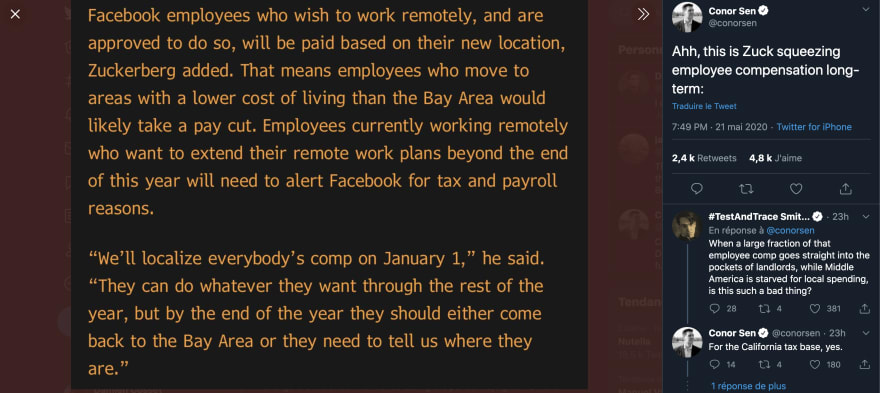
Our good friend Zucky is basically saying Facebook will not pay employees the same based on their location. There are no details yet of what will be done, and how. But it begs the question:
Should remote workers salaries differ based on their location?
Assuming two developers with the same skills, experience and productivity. One lives in New York, the other lives in Marrakech. As a CEO, should you adapt the salary of the developer living in New York, because the cost of living will be much higher than in Morocco?
Basecamp, a company with most of their employees working from home, pays their employees based on same base, which I believe is the New York market. Doesn't matter where they work from. Same experience? Same job? Same pay, period.
If you are a Facebook worker in California, you will be payed higher than a Facebook worker in London. And that disparity will continue after the coronavirus crisis ends and Facebook moves to a remote friendly environment.
What do you think? On one end, if two developers have the same position, they should be able to claim the same compensation for the same work. Should we include the environment they live in in that compensation? A worker in San Francisco is most likely to spend a good amount of his salary to pay a rent. While the developer in Morocco will most likely spend a smaller percentage of his salary towards her housing.
But then, if you start with housing, where do you stop? Should you consider the size of the employee's family? If they still want to work at the office from time to time or full time, should you compensate the salary for the commute costs?
This is a difficult issue, with quite a lot of nuances. Personally, I quite like the "Basecamp" way: pick a fair location and adapt your salaries based on that location.
I'd love to know where you stand on this issue 😄
Love ❤️
Sources:


Latest comments (46)
As we seen before this problem will be answered by economy dynamics:
1st - Facebook believes this is the right way and keep the strategy.
2nd - Good developers at FB won't see any interest in working at FB anymore.
3rd - Emergeing Startups will see the opportunity and use the same payroll as Basecamp to steal FB developers.
4th - Good developers at FB will leave FB and start to work on the emerging startups.
5th - FB Human Resources team will be in crises by their talent retention and engagement metrics and Product team will be getting problems with productivity.
6th - FB will spend some millions in propaganda to say that they are very honest with their payroll and will keep Basecamp strategy.
That's all folks. End of story!
If a company decides to go 100% fully remote then it is my deep conviction that they should NOT differentiate salaries based on location.
The point is, if a company is all-out and completely remote then location is not a factor at all anymore - ZERO. People could move around, to other places, countries, go "digital nomad". Location then needs to be removed from the picture, so differentiating salary based on location should go out the window as well.
If two people have the same job, perform the same and produce the same, why should one be paid less than the other? And I'm not talking only about remote jobs, I think it should be applied to people who go to offices as well. Of course, there are laws and benefits based on the location, but I believe the base payment should be the same.
Quick point to note - Basecamp bases their pay on the Chicago market.
A few others have pointed that paying Indian developers less than the USA is somehow relevant here. That is simply not the case. I know good developers in India making mid-high Seattle rates from right here in Bangalore. I also know of people who work at body shops that farm out a single developer's job to 3-4 engineers and paying them less than a tenth in aggregate compared to an Engineer making high-market rates. The services being rendered are widely different and hence the pay disparity.
The point here is, if we're accepting geographical location as a factor, what about the area they live in? Let's say someone wants to live in small room in a shared house in Daly City and someone else wants to rent a nice cabin in Woodside. Is facebook going to pay them different rates now? What about Harrison NJ vs Manhattan? This whole argument is absurd.
Also, someone mentioned the COLA in the Military. That works very wel. But for one condition. The person actually is required to be on the base. People here will be remote, meaning they don't "have to" be anywhere really. As far as the company is concerned, absolutely nothing is different.
This:
The person actually is required to be on the base. People here will be remote, meaning they don't "have to" be anywhere really.
That is the whole point. If as a company you're going fully remote then location should go completely out of the window as a factor. People can move around, even go abroad, go "digital nomad".
If you choose this company model then you just need to pay based on competency and performance, period.
Not necessarily on the base. I lived in a town within an hour from the base with lower housing costs (rent and housing immediately around the base is always based on military pay rates, and that drops the further out you go from the base). My COLA didn't change, because it was based on the base's location.
That said, I don't think it could be an exact 1:1 comparison to the military system, nor do I think it would work worldwide, but I do think it could work with something along the lines of "US/Irish/Indian/Chinese/Australian/Costa Rican base salary + geographic COLA adjustment"
As long as the worker stays within their original geographic base, moves are a simple COLA adjustment. If you move to another "base" it requires a renegotiation of salary (up or down)
This would allow the company to avoid overpaying based on the market value of labor, but also allows the employee freedom to move to anywhere in the world.
The "geographic base" approach does less to even-out pay disparities across countries, and would benefit companies that want to exploit market labor rate differences, BUT with a high degree of transparency (IE: Clear documentation of what the median salary is per "geographic base") you could easily convert someone to a new base ("previously you made the median + 25% in base1 due to a successful negotiation/advanced skillset/documented reason, so you will make median + 25% in your new base, and the region you live in has a COLA adjustment of +2.5%"
It requires a lot of initial and ongoing effort on the company's part to carry something that detailed, so I don't think any smaller shop would ever be able to keep up with it, but for a Facebook? That's not that hard at all... It DOES require transparency in the pay bands for all markets to allow employees to make informed decisions when deciding on whether or not to change their geographic base...
Just spit-balling ideas based on the rest of the discussion. I know we would probably all like there to be one universal salary, but unless we have a universal set of laws, market forces and even economic systems, that's impossible to implement economically.
I hear the point about regional base salaries and a more fine-tuned COLA type adjustment.
My question is, what would facebook lose if a developer who lived for so long in the Bay Area decides to move to Montreal or Chattanooga or wherever (let's say for this conversation, within a reasonable time zone difference)? They get X value and in return pay Y amount. What are they losing to reduce Y? The argument that the employee no longer needs Y is a silly and absurd argument very much along the lines of Twentieth Century Motor Company.
The cost to the company is less (no money spent on an office space for this person + any of the office perks). Are they claiming remote workers are inherently less efficient to warrant the pay difference?
Nothing is ever truly universal. But something along the lines of "Anywhere in the world except [these places we aren't allowed to do business in, can't get a payroll system up in, etc] gets the same pay" is not all that complicated.
The only beneficiary wrt location-specific pay is the employer. Given that they're already saving on expensive real-estate, this is nothing but a "we'll try this too and keep doing this if we can get away with it" type situations.
If this is applied across the board, engineers who are now already in smaller cities and towns or cheaper countries can, in theory, move to the more expensive locations and demand a higher pay? I don't for a second believe Facebook or any other company is ever going to support or even begrudgingly get on board with this side of the equation. They will find a way to block such moves, claim employees are free to do so on their own without a change in pay, etc.
The level of transparency required for this is absolutely in stark contrast to the very nature of companies like Facebook (there's so much documented evidence that if they could run a black box without zero oversight they'd jump at the chance).
Oh, don't get me wrong: I absolutely believe all companies SHOULD pay the same rate for the same work. Full stop.
Edit: I forgot to address the primary issue: What does FB have to lose?
It's purely economics. They consider it an overpayment for payroll. See below for the reasoning, I just wanted to make sure I was talking TO you and not past you by not addressing the specific point... Sorry about that!
I'm simply describing what I see as an economically viable alternative system to "Your pay is going to get cut arbitrarily if you don't come back to the Bay Area"
The key here is that the Bay Area cost of living is so astronomically above the average that someone making 300k is making 300k not because that is the value of their labor on the open market, but because companies cannot recruit employees without either an incentive to drive an hour+ from affordable housing (I don't know where the affordable housing is in that area) or enough that they can live nearby.
Without the enormous cost of living, none of those workers would be making as much as they do.
Zuck is (shudder) correct that if a worker isn't in the Bay Area, then they shouldn't get paid the recruitment premium necessary to get the best and the brightest to come work for FB in the Bay Area.
The thing that most people fail to realize is that if we truly had a globalized average of pay for Senior Software engineers, the average would probably be (off the top of my head, zero research) somewhere in the 60 to 80k/year range.
But COLA is already baked into the salary. This is just making it explicit.
Now that I feel icky, I do think there are a lot of important conversations to be had around worker treatment, profit sharing and general compensation packages, but when it comes to a company trying to optimize pay based on localized cost of living, we can say things like "They should get the same pay regardless" (which would make them targets for the next round of layoffs), "They should pay overseas engineers the same as domestic US engineers for the same work" (decimating the offshore engineering market by removing it's primary value proposition, which is labor in markets with much lower cost of living thresholds than the US), or we can approach it from a position of how to get the most good and best transparency in the process so workers can be informed and know what to expect rather than what Zuck did, which is just say "we'll cut your pay if you don't come back"...
Jeez... I feel like I'm defending giant companies (I'm not, I just don't think this is a good target)... I need a shower now 🤣
I think it's important to be fair. And it's up to every business how they want to do. I'd rather be paid fair. If I would remote from Sweden to a US company I would prefer a fair compens based on how my life would have the change, like timezone wise. If I had to setup my life to be able to attend meetings at night I would ask to be compensated the same for that time, 3-4 hours maybe, the rest I could do myself with appropriate location based comp.
Gitlab has a good article on why they pay local rates for remote workers about.gitlab.com/blog/2019/02/28/w...
I am working remotely (another country) and I am getting paid less from others who are working in the office. But I strongly dissagree with that culture and here are my reasons:
Don't know if anyone has mentioned it here, but the US Military has had this figured out for decades.
You establish the base salary for the "average" position, and then you apply Cost of Living Allowance (COLA) adjustments (always up, never down) for high cost of living areas like NYC or San Francisco.
This is very easy for them given the exact nature of military pay, but I thought there were businesses that had figured this out as well.
A person can still negotiate their base, and still move wherever they like. If the area they move to is allowed a COLA adjustment, then at some point after the move they start receiving it. If not, they do not.
Divorce it from total pay and make it a standard percentage increase applied to all workers in that geographic region.
This is interesting. Seems like whenever we talk about adjusting to the cost of living, it's always about places where the cost of living is lower and therefore the salary should be decreased accordingly. Here, we have a contrary example where the salary can only go up if you live in places where the cost of living is high.
I can imagine that because a lot of "famous" tech companies are based around San Francisco, we have the "salary down" mentality rather than one that could resembles the US Military example.
you dont have to outrun the bear
That depends on what factors are used to determine value for both parties involved. Does FB find value in having developers in NY vs Indiana? If they had to make a layoff and all things being otherwise equal, would they fire that $125,000 Ny dev or the $70,000 Indiana Dev.
My first startup will probably implement a Double Dare! style physical challenge system. This will settle disputes as well as encourage uniformity due the required jumper.
Some comments may only be visible to logged-in visitors. Sign in to view all comments.