
title: [Learning Notes][Golang] How to Achieve Inheritance Effects with Golang Interfaces - Using LINEbot to Connect to Different Databases as an Example
published: false
date: 2023-01-12 00:00:00 UTC
tags:
canonical_url: http://www.evanlin.com/go-interfaces-inheritance/
---
# Preface
When preparing LINE Bot related sample code, I usually don't include a database. However, some sample code would benefit from storing data. Therefore, it's necessary to add database-related read and write operations.
Of course... there's also a "poor man's" version of a database. Since many services charge for their database services, there's a need for some workarounds. Using memory as a database setup.
So, how do you write the data processing logic only once in your code, and then use different databases for access depending on your deployment environment variables?
For example:
- If you have a PostgreSQL database URL, use the PG SQL related processing method.
- If not, use memory as the database.
- In the future, you can also add different cloud deployment methods (or support Firebase related databases).
This article will begin to describe how to achieve a similar inheritance effect through Golang's Interfaces. Using the same set of program logic code, you can read different databases based on your configured parameters.
# Sample Code: LINE Bot Group Chat Summary Generator
This time, I'm using the previous sample article [[Learning Document] LINE Bot Group Chat Summary Generator](https://www.evanlin.com/linebot-chatgpt/) as an example code. Let's first look at the overall structure.
#### Github Repo: https://github.com/kkdai/LINE-Bot-ChatSummarizer
## Data Structure Diagram
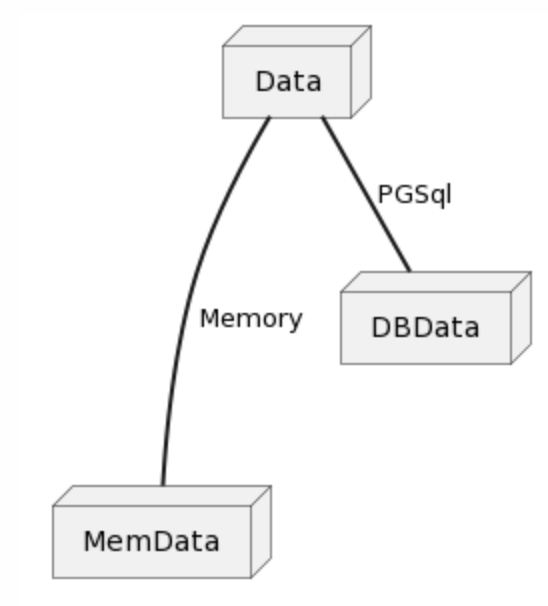
All implementations access related data through Data, which is the API of the Basic Class. As long as you create it, use the related Interfaces with different initial variables, and you can call the same processing information.
First, list the related processing code:
## Related Processing Code
<script src="https://gist.github.com/kkdai/62dc8354e7ce3e7607aeda0513513a58.js"></script>
Here, the implementation of `GroupDB` defined as Interfaces is used. Depending on different settings, `NewPGSql(url)` or `NewMemDB()` can make the corresponding implementation inside different.
## Detailed Listing of Different Database Development Methods
Next, list the implementation methods for different databases.
### Basic (Data)
<script src="https://gist.github.com/kkdai/e186c9ed2b088b3f30e5d2e9cee62668.js"></script>
This is the most basic setting. The most important thing is the declaration of the interface `GroupDB`, and then the other two must also have
- `ReadGroupInfo(string) GroupData`
- `AppendGroupInfo(string, MsgDetail)`
The implementation of the two functions, and the input parameters and output parameters must be the same. This way, you can use the same logic to operate on the data.
### Memory DB
<script src="https://gist.github.com/kkdai/7ff6487458ee8691b9ddf6993872186d.js"></script>
Next, this is the implementation of using Memory as the database. You can see that it mainly operates on related data processing through `map`. This way of using memory as a DB, if it is in FAAS (e.g. Heroku or Render.com), you will lose your stored data when the service sleeps.
### PostGresSQL DB
<script src="https://gist.github.com/kkdai/f1c4277ea2dfe7cabeb3a54e73aa7376.js"></script>
Next, this is the implementation of PostGresSQL. It mainly uses the version of the `"github.com/go-pg/pg/v10"` package, which can directly operate PostgresSQL through ORM, which can save a lot of trouble. But in many cases, not using SQL directly is actually more troublesome.
In the development process here, there is nothing to pay attention to. You only need to pay attention to the following implementations.
- `ReadGroupInfo(string) GroupData`
- `AppendGroupInfo(string, MsgDetail)`
## Future Development
Using Interfaces as a database access development method can be very convenient and leaves room for many future database resources. Whether it's supporting MongoDB or wanting to use MySQL, or even moving the entire database to FireStore, there's no need to change my original business logic. You only need to complete the basic database implementation.
I hope this article can give you some ideas.

Evan Lin
Posted on Originally published at evanlin.com on
Golang Interfaces for Inheritance: A LINEbot Example
For further actions, you may consider blocking this person and/or reporting abuse


Top comments (0)