


Originally published on xiongpin.dev.
Building a small website today takes about ten minutes. A landing page, a form, a data table to store the submissions and an admin view to read them. You describe what you want, an AI coding tool writes the code, and then it deploys the service.
Twenty years ago the same website started with a harder question: where does the code run? You picked a machine, installed an operating system, configured the runtime, opened the network ports and set up a way to release changes.
New technology keeps arriving faster
That question has been answered six times in thirty years.
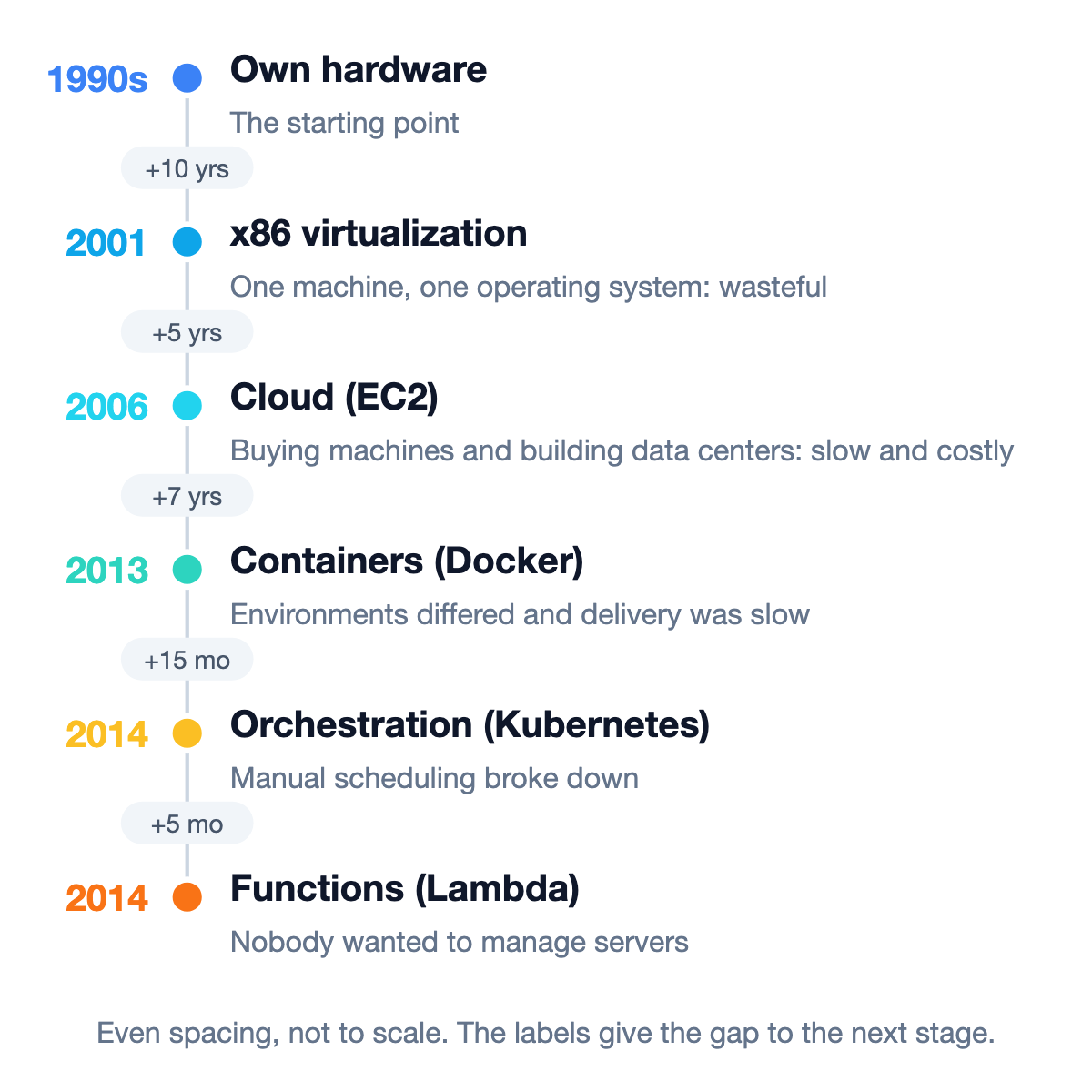
Two things stand out in that timeline.
First, no generation kills the one before it. Each one builds on the last and solves what it left behind, so putting software into production keeps getting easier.
Second, the gaps turn from years into months. The first stages sit roughly ten, five and seven years apart; the last three, from Docker in March 2013 to Lambda in November 2014, all land inside twenty months.
Then the chain collapsed into a single step. An AI coding tool can do the whole thing now: it writes the code, sets up the environment and deploys the service. The same website that once needed all of that preparation comes together in minutes. The point is the speed, not the tool.
How to understand a technology
Before we talk about how to learn a new technology, we should look at how to understand one. Deployment is not a single technology, and neither are Kubernetes and AI coding. We talk about each as if the name covered one skill, but what sits under it is not the same kind of thing: some are notations you memorize, some are products you choose, some are philosophies you reason about, and some are mechanisms. Some turn over every few months; others have not changed in decades. Modeling a technology in layers is what makes that visible.
The four layers
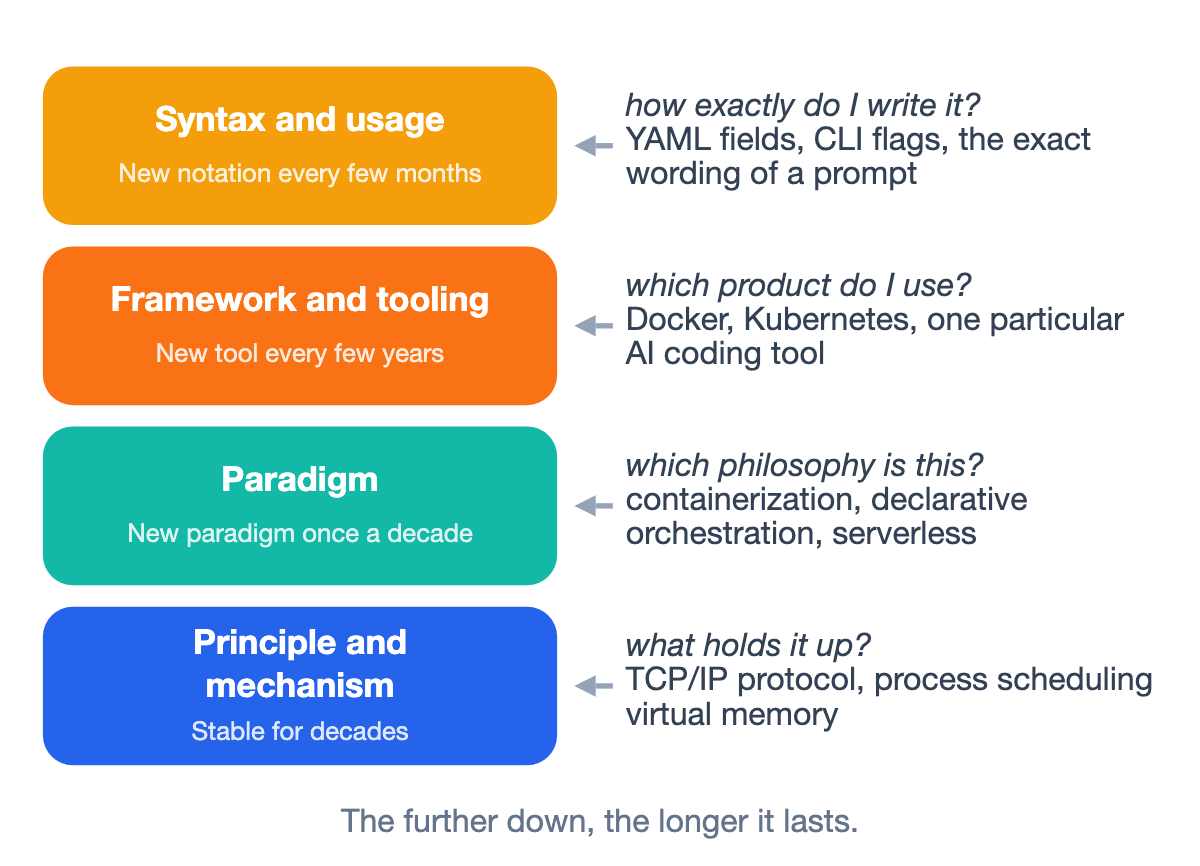
The four layers are a way to take a technology apart. Splitting it shows where each piece lands: a single capability tends to sit in one layer, while a product reaches across several. That is what makes the real questions answerable: how to learn it, whether it is worth learning and how much time it deserves.
How to learn each layer
Take the first of those questions, how to learn it. The strategy is different for every layer, but each one comes down to the same questions: which direction to work in, how deep to go and how you know you have gone far enough.
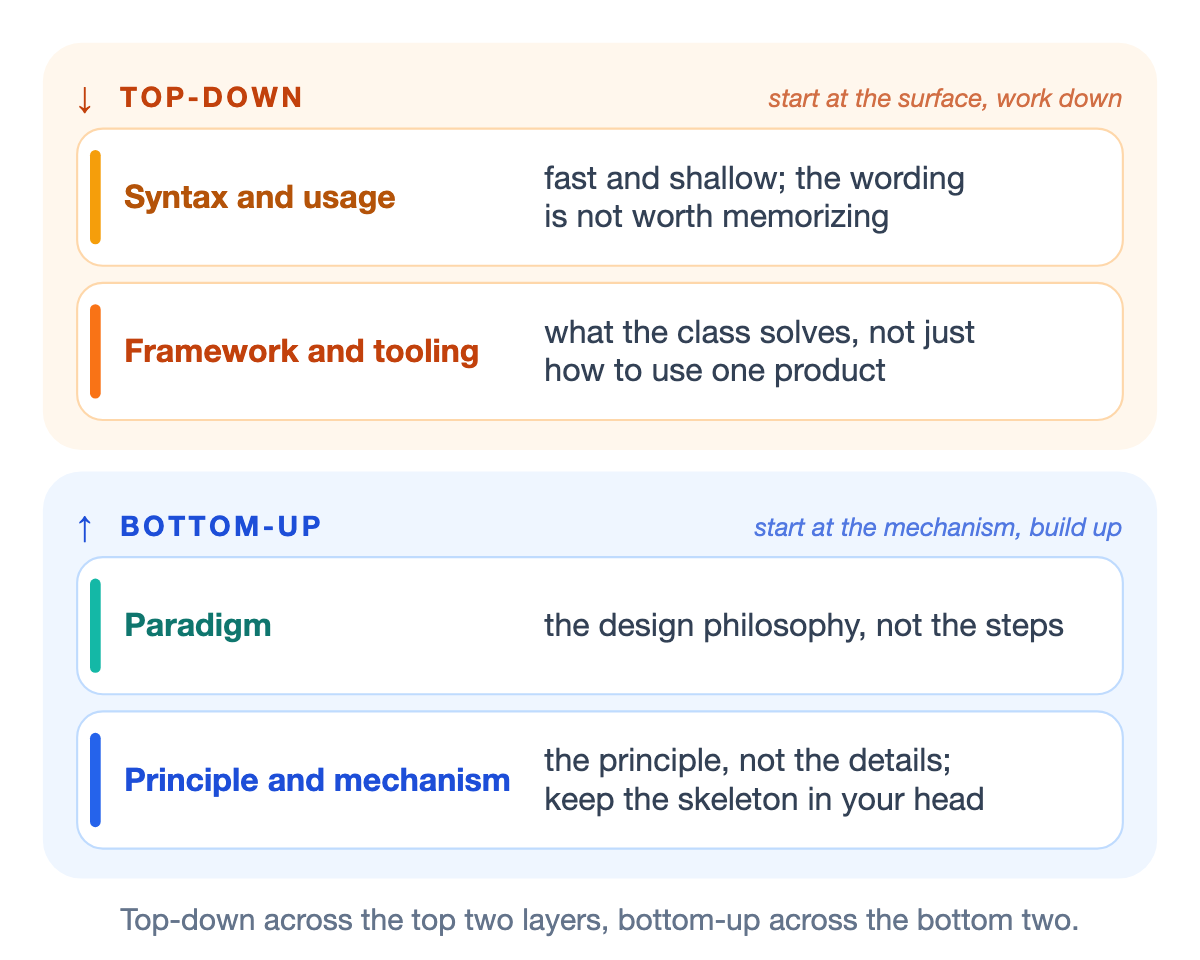
That is the whole model: four layers, each with its own way in, its own depth and its own test. It holds for any technology that is new to you.
How to understand AI coding
The model stays abstract until it lands on a technology you actually use. AI coding is the obvious place to test the model, because almost everyone is already working with it. When a new technology arrives, there is one judgment to make: split it, see which layers it spans and learn each layer in its own way. You do not have to label yourself top-down or bottom-up first. In the AI era the two have largely merged, because AI hands you the surface in seconds and explains the mechanism on demand, so there is little to gain by picking a side in advance.
Where AI coding lands

At the framework layer: Cursor, Claude Code, Kiro and Qoder.
The picture says one thing clearly: AI coding spans all four layers, so "should I learn AI coding" is the wrong question. It breaks into four.
How to learn it, layer by layer
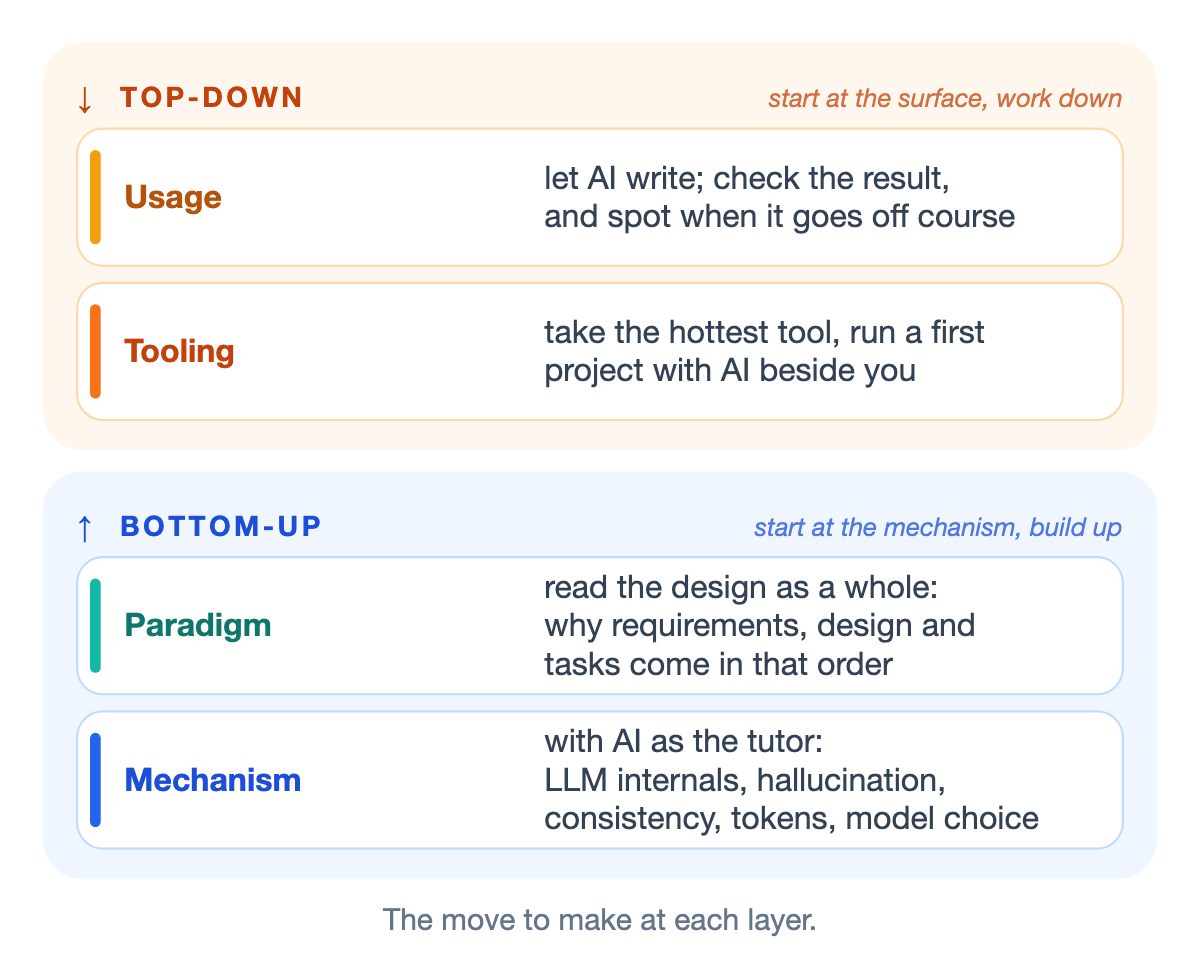
How to learn in the AI era
Three points to end on. The first two sit at opposite ends of the same model, and they answer the other two questions: whether it is worth learning, and how much time it deserves.
Bet early on the top two layers
Usage and tooling have always been the fastest to turn over. Getting a bet wrong there now costs days instead of months, so there is no reason to wait for a technology to settle. Place the bet early and place several at once. All of that starts with an open mind toward whatever is new.
Hold on to the bottom two
Paradigm and mechanism barely move. Knowledge from the top layers expires with the tools; the principles underneath do not. That payoff takes the longest to arrive, which is why you keep the understanding rather than a memory of details.
Abstract whatever you learn
Understanding how a technology works is half of it. The other half is pulling the principle out into a shape that is not tied to that one technology, so it carries into the next one.
That is the answer: not the newest tool, and not the fundamentals alone, but both, plus the abstraction that lets you carry what you learn forward.


Top comments (0)