

MCP adoption is accelerating — but so are the risks. Every AI agent with direct API access is a potential data leak, permission escalation, or compliance violation waiting to happen.
What if you could govern every AI agent tool call through a single layer?
This is Part 1 of a 3-part series on ContextForge, an open-source MCP gateway that brings enterprise-grade security, observability, and 42 built-in plugins to AI agent infrastructure.
The Problem: AI Agents Without Guard Rails
Imagine your company adopts an AI agent platform. Different teams spin up agents:
                          ┌→ SAP ERP (REST)
HR Agent ─────────────────┼→ Employee DB (SQL)
                          └→ Slack API

                          ┌→ Salesforce (REST)
Sales Agent ──────────────┼→ Internal CRM (gRPC)
                          └→ Email Service

                          ┌→ Jenkins (REST)
DevOps Agent ─────────────┼→ GitHub API
                          └→ Cloud Infrastructure
Each agent connects directly to each API. What could go wrong?
| Problem | Real-World Scenario |
|---|---|
| Data Leaks | HR agent accidentally sends employee SSNs to the LLM |
| Permission Chaos | An intern's agent runs DROP TABLE on production |
| No Audit Trail | "Who called what API when?" — nobody knows |
| Connection Sprawl | 100 APIs x 50 agents = 5,000 individual connections |
| Cost Blindness | No idea which team is burning through LLM tokens |
These aren't hypothetical risks. They're the inevitable result of letting AI agents access enterprise systems without centralized governance.
The Solution: Put a Gateway in the Middle
ContextForge sits between your AI agents and your backend systems:
                                                ┌→ SAP ERP
HR Agent ─────────┐                             ├→ Employee DB
                  │    ┌────────────────────┐   ├→ Salesforce
Sales Agent ──────┼───→│   ContextForge     │──→├→ CRM (gRPC→MCP auto-convert)
                  │    │                    │   ├→ Jenkins
DevOps Agent ─────┘    │  Security · Audit  │   ├→ GitHub
                       │  Plugin Pipeline   │   └→ Cloud APIs
AI Platform ──────────→│                    │
(Claude Code, etc.)    └────────────────────┘
Every request flows through the gateway. Every response gets filtered. Everything gets logged.

What ContextForge Actually Does
1. Turns Your Existing APIs into AI Tools — Automatically
Enterprises already have hundreds of REST and gRPC APIs. ContextForge converts them into MCP tools without modifying the original services:
Existing SAP REST API  → Register in ContextForge → Agents use it as a "tool"
Existing gRPC service  → Auto-discovery via Reflection → MCP tool, no schema needed
No code changes to existing systems. Your investment is protected.
2. Prevents Data Leaks at the Gateway Level
Every tool call and response passes through a plugin pipeline:
Agent Request: "Look up John's employee record"
     ↓
[ContextForge Plugin Pipeline]
     ├─ PII Filter        → SSN 123-45-6789 → ***-**-****
     ├─ Secrets Detection  → DB password detected → masked
     ├─ SQL Sanitizer      → SQL injection attempt → blocked
     └─ DenyList           → Prohibited keywords → blocked
     ↓
Only safe results reach the agent
GDPR, HIPAA, SOC 2 — compliance is enforced at the infrastructure layer, not in application code.
3. Isolates Teams with Multi-Tenancy
Different teams see different tools, enforced by a two-layer security model:
- Layer 1 — Token Scoping: Controls what you can see (data filtering)
- Layer 2 — RBAC: Controls what you can do (permission checks)
HR Team Agent     → Can only access HR servers (payroll, employee DB)
Sales Team Agent  → Can only access CRM, Salesforce
Intern's Agent    → Read-only (viewer role), write/delete returns 403
| Role | Can See (Token Scoping) | Can Do (RBAC) |
|---|---|---|
| platform_admin | Everything | Everything |
| team_admin | Team tools | Team management + tool execution |
| developer | Team tools | Tool execution |
| viewer | Team tools | Read only |
4. Tracks Costs and Usage
ContextForge Observability:
├─ Prometheus Metrics   → Per-team, per-agent API call counts
├─ TOON Compression     → 30-70% LLM token reduction (= cost savings)
├─ Rate Limiter         → Per-team, per-user call limits
├─ Token Catalog        → Per-token quotas, expiry, usage tracking
└─ Audit Logs           → Full record of who did what, when
Finally, you can answer: "How much did AI agent operations cost this month?"
5. Deploys Like Enterprise Software
AI Platform (Cloud)
       ↓
ContextForge (OCP / K8s / Docker)
├─ Helm Charts       → Auto-scaling (HPA)
├─ PostgreSQL        → Persistent storage
├─ Redis             → Caching / sessions
├─ TLS 1.3           → End-to-end encryption
├─ NetworkPolicy     → Network isolation
└─ OAuth / SSO       → Enterprise identity (Entra, Okta, Keycloak)
By the Numbers
| Metric | Value |
|---|---|
| Built-in plugins | 42 |
| Unit tests | 13,755+ |
| Code coverage | 99% |
| Supported protocols | MCP, A2A, REST→MCP, gRPC→MCP |
| API endpoints | 344 (OpenAPI 3.1.0) |
| Supported databases | SQLite, PostgreSQL, MySQL, MariaDB |
| Deployment options | Docker, K8s Helm, OpenShift, AWS/Azure/GCP/IBM Cloud |
A Real-World Scenario
1. Employee asks AI platform:
   "Analyze last week's production incident logs"

2. AI agent calls tools through ContextForge:
   ├─ Splunk API (REST→MCP auto-convert) → Fetch logs
   ├─ Jira API → Search related issues
   └─ PagerDuty API → Retrieve incident history

3. ContextForge plugin pipeline:
   ├─ PII Filter → Mask customer PII in logs
   ├─ TOON Compression → Reduce token usage on large log data
   └─ Audit Log → Record "who accessed production logs"

4. Agent delivers safe, filtered analysis
Without vs. With
| Without ContextForge | With ContextForge | |
|---|---|---|
| API connections | Each agent implements its own | Register once, share everywhere |
| Security | Handled in each agent's code | Applied uniformly at the gateway |
| Auditing | Build it yourself | Built-in (Prometheus + logging) |
| Permissions | Configure per API | Unified RBAC + token scoping |
| Cost tracking | Not possible | Per-team, per-token usage tracking |
| Adding new APIs | Modify agent code | Just register the REST/gRPC endpoint |
What's Next
In Part 2, we'll get hands-on: clone the repo, start a dev server, register an MCP server, and execute tool calls — all in under 15 minutes.
In Part 3, we'll deep-dive into the 42-plugin pipeline: PII filtering, rate limiting, circuit breakers, LLM summarization, and the unique TOON compression that saves 30-70% on LLM tokens.
ContextForge is open source under Apache 2.0.
 IBM
/
mcp-context-forge
IBM
/
mcp-context-forge
An AI Gateway, registry, and proxy that sits in front of any MCP, A2A, or REST/gRPC APIs, exposing a unified endpoint with centralized discovery, guardrails and management. Optimizes Agent & Tool calling, and supports plugins.
ContextForge
An open source registry and proxy that federates MCP, A2A, and REST/gRPC APIs with centralized governance, discovery, and observability. Optimizes Agent & Tool calling, and supports plugins.





ContextForge is an open source registry and proxy that federates tools, agents, and APIs into one clean endpoint for your AI clients. It provides centralized governance, discovery, and observability across your AI infrastructure:
- Tools Gateway — MCP, REST, gRPC-to-MCP translation, and TOON compression
- Agent Gateway — A2A protocol, OpenAI-compatible and Anthropic agent routing
- API Gateway — Rate limiting, auth, retries, and reverse proxy for REST services
- Plugin Extensibility — 40+ plugins for additional transports, protocols, and integrations
- Observability — OpenTelemetry tracing with Phoenix, Jaeger, Zipkin, and other OTLP backends
It runs as a fully compliant MCP server, deployable via PyPI or Docker, and scales to multi-cluster environments on Kubernetes with Redis-backed federation and caching.
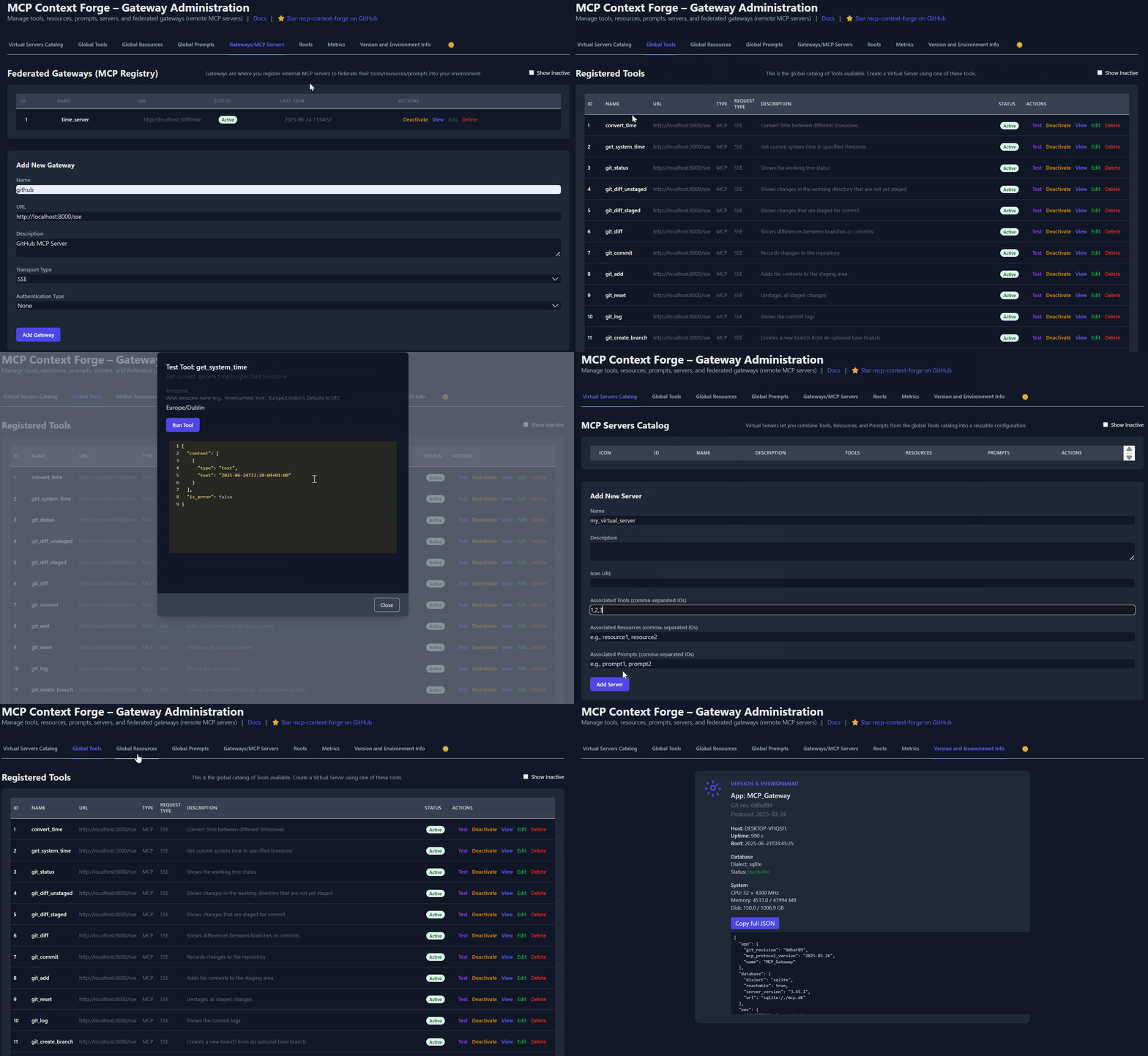
Table of Contents
If this resonated with you, follow this series — in Part 2, we go from zero to tool calls in 15 minutes.


Top comments (0)
Some comments may only be visible to logged-in visitors. Sign in to view all comments.