


865. Smallest Subtree with all the Deepest Nodes
Difficulty: Medium
Topics: Hash Table, Tree, Depth-First Search, Breadth-First Search, Binary Tree, Weekly Contest 92
Given the root of a binary tree, the depth of each node is the shortest distance to the root.
Return the smallest subtree such that it contains all the deepest nodes in the original tree.
A node is called the deepest if it has the largest depth possible among any node in the entire tree.
The subtree of a node is a tree consisting of that node, plus the set of all descendants of that node.
Example 1:
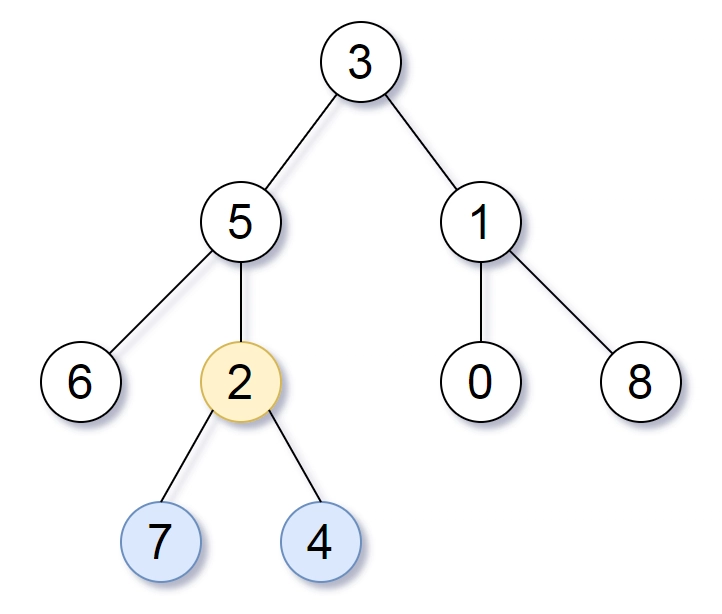
- Input: root = [3,5,1,6,2,0,8,null,null,7,4]
- Output: [2,7,4]
-
Explanation: We return the node with value 2, colored in yellow in the diagram.
- The nodes coloured in blue are the deepest nodes of the tree.
- Notice that nodes 5, 3 and 2 contain the deepest nodes in the tree but node 2 is the smallest subtree among them, so we return it.
Example 2:
- Input: root = [1]
- Output: [1]
- Explanation: The root is the deepest node in the tree.
Example 3:
- Input: root = [0,1,3,null,2]
- Output: [2]
- Explanation: The deepest node in the tree is 2, the valid subtrees are the subtrees of nodes 2, 1 and 0 but the subtree of node 2 is the smallest.
Constraints:
- The number of nodes in the tree will be in the range
[1, 500]. 0 <= Node.val <= 500- The values of the nodes in the tree are unique.
Note: This question is the same as 1123. Lowest Common Ancestor of Deepest Leaves
Solution:
We eed to find the smallest subtree containing all deepest nodes. Essentially, we need to find the lowest common ancestor of all deepest leaves.
Approach:
I'll use a recursive approach where each node returns:
- The depth of the deepest node in its subtree
- The node that is the LCA of deepest nodes in its subtree
Key Insight:
- For each node, compare the depths of its left and right subtrees
- If both subtrees have the same maximum depth, then this node is the LCA for deepest nodes in both subtrees
- Otherwise, the LCA is from the subtree with greater depth
Let's implement this solution in PHP: 0865. Smallest Subtree with all the Deepest Nodes
<?php
/**
 * Definition for a binary tree node.
 * class TreeNode {
 *     public $val = null;
 *     public $left = null;
 *     public $right = null;
 *     function __construct($val = 0, $left = null, $right = null) {
 *         $this->val = $val;
 *         $this->left = $left;
 *         $this->right = $right;
 *     }
 * }
 */
class Solution {

    /**
     * @param TreeNode $root
     * @return TreeNode|null
     */
    function subtreeWithAllDeepest(TreeNode $root): ?TreeNode
    {
       ...
       ...
       ...
       /**
        * go to ./solution.php
        */
    }

    /**
     * @param $root
     * @param $p
     * @param $q
     * @return mixed
     */
    private function findLCA($root, $p, $q): mixed
    {
       ...
       ...
       ...
       /**
        * go to ./solution.php
        */
    }
}

/**
 * @param array $arr
 * @return TreeNode|null
 */
function buildTree(array $arr): ?TreeNode {
    if (empty($arr)) return null;

    $root = new TreeNode(array_shift($arr));
    $queue = new SplQueue();
    $queue->enqueue($root);

    while (!$queue->isEmpty() && count($arr) > 0) {
        $node = $queue->dequeue();

        $leftVal = array_shift($arr);
        if ($leftVal !== null) {
            $node->left = new TreeNode($leftVal);
            $queue->enqueue($node->left);
        }

        if (count($arr) === 0) break;

        $rightVal = array_shift($arr);
        if ($rightVal !== null) {
            $node->right = new TreeNode($rightVal);
            $queue->enqueue($node->right);
        }
    }

    return $root;
}

/**
 * @param TreeNode|null $root
 * @return array
 */
function printSubtree(?TreeNode $root): array {
    if (!$root) return [];

    $res = [];
    $queue = new SplQueue();
    $queue->enqueue($root);

    while (!$queue->isEmpty()) {
        $node = $queue->dequeue();
        $res[] = $node->val;

        if ($node->left) $queue->enqueue($node->left);
        if ($node->right) $queue->enqueue($node->right);
    }
    return $res;
}


// Test cases
$solution = new Solution();

/**
 * Test Case 1
 * Input: [3,5,1,6,2,0,8,null,null,7,4]
 * Output: [2,7,4]
 */
$root1 = buildTree([3,5,1,6,2,0,8,null,null,7,4]);
$result1 = $solution->subtreeWithAllDeepest($root1);
print_r(printSubtree($result1));
// Expected Output: [2, 7, 4]


/**
 * Test Case 2
 * Input: [1]
 * Output: [1]
 */
$root2 = buildTree([1]);
$result2 = $solution->subtreeWithAllDeepest($root2);
print_r(printSubtree($result2));
// Expected Output: [1]


/**
 * Test Case 3
 * Input: [0,1,3,null,2]
 * Output: [2]
 */
$root3 = buildTree([0,1,3,null,2]);
$result3 = $solution->subtreeWithAllDeepest($root3);
print_r(printSubtree($result3));
// Expected Output: [2]


/**
 * Test Case 4 (deepest nodes on both sides)
 * Input: [1,2,3,4,5]
 * Output: [1]
 */
$root4 = buildTree([1,2,3,4,5]);
$result4 = $solution->subtreeWithAllDeepest($root4);
print_r(printSubtree($result4));
// Expected Output: [1]


/**
 * Test Case 5 (left-heavy tree)
 * Input: [1,2,null,3,null,4]
 * Output: [4]
 */
$root5 = buildTree([1,2,null,3,null,4]);
$result5 = $solution->subtreeWithAllDeepest($root5);
print_r(printSubtree($result5));
// Expected Output: [4]
?>
Explanation:
The recursive solution is more elegant and efficient. Here's how it works:
- For each node, recursively get results from left and right children
- Each result contains:
- The LCA of deepest nodes in that subtree
- The maximum depth in that subtree
- Compare depths:
- If equal: current node becomes LCA (deepest nodes are in both subtrees)
- If left deeper: left's LCA becomes current LCA
- If right deeper: right's LCA becomes current LCA
- Return result with depth incremented by 1
The base case is when node is null (depth 0, LCA null).
Complexity
Time Complexity: O(N) where N is the number of nodes
- The recursive approach visits each node exactly once
- The BFS approach also visits each node once, plus LCA calculations
Space Complexity: O(H) where H is the height of the tree
- For recursion, it's the recursion stack depth
- For BFS, it's O(N) in worst case for storing deepest leaves
Contact Links
If you found this series helpful, please consider giving the repository a star on GitHub or sharing the post on your favorite social networks 😍. Your support would mean a lot to me!

If you want more helpful content like this, feel free to follow me:


Top comments (0)