


2685. Count the Number of Complete Components
Difficulty: Medium
Topics: Staff, Depth-First Search, Breadth-First Search, Union Find, Graph, Weekly Contest 345
You are given an integer n. There is an undirected graph with n vertices, numbered from 0 to n - 1. You are given a 2D integer array edges where edges[i] = [ai, bi] denotes that there exists an undirected edge connecting vertices ai and bi.
Return the number of complete connected components of the graph.
A connected component is a subgraph of a graph in which there exists a path between any two vertices, and no vertex of the subgraph shares an edge with a vertex outside of the subgraph.
A connected component is said to be complete if there exists an edge between every pair of its vertices.
Example 1:
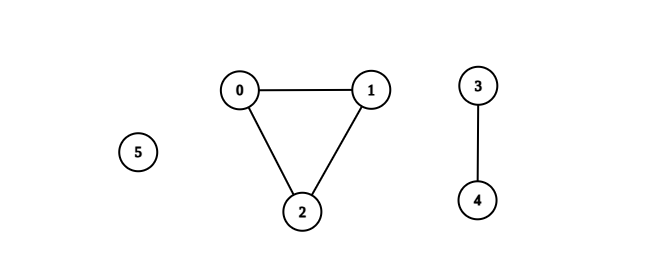
- Input: n = 6, edges = [[0,1],[0,2],[1,2],[3,4]]
- Output: 3
- Explanation: From the picture above, one can see that all of the components of this graph are complete.
Example 2:
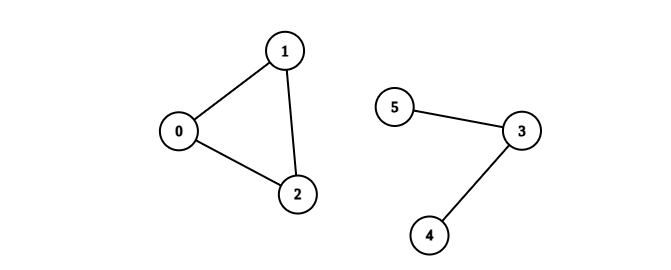
- Input: n = 6, edges = [[0,1],[0,2],[1,2],[3,4],[3,5]]
- Output: 1
- Explanation: The component containing vertices 0, 1, and 2 is complete since there is an edge between every pair of two vertices. On the other hand, the component containing vertices 3, 4, and 5 is not complete since there is no edge between vertices 4 and 5. Thus, the number of complete components in this graph is 1.
Example 3:
- Input: n = 1, edges = []
- Output: 1
Example 4:
- Input: n = 4, edges = [[0,1],[2,3]]
- Output: 2
Example 5:
- Input: n = 4, edges = [[0,1],[0,2],[0,3],[1,2],[1,3],[2,3]]
- Output: 1
Example 6:
- Input: n = 5, edges = []
- Output: 5
Example 7:
- Input: n = 3, edges = [[0,1],[1,2]]
- Output: 0
Example 8:
- Input: n = 5, edges = [[0,1],[0,2],[1,2],[3,4]]
- Output: 2
Constraints:
1 <= n <= 500 <= edges.length <= n * (n - 1) / 2edges[i].length == 20 <= ai, bi <= n - 1ai != bi- There are no repeated edges.
Hint:
- Find the connected components of an undirected graph using depth-first search (DFS) or breadth-first search (BFS).
- For each connected component, count the number of nodes and edges in the component.
- A connected component is complete if and only if the number of edges in the component is equal to
m*(m-1)/2, where m is the number of nodes in the component.
Similar Questions:
Solution:
We used an adjacency list to traverse the graph, found each connected component using BFS, and verified completeness by checking if the number of edges in the component equals the total possible edges for that many vertices.
Approach
- Build an undirected graph using an adjacency list and store all edges in a set for O(1) edge lookup.
- Traverse all nodes, and for each unvisited node, perform BFS to collect all vertices in that connected component.
- For each component:
- Count its vertices (
m). - Count the actual edges inside it by checking every pair of vertices in the component.
- If the actual edges equal
m * (m - 1) / 2(maximum possible edges), it's a complete component.
- Count its vertices (
- Return the count of complete components.
Let's implement this solution in PHP: 2685. Count the Number of Complete Components
<?php
/**
 * @param Integer $n
 * @param Integer[][] $edges
 * @return Integer
 */
function countCompleteComponents(int $n, array $edges): int
{
    ...
    ...
    ...
    /**
     * go to ./solution.php
     */
}

// Example usage:
echo countCompleteComponents(6, [[0,1],[0,2],[1,2],[3,4]]);                         // Output: 3
echo countCompleteComponents(6, [[0,1],[0,2],[1,2],[3,4],[3,5]]);                   // Output: 1
echo countCompleteComponents(1, []);                                                // Output: 1
echo countCompleteComponents(4, [[0,1],[2,3]]);                                     // Output: 2
echo countCompleteComponents(4, [[0,1],[0,2],[0,3],[1,2],[1,3],[2,3]]);             // Output: 1
echo countCompleteComponents(5, []);                                                // Output: 5
echo countCompleteComponents(3, [[0,1],[1,2]]);                                     // Output: 0
echo countCompleteComponents(5, [[0,1],[0,2],[1,2],[3,4]]);                         // Output: 2
?>
Explanation:
-
Graph Representation
- Used an adjacency list (
$adj) for traversal. - Stored edges as a string key (e.g.,
"0,1") in$edgeSetfor quick edge existence checks.
- Used an adjacency list (
-
Component Discovery
- Iterated over all nodes
0ton-1. - For each unvisited node, initiated a BFS queue to discover its entire connected component.
- Iterated over all nodes
-
Completeness Check
- For a component with
mnodes, a complete graph requires exactlym*(m-1)/2edges. - Iterated over all unordered pairs inside the component using
$edgeSetto count actual edges. - Compared actual edge count with the required number.
- For a component with
-
Isolated Vertex Handling
- A single vertex with no edges is trivially complete, so it is counted directly.
-
Result Accumulation
- Incremented the answer for each component that passed the completeness test.
Complexity Analysis
-
Time Complexity:
O(n + e + sum(m_i²))-
O(n + e)for BFS traversal across all nodes and edges. -
O(sum(m_i²))for pair checks inside each component, wherem_iis the component size. - In the worst case (one large component), this becomes
O(n²).
-
-
Space Complexity:
O(n + e)- For adjacency list, edge set, visited array, and BFS queue.
Contact Links
If you found this series helpful, please consider giving the repository a star on GitHub or sharing the post on your favorite social networks 😍. Your support would mean a lot to me!

If you want more helpful content like this, feel free to follow me:


Top comments (0)